
Lore: In the sprawling metropolises and bustling trade ports of Saṃsāra, risk is a commodity as valuable as any precious metal. Every ship that sails the endless ocean, every airship that braves the roaring winds, and every adventuring party that delves into forgotten ruins represents a complex equation of investment versus potential ruin. It is said that the first true actuary in the world was an isekai soul from a world built on data and finance, who was bewildered by the chaotic, magical nature of Saṃsāran commerce. Unable to rely on their old world’s tools, they commissioned a set of simple, magically-attuned claw sheaths from a gnomish artificer. The goal was not to enhance combat prowess, but to create a tool that could “feel” the currents of probability and bring order to the chaos. The design proved remarkably effective. These claw sheaths allowed the wearer to physically interact with the abstract concepts of chance. Apprentices in actuarial guilds, investment houses, and the powerful “Insurer’s Collective” are often gifted a set of these upon their initiation. They are considered the fundamental tool of their trade, a way to learn how to read the fortunes of the world not through divination, but through the cold, hard numbers of magical reality.
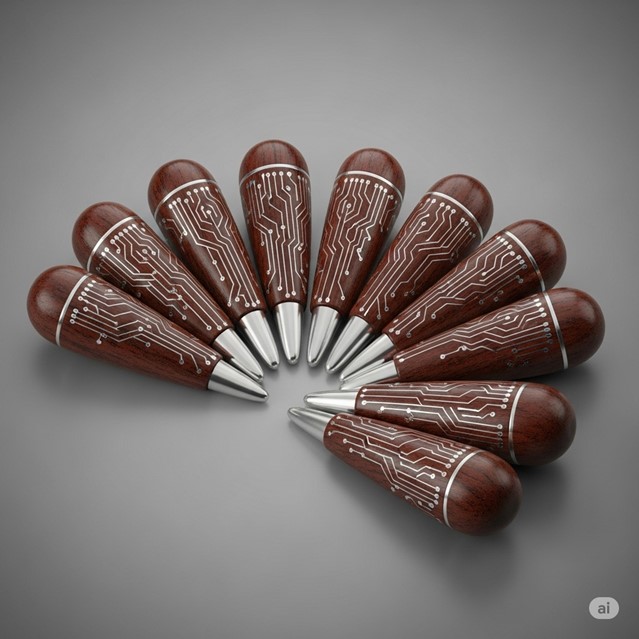
Description: These are not weapons, but a set of ten masterfully crafted sheaths designed to fit over an avatar’s natural claws, or over the fingers of a claw-less being where they adhere by a gentle magical bond. They are carved from polished, dark mahogany wood, giving them a professional and understated appearance. The sheaths are blunted and smooth, ending in a rounded tip rather than a point. When tapped together, they produce a series of soft, satisfying clicks reminiscent of abacus beads. Inlaid into the dark wood are incredibly fine lines of electrum that form complex, circuit-like patterns. These patterns are not merely decorative; they are passive magic circuits that hum with a faint, almost imperceptible energy when the wearer is concentrating on a complex problem. The wood feels warm to the touch and seems to absorb and quieten the wearer’s own anxieties, allowing for a state of calm, focused calculation.
Color: Deep, polished mahogany brown with shimmering electrum inlays.
Gained Stats While Worn
- Upon equipping this gear, the wearer gains a permanent bonus of +2 to their Intellect attribute.
- The wearer gains proficiency in the “Appraisal” skill. If the wearer is already proficient, they may add double their proficiency bonus to checks involving the valuation of goods, assets, or risk.
Tags: Worn, Gear, Claws, Common, Tier 1, Mind, Utility, Calculation, Alchemical, Steam-Powered, Runic, Psionic, Elemental, Clockwork, Ancient, Consumable, Social
Passive Magic
- Statistical Intuition: The magic circuits within the sheaths constantly analyze the ambient magical field for probabilistic anomalies. The wearer does not see numbers, but rather experiences a subtle, instinctual feeling when observing an action or situation. A course of action with a high probability of success imparts a feeling of calm clarity and rightness. Conversely, a course of action with a high probability of failure manifests as a faint, dissonant hum in the wearer’s mind, a subtle sense of “wrongness” about the situation. This allows the avatar to intuitively gauge the baseline risk of their immediate environment and the choices presented to them.
- Runic Scribe: The blunted tips of the sheaths can be used as styluses. By tracing motions in the air or on any solid surface, the wearer can cause glowing, temporary runes representing numbers and mathematical operators to appear. These ethereal figures are visible only to the wearer and those they are in physical contact with. The calculations hang in the air for up to five minutes before slowly fading, allowing the user to perform complex arithmetic and record temporary notes without need for parchment or ink.
Active Magic
- Favorable Odds: Once between long rests, the wearer may channel a small burst of magic into a single, non-sentient object governed by chance or simple mechanics. The user must physically touch the object, such as a lock tumbler, a die, a spinning wheel, or a series of gears, and focus for a moment. For the next minute, the object’s probabilistic outcomes are subtly skewed in the wearer’s favor. This does not guarantee success, but it makes a positive outcome measurably more likely. A locked chest might be easier to pick, a roll of the dice may favor a higher number, or a complex machine might avoid a jam at a critical moment.
- Cost-Benefit Analysis: By focusing intently on a single creature, item, or proposed course of action for one full minute without interruption, the wearer can receive a flash of insight. The magic analyzes the target and presents the wearer with a clear, two-part mental summary. The first part is the “Cost,” a general estimation of the resources, danger, or potential loss involved. The second part is the “Benefit,” a general estimation of the material value, tactical advantage, or potential reward. For example, focusing on a monster might reveal the market value of its hide and claws versus the likely cost of healing potions needed to defeat it. Focusing on a sealed door might reveal the estimated value of the treasure behind it versus the high chance of a dangerous trap. This ability can be used at will, but the mental fatigue from the intense focus prevents its use more than three times per hour.
Slot: Claws
The Claws 734 of the Probable Outcome, being a specialized yet common Tier 1 tool, would be found in a variety of commercial settings across the islands of Saṃsāra, each with its own atmosphere and pricing structure.
1. The Insurer’s Collective Guildhall Provisioner
In the grand financial districts of megacities like Aethelgard or the floating metropolis of Aeridor, the powerful Insurer’s Collective maintains opulent guildhalls. Within these impressive structures, often adjacent to their libraries of risk assessment, is a provisioner’s office specifically for members. This is not a shop in the traditional sense, but a formal office where a guild-certified quartermaster dispenses equipment. The room would be quiet, paneled in dark wood, and smell of old parchment and expensive oil lamps.
How it’s sold: A prospective buyer, typically a newly-inducted actuarial apprentice, would present their guild credentials. The transaction is a formal affair, recorded in a large ledger. The quartermaster, a stern and meticulous individual, would present a new, pristine set of the claws in a velvet-lined wooden box bearing the guild’s crest. They would explain the guild’s guarantee of quality and craftsmanship. The purchase is seen less as a simple transaction and more as an investment in one’s career and the guild’s reputation.
Cost: 2 Gold. The price is fixed and non-negotiable. Payment is expected in full, often directly deducted from the new member’s initial guild stipend. The cost is higher here due to the guarantee, the prestige of the seller, and the immaculate condition of the item.
2. Mercantile and Trade Suppliers in Port Cities
Along the bustling waterfronts of major port cities, where goods from the 73 Island countries are constantly being loaded and unloaded from steam-powered ships and magical airships, there are specialized suppliers for merchants and captains. These shops, such as “Fair-Sail Outfitters” or “The Calculated Risk,” are practical, crowded places smelling of sea salt, canvas, and lubricating grease. The shelves are packed with everything a trader might need, from nautical charts and griffon saddles to accounting ledgers and simple magical tools.
How it’s sold: The Claws would be displayed in a glass case alongside sextants, enchanted compasses, and other tools of trade. The shopkeeper, a fast-talking, no-nonsense merchant, would tout its practical applications for assessing cargo risk or anticipating market fluctuations. The sale is a business transaction, likely involving some light haggling. The claws might be sold as “new old stock” or be from a variety of small, independent artificers.
Cost: 1 Gold and 5 Silver. A savvy haggler might be able to get the price down to 1 Gold and 2 Electrum, especially if buying other goods. The shopkeeper might also be open to barter, perhaps trading the item for a rare map or a useful piece of information about shipping lanes.
3. Gnomish Tinker’s Workshop or Artificer’s Stall
In districts known for craftsmanship, like the “Tinker’s Alley” in a subterranean city or the “Cogsworth Market” in a steam-driven industrial town, one could find the workshops of individual artificers. These places are chaotic marvels of whirring gears, bubbling alchemical solutions, and the crackle of contained magical energy. Here, an independent gnome or a magically-inclined artisan might craft these claws to order or have a few pre-made sets available.
How it’s sold: The item would likely be hanging on a hook on the wall or sitting on a workbench amidst other inventions. The artificer who made it would sell it directly. They would be able to speak at length about the specific mahogany used, the purity of the electrum inlay, and the precise calibration of the magical circuits. They might even offer minor customizations for an additional fee, such as changing the wood type or adding a small personal rune.
Cost: 1 Gold. The price is for the craftsmanship and materials. There is little room for haggling on the price of the item itself, but one might be able to negotiate a lower cost for a slightly “experimental” or cosmetically flawed version. The artificer might also be more interested in a trade for rare components, like elemental fire cores or a vial of refined magical essence, than in simple coin.
4. Second-hand Shops and Pawn Brokers in Undercities
In the sprawling, dimly lit underlevels of a skyscraper city or the back alleys of a crowded port, pawn shops and second-hand dealers trade in the cast-offs of a bustling population. These shops are crammed floor to ceiling with a miscellany of items, each with an unknown history. The air is thick with dust and the faint metallic tang of old coins.
How it’s sold: The Claws of the Probable Outcome would be found tangled in a bin with other, more mundane claw sheaths, or perhaps lying forgotten in a dusty display case. The shopkeeper, likely a shrewd and observant individual, would probably not know its specific function, marketing it simply as “fancy finger-caps” or “some kind of wizard’s tool.” The buyer would need to recognize it for what it is. The transaction would be quick, discreet, and final. The claws would be sold as-is, perhaps with a few scratches on the mahogany or a flicker in the electrum inlay.
Cost: 6 Silver. This is the cheapest price one could hope for, reflecting the seller’s ignorance and the item’s used condition. The shopkeeper’s primary motive is to clear inventory, so the price is low but firm. They would only accept hard currency, and would likely refuse any attempts at barter.
The Claws 734 of the Probable Outcome are not weapons in the traditional sense; their blunted tips would do little more than bruise an opponent. Their power in a conflict comes not from direct physical force, but from the wearer’s ability to manipulate and comprehend probability, turning the environment and the actions of others into weapons. An avatar wearing these engages in combat as a master strategist, seeing the battlefield as a complex equation to be solved in their favor.
In a Crowded Urban Marketplace
This environment is a chaotic system of variables: countless people, rickety stalls, steam-pipes, and goods that can be used as obstacles or projectiles. For the wearer of the Claws, it is a target-rich environment for statistical manipulation.
Roleplay for Defense: As a political rival’s thugs close in, the avatar doesn’t prepare to fight, but to calculate. Their Statistical Intuition hums with a dissonant wrongness whenever they consider moving down an open street, but feels calm when they eye a path through a crowded textile stall. They duck behind a tapestry just as a thrown knife embeds itself where their head would have been. Pursued through the market, they see their path is about to be cut off by a steam-powered delivery cart. Instead of trying to outrun it, they activate Favorable Odds, lightly touching a nearby fruit vendor’s stall as they pass. A moment later, the stall’s poorly-balanced support gives way, spilling hundreds of slick, round fruits under the feet of their pursuers, causing them to slip and fall into a comedic, frustrating pile and giving the avatar time to escape.
Roleplay for Offense: The avatar needs to incapacitate a corrupt city guard who is extorting a shopkeeper. A direct confrontation is unwise. Instead, they use their Cost-Benefit Analysis on the surrounding environment. The analysis flashes a mental summary: “Target: Guard’s coin purse. Benefit: 4 Silver, 7 Nickel. Cost: High probability of arrest. Target: Overhead steam-pipe pressure valve. Benefit: Harmless but massive cloud of disorienting steam, high chance of guard losing his footing. Cost: Negligible.” Making their choice, the avatar subtly uses their Runic Scribe ability to trace the trajectory of a small stone in the air, then flicks it perfectly at the valve. The resulting blast of hot, wet steam erupts downwards, causing chaos. The guard, blinded and sputtering, slips on the wet cobblestones, allowing the shopkeeper to retrieve their money and disappear into the confused crowd. The offense wasn’t a physical attack, but the execution of a calculated, favorable event.
Within Unstable Ancient Ruins
Here, the environment itself is an adversary. Every step could trigger a trap, collapse a floor, or awaken a dormant guardian. The Claws become an indispensable tool for survival and for turning the dungeon’s dangers against its denizens.
Roleplay for Defense: While exploring a crumbling subterranean temple, the party’s warrior steps on a pressure plate. The avatar’s Statistical Intuition screams a warning not about the dart traps that spring from the walls, but about the ceiling above the warrior. They yell for the warrior to roll forward as the section of ceiling, statistically the most likely to be weakened by the trap’s mechanism, crashes down precisely where they were standing. Later, faced with a chasm and a series of crumbling stone platforms, the avatar uses their Runic Scribe to project a glowing, shifting percentage over each stone, indicating its probability of holding their weight, allowing the party to cross safely by following the most statistically sound path.
Roleplay for Offense: A massive, ancient stone golem animates and blocks the path. Its stony hide is impervious to the party’s weapons. While the others engage it futilely, the avatar uses Cost-Benefit Analysis on the golem. The result is grim: “Benefit: None. Cost: Certain party death.” They immediately switch targets, analyzing the chamber itself. A new summary appears for a large, cracked support pillar: “Benefit: High probability of crushing the golem if destabilized. Cost: High probability of chamber collapse in 2 minutes.” Deciding the risk is acceptable, they activate Favorable Odds and point to a specific, crumbling section of the pillar, telling the fighter, “Hit it there! The vibrations are wrong!” The fighter strikes the designated spot, and the magic of the Claws ensures the resulting crack propagates in the most destructive way possible, causing the pillar to topple directly onto the golem, shattering it under tons of rock.
Aboard a Racing Zeppelin During a Thunderstorm
On the deck of a racing airship, buffeted by winds and rain, surrounded by complex machinery and rival racers, the avatar’s abilities can mean the difference between victory and a long fall.
Roleplay for Defense: A rival airship pulls alongside, its crew preparing to fire a harpoon gun. The avatar’s Statistical Intuition gives them a sharp, painful jolt of “wrongness” focused on their own ship’s rudder mechanism. They realize the enemy isn’t aiming for the crew, but is trying to disable their steering. They are able to shout a warning to the pilot to execute a hard turn just as the harpoon flies wide of the newly-exposed rudder. When a lightning strike overloads a nearby magical capacitor, causing a vital steam-gear to begin shaking violently, the avatar rushes over and uses Favorable Odds, laying their blunted claws on the mechanism’s housing to gently nudge the chaotic vibrations back into a stable, functional rhythm, preventing a catastrophic engine failure.
Roleplay for Offense: The avatar needs to disable the lead airship without causing it to crash. A direct attack is too dangerous for everyone involved. Using a spyglass, the avatar performs a Cost-Benefit Analysis on the rival ship’s primary sail rigging. The result is promising: “Benefit: Total loss of wind propulsion, forcing them to rely on slower elemental thrusters. Cost: Requires a precise, low-energy impact on the primary tension clasp.” The avatar then takes a small, enchanted bolt from an ally’s hand crossbow. Using Runic Scribe, they trace the complex arc needed to hit the clasp through the driving rain and wind. They hand the bolt back and activate Favorable Odds on the clasp itself, a mere speck in the distance. When their ally fires the crossbow, the magically-nudged clasp shatters from the improbable, perfectly-placed impact, causing the rival’s grand sail to tear loose and flap uselessly in the wind. They have won the race not with superior firepower, but with superior math.
Perception of Activation:
User’s Perspective
When an avatar actively channels magic into the Claws, the experience is primarily internal and nuanced, a synesthesia of logic and magic.
- Touch: The initial sensation is a pleasant, spreading warmth originating from the mahogany sheaths, feeling as if they have been resting in a sunbeam. This is immediately followed by a low-frequency vibration that buzzes directly against the skin, a feeling less like a physical tremor and more like a resonating tuning fork pressed against the user’s own magical aura.
- Sound: Internally, the world’s ambient noise seems to momentarily quieten. It is replaced by a faint, crisp soundscape like the ticking of a thousand microscopic clockwork mechanisms or the soft, orderly clicking of abacus beads arranging themselves into a complex, but understandable, pattern.
- Sight: The fine electrum lines on the claws do not erupt in a brilliant flash, but instead deepen in color, shifting from a silvery-gold to the color of pure, liquid honey. They appear to gain a visual depth, as if one were looking into a tiny, illuminated circuit board. If using an ability like Runic Scribe, glowing ethereal figures of pure mathematical logic appear in the air, visible only to the user as translucent, shimmering blue light.
- Extra-Sensory (Mind’s Eye): This is the most profound sensation. The user feels a chaotic storm of possibilities in their mind suddenly snap into a state of serene, crystalline order. Random chance feels less random and more like a series of cascading, calculable events. Doubt and anxiety are momentarily suppressed, replaced by a feeling of absolute mental clarity and focus. If using Cost-Benefit Analysis, this manifests as a clear, concise data stream delivered directly to their consciousness, devoid of emotion and presented as simple fact.
- Extra-Sensory (Probabilistic Sense): The user temporarily gains a sixth sense for the flow of fortune. They can feel the “weight” of a decision, sensing a “heavy” path laden with risk and a “light” path that feels smooth and unburdened by consequence. It’s a feeling of being perfectly in sync with the rhythm of cause and effect.
Observer’s Perspective
To an outside observer, the activation is incredibly subtle, often passing completely unnoticed unless one is paying extremely close attention.
- Sight: A person standing nearby might catch a brief, soft pulse of light from the user’s hands, as if they had passed through a stray sunbeam. The electrum inlays might shimmer for a second before returning to normal. There is no grand spectacle, no arcane explosion of color.
- Sound: If the environment is nearly silent, an observer with keen hearing might perceive a very faint thrum, like the sound of a distant electrical substation, which lasts for only a moment before vanishing. It is easily mistaken for a trick of the ear or background noise.
- Extra-Sensory (Magical Sense): An individual trained in perceiving magic would not see a raw, chaotic burst of power. Instead, they would witness a brief, intricate aura of pure order flare around the user’s hands. It would look like a complex, three-dimensional lattice of light, perfectly symmetrical and structured, which coalesces and then fades in less than a second. To them, it is clearly an act of sophisticated, controlled magic, but one focused on intellect rather than force.
Positives
- Discretion: The primary positive is the activation’s subtlety. The user can analyze a situation, weigh probabilities, or even subtly influence an object from across a negotiating table or in a crowded room without anyone realizing a magical ability has been used. This is invaluable for espionage, haggling, and games of chance.
- Mental Fortitude: For the user, the feeling of calm, ordered clarity can be a powerful psychological defense, allowing them to think rationally and logically even when faced with terrifying or chaotic circumstances.
- Lack of Provocation: Because the activation is not overtly magical or threatening, it does not escalate tense situations. It can be used defensively without being perceived as an act of aggression.
Negatives
- Internal Distraction: For a novice user, the sudden influx of sensory and extra-sensory data can be disorienting. Trying to process the hum, the warmth, and the stream of probabilistic data while also paying attention to the physical world can be overwhelming and might cause them to miss important external cues.
- Misinterpretation: The subtlety can be a drawback. If the user successfully employs Favorable Odds to win a game, opponents will not see a magical activation; they will simply assume the user is cheating through mundane means, potentially leading to a physical confrontation the magic itself cannot help with.
- Lack of Deterrence: The item offers no intimidating presence. Activating it in an attempt to frighten off a potential attacker will have no effect, as the foe will perceive nothing of consequence. It is a tool of circumvention, not intimidation.
Artificer’s Schema: Sheaths of Calculated Odds
This schema outlines the procedure for crafting a set of Tier 1 magical claw sheaths designed to aid the wearer in the assessment and subtle manipulation of probability. The process requires a steady hand, a keen mind for both mechanical and magical theory, and a workshop environment shielded from chaotic magical fluctuations.
Materials Needed
- 1x Block of Heartwood Mahogany: Must be a dense, flawless block, aged for at least a decade and sourced from a tree grown in a region with a stable, placid magical field.
- 1x Spool of Fine-Gauge Electrum Wire: Must be of high purity to serve as an effective magical conductor for the intricate circuitry. Approximately 20 feet is required.
- 1x Perfected Gear from a Masterwork Chronometer: This is the focusing component. The gear must have no chips, cracks, or signs of wear. Its purpose is less mechanical and more conceptual; its history of perfect, predictable movement provides the logical foundation for the enchantment.
- 1x Jar of Pearl-Infused Alchemical Resin: A specialized, translucent resin used to seal magical enchantments and act as a non-conductive insulator between delicate magical circuits. The powdered pearl within helps to amplify and clarify enchantments of the mind.
- 1x Vial of Stabilized Magical Essence: Ambient magic drawn and condensed from a place of great order and predictability, such as a grand library or a master artisan’s guildhall. It will serve as the item’s power source.
- Polishing Oils and Fine-Grain Sandpaper: For the final finishing of the wood.
Tools Required
- Artisan’s Woodcarving Kit: A set of masterwork-quality chisels, gouges, and shaping files suitable for exceptionally detailed work.
- Runic Etching Stylus: A pointed steel tool with a magically-hardened tip, used to scribe the precise channels for the inlay work without splintering the wood.
- Jeweler’s Loupe: For magnifying the work area during the delicate inlay process.
- Alchemically Heated Inlay Iron: A specialized tool with an extremely fine tip, heated by a contained chemical reaction, used to gently press the electrum wire into the scribed channels.
- Mana-Lens Calibrator: A device consisting of several adjustable crystal lenses on a brass frame. It is used to focus the raw magical essence into a coherent beam for the final enchantment.
- Small Attunement Anvil: A small, dense block of rune-etched obsidian that absorbs stray magical energy, providing a stable surface for enchanting small objects.
- Mortar and Pestle (Obsidian or Marble): For grinding the focusing component.
Skill Requirements
- Primary Skill: Artificing (Journeyman)
- Secondary Skills: Woodworking (Adept), Enchanting (Adept), Runic Theory (Novice)
Crafting Steps
- Preparation of the Workspace: The crafting must take place in a controlled environment. The Attunement Anvil is placed at the center of the workbench, and all tools are cleaned and laid out in order of use. The crafter should take a moment to meditate, clearing their mind of chaotic thoughts to ensure they do not accidentally influence the delicate enchantment.
- Shaping the Sheaths: The crafter takes the block of Heartwood Mahogany and, using their woodworking tools, meticulously carves out ten identical, blunted sheaths. This is a process of hours, requiring immense precision to ensure they are perfectly smooth, balanced, and uniform in size and shape. They are sanded to a near-perfect finish but are not yet polished.
- Etching the Probabilistic Circuits: With the sheaths shaped, the crafter uses the Jeweler’s Loupe and the Runic Etching Stylus. They carefully scribe the complex, circuit-like patterns onto the surface of each sheath. This is not random decoration; the patterns are derived from runic principles of order, causality, and fate. A single slip or misplaced line at this stage will ruin the sheath’s ability to properly channel the magic.
- The Electrum Inlay: The most physically demanding step. The crafter heats the Alchemically Heated Inlay Iron. Using tweezers and the loupe, they carefully lay the Fine-Gauge Electrum Wire into the scribed channels, using the heated iron to gently set the wire flush with the wood’s surface. This process is repeated for all ten sheaths, connecting the beginning and end of each circuit to small terminals where the core enchantment will be applied.
- Creating the Focusing Paste: The Perfected Gear is placed into the mortar. It is carefully ground down into a fine, shimmering powder. This powder is then slowly mixed with the Pearl-Infused Alchemical Resin until it forms a thick, sparkling paste. This paste is the heart of the item’s logic-based magic.
- The Final Enchantment: Each sheath is placed upon the Attunement Anvil. A small dab of the focusing paste is applied to the terminals of the electrum circuit. The crafter then positions the Mana-Lens Calibrator over the sheath and uncorks the Vial of Stabilized Magical Essence. The essence is guided through the lenses, creating a focused beam of pure, orderly magic aimed directly at the paste. The paste will glow brightly as the magic is absorbed, flowing into the electrum wires and activating the circuits. The crafter must maintain the beam until the glow spreads evenly throughout the entire pattern and then fades to a soft, barely-perceptible hum, indicating the enchantment is stable.
- Curing and Finishing: Once all ten sheaths are enchanted, they are left on the anvil to cure for a full day-night cycle as the magic settles. After curing, the crafter performs a final polishing with fine oils, bringing the mahogany to a deep, professional luster and sealing the now-enchanted electrum from the elements. The item is now complete.
Reckoning of Ozym
And it was, in the time before the islands knew their own names, when the sky was a wild canvas and the seas had no master. There was a kingdom ruled by a king of great lands but small certainty. His harvests failed when the sky-maps promised rain, and his ships were eaten by waves on days the tide-watchers swore were calm. The spirit of Chaos, it was said, had laid a heavy, unseen hand upon the domain, and all things were without pattern. The kingdom was breaking apart, not by sword, but by the slow poison of doubt.
In this kingdom lived a man whose purpose was the numbering of things. He was Ozym, called the Reckoner. From his high tower, he counted the grains in the king’s silos, the stars in the sky, and the heartbeats in a minute. He saw the world as a great abacus, but its beads had begun to move on their own. His charts were lies, and his numbers were fools. Great despair fell upon Ozym, for a Reckoner who cannot reckon is a man without a soul.
He left his tower and journeyed to the Unmoving Mountain, which casts no shadow. There, it was known, lived an Artisan who did not build with hands, but with thoughts. Ozym came before the Artisan and spoke of the chaos, the broken patterns. The Artisan listened, and his voice was the sound of stone grinding on stone. He did not give Ozym a tool, but a journey.
“Go,” the Artisan said, “and bring me wood from the Silent Grove, where the wind does not blow and leaves do not fall. Then, find the vein of sun-and-moon metal, which is the child of a star that fell in grief. Lastly, you must seek the Sleeping God of the world’s core, and beg from it a single, final gear from the great machine that was.”
For many seasons Ozym traveled. He found the Silent Grove and took wood that had never known a tremor. He found the fallen star deep in a crater, and from it drew wires of electrum that shone with the light of both day and night. He journeyed to the heart of a volcano, and spoke to the great, dreaming mind of the Sleeping God. He begged for a single gear, and a tiny, perfect cogwheel of unknown metal appeared in his hand, warm with creation.
He returned to the Unmoving Mountain, and the Artisan took the things. He did not use a hammer or a forge. He breathed on the wood, and ten sheaths, like the fingers of a hand, took form. He sang to the sun-and-moon wires, and they laid themselves upon the wood in paths of light. He whispered a secret to the gear, and it turned to dust, which he sealed into the wood with a tear of his own. He gave the ten fingers to Ozym. “These do not show what will be,” the Artisan warned. “They show the weight of what could be. Wear them, and see the true paths.”
Ozym returned to the kingdom of chaos and put on the ten fingers. And behold, his sight was changed. The world was no longer a single, confusing reality. It was a tapestry of infinite glowing threads, the paths of all things. He could see the path of the rain, a light blue thread, would cross the fields in two days. He saw the path of the king’s fleet, a dark, heavy thread that led straight into the heart of a waiting storm. He saw the threads of diplomacy with the northern lords, light and gold, and the threads of war with them, heavy and black and tangled with the red threads of death.
He went to the king. His words were as weights in a scale. “Plant now, for the path of rain is light. Do not sail, for the sea’s path is heavy with doom. Send gifts, not soldiers, for the path of peace is true.” The king, desperate, listened. And it came to pass, the harvests were bountiful. The fleet remained in port and was saved from the storm that came. The northern lords became allies. The kingdom was saved. Ozym the Reckoner was no longer a counter of things, but the king’s most trusted prophet.
But the gift was a subtle poison. Ozym began to see the paths in all things. At the market, he saw the path to the freshest bread, the path to the sweetest fruit. He took them. In conversation, he saw the thread of the most pleasing words, the thread of the most agreeable laugh. He spoke and laughed along those lines. He saw the path his feet should take across a courtyard to avoid the most stones. He never stumbled. Every choice, from the greatest matter of state to the smallest bite of food, was preceded by a calculation of its path. He always chose the lightest, easiest, most correct thread.
He grew distant. His face became a placid mask. His wife said his heart had been replaced by a gear. He never made a mistake. He never had a surprise. He never felt the sting of a wrong choice, nor the sudden joy of a lucky guess. He was no longer living a life, but flawlessly navigating a maze. One day, the king asked him for advice, and Ozym stood silent for an hour. The king grew angry. “Speak, Reckoner! What do you see?”
Ozym finally looked at the king, but his eyes were like glass. He said, “There are seventeen possible replies. All have a calculable outcome. The optimal path is to say nothing.”
After that day, Ozym the Reckoner never spoke again. He sat in his tower, his hands folded on his lap, the ten fingers of calculation gleaming. He did nothing, for the most optimal path was to await the most optimal time to act, and that time never arrived. He simply… stopped. The famed fingers were taken from his unresisting hands, and their story became a legend told with a hushed voice.
The Moral of the Story: A life without the possibility of a wrong choice is not a life, but a calculation. To be truly alive is to walk a path of your own making, no matter how heavy it may be.
Suggested conversions to other systems:
Call of Cthulhu (7th Edition)
The Yithian Calculating Sheaths
These ten blunted, mahogany-colored sheaths are crafted from a strange, non-terrestrial wood that feels unnervingly warm. Inlaid with electrum that seems to shift in the light, they are believed to be a lesser artifact connected to the Great Race of Yith, used for their complex temporal calculations. An Investigator who wears them finds their mind subtly guided toward the cold, terrifying logic that underpins the universe.
Game Mechanics:
- Passive Analysis: While wearing the sheaths, the Investigator gains one Bonus Die on all Appraise checks and on Spot Hidden checks specifically made to identify patterns, repetitions, or flaws in construction.
- Active Probabilistic Assessment: When faced with a complex problem involving patterns or risk (such as navigating a collapsing structure, disarming a complex non-alien bomb, or predicting the patrol route of cultists), the Investigator may attempt to activate the sheaths. This requires a Hard POW roll.
- On a success: The Investigator gains a flash of insight, understanding the most and least likely outcomes. They may ask the Keeper a single, direct question about the probabilities of the situation (e.g., “Which floorboard is most likely to break?” “Is the creature more likely to attack me or my companion?”). The answer is a cold, logical fact, stripped of context. Using this ability costs 0/1d2 Sanity points as the mind grapples with inhuman logic.
- On a failure: The sheaths do not activate, and the feedback of chaotic probability costs the Investigator 1 Sanity point.
- World-Bending Luck (Favorable Odds): Once per game session, the Investigator may spend 10 points of Luck to touch a single mechanical object and declare a specific, simple malfunction (a gun jams, a car fails to start, a lock seizes). This is not a suggestion of probability but a brief, localized imposition of near-certainty.
- Sanity: First wearing and understanding the sheaths costs 1/1d4 Sanity points. Studying the patterns on the sheaths for at least one hour grants the Investigator +2% to their Cthulhu Mythos skill.
Blades in the Dark
The Unseen Reckoner’s Sheaths
A bizarre piece of pre-Cataclysm tech, rumored to have been designed by a forgotten sect of Whisperers who sought to chart the echoes of the ghost field. These ten polished wooden sheaths fit over the fingers, and their electrum circuits seem to hum in sympathy with the city’s electroplasmic energies. A scoundrel wearing them can feel the unseen odds, the faint tug of action and consequence, making them an uncanny planner and opportunist.
A Weird, Arcane Implement
Game Mechanics:
- Special Item Quality: When you wear the sheaths, you gain the following abilities. Using either of the active abilities costs 1 Stress.
- Passive – Calculated Risk: When you Gather Information to assess risks for a score, you get a free +1d to your roll.
- Active – Favorable Odds: When you or a crewmate suffers a consequence related to a mechanical or environmental failure (a trap springs, a structure collapses, a machine breaks), you can activate the sheaths. Take 1 Stress to describe how you subtly manipulated the object’s function, allowing the character to resist the consequence entirely. This can only be done once per score.
- Active – Ghostly Calculus: Take 1 Stress when you Survey or Study a situation. You can ask the GM “What is the most likely outcome if we do nothing?” The GM will give you an honest, direct answer. Additionally, you may start a 4-segment clock labeled “Capitalize on Unforeseen Opportunity.” You and your crew may tick this clock by taking actions that align with the logical probabilities you have foreseen. When the clock is full, you can declare the emergence of a golden opportunity, creating a sudden advantage in the fiction.
Dungeons & Dragons (5th Edition)
Gloves of the Probable Outcome
Wondrous item, uncommon (requires attunement)
This pair of dark mahogany gloves is masterfully crafted, with ten blunted sheaths extending to cover the wearer’s fingers. Fine electrum wire is inlaid into the wood, forming complex patterns reminiscent of magical circuits. Originally designed for guild actuaries and high-stakes gamblers in large cities, these gloves allow the wearer to see the world not as it is, but as a collection of statistical probabilities.
Game Mechanics:
- Innate Logic: While wearing these gloves, you have advantage on Intelligence (Investigation) checks made to decipher patterns or assess the structural integrity of an object or building.
- Charges: The gloves have 3 charges and regain 1d3 expended charges daily at dawn.
- Favorable Odds (1 Charge): As a reaction when a creature you can see within 30 feet makes an attack roll, ability check, or saving throw, you can expend 1 charge to impose a subtle, probabilistic influence. Roll a d4 and subtract the number rolled from the creature’s roll. You can choose to use this ability after the creature makes its roll, but before the DM determines the outcome.
- Cost-Benefit Analysis (1 Charge): As an action, you can expend 1 charge to focus on a single course of action you plan to take within the next minute. The DM tells you whether the outcome will be Weal (good), Woe (bad), Weal and Woe (both good and bad), or Nothing (neither good nor bad), based on the likely probabilities. This functions as the Augury spell, but its insights are derived from logical calculation, not divine power, and can therefore assess probabilities related to any course of action, not just those tied to specific locations or objectives.
Knave (2nd Edition)
The Calculating Claws
1 Slot
A set of ten smooth, dark wooden sheaths that fit over your fingers. Intricate silver-gold wire is set into the wood. They are not weapons, but a tool for a mind that sees numbers in all things.
Game Mechanics:
- Passive – Read the Odds: If you spend your turn observing a situation involving chance (e.g., a rickety bridge, a monster’s patrol, a shell game), the GM will tell you if a specific outcome is Likely or Unlikely.
- Active – Tip the Scales: Once per day, you may touch a single non-magical, mechanical object (a crossbow trigger, a trap’s pressure plate, a lock’s tumbler). The next character to make a roll involving that object must roll a second d20. If it is an enemy or an unwelcome effect, they must use the worse of the two rolls. If it is you or an ally, you may use the better of the two rolls.
- Active – Appraise Value: When you hold a non-magical item, you immediately know its precise value in copper pieces to the nearest buyer and can identify its most significant weakness or flaw (if any).
Fate Core
The Reckoner’s Threads
This is an Extra that represents a set of ten strange, mahogany-finished finger sheaths. They are not a weapon, but a tool for seeing the world as it truly is: a series of causes and effects, of paths taken and paths ignored. To wear them is to feel the faint, invisible threads of probability and learn to pluck them.
Game Mechanics:
- New Aspect: When you acquire this item, you gain the Aspect: Seer of the Likely Path. This can be invoked when you try to calculate risks, plan a meticulous action, or spot a subtle pattern in a chaotic situation. The GM can compel this Aspect to represent you getting lost in the endless probabilities of a simple choice, or to force you to follow the “optimal” path even when it is morally grey or personally difficult.
- Stunt – Cost-Benefit Analysis: When you use the Investigate skill to Create an Advantage related to a plan or a risk assessment, and you succeed with style, you can choose this benefit instead of a second free invocation: The GM must give you a brief, direct statement about both the most likely positive outcome and the most likely negative outcome of one proposed course of action.
- Stunt – Pluck the Thread: Once per session, you can spend a Fate Point to subtly alter a simple, physical cause-and-effect event you are observing. This could be a guard’s key slipping from his grasp, a rope fraying at the most opportune moment, or a support beam groaning under a new strain. You and the GM work together to define the new, minor situation aspect that results from this unlikely “accident.”
Numenera & Cypher System
Probability Sheaths
A set of ten smooth, hard sheaths made from some unknown, dark organic material. They fit perfectly over the user’s fingers. Fine, metallic lines, almost too small to see, are inlaid in their surface, and they hum with a faint energy when the wearer concentrates. They seem to interface with local datafields and quantum states, providing the user with a crude but effective analysis of probable realities.
Artifact
- Level: 1d6+2
- Form: A set of ten fitted finger sheaths made of polished, dark organic material.
- Effect: When worn, the sheaths provide the wearer with a constant, low-level stream of probabilistic data. The wearer is considered trained in tasks involving calculating risks, noticing subtle patterns, and appraising the value of objects. In effect, any of these tasks is eased.
- Active (Favorable Odds): The wearer can concentrate and attempt to influence a single, simple mechanical or electronic event within immediate range (a bolt sticking, a screen displaying corrupt data, a wire coming loose). This task, determined by the GM, is eased by two steps.
- Active (Cost-Benefit Analysis): By concentrating for one minute on a plan or visible objective, the wearer receives a clear, two-part mental message from the sheaths: one sentence describing the most likely benefit, and one sentence describing the most likely cost or danger.
- Depletion: 1 in 1d20.
Pathfinder (2nd Edition)
Actuary’s Calculating Gauntlets – Item 3
[Uncommon] [Divination] [Invested] [Magical] Price 60 gp Usage worn gauntlets; Bulk L
These masterfully crafted gauntlets are made of dark, polished mahogany articulated with supple leather, ending in ten blunted sheaths that cover the fingers. Fine electrum wire forms complex, circuit-like patterns across the wood. Originally conceived for guild assessors and risk-management specialists, these gauntlets allow the wearer to perceive the world as a flow of quantifiable data.
Game Mechanics:
- Passive: While wearing the gauntlets, you gain a +1 item bonus to Perception checks to Discern Patterns and to Society checks to Predict Market Trends or Gamble.
- Activation [reaction] (Concentrate) Frequency: once per 10 minutes; Trigger: A creature’s roll for a skill check or saving throw is revealed by the GM; Effect: You receive a flash of insight into the immediate future of that action. You know the exact result of the roll (the number rolled on the die plus any modifiers). This activation does not alter the roll, it simply grants you perfect information about the outcome before its effects are described.
- Activation [two-actions] (Concentrate, Interact) Frequency: once per hour; Effect: You focus on a single course of action you intend to take in the near future. The gauntlets provide a quick probabilistic forecast. This duplicates the effects of a 2nd-level Augury spell, but the result is a logical prediction rather than a divine omen.
Savage Worlds Adventure Edition (SWADE)
The Dead Reckoner’s Gloves
A beautiful but strange pair of gloves made from dark wood plates and leather. Ten smooth, blunted sheaths cover the fingers, inlaid with what appears to be silver-and-gold wire. They don’t seem practical for a fight, but card sharps, spies, and anyone who plays the odds for a living knows their value. They let you feel the “weight” of a choice, giving you an edge when luck is on the line.
Game Mechanics:
- Requirements: Novice, Smarts d6+
- Passive – Plays the Percentages: The wearer gains a +1 bonus to Common Knowledge, Notice, and Gambling rolls when the roll involves spotting patterns, assessing odds, or calculating risks.
- Active – Favorable Odds: Once per session, the wearer can spend a Benny to declare that a simple, non-magical mechanical device within sight fails at a critical moment. No roll is required. A gun misfires and is considered unloaded, a door lock jams, a vehicle swerves from a sudden tire blowout, etc. The GM has final say on the extent of the failure, but it always works to the player’s advantage.
- Active – Cost-Benefit Analysis: By spending a full round concentrating on a single proposed action (and taking no other actions), the player can ask the GM for a simple, one-word assessment of the plan’s immediate risk: “Good,” “Bad,” or “Even.” This allows the player to better decide whether to commit to the plan or spend Bennies on it.
Shadowrun, Sixth World
Aztechnology Actuary Gloves
A pair of high-fashion gloves made from dark, synth-mahogany plates over a smart-fabric liner. While they appear to be purely aesthetic corporate wear, the gloves are actually a subtle Qi Focus, intricately inscribed with microscopic circuits that are only visible under high magnification. Rumored to be a prototype from Aztechnology’s thaumaturgical R&D department, these gloves allow an adept to feel the ebb and flow of probability, or as the corps call it, “predictive market analysis.”
Game Mechanics:
- Type: Qi Focus
- Rating: 2
- Attunement (Adept): 4 Karma
- Availability: 10R
- Cost: 12,000 Nuyen
- Passive – Risk Assessment: While the focus is active, the adept adds the focus’s Rating (2) as a dice pool bonus to all Perception tests to notice security patterns and to all Etiquette or Negotiation tests when financial risk or value is being discussed.
- Active – Favorable Odds: When an opponent within your line of sight takes an action using a simple electronic or mechanical device (such as reloading a firearm, opening a maglock door, or using a detonator), you may spend a point of Edge before they roll. Their action automatically suffers a Glitch. You describe this as a moment of improbable failure—the magazine sticks, the keycard errors out, the signal scrambles—caused by your subtle manipulation.
- Active – Cost-Benefit Analysis: Once per run, you may spend 10 minutes observing a location or discussing a plan. Make a Logic + Intuition (Rating 2) test. The hits generated may be used to ask the GM specific questions about the financial or tactical probabilities of the situation, one question per hit. (e.g., “What is the single most valuable physical asset here?” “What is our most likely point of failure?” “Which guard is most likely to accept a bribe?”).
Starfinder
AbadarCorp Actuary Gloves
These fashionable but sturdy gloves are made from polished, dark brown polymer plates over a comfortable liner. Fine, silver-gold lines of conductive material form complex, elegant patterns on the back of the hands and fingers. A popular, if expensive, item among AbadarCorp agents, starship insurance adjusters, and high-stakes traders, these gloves are imbued with subtle divination magic that translates raw probability into gut feelings and flashes of insight.
Game Mechanics:
- System: Worn Magic Item (Hands Slot)
- Level: 3
- Price: 1,400 credits
- Bulk: L
- Passive – Innate Logic: While wearing these gloves, you gain a +2 insight bonus to Sense Motive checks and to Computers checks to defeat countermeasures.
- Active – Analyze Probabilities: Once per day, you can spend 10 minutes meditating on a specific goal or course of action to be undertaken within the next 30 minutes. This functions as the Augury spell, but its results are based on a logical analysis of your current situation and can only provide insight into non-magical outcomes.
- Active – Impose Failure: Once per day, as a reaction when a foe you can see within 60 feet attempts to use a technological item that requires an attack roll or skill check (such as firing a gun, hacking a computer, or disabling a trap), you can force that foe to roll a second d20 and use the lower result. You may spend 1 Resolve Point to use this ability one additional time per day.
Traveller (Mongoose 2nd Edition)
Ancient Probability Modulator
This device appears to be a pair of thin, form-fitting gloves made from a matte-black, non-reflective material. When activated, fine, hair-like lines on the back of the hands glow with a soft, amber light. The technology is clearly not of human origin and is believed to be a relic of the Ancients, capable of interfacing with local reality on a quantum level to observe and influence probabilistic outcomes. Possessing such an item is highly illegal on most worlds.
Game Mechanics:
- TL: 16
- Mass: 0.5 kg
- Cost: Cr 2,000,000 (Illegal)
- Power: Internal power cell, good for 12 uses. Recharges after 24 hours if connected to a TL 10+ power source.
- Passive – Risk Analysis: The wearer gains DM+2 on all Gambler and Investigate checks.
- Active – Cost/Benefit Analysis (1 Use): The user can spend one minute observing a situation and declare a single, specific course of action. The modulator provides a simple, one-word readout on a small display: SUCCESS, FAILURE, or UNCERTAIN. This gives the Traveller a general idea of the immediate outcome, allowing them to decide whether to commit to the action.
- Active – Favorable Odds (1 Use): The user can target a single individual within 30 meters. The next time that individual attempts a skill check involving a piece of technology, the Effect of their roll is reduced by 2. This represents a subtle, improbable failure or inefficiency in the device’s operation.
Warhammer Fantasy Roleplay (4th Edition)
The Gloves of the Eon-Watchers
A pair of exquisitely crafted gloves made of darkened, polished wood plates stitched to supple elven leather. The patterns on the wood are not carved, but seem to be a part of the grain itself, flowing in elegant, circuit-like lines. This is a rare magical item from the time of the great Elven civilizations, created not for war, but to aid the farseers in their long, slow observation of the world’s unfolding fate. To wear them is to feel the subtle tugs of destiny and fortune.
Game Mechanics:
- Encumbrance: 0
- Price: 25 GC
- Availability: Very Rare
- Qualities: Magical, Subtle, Elven
- Passive – A Sense of What’s to Come: While wearing the gloves, you gain a +10 bonus to all Gamble Tests. Additionally, when you make an Intuition Test to discern a “hunch” or gut feeling, you add a bonus Success Level (+1 SL) to your result on a success.
- Active – The Unlucky Slip: Once per session, when an opponent you are observing performs an action using a physical object (reloading a pistol, lighting a fuse, pulling a lever) and fails the associated Test, you may declare that their failure is particularly unfortunate. The GM should add a dramatic, negative consequence to the failure, such as the weapon jamming, the fuse sputtering out, or the mechanism breaking entirely. The magic is subtle and the event appears to be merely bad luck.
- Active – A Moment’s Calculation: Once per day, you may spend five minutes in quiet contemplation of a specific, imminent plan. At the end of this time, make a Challenging (+0) Cool Test. If you succeed, you feel a sense of calm certainty about the plan’s potential; you immediately gain 1 Resolve Point. You may not use this ability again until you have had a full night’s rest.