
Original Life Forms:
- Class Aves: Shoebill Stork (Balaeniceps rex)
- Class Amphibia: Poison Dart Frog (Dendrobates tinctorius)
- Class Malacostraca: Pistol Shrimp (Family Alpheidae)
- Class Arachnida: Trapdoor Spider (Family Ctenizidae)
Appearance The Dendro-Cteniza 4 is an unsettling creature that seems to defy natural classification. Its body is stout and low to the ground, roughly the size of a panther, with a tough, leathery skin that is smooth and moist like that of a frog. This skin is its most striking feature, colored with dazzling, aposematic patterns—vibrant stripes and swirls of electric blue, bright yellow, and jet black that serve as a stark warning. It moves on six multi-jointed, spider-like legs that allow it to scuttle with surprising agility. Instead of a traditional head, its torso tapers directly into an enormous, disproportionately large beak, shaped exactly like the massive, clog-like bill of a shoebill stork. The beak is bone-white and appears to be made of a thick, keratinous material, sharp enough at the edges to shear through leather and hide. Arranged around the base of this beak are eight simple, black, unblinking eyes, providing it with a panoramic view. Its two front-most limbs are drastically different from each other: one is a slender, spider-like leg ending in a sharp point, used for gripping and manipulating its environment. The other is the oversized, asymmetrical snapping claw of a pistol shrimp, a heavily armored and swollen appendage that it holds cocked and ready.
Size An adult Dendro-Cteniza stands about 3 feet tall, with a body length of 5 to 6 feet, not including its legs. Its weight is considerable due to its dense musculature and the heavy snapping claw, averaging between 150 and 200 pounds.
Speed This creature is not a pursuer. Its primary mode of movement is a slow, deliberate, spider-like scuttle. It is, however, incredibly fast in short bursts, capable of lunging from its burrow with explosive speed. It is equally at home in the water, able to swim efficiently using its powerful legs. Its greatest speed is in its ability to burrow; it can excavate a new tunnel in soft earth or mud with remarkable swiftness using its sharp legs.
Stat Modifiers
- Dexterity: High
- Constitution: High
- Strength: Moderate
- Wisdom (Perception): Very High
- Intelligence: Low (instinctive and patient, not a problem-solver)
- Charisma: Very Low (it is an alien and intimidating creature)
Skills
- Stealth: Masterful, particularly when concealed within its burrow or submerged in murky water.
- Burrowing: Unmatched in its ability to create and conceal complex tunnels.
- Perception: Its multiple eyes give it nearly 360-degree vision, making it very difficult to surprise.
- Acrobatics: Capable of immense leaps and lunges from a standstill.
Behavior The Dendro-Cteniza is the ultimate ambush predator, embodying the patience of its varied ancestors. It spends almost its entire life in, or near, a meticulously constructed burrow, which is often sealed with a perfectly camouflaged “trapdoor” made of silk, mud, and local foliage. It will wait, motionless, for days on end for prey to pass near the entrance. When a target is in range, its attack is a two-stage process: first, it unleashes a devastating blast of sound from its pistol shrimp claw. This creates a stunning shockwave in the air or water, disorienting or even knocking out its victim. Second, in the same instant, it lunges from its burrow with incredible speed, snatching the stunned prey in its massive shoebill-like beak to drag it back into its subterranean lair.
Diet The Dendro-Cteniza is an opportunistic carnivore. It will eat anything it can successfully ambush and subdue, from large fish and waterfowl to deer, wild boar, and unlucky adventurers. It crushes its prey with its powerful beak before consuming it.
Emotions The creature seems to operate on a level of cold, alien patience. It does not exhibit rage or fear in a recognizable way. Its existence is a singular, focused state of waiting, followed by a moment of explosive, predatory violence, and then a return to waiting. Its bright colors are not a sign of aggression, but a simple, factual statement of its poisonous nature.
Environment Where Found It is found exclusively in wetland environments: swamps, marshes, muddy riverbanks, and humid, water-logged jungles. It requires soft, damp earth for its burrows and a steady supply of creatures drawn to the water. Its lairs are notoriously difficult to spot, often appearing as nothing more than a small mound of earth or a pile of river debris.
Tags: Feral, Beast, Monster, Solitary, Ambusher, Burrower, Poisonous (Skin), Territorial, Stunning, Aposematic, Amphibious, Arachnoid, Predator, Hybrid, Magical Beast, Carnivore, Sonic, Patient, Subterranean, Toxin
Age
The Dendro-Cteniza 4 has a remarkably long lifespan, attributed to its low-energy ambush lifestyle and potent defensive capabilities.
- Lifespan: An individual can live for 60 to 80 years, with its burrow becoming a more complex and dangerous labyrinth with each passing decade.
- Egg Stage: The life cycle begins with a clutch of 10-20 soft, gelatinous, and translucent eggs, each about the size of a fist. They are laid in a secure, submerged chamber deep within the parent’s burrow.
- Nymph (“Popper”): After hatching, the nymphs are about the size of a human hand, resembling spiders with one slightly oversized claw. At this stage, their skin is a dull mottled brown and not yet poisonous. They are vulnerable and instinctively hide in the mud of the burrow’s floor. Their primary defense is their undeveloped snapping claw, which produces a loud “pop” that is more startling than stunning.
- Adolescent (“Trap-Setter”): Once it grows to the size of a small dog, the creature develops its vibrant warning colors and potent skin toxin. Its shoebill-like beak begins to harden and grow, and it starts to instinctively practice creating its own crude, smaller burrows. Adolescents are often cast out of the parent lair and are highly aggressive as they try to establish their own territory.
- Ancient (“Lair-Lord”): A specimen that has survived for over half a century becomes a true master of its domain. Its burrow can be an enormous, multi-generational maze spanning a hundred yards or more. Its Stun Clap is powerful enough to shatter nearby stone, and its skin toxins become so potent that they can poison the very water in its lair.
Tactics
The creature’s tactics revolve entirely around its burrow and the art of the perfect ambush. It is a patient and intelligent hunter that rarely engages in open combat.
- The Trapdoor Lair: The core of its strategy is its lair. The Dendro-Cteniza excavates a vertical tunnel with a larger “kill chamber” just below the surface. It then seals the entrance with a meticulously crafted plug of woven silk, mud, and local plants, making it nearly indistinguishable from the surrounding terrain. It will then wait, sensing the vibrations of approaching footsteps through the soil.
- The Sonic Kill-Zone: Its opening move is always the Stun Clap. Before the trapdoor is even opened, it will unleash the blast from its pincer. The shockwave travels through the ground and air, stunning or disorienting any creature standing directly above or near the burrow’s entrance. In wetland environments, this blast is even more effective, transmitting through the water with devastating force.
- Lunge and Drag: Immediately following the sonic blast, the Dendro-Cteniza lunges vertically from the now-open burrow. It uses its massive beak to seize the stunned victim, crushing limbs or torsos in a single motion. It does not fight on the surface; its goal is to immediately drag the incapacitated prey down into its subterranean larder.
- Aposematic Defense: If discovered outside its burrow or if its lair is compromised, it relies on its vibrant colors as a primary defense. It will puff up its body and display its dazzling patterns, a clear warning of its poisonous skin. It will avoid a fight if possible, always seeking to retreat back to the safety of its tunnels.
Actions
- Beak Crush: A devastating melee attack where the creature uses its enormous, sharp-edged beak to slam shut on a target. The force is sufficient to shatter bone and crush metal armor.
- Stun Clap: By snapping its oversized claw with phenomenal speed, the creature produces a sonic shockwave. All creatures in a short radius must resist being stunned, deafened, and knocked off their feet. This ability is significantly more potent when used in or near water.
- Subterranean Lunge: From its hidden burrow, the creature can explode upwards, moving with incredible speed to attack a target on the surface before retreating back into the earth.
- Toxic Skin: A potent defensive trait. Any creature that grapples the Dendro-Cteniza or makes prolonged, direct contact with its skin is exposed to a powerful neurotoxin. The toxin causes numbness, followed by paralysis and eventual cardiac arrest.
- Excavate: Using its six sharp, powerful legs, the creature can dig through mud, soil, and soft clay with remarkable speed, either to create a new lair or to bypass an obstacle underground.
Other Interesting Information
- Ecological Niche: In the wetlands it inhabits, the Dendro-Cteniza is a keystone predator. It keeps populations of other large predators and herbivores in check. Its abandoned, multi-chambered burrows become highly sought-after real estate for smaller creatures, creating entire ecosystems within the swamp floor.
- Lair Architecture: The burrow of an Elder is a marvel of natural engineering. It often includes a primary entrance with a kill chamber, multiple bolt-holes for escape, a submerged tunnel leading to a nearby body of water, a larder where prey is stored, and a deep, flooded chamber for laying its eggs.
- Unusual Symbiosis: Many lairs have a unique species of bioluminescent moss growing on the trapdoor. It is believed the creature’s toxic secretions nourish the moss. In return, the faint glow of the moss at night attracts insects, which in turn attract larger nocturnal animals, effectively creating a baited lure for the Dendro-Cteniza’s trap.
- Harvestable Components: A slain Dendro-Cteniza is a source of rare and valuable reagents. Its massive Beak can be ground into a powder used by alchemists to create potions that grant resistance to crushing and bludgeoning damage. The Poison Glands from its skin can be carefully harvested to create deadly contact poisons. Most prized is the complex Snapping Claw, which engineers and artificers study relentlessly, seeking to replicate its sonic-blast mechanism for use in mining equipment, sonic cannons, or advanced steam-piston drivers.
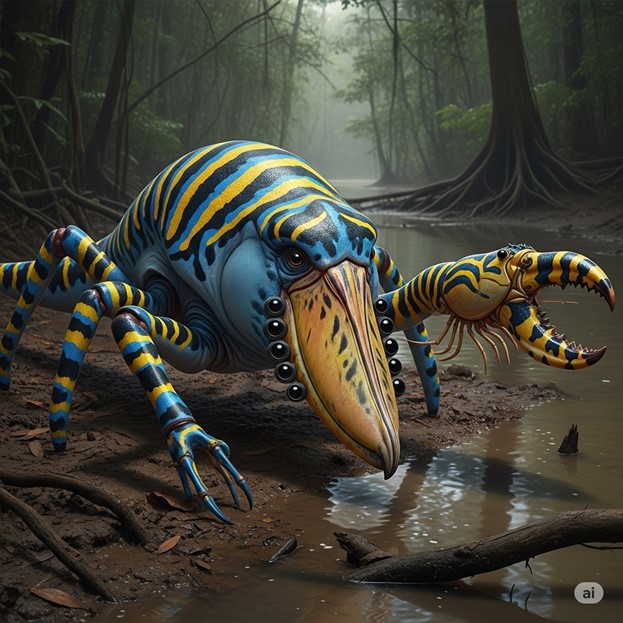
An encounter with a Dendro-Cteniza 4 is a rare and terrifying event, as the creature’s entire existence is based on not being seen until it is far too late. Adventurers who cross paths with one are either phenomenally unlucky or have been hired for a very specific, high-risk contract that requires dealing with this unique and dangerous beast. The reasons for such an encounter range from accidental intrusions to deliberate, targeted hunts for its bizarre and valuable biological components.
Incidental Encounters
These encounters occur when a party unwittingly stumbles into the creature’s territory or becomes collateral damage in its patient hunt. The Dendro-Cteniza does not seek out adventurers; it simply reacts to their presence as it would to any other prey or threat.
- The Collapsing Riverbank: A party traveling by boat or trekking along a muddy riverbank might pass directly over the extensive, unseen burrow of a Dendro-Cteniza. The weight of the adventurers or their pack animals could be the final straw that causes the compromised earth to give way, plunging them into a sinkhole that opens directly into the monster’s subterranean kill-chamber. The encounter begins not with a battle cry, but with confusion, darkness, and the sudden, deafening clap of its sonic claw from somewhere in the tunnels.
- The Deceptively Safe Campsite: While navigating a dangerous swamp or jungle, the adventurers spot a small, dry mound of earth, curiously devoid of the usual swamp pests and predators. Believing it to be a safe place to make camp for the night, they light a fire and settle in. In reality, they are resting on the camouflaged trapdoor of the creature’s lair. The vibrations from their activity and the heat from their fire are perceived as a threat or a challenge, provoking the patient hunter to emerge explosively from right under their bedrolls.
- Investigating the Vanished: A local wetlands village has been plagued by disappearances. People or livestock who wander too close to a particular stretch of marsh simply vanish, leaving no tracks and no signs of a struggle. The party is hired to solve the mystery, likely expecting to find a band of kidnappers or a more common swamp monster. Their investigation leads them to the edge of the water where all tracks end abruptly. The only clue is a strange, perfectly circular patch of ground that seems different from the earth around it. Their investigation turns into a fight for survival when they realize the ground itself is the predator’s front door.
Purposeful Quests
No one hunts a Dendro-Cteniza for simple meat or glory; the creature is far too dangerous and its flesh is saturated with its own toxins. Quests to find one are always specialized contracts, commissioned by those who need the monster’s unique biological attributes.
- The Artificer’s Sonic Device (The Snapping Claw): An ambitious engineer from a steam-werk guild believes the mechanism within the creature’s oversized claw is the key to a new form of sonic technology. They theorize it can be replicated to create powerful sonic drills for shattering rock without explosives, or non-lethal cannons for crowd control. The party is hired to hunt an adult specimen and bring back the complex claw mechanism intact, a difficult task that requires precise dismemberment without shattering the delicate internal structures.
- The Spymaster’s Toxin (Poisonous Skin): The vibrant skin of the Dendro-Cteniza is not just for show; it constantly secretes a potent contact poison. An intelligence agency or an assassins’ guild desires a sample of this toxin, as it is incredibly difficult to detect and can be delivered via a simple touch or applied to an object. This quest would require the party to subdue the creature and use a special alchemical kit to scrape and preserve the toxic secretions, a task that involves getting dangerously close to the living beast.
- The Foundation Breaker (The Burrowing Menace): An Elder Dendro-Cteniza has established its massive, labyrinthine lair directly beneath a vital piece of infrastructure, such as a crucial bridge, a new fortress foundation, or a dam controlling the flow of water to a city. Its constant tunneling threatens to cause a catastrophic collapse. The party is hired by the overseeing guild or government not just to kill the beast, but to do so with surgical precision, navigating its tunnels and eliminating the creature without using explosives or tactics that could trigger the very cave-in they are trying to prevent.
- The Artist’s Pigment (The Aposematic Hide): A fabulously wealthy noble or a master artist has become obsessed with creating a color that no dye can replicate—the electric blue and vibrant yellow of the Dendro-Cteniza’s skin. The pigments in its hide are legendary for being both dazzlingly bright and unnaturally resistant to fading. The party is commissioned to bring back a large, undamaged swatch of this colorful hide, with their payment directly proportional to the quality and size of the piece they recover.
- The Trial of the Beak (The Shoebill Beak): A reclusive and hardy tribe that lives on the fringes of the swamps has a rite of passage for its future leaders. To prove their worth, a contender must face the greatest dangers of the swamp and bring back a trophy. The ultimate symbol of strength and cunning is the massive, bone-white beak of a Dendro-Cteniza. A young and ambitious warrior from the tribe, lacking the experience to hunt the beast alone, might hire the adventurers to act as their support, helping them survive the hunt and claim the trophy needed to secure their position as chieftain.
While the most obvious reasons to hunt a Dendro-Cteniza 4 are for its snapping claw, poisonous skin, or massive beak, a skilled harvester with a deep knowledge of alchemy and anatomy can find that nearly every part of the unnatural beast is a source of rare and valuable ingredients. Its corpse is a treasure trove of biological contradictions, highly prized by specialists.
Here are additional items and ingredients that can be harvested and their uses:
1. Keratinous Beak Shards
- Harvestable Item: The sharp, bone-white edges and tip of the massive shoebill-like beak. The material is incredibly hard, yet lightweight and resistant to chipping.
- Use: While the entire beak is a trophy, the shards are more practical. When carefully flaked off and shaped by a master fletcher, they can be fashioned into arrowheads or crossbow bolts of exceptional quality. These Beak-Shard Bolts are renowned for their ability to punch through tough hide and leather armor more effectively than steel, and they have the added benefit of being non-metallic, allowing them to bypass certain magical wards or the weaknesses of creatures like rust monsters.
2. The Cavitation Nodule
- Harvestable Item: Found deep within the primary joint of the oversized snapping claw is a small, pearl-like nodule of incredibly dense, smooth cartilage. This is the biological component that focuses the energy for the creature’s stunning sonic blast.
- Use: This is the true prize of the claw. A master artificer can use the nodule as the core component in a variety of sonic devices. A single nodule can be used to create a Stun Grenade, a thrown device that releases a single, powerful, non-lethal concussive blast to disorient a group of enemies. Alchemists also grind them into powder to use as a key ingredient in potions that grant resistance to thunder and sonic damage.
3. Resonant Silk
- Harvestable Item: The creature has a set of vestigial but functional spinnerets near its abdomen that produce a thick, sticky, and incredibly strong silk used to construct its trapdoor lair.
- Use: Dendro-Cteniza silk is not just strong; it is phenomenally sensitive to vibration. When a strand is stretched out, a person holding one end can feel the footsteps of a mouse from fifty yards away. It is highly valued for creating the ultimate perimeter alarms and tripwires. A small amount woven into the fingertips of a pair of gloves greatly enhances a rogue’s ability to feel the inner workings of a lock’s mechanism or the trigger of a delicate pressure-plate trap.
4. Aposematic Pigment Glands
- Harvestable Item: Located just beneath the skin are distinct glands containing the incredibly vibrant, non-toxic pigments for its warning colors. These can be separated from the nearby poison glands by a skilled hand.
- Use: The pigments are famous for creating paints and dyes that never fade. Beyond simple aesthetics, when these pigments are mixed into magical inks for scroll-scribing, they have a unique effect on certain spells. Wards or glyphs painted with these inks are particularly unsettling to beasts and monstrosities, who have a primal, instinctual aversion to the warning colors. A magical circle painted with this ink may cause a feral beast to hesitate before crossing it, even if it is not magically compelled to do so.
5. Multi-Faceted Eye Humor
- Harvestable Item: The gelatinous fluid harvested from the creature’s eight simple, black eyes. It has a strange, viscous quality and seems to refract light from multiple angles at once.
- Use: This is a rare and esoteric alchemical ingredient. When prepared into a paste and smeared over a map, blueprint, or tactical diagram, it grants the viewer a brief, intuitive “holographic” understanding of the space. For a few moments, the flat drawing is perceived in the viewer’s mind as a three-dimensional layout, allowing them to grasp complex architectural spaces or battlefield positions at a glance. It is highly sought after by military tacticians, architects, and dungeon delvers.
6. Amphibious Lung Filter
- Harvestable Item: The creature’s lungs are a bizarre, spongy hybrid of amphibian and arachnid respiratory systems, allowing it to survive for long periods both in and out of water.
- Use: The lung tissue, when properly excised and treated by a master leatherworker or artificer, remains pliable and retains its unique filtering properties. A piece of this cured tissue can be incorporated into a breathing mask or apparatus. While it doesn’t allow for indefinite underwater breathing, it can filter enough oxygen from water to allow a user to hold their breath for ten to fifteen minutes, a priceless advantage for anyone needing to escape through waterways or explore submerged ruins.
Parable of the Patient Hunger
The ancient tellings say there was a village by a wide and muddy river. The people of this village were prosperous. Their nets were always full of fish, and their fields were always green. And because they were prosperous, their hearts were full of pride. They said, “We know the river. We know its moods and its monsters. The river is our servant.”
And so it was for a long time. Then, small things began to vanish from the riverbank in the night. A fishing net left to dry. A goat that had wandered from its pen. A child’s wooden boat. The villagers were not afraid. They said, “It is a thief from another village,” or “It is a common river-gator, growing bold.” They did not feel fear, for they were proud and believed they knew all the shapes of danger.
One day, a stranger came to the village. She was an old woman, an avatar whose feet were covered in the dust of many roads and whose eyes were full of quiet. She was a listener of the earth. She could feel its vibrations. The villagers gave her food, and as she ate near the riverbank, she grew still. She told the village elder, “There is a wrongness in your earth. Near the water, there is a great stillness that is not peace. It is a patient hunger. Something waits in the mud.”
The villagers laughed. “Old mother,” they said, “you are a stranger here. We are not. We know the river. There are no new monsters here.” And they paid her no mind.
A young fisherman, the most proud and boastful of all, declared he would catch the thief. “I will wait by the bank at dusk,” he said. “And I will put my spear in this thing that steals from us.” And so he went. But he did not return. The next sun, the villagers found his spear, broken in two, lying on the mud. There were no tracks of a man being dragged away. There were no tracks of a great beast. There was only a strange, circular patch of ground that looked like it had been healed over, like a wound.
Now, fear came to the village. The stranger told them, “Stay away from the river’s edge when the sun is low. Do not walk on the soft mud.” One evening, as the sky turned purple, a great wild boar, chased by hunters from the deep woods, ran squealing toward the river. As it neared the bank where the spear was found, the world went quiet for a moment. Then came a sound. It was not a roar or a hiss. It was one loud, sharp CLAP. A sound like a giant snapping his fingers, like thunder breaking a single stone. The great boar was thrown to its side as if struck by an invisible fist. It lay on the ground, stunned and twitching.
The villagers, watching from the safety of the trees with the old woman, saw the ground itself erupt. The circular patch of earth opened like a mouth, and a creature of nightmare pulled itself out. It had the many legs of a spider and the poison-bright skin of a jungle frog. Its head was a great, pale beak, shaped like the hard shoe of the giant river-bird. And one of its arms was a huge, swollen claw, which steamed faintly from the great clap it had made. The creature grabbed the stunned boar with its beak, which was strong enough to crack the boar’s bones, and dragged it down into the hole. The earth closed over it, and all was silent again.
The people were full of a terror greater than any they had known. The old woman said, “You cannot fight a monster by standing on its dinner plate. You cannot stab the earth. You must change the earth.” For a week, the villagers worked. They did not sharpen spears. They carried heavy stones and logs. They built a small wall, a dam, upstream from their village, pushing the river’s path a little wider, a little farther away. The muddy bank where the creature lived began to grow dry and hard.
On the tenth night, the creature came out of its hole. Its home was no longer soft. Its door was no longer hidden. It looked at the village, and at the hard, dry ground. And it knew it could not wait there any longer. And so the creature, the patient hunger, scuttled away from the village and into the deeper, wetter swamps where it could live its life of waiting. The old woman watched it go, and then she too continued on her journey, leaving the humbled village behind.
The moral of the story is: Pride tells you that you know the ground you stand on, but wisdom listens for what is waiting underneath.
Suggested conversions to other systems:
Call of Cthulhu
The Trapdoor Snapper Unnatural Organism
A bizarre amphibious predator found in the swamps and muddy riverbanks of remote, uncharted islands. It is believed to be a modern descendant of a prehistoric life form, combining traits of amphibians, arachnids, and crustaceans in a way that defies conventional biology. It is a patient ambush hunter, creating a perfectly camouflaged burrow from which it launches its lightning-fast, stunning attacks.
STR: 70 CON: 80 SIZ: 75 DEX: 75 INT: 25 POW: 60 HP: 15 Move: 7 / 7 swimming Build: 1 Damage Bonus: +1d4
Attacks:
- Beak Crush: 1d10+1d4 damage, with Impale rule on an extreme success. Fighting 60%.
- Sonic Clap: See Special Abilities.
Special Abilities:
- Burrow Ambush: The Trapdoor Snapper spends most of its time hidden in a subterranean burrow sealed with a camouflaged plug of mud and vegetation. Spotting this trapdoor requires a Hard Spot Hidden or Natural World roll. The creature almost always gains a surprise round when attacking from its burrow.
- Sonic Clap: As its first action, the creature can snap its oversized claw, targeting a single individual within 10 yards. The target must make a Hard CON roll or be stunned for 1d3 rounds, unable to take any actions.
- Poisonous Skin: Its brightly colored skin is coated in a mild toxin. Any Investigator who makes physical contact with the creature must make a CON roll or suffer 1d4 damage per round until the roll is successful or they receive first aid.
- Armour: Its tough, leathery hide provides 1 point of armour.
Skills: Stealth 80%, Swim 70%.
Sanity Loss: 0/1d4 Sanity points to witness the creature erupt from the ground.
Blades in the Dark
The Sump-Clapper An Unnatural Horror, A Guardian Beast
This thing lives in the dark, forgotten waterways beneath Doskvol—flooded vaults, cisterns, and the sump-pits of old factories. Some smugglers or nobles acquire them as eggs and raise them as living traps to guard a hidden cache or a secret entrance. A Sump-Clapper’s lair is a death sentence for the unwary. It is a Tier II threat.
Qualities:
- Amphibious Horror: It can live and fight equally well on land or in water.
- Patient Hunter: It waits in absolute silence and stillness for its prey.
- Subterranean Ambush: It creates a hidden lair in mud or refuse, erupting from it to attack with perfect surprise.
- Sonic Blast: Its claw emits a deafening clap that can stun and disorient anyone nearby (inflicts level 2 harm Dazed & Deafened).
- Crushing Beak: Its massive beak can punch through wood and light armor, and easily snaps bones (inflicts level 3 harm Crushed Limb).
- Toxic Skin: Touching it is a very bad idea (a tick on the Poisoned clock).
Clocks:
- The Trap is Sprung! (6-clock) When filled, the Sump-Clapper erupts from its hidden lair, stunning one PC and grabbing another.
- Dragged Below: (4-clock) When it has a victim, start this clock. If it fills, the victim is pulled into its flooded tunnel network.
- The Lair Collapses: (8-clock) If the fight involves explosives or great force, start this clock. If filled, the unstable ground gives way, plunging everyone into the sump.
Dungeons & Dragons
Dendroctenid Medium monstrosity, unaligned
Armor Class 14 (natural armor) Hit Points 60 (8d8 + 24) Speed 30 ft., burrow 20 ft., swim 30 ft.
STR 15 (+2), DEX 16 (+3), CON 17 (+3), INT 3 (-4), WIS 14 (+2), CHA 5 (-3)
Skills Perception +6, Stealth +7 Damage Immunities poison, thunder Condition Immunities poisoned Senses Darkvision 60 ft., Tremorsense 60 ft., passive Perception 16 Languages — Challenge 3 (700 XP)
Amphibious. The dendroctenid can breathe air and water.
Trapdoor Ambusher. When the dendroctenid is hidden in its burrow, it is effectively invisible and has total cover. It has advantage on attack rolls against any creature that has not detected the entrance to its burrow.
Poisonous Skin. A creature that grapples the dendroctenid or otherwise comes into direct contact with its skin must succeed on a DC 13 Constitution saving throw or become poisoned for 1 minute. A poisoned creature can repeat the saving throw at the end of each of its turns, ending the effect on itself on a success.
Actions Beak. Melee Weapon Attack: +5 to hit, reach 5 ft., one target. Hit: 11 (2d8 + 2) piercing damage. If the dendroctenid hits a stunned creature, the target takes an extra 7 (2d6) damage.
Sonic Clap (Recharge 5–6). The dendroctenid snaps its oversized claw. Each creature in a 15-foot cone must make a DC 13 Constitution saving throw. On a failed save, a creature takes 10 (3d6) thunder damage and is stunned until the end of its next turn. On a successful save, the creature takes half as much damage and is not stunned.
Knave
Trapdoor Stun-Maw HP 8, Armor 14 (tough hide), Morale 9, Beak +4 (d10), Special
Qualities: Patient, Amphibious, Burrower.
- Trapdoor Ambush: The creature lives in a perfectly camouflaged burrow. PCs must make a Wisdom save to spot the trapdoor before walking over it. If they fail, the creature gets a free round to act and its first attack automatically hits.
- Stunning Clap: As its first action, the creature can unleash a sonic blast. All PCs within 30 feet must make a Constitution save vs paralysis. Failure means they are stunned and cannot act for d4 rounds.
- Poison Skin: Anyone grappling or striking the creature with bare hands must make a Constitution save vs poison or take d6 damage.
- Drag to Lair: If the creature successfully hits a stunned or helpless target, it can use its entire next turn to drag the victim into its burrow.
Fate
The Trapdoor Horror
This creature is a dangerous environmental predator, best treated as an antagonist with a specific territory. Its danger comes less from a straight fight and more from its ability to control the battlefield, surprising and incapacitating its victims before they can react.
- High Concept: Patient Subterranean Ambush Predator
- Trouble: Must Drag Prey Into Its Lair to Feed
- Other Aspects: Vibrantly Poisonous Skin, Bone-Crushing Beak, Deafening Sonic Clap
Skills:
- Great (+4): Athletics
- Good (+3): Physique, Stealth
- Fair (+2): Fight
- Average (+1): Notice
Stunts:
- Stunning Clap: Once per scene, as an action, the Horror can use its oversized claw to make a special Physique attack against one target in its zone. If successful, instead of inflicting stress, it creates the temporary situation aspect Stunned and Deafened on the target with two free invocations.
- Erupt from the Earth: The Horror can use Athletics to create advantages related to stealth and surprise by burrowing. When it emerges from the ground to attack, it gets +2 on its first Fight roll of the conflict.
- Poisonous Touch: When another character makes physical contact with the Horror (such as by successfully attacking it with their bare hands or grappling it), the Horror can inflict a 2-stress hit on them as a free action.
Stress: [1] [2] [3] Consequences: One Mild
Numenera & Cypher System
The Cavitation Ambusher
This bizarre creature is a triumph of biological engineering, a living trap that populates the swamps and waterways of the Ninth World. It is believed to be a bio-weapon that has since gone feral, perfectly adapted to its role as a patient predator.
- Level: 4 (stealth and perception as level 6)
- Health: 15
- Damage Inflicted: 4 points
- Armor: 1
- Movement: Short; also burrows at a short distance.
- Combat: The ambusher attacks from a hidden burrow. An Intellect defense roll is needed to spot the burrow before the attack. If the roll fails, the ambusher’s first attack on that target is eased by two steps. Its beak inflicts 4 points of damage.
- Special Abilities:
- Sonic Stun: As its first action in a conflict, the creature can snap its claw. All creatures within immediate range must succeed on a Might defense roll or be stunned, unable to take any actions on their next turn.
- Toxic Skin: Any character that grapples the creature takes 2 points of poison damage (ignores Armor).
- GM Intrusion: The creature uses its sonic stun and then, on the same turn, lunges with its beak to grab a stunned character, attempting to drag them back into its burrow.
Pathfinder
The Mud-Trap Stalker — Creature 3 Uncommon, Amphibious, Beast Perception +11; darkvision, tremorsense 30 feet Skills Acrobatics +9, Athletics +9, Stealth +11 Str +3, Dex +4, Con +4, Int -4, Wis +2, Cha -3
AC 19; Fort +11, Ref +9, Will +7 HP 45
Poisonous Skin (poison) A creature that touches the mud-trap stalker (including hitting it with an unarmed attack or being hit by its beak) must succeed at a DC 19 Fortitude save or become sickened 1 (plus slowed 1 on a critical failure).
Subterranean Ambush [reaction] Trigger A creature walks on the ground within 5 feet of the stalker’s concealed burrow entrance, and the stalker is aware of the creature and hidden; Effect The stalker makes a Beak Strike against the triggering creature.
Actions Speed 25 feet, burrow 15 feet, swim 25 feet
Melee [one-action] Beak +11, Damage 1d10+5 piercing
Stunning Clap [two-actions] The stalker snaps its claw, creating a sonic boom in a 15-foot cone. Each creature in the area must make a DC 21 Fortitude save.
- Critical Success The creature is unaffected.
- Success The creature is deafened for 1 round.
- Failure The creature is stunned 1 and is deafened for 1 minute.
- Critical Failure The creature is stunned for 1d4 rounds and is deafened for 10 minutes.
Drag Down [one-action] Requirements The stalker has a creature of its size or smaller grabbed or restrained; Effect The stalker moves up to its burrow Speed, pulling the grabbed creature with it. This movement does not trigger reactions.
Savage Worlds
The Swamp-Clapper (Wild Card)
A patient, terrifying predator of the swamps and marshes, the Swamp-Clapper creates a hidden, water-logged burrow and waits for days for prey to wander by. Its stunning clap can incapacitate a whole group of adventurers long enough for it to grab one and disappear back into the mud.
Attributes: Agility d8, Smarts d6(A), Spirit d8, Strength d8, Vigor d8 Skills: Athletics d8, Fighting d8, Notice d10, Stealth d10 Pace: 5; Parry: 6; Toughness: 8 (2)
Edges: Alertness, Quick
Special Abilities:
- Armor +2: Tough, leathery hide.
- Amphibious: Can breathe water, Pace 5 in water.
- Burrow (10″): Can move through soft earth/mud.
- Poisonous Skin: A character who makes a successful Touch Attack or is grappled by the creature must make a Vigor roll or suffer a level of Fatigue from the potent toxin.
- Crushing Beak: Str+d8.
- Stun Clap: As an action, the Swamp-Clapper can make a special attack. It makes an opposed Athletics roll against all targets in a Cone Template. Anyone who fails is Stunned.
- Ambush: The creature gains a +4 bonus to Stealth rolls when hiding in its burrow. It may automatically go on a Joker card in the first round of combat if it emerges from hiding to attack.
Shadowrun
The Clap-Jaw Creeper Paranormal Critter
A highly adapted magical beast found in polluted swamps and magically active marshlands on the outskirts of major sprawls. The Clap-Jaw Creeper is an ambush predator that creates a submerged, camouflaged burrow from which it launches devastatingly fast attacks. Its most notable feature is an oversized, asymmetrical claw that can snap shut with enough force to create a stunning sonic boom.
Attributes:
- Body: 5
- Agility: 6
- Reaction: 5
- Strength: 5
- Willpower: 3
- Logic: 1
- Intuition: 4
- Charisma: 1
- Edge: 3
- Magic: 6
- Initiative: 9 + 2d6
Skills:
- Perception: 4
- Stealth: 7
- Unarmed Combat: 4
Powers:
- Armor: 4
- Natural Weapon (Beak): Damage Value (DV) of (STR + 2)P, AP -2.
- Toxin (Contact): A creature making bare-handed contact with the Creeper is exposed to a toxin with a speed of 1 combat turn and a power of 7. The effect is Stun damage and the Paralyzed condition.
- Enhanced Senses: Tremor Sense (10m).
- Burrowing: Can move through soft earth or mud as a Complex Action.
- Concussive Clap: As a Major Action, the Creeper can snap its claw. All targets within a 5-meter radius must make a Body + Willpower (3) test. Failure results in the target being deafened and disoriented, suffering a -2 dice pool penalty to all actions for 1d6 combat turns.
Starfinder
The Trapdoor Thrasher CR 3 XP 800 N Medium magical beast Init +4; Senses darkvision 60 ft., tremorsense 30 ft.; Perception +8
Defense EAC 14; KAC 16 HP 40 Fort +7; Ref +7; Will +2 Defensive Abilities poisonous skin
Offense Speed 20 ft., burrow 15 ft., swim 20 ft. Melee beak +11 (1d6+6 P)
Statistics Str +3; Dex +4; Con +2; Int -4; Wis +1; Cha -2 Skills Athletics +8, Stealth +13
Special Abilities Ambush Lunge (Ex): If the thrasher attacks a creature that was unaware of its presence, its beak attack deals an additional 1d6 damage. Poisonous Skin (Ex): A creature that grapples the thrasher or hits it with an unarmed strike must succeed at a DC 12 Fortitude save or gain the poisoned condition for 1d4 rounds. Sonic Clap (Ex): As a standard action, the thrasher can snap its claw, creating a sonic burst in a 15-foot cone. Creatures in the area must succeed at a DC 12 Fortitude save or be stunned for 1 round. The thrasher cannot use Sonic Clap again for 1d4 rounds.
Traveller
Subterranean Percussion Hunter
A solitary ambush predator from a high-gravity, wetland world. This creature evolved to hunt in murky conditions by stunning its prey before attacking. It creates a camouflaged burrow in soft earth and detects prey via ground vibrations, erupting from below with a stunning sonic clap before crushing its victim in a massive, keratinous beak.
(Percussion Hunter) 79A831- A Skills: Stealth-3, Melee(natural)-1, Recon-2 Pace: 8m Damage: 2d6+2 (beak) Armor: Leathery Hide (Armor 2) Traits: Enhanced Senses (Vibration), Burrower, Amphibious
Special Abilities:
- Poison Skin: Direct physical contact requires an Endurance 8+ check or the character suffers 1d6 damage as a mild paralytic toxin is absorbed.
- Sonic Burst: As an attack action, can create a sonic stun effect in a 5m radius. All targets must make a Difficult (10+) Endurance check or be stunned and unable to act for 1d6 rounds. The creature must wait 3 rounds before using this ability again.
- Trapdoor Ambush: The creature is almost impossible to spot when concealed in its burrow, requiring a Difficult (10+) Recon check. It gains a surprise bonus on its first turn in combat, granting DM+4 to its initiative and first attack roll.
Warhammer Fantasy Roleplay
The Bog-Clapper
A reviled creature of the deep marshes and muddy riverbeds of the Old World. The Bog-Clapper is a patient horror, waiting for days in its hidden, water-logged burrow for unwary travellers or livestock to wander by. Fishermen tell tales of a sudden, deafening clap echoing over the water, followed by a scream and then silence.
Main Profile WS 45, BS 0, S 40, T 55, I 45, Ag 50, Dex 25, Int 15, WP 35, Fel 5
Traits: Amphibious, Armour (1), Bite (8), Fear (1), Hardy, Poison, Skittish, Stealthy, Swamp-strider, Weapon (Beak) +8 Skills: Athletics 60, Endurance 65, Perception 55, Stealth (Rural) 70
Special Abilities:
- Trapdoor Ambush: When attacking from its hidden burrow, the Bog-Clapper automatically gives its target the Surprised Condition, unless that target has succeeded on a Very Hard (-30) Perception Test to spot the lair.
- Stunning Clap: As a Full Action, the Bog-Clapper can make a special attack. All targets within 6 yards must make an Opposed Cool/Endurance Test against the creature’s Toughness of 55. Those who fail gain 1 Stunned Condition. After using this ability, the creature cannot use it again for 1d5 rounds.
- Poisonous Skin: Any character who ends their turn grappling the Bog-Clapper gains 1 Poisoned Condition with the Paralysed symptom.