
Lore: When the myriad peoples were scattered across the face of Saṃsāra, they brought with them not just their bodies and beliefs, but the very weight of their timelines. History became a tangled, overlapping thing. A castle from a medieval world might appear next to a jungle containing ruins from a forgotten future, causing the spirits of both places to become confused and distressed. Among the arrivals was a sect of Miko whose sacred duty had been to serve as chroniclers, marking the passage of time and presiding over rituals that honored the ancestors and the history of the land.
In the chaotic temporal landscape of Saṃsāra, their traditional methods failed. The past was no longer a clear line but a knot of competing echoes. To soothe the tormented spirits and understand the lands they now inhabited, they needed a new kind of divination—not one that peered into the future, but one that could listen patiently to the past. They developed a new ritual art, a form of spiritual chronography. The Echoing Sutra was the foundational tool of this practice. Each set of beads was crafted to act as a temporal resonator, a focus that allowed a Miko to filter out the noise of the present and perceive the spiritual imprints of what came before. These items are common among this Miko tradition, given to every novice to train them in listening to the echoes of time itself.
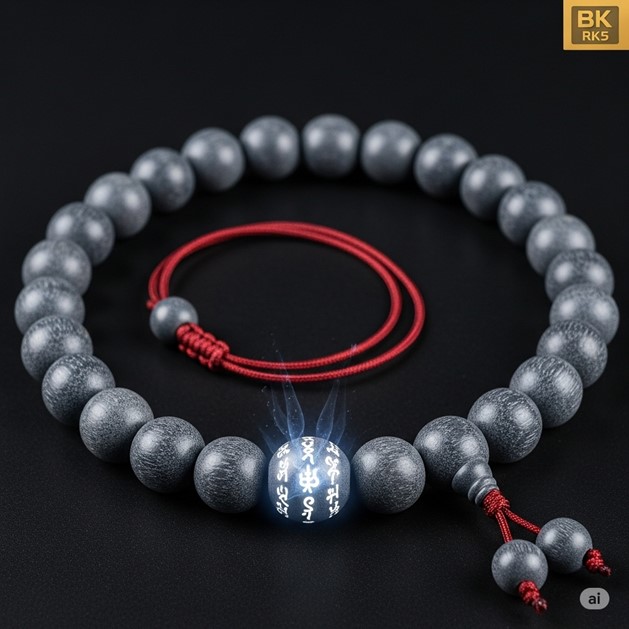
Description: This item is a string of 108 perfectly smooth, round beads, each about the size of a small marble. The beads are carved from a type of fossilized wood that is cool to the touch and unnervingly heavy, feeling far older than they appear. Their color is a deep, uniform slate grey, polished to a soft, matte sheen. The string itself is a simple but durable dark red cord, knotted expertly between each bead. There is no clasp; the string is a continuous loop long enough to be wrapped several times around the wrist or held as a prayer rope. The item is entirely non-metallic and unadorned. When activated, the beads do not glow. Instead, by focusing on a specific bead while performing a ritual, faint, ghostly images or flowing, script-like patterns momentarily appear on its grey surface, visible only to the user.
Slot: Held or Wrists
Detailed Stats
- Temporal Resonance: +5
- Historical Acuity: +3
- Spiritual Composure: +2
Passive Magic
- Age Sense: When the wearer physically touches an object or is in the presence of a distinct spiritual entity, they receive a general, intuitive sense of its relative age. This perception is not precise but provides a clear feeling of antiquity. They might touch a stone wall and feel “ancient, before the city,” touch a sword and feel “recent, forged within this lifetime,” or encounter a spirit and feel “ageless, from the dawn of this world.”
- Temporal Anchor: The wearer’s spirit is lightly anchored to their personal timeline. This provides a minor spiritual fortitude against magical effects that would alter their personal time flow. They have a greater ability to resist magic that causes unnatural aging, magical slowness (like the Slow spell), or forced magical haste.
Activable Magic
- Ritual of Echoes: By standing in a single location and entering a meditative trance for one full minute, the user can use the sutra to perceive a significant spiritual or emotional event that occurred there in the past. The user chooses one bead to focus on, and a faint, soundless, ghostly replay of a single past event will play out in their mind’s eye. The vision is often fragmented, like a memory worn by time. For example, in a desecrated temple, they might witness the echo of the final prayer offered before its fall. In a tavern, they might see the echo of a fateful brawl or a promise being made. The user has no control over which echo is revealed, only that it was significant to the location.
- Prayer of Stillness: The user can target a single, lingering, and minor temporal-spiritual disturbance—such as the psychic residue of a powerful emotion (fear, joy, anger) or a “ghost echo” that replays a harmless, mundane event over and over. By holding the sutra and offering a ten-second prayer, the user can “calm” the echo. This does not change the past but cleanses the spiritual imprint from the location, causing the lingering feeling to dissipate and the visual echo to cease, bringing a sense of peace and neutrality to the immediate area.
Tags: Common, Held, Wrists, Miko, Chronography, Divination, History, Spiritual, Utility, Diagnostic, Temporal, Investigative, Meditative, Focus, Subtle, Informational, Soothing, Ancestral, Beaded
In the world of Saṃsāra, where history itself is a tangled and layered phenomenon, the Miko 72 of Echoing Sutra is a specialized tool sought after by historians, investigators, and spirits-seers. Its availability is more niche than common weapons or general-purpose charms. An avatar would need to frequent places concerned not with the future, but with the quiet, indelible imprints of the past. The cost is based on the established currency of Glims (copper), Shards (silver), and Lumens (gold).
Monastic Scriptoriums and Shrine Shops
This is the origin point for an authentic Echoing Sutra. In reclusive monasteries or shrines dedicated to the preservation of history—often found in quiet mountain valleys or on islands shielded from the chaotic flux of major trade routes—the Miko and monks of the chronicler tradition craft these items. Their shops are less like markets and more like libraries or museums, smelling of old parchment, polished wood, and herbal incense.
How it is Bought and Sold: The process is reverent and educational. A Miko or monastic librarian serves as the shopkeeper. They do not simply sell the sutra; they present it as a key to understanding and respecting the past. A buyer might be asked about their intentions, to ensure the tool will be used for respectful inquiry rather than exploitation. The transaction is seen as a contribution to the shrine’s work of historical preservation. Haggling is unheard of.
Cost: The price is set to be accessible to acolytes, pilgrims, and visiting scholars. It covers the cost of the ritually-sourced fossilized wood and the time-intensive knotting ceremony. The cost would be approximately 85 Glims.
University Antiquarian Booksellers
In the scholarly quarters of major cities, particularly those with renowned history or anthropology departments, one can find antiquarian shops. These establishments are crammed floor-to-ceiling with books, scrolls, maps, and historical artifacts. They are quiet, dusty places where the air hums with the low murmur of academic debate and the rustle of turning pages.
How it is Bought and Sold: The transaction is academic in nature. The proprietor is likely a retired professor or a master archivist who understands the item’s practical application. It would be known as a “Temporal Rosary” or “Hagiographic Chronometer.” A buyer is assumed to be a fellow academic or a serious student. The seller might recommend companion texts on temporal theory or the study of spiritual residue. The sale is formal and would be recorded by hand in a large, leather-bound sales journal.
Cost: The price is marked up to reflect its value as a specialized piece of scholarly equipment. A university or a wealthy student would be the expected buyer. The cost would be a firm 1 Silver Lumen (equivalent to 10 Shards).
Antique and Curiosity Shops
In the winding back alleys of ancient port cities, shops overflow with the flotsam and jetsam of a thousand worlds and timelines. The “Dusty Shelf” or “The Forgotten Attic” sells anything and everything that appears old or unusual. An Echoing Sutra could easily end up here, mistaken for a simple string of prayer beads from a forgotten faith.
How it is Bought and Sold: The transaction here is a gamble. The shopkeeper is a collector of oddities, not a user of them. They likely have no true understanding of the sutra’s function, only that it feels “old” and has a “heavy, quiet feeling.” They might invent a fanciful story for it, calling it the “Beads of the Silent Monk” or a “Worry Stone from a Sunken City.” The price is based entirely on the shopkeeper’s whim and the buyer’s ability to either see its true value or haggle based on its simple appearance.
Cost: This is where the price is most volatile. If the shopkeeper thinks it is just a plain set of stone beads, a savvy buyer might acquire it for as little as 50 Glims. If the shopkeeper spins a convincing tale of its mystic power, they might try to charge 12 Shards or more.
Purveyors of Ecumenical Religious Goods
In the grand, multicultural hubs of Saṃsāra, shops exist to cater to the countless faiths of the 7 billion souls living there. These stores, often located near major temples or spaceports, sell a dizzying array of religious paraphernalia side-by-side.
How it is Bought and Sold: The transaction is purely retail. The Echoing Sutra would be displayed in a glass case or hanging from a peg, likely nestled between incense burners, prayer wheels, and holy symbols from a dozen other cultures. The clerk would know it only by its common name and purpose, perhaps telling a customer, “These are the grey beads for talking to ghosts of a place.” The item is sold as-is, with no instructions or ceremony.
Cost: The price is a standard retail calculation, based on what the merchant paid for a crate of them from a trader. It’s consistent and non-negotiable. The cost would be a set 9 Shards.
The Miko 72 of Echoing Sutra is not an item of direct confrontation; its power is subtle, cerebral, and rooted in the past. Its use in defense and offense is a matter of wielding history as a shield and knowledge as a weapon, allowing an avatar to re-contextualize the present by understanding what has already transpired.
In a Recently Unearthed, Time-Lost Tomb
The air is stale with the dust of millennia. The party delves into a tomb that has been magically sealed, where the flow of time itself is stagnant and strange.
Defensive Roleplay The party enters a large chamber with a pressure plate trap set in the floor. The trap isn’t designed to trigger a simple dart or blade, but a temporal one: a rune that will rapidly age whatever is on the plate to dust. The avatar, holding the sutra, feels the effect of their Temporal Anchor passive. As they get near the trap, they feel a strange, personal resistance, a sense of their own timeline refusing to be influenced by the ambient magic. It’s not a loud alarm, but an intuitive, wrong-feeling “drag” against their spirit. This alerts them to the presence of hostile time magic, allowing them to spot the nearly invisible runes. The defense is the early warning, their personal stability acting as a living compass needle that points away from temporal danger.
Offensive Roleplay The tomb’s powerful guardian, a spectral warrior, is immune to all physical harm. It is bound by an ancient oath and cannot be reasoned with. The party cannot defeat it. The avatar finds the center of the warrior’s patrol route and begins the Ritual of Echoes. The beads in their hand seem to grow heavy as they witness a ghostly replay of the past: the warrior, then a living person, kneeling before their dying king. The avatar sees the king bestow the warrior with his duty, and sees the specific, personal symbol—a family crest of a crane and a serpent—that was the focus of the binding oath. The offense is the acquisition of a perfect key. The party’s artist can now quickly draw the crest on a shield or banner. Presenting this specific, historically accurate symbol to the spectral warrior is a targeted psychological attack. It might cause the spirit to hesitate, become confused, or even recognize the party as heirs to the king’s authority, allowing them to pass peacefully.
On a Contested Battlefield, Still Haunted by War
The party must cross a desolate plain where a great battle was fought ages ago. The spiritual residue of fear, rage, and sorrow is so thick it manifests as a psychic weight upon all who enter.
Defensive Roleplay As the party advances, they feel their own moods shifting. They become irritable, paranoid, and hopeless, testing their resolve. The avatar recognizes this as the lingering emotional imprint of the battle. They use the Prayer of Stillness not as a single action, but as a continuous, cleansing rite. As they walk, they chant softly, holding the sutra. They target the most potent pools of emotion: they find a spot of ground saturated with “despair” and cleanse it, creating an island of calm for the party to rest. They feel a wave of “rage” from a collapsed trench and still it. The defense is a form of spiritual pathfinding, actively clearing a safe corridor through a hazardous emotional landscape, protecting the party’s minds from the psychic wounds of the past.
Offensive Roleplay The party is being hunted by a creature that feeds on these negative emotions, a “grief-eater” that is empowered by the battlefield. A direct confrontation is foolish as the creature is at its strongest here. The avatar’s offensive tactic is to starve their enemy. They find the epicenter of the battlefield’s pain—the site of the command tent where the losing general fell on his sword. The echo of this event is the “heart” that pumps despair into the land. The avatar performs a lengthy, focused Prayer of Stillness, targeting not a minor feeling, but this foundational echo of grief. As the prayer succeeds, the ambient despair lessens dramatically. The grief-eater, its food source suddenly and shockingly cut off, becomes weakened and disoriented, lashing out in confusion. This allows the party to either attack it in its weakened state or bypass it entirely. The offense was an attack on the enemy’s logistics, by weaponizing purification.
Within the Crowded Corridors of a Corrupt Bureaucracy
The party is navigating a labyrinthine government building, seeking a specific document. Every official is suspicious, and every room has secrets.
Defensive Roleplay An official offers to lead the party to the records room, but they seem too eager. The party is led into an empty office to “wait for the archivist.” Suspicious, the avatar uses the Ritual of Echoes. The vision they receive is faint, as no single event was world-shattering, but a pattern emerges: they see the ghostly replay of dozens of other individuals being led into this same room, followed by the echo of guards entering and leading them away in binders. The defense is confirmation of the trap. The party knows this is a holding cell and can prepare an ambush or an escape before the guards arrive.
Offensive Roleplay The party needs to get past a powerful and famously incorruptible magistrate who blocks their access to the archives. They cannot bribe or intimidate him. In his public office, the avatar uses Age Sense while subtly touching the magistrate’s ornate desk. The desk feels ancient, far older than the building. Later that night, they sneak back in and perform the Ritual of Echoes focused solely on the desk. They witness an echo from a century ago, of a young man—the magistrate’s grandfather—accepting the desk as a bribe from a notorious crime syndicate. The magistrate himself is incorruptible, but his entire family legacy is founded on a crime. The offense is the discovery of a secret history. They can now approach the magistrate not with a threat, but with quiet, undeniable proof of his family’s secret shame, forcing him to cooperate to protect his name.
Perception of Activation:
Sight
- User’s Perspective: The activation is an intensely private and focused visual event. As the user enters their meditative state and focuses on a single slate-grey bead, the outside world seems to dim slightly. The surface of that one bead becomes a miniature scrying pool, not glowing, but displaying faint, ghostly, and translucent images. These images, depicting past events, seem to flow within the bead itself. Alongside the images, ephemeral, script-like patterns may drift across the surface, providing conceptual data. The user must maintain intense visual focus on the bead to discern the details of the vision.
- Observer’s Perspective: An observer sees almost nothing. If they were to stare intently at the exact bead the user is focusing on, from inches away, they might notice a subtle, momentary distortion on its matte surface, like heat haze or a trick of the light. From any normal distance, the beads appear completely inert and unchanged. The only visual cue that anything is happening is the user’s fixed, unwavering stare at their own hand or wrist.
Sound
- User’s Perspective: The activation is profoundly silent in the user’s ears. However, they perceive the “sound” of the past event as a form of mental echo. There are no true auditory signals, but the user’s mind fills in the gaps—they might “feel” the roar of a crowd, “sense” the quiet whisper of a betrayal, or “know” the sound of a shattering vase, even though no physical sound is produced. It is a memory of a sound, perceived directly by the consciousness.
- Observer’s Perspective: The item is, and remains, completely silent. There is no hum, chime, or any other sound associated with its activation.
Touch
- User’s Perspective: The beads retain their signature coolness and weight. The user does not feel a vibration or change in temperature. The primary tactile sensation is an internal one; a feeling of “temporal drag” or “gravity,” as if their mind is being gently but firmly pulled back through time. It is a distinct, non-physical heaviness centered on their point of focus.
- Observer’s Perspective: An observer touching one of the beads would feel only cool, heavy, polished stone. There is no physical change to perceive.
Smell
- User’s Perspective: The user perceives the “ghost” of scents associated with the vision they are witnessing. If the echo is of a great feast, they might perceive the faint, phantom aroma of roasted meats and wine. If it is of a fire, they would perceive the mental impression of smoke and ash. These scents are not physical but are part of the holistic, memory-like vision, adding a layer of immersion.
- Observer’s Perspective: There is no smell produced by the activation. The air around the user remains unchanged.
Taste
- User’s Perspective: This sense is the least commonly engaged, but for events with extremely powerful emotional or physical components, a phantom taste might register. The echo of a poisoning might leave a faint, bitter taste on the user’s tongue. The echo of a joyous wedding toast might produce a fleeting, sweet taste. It is rare, and often signals an event of great significance.
- Observer’s Perspective: There is no taste perception for an observer.
Extra-Sensory Perceptions
- Temporal Vision (User’s Perspective): This is the core of the activation. The user is experiencing a form of scrying that looks not into the future or across space, but directly into the past of their immediate location. They are a passive, invisible observer of a past event, seeing it unfold in a ghostly, translucent replay. The information is often incomplete, like a damaged film, but it is direct visual evidence of what transpired.
- Temporal Vision (Observer’s Perspective): A magically perceptive observer would not see the vision itself. Instead, they might perceive the user’s aura extending a thin, ethereal “tendril” backwards in time, anchoring itself to the location’s history. They would see the user become a point of temporal stillness while this connection is active.
- Historical Resonance (User’s Perspective): The user feels the emotional weight of the events they witness. They don’t just see a betrayal; they feel the ghost of the shock and pain associated with it. They don’t just see a building being constructed; they feel the echo of the workers’ hope and effort. This provides crucial context to the visual information.
- Historical Resonance (Observer’s Perspective): An empathic observer might notice a flicker of profound, second-hand emotion cross the user’s face, even if their expression remains largely placid. They might see a glimmer of sorrow or a shadow of anger that doesn’t match the current situation, reflecting the historical event the user is witnessing.
Positives
- The activation is supremely discreet, allowing the user to investigate the past of a location without alerting anyone nearby to their actions.
- Because the sensory input is almost entirely mental and internal, the user remains fully aware of their immediate physical surroundings, preventing them from being completely vulnerable.
- The information gained is direct and experiential, providing a much richer and more nuanced understanding of a past event than a simple text description.
Negatives
- The disconnect between the user’s physical senses and the internal, historical vision can be disorienting, potentially causing a kind of “temporal vertigo” or mental fatigue after prolonged use.
- The visions are fragmented and without sound, requiring interpretation. An echo could be easily misunderstood without proper context.
- The process is slow and requires a state of calm meditation, making it entirely unusable during a crisis, in combat, or while under immediate threat.
- Witnessing traumatic, violent, or sorrowful events from the past can take a significant psychological toll on the user, even if they were not physically present. The emotional resonance is very real.
Chronicler’s Guide to Crafting the Echoing Sutra
Materials Needed
- Bead Stock: One solid block of petrified ironwood, sourced from a forest where the flow of time is known to be unnaturally slow or has come to a complete standstill. The wood must be dense, free of cracks, and large enough to yield 108 beads.
- Binding Cord: A spool of cord spun from the silk of a ‘dreaming’ caterpillar, one that remains in its chrysalis for a full decade before emerging. The cord must be dyed a deep red using the juice of mountain hawthorn berries.
- Polishing Compound: A paste made from two parts powdered river stone, collected from a cave unlit by the sun, and one part morning dew collected from the petals of a century plant.
- Temporal Catalyst: An intact, undisturbed spider’s web, gathered from the corner of a ruin that has been sealed for at least one hundred years. The web must be transported in a sealed, air-tight container to preserve its delicate structure and the dust of ages it holds.
- Spiritual Focus: The captured echo of a historical lament or song. This is prepared by humming a song of great age and sorrow into a crystal vial filled with still water, then sealing it. The water now holds the resonant memory of the song.
Tools Required
- Lapidary’s Workshop: A full set of masterwork lapidary tools, including diamond-tipped drills, fine-toothed saws, and shaping rasps, necessary for working the incredibly dense petrified wood.
- Knotting Board: A wooden board with pegs and a weighted awl, designed specifically for creating the tight, evenly-spaced knots characteristic of a prayer sutra.
- Polishing Wheel: A slow-turning, hand-cranked polishing wheel fitted with a soft felt or leather surface.
- Ritual Basin: A shallow, unassuming clay basin, aged for at least one generation and used only for meditative or ritual purposes.
- A Chamber of Stillness: A workspace that is acoustically isolated and, if possible, located in a place with a weak connection to the flow of ambient time, such as a deep cellar or a cave system.
Skill Requirements
- Artisan Skill: Master-level Lapidary or Gemcutting. The skill required to shape 108 identical, perfectly round beads from petrified wood is immense. A single mistake can ruin a bead.
- Ritualistic Craft: Expert Knot-Tying. The practitioner must be able to tie the specific, symbolic knots that separate the beads, which are both functional and part of the enchantment.
- Spiritual Aptitude: The crafter must possess the innate ability of Psychometry or a similar clairvoyant skill that allows them to perceive the history of objects and locations.
- Personal Attributes: This craft demands monastic patience, an unwavering hand, and a profound respect for the integrity of history. The crafter must be able to work in silence for days on end.
Crafting Steps
- The Shaping of Moments: This is the most labor-intensive step. The crafter must meticulously cut, shape, and drill each of the 108 beads from the block of petrified ironwood. Each bead must be a perfect sphere, identical to its sisters. This process can take weeks of continuous, focused effort. It represents the orderly and demanding progression of individual moments that form history.
- The Polish of Ages: Each bead is then taken to the polishing wheel. The crafter applies the polishing compound of river stone dust and dew and works each bead until it has a uniform, soft, matte sheen. During this process, the crafter must meditate on the concept of smoothing the rough edges of the past, of seeing events with clarity rather than sharp, painful emotion.
- The Imbuement of Memory: The 108 finished beads are placed carefully into the ritual basin. The crafter then takes the ancient spider’s web and gently lays it over the beads. The web, heavy with the dust of a century, is the physical anchor for time itself. The vial containing the “memory of a song” is then unsealed, and the water is poured over the web. The ancient web dissolves, and its essence—the captured stillness, the dust of ages, the quiet passage of a hundred years—is absorbed into the porous surface of the beads.
- Stringing the Timeline: The crafter takes the red cord and begins the knotting ritual. They thread the first bead, then tie the first knot. As they tighten the knot, they must focus their mind, using their psychometric ability to recall a specific, known historical event in great detail. They then thread the next bead and tie the next knot, recalling another event. This continues for all 108 beads, creating a physical timeline where each knot is a anchor for a historical record, teaching the sutra its function.
- The Curing of Stillness: The completed sutra is coiled and placed back into the empty ritual basin. It must then be left completely undisturbed in the Chamber of Stillness for a full cycle of the moon. During this month-long period, the temporal energies within the beads settle and harmonize, the individual memories imbued in the knots merge into a single, cohesive enchantment, and the item becomes stable. If the sutra is moved or exposed to strong magic during this time, the enchantment will fail, leaving nothing but a string of heavy, lifeless stones.
Child and River of Time
It is told, from records copied with a poor hand, that in the early settlements of Saṃsāra, there was a village built beside a waterfall. The people were new to the land, having come from a world of quiet fields. But the ground upon which they built their edifices was not new. It was old with the history of another people, from another time, who had also fallen from the sky and whose own village had long turned to dust. The memories of the ground were a tangle.
A great malady then began among the children of the village. They would become lost. Not lost in the jungle, for their bodies would be in their beds or at the dinner table. Their spirits became lost. A child would be playing, and then their eyes would become like still pools of water, seeing a thing that was not there. They would not speak. They would not eat. They were listening to a story from the ground, a story that was not their own.
The people were full of a great fear. The healers made charms against evil spirits. The warriors made patrols against unseen monsters. But the children remained lost.
To this village came a Miko. Her name was Ine. Her duties were not to fight spirits or to heal the flesh. She was a tender of histories, a keeper of the calendar. She looked upon the lost children, and she did not see sickness. She placed her hand on the ground, and she was quiet for a long time.
She spoke to the village elders. Her voice was like the slow movement of water. “The ground here is a river,” she said. “But it is a river of time, and many streams have flowed into it. The water is full of echoes. The children, their souls are like small, light leaves. They have fallen into this river and are carried away by currents of what-was. They are not bewitched. They are simply listening to too many stories at once.”
The elders asked, “How do we pull them from this river of time?”
Ine answered, “To pull them out would be to tear them. We cannot dam the river, for it is history itself. But we can make an anchor. We need a tool that can feel the weight of ‘now,’ so the children remember the shore. And we need a tool to let us see the echoes that have captured them, so we may give them their proper respect.”
So Ine began a great work. She went to a forest where the trees were stone, for they had lived so long they forgot how to be wood. From this petrified wood, she took a piece. She worked it for many days, making small beads, each one a perfect circle like a full moon. She said, “These beads are heavy with age. They will remember what it is to be solid.”
She took a cord of red, the color of life’s blood, and she began to string the beads. But she did not just string them. With each knot she tied between the beads, she would perform a small, simple ritual of the present. She would smell a flower that was blooming now. She would taste a berry that was ripe now. She would listen to the waterfall as it sounded now. She put the feeling of the present moment into each knot, to hold the ancient beads in place.
When the string of beads, the sutra, was complete, she went to the most lost child. He was a small boy who sat by a window, staring at a tree, but his eyes saw a different tree, in a different world, in a different time. Ine sat beside him. She did not shake him or call his name. She gently wrapped the Echoing Sutra around the boy’s wrist. The heavy, old beads seemed to give his small body a new weight.
Then, holding the other end of the sutra, Ine closed her eyes and used the tool she had made. She focused her mind, not on the boy, but on the echo he was seeing. On the surface of the bead in her hand, a faint, ghostly image appeared for her eye alone. She saw a different family, in a different house that stood on this very spot. She saw a birthday party. She saw a cake with candles. She saw the ghost of a child, the same age as the lost boy, laughing and opening a gift. The lost boy was not trapped by a monster. He was mesmerized by the echo of another’s happiness.
Ine, understanding now, began a new ritual. The Prayer of Stillness. She did not banish the happy memory. She gave it honor. She spoke aloud, in a soft voice. “We see you, family that was. Your joy was real. Your child was happy. We honor this memory.” She bowed her head to the ghost-vision. By acknowledging the echo, by giving it respect, its power over the present was lessened. It was a story that had been heard, and so it did not need to shout anymore.
In the vision, the ghostly family smiled and faded away. The lost boy blinked his eyes. He looked down at his own hands, then up at Ine. He saw her, truly saw her, for the first time in a month. He was back on the shore of ‘now.’
Ine did this for all the lost children. Each one was trapped in a different echo—a memory of sadness, a moment of fear, a day of love. Each time, she used the sutra to see the story, and then she gave that story its proper place. She taught the people that the past was not an enemy to be fought, but a crowd of ancestors who all wished to speak at once. The sutra was the tool that allowed one to listen to one voice at a time.
The Moral of the Story: A ghost is not a monster to be slain, but a story that has not yet been heard.
Suggested conversions to other systems:
Call of Cthulhu (7th Edition)
The Beads of Lost Hours
A string of 108 slate-grey beads, carved from an unidentifiable type of fossilized wood. This strange artifact, sometimes surfacing in auctions of occult items from East Asia, is a psychometric tool of unusual power. It does not communicate with spirits, but rather attunes the user to the “memory” of a place, allowing them to witness ghostly, soundless replays of events that left a strong psychic imprint.
- Game Mechanics:
- Sense Antiquity: While holding the beads, the investigator can get a general, intuitive sense of the age of any object they are touching. This requires a successful Listen roll, re-interpreted as listening to the “hum of time.”
- Witness the Echo: To activate the beads’ primary function, the investigator must be in a specific location and spend 10 minutes in quiet, meditative concentration. At the end of this period, the player makes a POW x 5 roll.
- On a Success: The investigator experiences a vivid, silent, ghostly vision of a single, significant past event that occurred in that location. The Keeper describes the event, providing clues relevant to the investigation.
- On a Failure: The temporal energies are too faint or chaotic. No vision is received. The investigator may not attempt to use the beads in this location again for 24 hours.
- On a Fumble (or if the witnessed event is particularly horrific): The investigator becomes psychically entangled in the vision. They experience the event with terrifying clarity and must make a SAN roll (1/1d4 loss).
Blades in the Dark
The Echo-Knot Rosary
A heavy loop of 108 grey, stone-like beads on a faded red cord. Each knot between the beads is tied in a complex, non-Dovlish pattern. Ghosts and whispers are common in Duskvol, but this artifact interacts with a different kind of residue: the echoes of living emotion, of events so significant they’ve permanently stained a place. It’s a tool for finding out what happened long before the ghosts arrived.
- Game Mechanics:
- Load: 1 Load.
- Perceive the Echo: When you are in a location with a mysterious history, you can spend a few moments in concentration and Study the area through the rosary. On a successful roll, you don’t just notice details, you see a silent, ghostly flicker of a past event. You can ask the GM: “What significant thing happened here a long time ago?” The answer should give you a new opportunity or reveal a hidden aspect of your current situation.
- Calm the Residue: When dealing with a ghost whose behavior is tied to a specific location (e.g., it always haunts the room where it was murdered), you can use the rosary to Attune to the location’s painful memory. On a success, you temporarily pacify the emotional echo that agitates the spirit. For the rest of the scene, the ghost becomes confused and passive, and all actions taken against it have +1 effect. This costs 2 Stress.
Dungeons & Dragons (5th Edition)
Rosary of Temporal Perception Wondrous item, uncommon (requires attunement)
This string of 108 slate-grey beads is carved from fossilized wood, feeling cool and heavy in the hand. The beads are a focus for Miko rituals that sought to understand the past. By meditating with the rosary, you can peer into the spiritual echoes of a location.
- Game Mechanics:
- While holding this rosary, you have advantage on any Intelligence (History) check made to recall lore about a specific location you are in or an object you are holding.
- The rosary has 3 charges. As an action, you can expend 1 charge to cast identify or augury. When you cast augury using the rosary, the spell does not glimpse the future, but instead gives you information based on the echoes of similar, past events that have occurred in your current location.
- Vision of the Past: By spending 10 minutes in uninterrupted meditation while in a specific location, you can expend 1 charge to receive a vision. The DM describes a short, silent, ghostly vision of a single significant event that happened there. The vision might be cryptic and is not under your control, but it is always truthful.
- The rosary regains 1d3 expended charges daily at dawn.
Knave
Time-Echo Beads Item Slot: Held, 1 slot
A heavy string of 108 grey, stone-like beads on a red cord. They feel ancient. Holding them and concentrating allows you to see things that happened long ago.
- Abilities:
- Age Sense: If you hold the beads and touch an object for one minute, you can determine its approximate age (e.g., “a few years old,” “decades old,” “centuries old,” “ancient”).
- Glimpse the Past: Once per day, you can sit or stand in one spot and meditate with the beads for 10 minutes. At the end of this time, the GM will describe a short, silent, ghostly vision of one important event that occurred at your location in the past. You cannot interact with the vision, and it reveals what it wants to reveal.
- Temporal Ward: You have +1 to all saving throws against magic that directly alters your age or speed (e.g., slows or hastens you).
Fate Core / Fate Condensed
The Past is Never Truly Gone
This is an Extra represented by a heavy string of 108 slate-grey beads. It does not show the future, but allows the wearer to connect with the “memory” of a place, viewing silent, ghostly echoes of events that left a deep spiritual or emotional scar on a location.
- Item Aspect: The Weight of What Was
- Game Mechanics:
- Invoke for Memory: Any character holding the beads can Invoke the Aspect to gain a +2 bonus or a reroll when using the Investigate skill to piece together clues about a past event. It can also be invoked when you Create an Advantage to discover a historically relevant aspect of a location, such as Scene of a Forgotten Betrayal.
- Echo of the Past (Stunt): Once per session, by spending a few minutes in quiet meditation at a location, you can spend a Fate Point to receive a detailed, silent vision of a single, crucial event that happened there. You and the GM work together to define the vision. This vision should grant you the answer to one key question about the past of that location, or it can be used to place a new, true Story Aspect on the scene (e.g., The Killer’s Secret Escape Route).
Numenera & Cypher System
Temporal Echo Locator
This artifact is a continuous loop of 108 perfectly smooth, non-metallic grey beads on a dark red cord. Each bead is a complex temporal resonator that, when focused upon by a sentient mind, can sift through local spacetime to find and display significant historical events that are “imprinted” on the location.
- Level: 5
- Form: A string of 108 grey beads on a red cord, worn on the wrist or held.
- Effect: Once per day, the wearer can spend ten minutes concentrating on their surroundings while holding the beads. At the end of this period, they experience a brief, silent, ghostly vision of a single significant event that occurred within short range of their current position in the past. The GM describes the vision, which should provide a useful or interesting clue about the location’s history. The vision is not interactive.
- Depletion: 1 in 1d20
Pathfinder (Second Edition)
Chronicler’s Beads of the Past Item 6+ Uncommon Divination Invested Magical
- Usage held, 1 hand; Bulk L
- Craft Requirements You are an expert in the Crafting skill and have access to petrified wood from a creature with the fey or spirit trait.
This string of 108 perfectly smooth, slate-grey beads is carved from wood that has been fossilized for millennia. By focusing on the beads, you can quiet the present and listen to the echoes of the past.
- Game Mechanics:
- The beads grant you a +1 item bonus to skill checks to Recall Knowledge about historical events, lineages, or specific locations.
- Activation [AAA] envision, Interact; Frequency once per day; Effect You spend a minute meditating with the beads on the history of your current location. At the end of this time, you receive a silent, ghostly vision of a significant event that transpired here. The vision grants you knowledge as if you had critically succeeded on a Recall Knowledge check about that specific event. The GM provides the details of what you learn.
Type Chronicler’s Beads of the Past; Level 6; Price 230 gp Type Greater Chronicler’s Beads of the Past; Level 12; Price 1,800 gp The item bonus is +2. The frequency of the activation becomes once per hour. Additionally, when you receive the vision, you can ask the GM one follow-up question about the context of the event, which they must answer truthfully.
Savage Worlds Adventure Edition (SWADE)
Ancestor Beads
A heavy set of 108 stone-like beads from a foreign land, this meditation tool is said to allow the user to commune with the “memory” of the earth itself. It is a tool for investigators, scholars, and those who believe the secrets of the past are the key to surviving the present.
- Game Mechanics:
- Historical Intuition: The wearer gains a +1 bonus to all Common Knowledge and Research rolls related to historical events or figures.
- Glimpse the Past: The wearer can perform a 10-minute ritual of meditation to connect with the history of their immediate surroundings. At the end of the ritual, the player makes a Spirit roll.
- Success: The GM provides a short, silent vision of a single important event that occurred at the location, revealing one useful clue or piece of information.
- Raise: The vision is clearer and more detailed. The GM reveals the clue from a Success, and also provides an additional, related piece of information, such as the identity of one person involved or the general emotional state (fear, anger, joy) of the event.
- This ability can be attempted once per day.
Shadowrun, Sixth World
Wuxing Tempus Foci (Power Focus, Object)
A product of Wuxing’s geomantic research division, this item is a string of 108 beads carved from petrified wood recovered from a location with a powerful temporal aura. While marketed as a meditation aid for executives, runners who have acquired them know they are actually a focus for psychometry, allowing a magically active user to read the astral echoes of past events.
- Rating: 3
- Bonding Cost: 6 Karma
- Game Mechanics:
- Temporal Sense: While the focus is active, the user can handle an object or touch a surface and get an intuitive sense of its age and the emotional weight of its history. This may grant a point of Edge on an appropriate skill test (like Judge Intentions on a person who has long owned the object) at the GM’s discretion.
- Psychometric Resonance: The focus allows the user to perform a special action: Read Astral Echo. This is a Charisma + Assensing [Astral] test that takes 1 minute of uninterrupted concentration on a single object or location. The number of hits determines the clarity of the vision of a past event associated with the target.
- 1 Hit: A single, fleeting image or sound.
- 2 Hits: A short, silent, ghostly scene lasting a few seconds.
- 3+ Hits: A clearer, more detailed scene that provides one key piece of information about the past event.
- This focus cannot be used as a general Power Focus; its rating only applies to the Read Astral Echo action, adding 3 dice to the user’s dice pool for that test.
Starfinder Roleplaying Game
Reliquary of Echoes Hybrid Item Level 7; Price 6,200 credits; Bulk L
This continuous loop of 108 slate-grey beads is crafted from fossilized alien wood and strung on a durable, dark red cord. Each bead is a sophisticated temporal resonator that interfaces with the user’s bio-magical field, allowing them to sift through the psychic residue of a location to witness past events.
- Game Mechanics:
- The wearer gains a +2 insight bonus to Culture and Mysticism checks made to recall knowledge about the history of a specific place, people, or tradition.
- Historical Inquiry: Once per day, the wearer can spend 10 minutes meditating with the reliquary to cast a special spell-like ability. This functions like divination, but with the following changes: The spell cannot ask about the future. Instead, you can ask a single question about a significant past event that occurred within 100 feet of your current location. The spell will answer with a short, truthful, but often cryptic, ghostly vision and a brief mental impression. The base chance for a correct answer is 70% + 1% per caster level (maximum 90%). If the dice roll fails, you receive no vision.
Traveller (Mongoose 2nd Edition)
Droyne Psychometric Loop
An artifact of the enigmatic Droyne, this string of 108 perfectly smooth, unnaturally heavy grey beads is believed to be a psionic focusing tool. The material is an unknown, non-metallic substance that seems to absorb and store psychic impressions over vast periods of time. For non-psions, it is merely a strange piece of jewelry. For a psion with the Clairvoyance talent, it is a key to unlocking the past.
- Tech Level: 15
- Mass: 0.25 kg
- Power: Psionic
- Game Mechanics:
- This device may only be used by a character with the Psionics (Clairvoyance) talent.
- Temporal Viewing: A psion may use the loop to look into the past of their current location. The psion must make a Psionics (Clairvoyance) check as normal, spending the required time in concentration. The difficulty of the check is determined by how far back the psion is trying to look (Referee’s discretion).
- Routine (8+): View events within the last 24 hours.
- Difficult (10+): View events within the last year.
- Formidable (12+): View events within the last century.
- The Effect of the roll determines the clarity and duration of the vision. An Effect of 0 provides only a fleeting, confusing image, while an Effect of 6+ would provide a clear, detailed, and informative (though silent) scene of the event the psion is looking for.
Warhammer Fantasy Roleplay (4th Edition)
Beads of the Ossuary Seer Magical Trinket
These are heavy, cold beads of polished stone the colour of a stormy sky, often found in the possession of morbid mystics or hedge wizards who traffic with the spirits of the dead. It is said that by meditating on the beads, one can force a location to give up the secrets of its most violent or sorrowful moments, re-witnessing deaths and tragedies as if they were ethereal plays.
- ENC: 1
- Qualities: Magical, Unsettling
- Game Mechanics:
- Death-Sight: If you are in a location where a person has died violently or with great emotion within the last year, you may spend 10 minutes in concentration, holding the beads and making a Challenging (+0) Lore (Magic) Test.
- On a Success: You witness a silent, ghostly reenactment of the moments leading up to the death, gaining a crucial clue as to the nature of the death, the identity of the killer, or the location of a hidden object related to the event. The GM provides this information.
- On a Failure: You see nothing but confusing, upsetting images.
- A Morbid Price: The minds of mortals were not meant to witness such events repeatedly. Each time you use the Death-Sight ability, you must make an Average (+20) Cool Test. If you fail, you gain 1 Corruption point as your soul becomes more accustomed to the energies of death and despair.
- Death-Sight: If you are in a location where a person has died violently or with great emotion within the last year, you may spend 10 minutes in concentration, holding the beads and making a Challenging (+0) Lore (Magic) Test.
Comments
One response to “Miko 72 of Echoing Sutra”
[…] Miko 72 of Echoing Sutra: The fossilized ironwood beads of temporal chronicling. […]