
(From Zygaena moth + Graviport [weight-mover] + Varanus [monitor] + Axon [nerve])
- Original Life Forms Referenced (Animalia Kingdom):
- Insecta – Zygaena Moth (bright, poisonous, slow-flier; aposematic)
- Reptilia – Black Tree Monitor (arboreal predator, long tongue, highly intelligent)
- Amphibia – Olm (Blind Cave Salamander) (aquatic, eyeless, cave-dwelling, long-lived)
- Cephalopoda – Blanket Octopus (membranous, flowing body; defense mimicry; sexually dimorphic)
Appearance: Zygravax 267 is an eerie and slow-moving creature with a stretched, serpentine body wrapped in flowing membranous fins that pulse like silk underwater. Its skin is glassy pale near the tail but deepens into ink-blue and venom-red patterns across the dorsal fins and hood. The head resembles a monitor lizard’s elongated skull, but eyeless—replaced by pulsating heat-pits and a triple-forked tongue constantly sampling the air.
Eight limb-like fins (derived from cephalopod and amphibian ancestry) spread from its sides in blanket-like sheets used for gliding, intimidation, or smothering prey. Near its spine, symmetrical patches of scales shimmer in warning colors, occasionally twitching or pulsing when it senses vibration or mana.
Size:
- Length: ~7 feet
- Spread Width (when fins expanded): ~10–12 feet
- Weight: ~80 lbs
- Slender but long-bodied; glides or swims like a sheet of haunted fabric
Speed:
- Land Speed: 20 ft (sinuous, wave-like crawling with short leaps)
- Climb Speed: 20 ft (clings to bark, rock, or ruin walls)
- Glide Speed: 40 ft (between tree canopies or cave ledges using membrane extension)
- Swim Speed: 25 ft (undulates through water, dragging fins behind like trailing robes)
Stat Modifiers (Tier 1):
- Strength: −1 (delicate frame, enveloping rather than overpowering)
- Dexterity: +2 (fluid movement, excellent glide control, fast tongue strikes)
- Constitution: +1 (resistant to poison, cold, and necrotic decay effects)
- Intelligence: +1 (problem-solver, trap-aware, semi-lingual mimicry)
- Wisdom: +2 (exceptional sensory reading of temperature, tremors, and auras)
- Charisma: −2 *(alien shape, no normal expressions, emits unsettling pheromones)
Skills:
- Stealth: +4 *(can slow heart rate, mimic hanging moss or stone drapery)
- Perception: +3 *(scent, tongue-taste, temperature sense, water ripple detection)
- Survival: +2 *(navigates old ruins, avoids predators, stores poisons in glands)
- Arcana (Nature): +1 *(intuitively tracks magical bleed, glyph warmth, or ley seepage)
- Intimidation: +1 *(displays membrane pulses to warn, hiss, or mimic threat colors)
Behavior: Zygravax 267 is a nocturnal ambush-glider, coiling in shaded cliffs, flooded ruin ceilings, or dead tree hollows. It uses stillness, camouflage, and mimic coloration to lie in wait until prey passes below—at which point it drops in complete silence and either suffocates or poisons targets using its sticky tongue and nerve-seep.
It does not pursue prey. Instead, it retreats if spotted, using false displays of size or mimicked predator calls. Only when starving will it show aggression. When nesting, it builds glistening drapes of silk-threaded toxin-mucus, often mistaken for mourning veils or cultist banners.
Diet:
- Carnivorous—feeds on small mammals, reptiles, amphibians, carrion, and low-tier magical fauna
- Prefers blood-rich or emotionally distressed prey (resonates strongly with auric discharges)
- Can survive for weeks on decayed matter soaked in latent magic
Emotions:
- Content: Slow side-to-side membrane waving, low humming from gill vents
- Threatened: Body flattens, color-shifts into eye-like spirals, hissing pulses
- Curious: Tongue flicks, tail coils to form loop or false mouth
- Territorial: Cloak-fins spread into full fan, poisons begin to vent through pores
- Aggressive: No warning—drops silently and attempts immediate constriction and envenomation
Environment Where Found:
- Abandoned cliffside monasteries and poison-fog forests
- Subterranean ruins intersected by collapsed aqueducts or inverted atriums
- Fungal towers in high canopy regions where light filters like water
- Often near ley-fracture zones or dead shrines with trapped ambient mana
Tags: Feral, Venomous, Gliding, Semi-Aquatic, Ambush Predator, Nocturnal, Cave-Dweller, Tree-Draper, Mimicry, Neurotoxic, Bioluminescent, Poison-Threaded, Heat-Sensitive, Low-Light Hunter, Tier 1, Rare, Silent-Killer, Magical-Echo Tracker
Stat Modifiers (Tier 1):
- Strength: −1 (relies on suffocation, neurotoxin, and stealth—not brute force)
- Dexterity: +2 (extremely fluid and evasive; excels in gliding, coiling, and clinging)
- Constitution: +1 (resistant to poison and environmental decay; can endure ruin-fog and necrotic air)
- Intelligence: +1 (cunning, trap-aware, capable of basic mimicry and tool curiosity)
- Wisdom: +2 (sensitive to soundless movement, tremors, heat shifts, and magical flux)
- Charisma: −2 *(alien appearance and aura-reactive body causes discomfort in most sapient beings)
Skills (Tier 1):
- Stealth: +4 *(shimmer-camouflaged, motionless ambusher, can pass for drapery or mold)
- Perception: +3 *(detects tremors, shifts in air pressure, heat, blood-scent, and latent magic)
- Survival: +2 *(nests in harsh mana-scarred terrain, hoards sustenance, senses collapse zones)
- Intimidation: +1 *(pulsating displays, mimicry of predators, sudden body-flare tactics)
- Arcana (Nature focus): +1 *(drawn to ley-bleed, magically saturated ruins, and curse residue)
Age:
- Lifespan: ~16–22 years in the wild
- Maturity: 1.5–2 years (though hunting begins earlier)
- Tier 1 Typical Age: 1–4 years *(young but dangerous and curious; known for erratic patterns)
Height & Length:
- Length (unfurled): ~7 feet
- Spread Width (membrane fully expanded): ~10–12 feet
- Height (coiled and hooded pose): ~2.5–3 feet
Weight:
- Average: 80 lbs
- Lightweight for size; mostly composed of muscle bands, toxin sacs, and pliable tissue with minimal skeletal support
Speed:
- Land Speed: 20 ft *(serpentine crawl, half-glide lunge)
- Climb Speed: 20 ft *(vertical tree, ruin, or stone ascent using clawed folds and sticky fins)
- Glide Speed: 40 ft *(silent directional descent between canopy or ledge layers; can angle upward briefly with wind or mana drift)
- Swim Speed: 25 ft *(streamlined, trailing fins offer aquatic grace in flooded ruins or mana-wells)
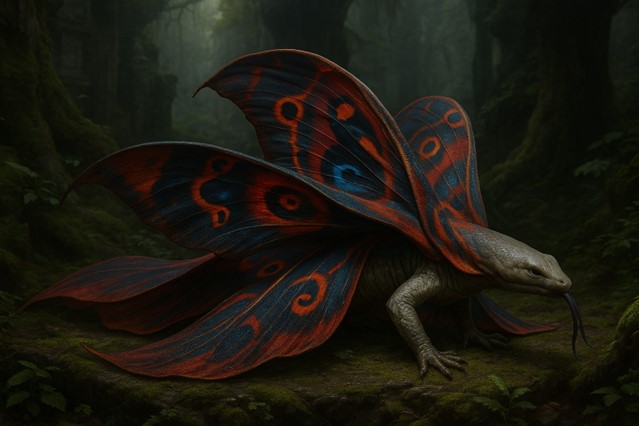
Adventurers may encounter—or seek out—the elusive and unnerving Zygravax 267 for a range of reasons, each rooted in its rare physiology, haunting presence, and entanglement with ancient and forgotten structures across Saṃsāra. Its hybrid traits make it a nexus point for myth, ecology, and esoteric utility.
1. Harvestable Components for Alchemy, Stealth, and Divination
The Zygravax’s mimic-pattern membranes, nerve-seep toxins, and aura-sensitive fins are prized components for:
- Emotion-nullifying cloaks used by assassins and mourn-rites
- Memory-binding inks that fade unless read under gliding shadow
- Arcane glide-thread spun from wing-edge tissue, used in scroll traps and silence spells
Collectors, whisper-masters, and volatile-glide poisoners may hire a party to harvest or trap a Zygravax under strict conditions of non-exposure to light or mana surge.
2. Guardian of a Forgotten Shrine or Sealed Vault
In certain moss-collapsed shrines, Zygravax 267 nests around long-abandoned, curse-locked repositories. Its:
- Nerve-hiss aura
- Toxin-sensitive camouflage
- Or even its movements through memory-thick air
may function as a biological key to opening doors that are not triggered by sound, touch, or spell, but by the silence of something that never speaks.
A party seeking pre-Flood glyphs, dream-sealed relics, or the final memories of a godseed may be required to bring the creature alive—or enter the vault without waking it.
3. Recent Trail of Suffocated Wildlife or Missing Scouts
Local scouts, druids, or glyphwardens may report that:
- Game has vanished silently
- Birds refuse to fly over certain trees
- A ruin sends back no echoes at all
The culprit may be a nesting Zygravax, which has turned a high ruin hollow into a nesting veil, dragging prey into folds of its membranes. The party is contracted to investigate, recover survivors (if any), or purge the nest before the creature molts and glides deeper into populated zones.
4. Echo-Cult Worship and Behavioral Mutation
A fringe sect, perhaps a splinter of the Veiled Mourning, may have begun feeding and venerating a Zygravax as a vessel of:
- Silence-walking prophecy
- Shadow-weaver lore
- An ancient god whose voice was sealed by its own grief
The party may be sent to retrieve an acolyte, break a binding veil, or disrupt the psychic link forming between cultist and creature before it begins reproducing through spectral imprint.
5. Escaped Familiar or Weaponized Spirit Beast
An exiled shadow-arcanist or ruinbound geomancer may have crafted or raised a Zygravax as a semi-sentient familiar for:
- Assassination-by-glide
- Emotion silencing during trials
- Harbinger mimicry rituals
The party must intercept the creature before it enters a populated temple, strikes a target, or unintentionally feeds on a magical child or prophet-seed it mistakes for ambient prey.
6. Lair of a Glider–Oracle
In rare cases, a Zygravax 267 has been bonded or tamed by echo-sensitive mystics who treat it as an oracle:
- Its behavior is used to interpret leyline fractures
- Its movement maps curses or hauntings
- Its venom is distilled into hallucinogenic draughts that replay past traumas of a site
The party might need to win the oracle’s favor, steal a scale, or drink a dose of its venom to unlock a sealed memory-path or confirm an ancient betrayal.
7. Transformation Symptom or Mana-Disease Carrier
Zygravax sightings might mark early signs of a ley-deep mana plague or curse-rot event. Its attraction to magical decay, corpse-emotion residue, and psychic disturbance can:
- Herald necrotic forest blooms
- Awaken slumbering ruins
- Feed on lingering battlefield emotions
The party is sent to locate and study the creature before a second Zygravax appears—suggesting it’s preparing to mate.
The corpse of a Zygravax 267 yields a suite of rare, volatile, and deeply unsettling organic materials. Each part is saturated with necromantic silence, gliding pressure, and aura-reactive toxins—making its remains valuable to alchemists, shadowbinders, death-poets, poison-guilds, silent monks, veilcrafters, and vault-keywrights across Saṃsāra.
Harvestable Components from a Zygravax 267
1. Veilmembrane Wings (Glider-fins with aposematic shimmer patterns)
- Use:
• Crafted into Silentfall Shrouds—garments that muffle sound and shimmer to match low-light terrain.
• Strips processed into Ghosttress Threads, woven into illusion layers or veil-bound oathrobes.
• Dried wing-dust applied to scrolls to create Forget-Me-Glyphs, which fade from memory after reading. - Harvest Notes: Must be removed in darkness or mist. Direct sunlight or vocal exposure causes color decay.
2. Nerve-Seep Glands (Toxin sacs embedded in the throat folds)
- Use:
• Distilled into Mourning Venom, a paralytic neurotoxin causing muscle collapse and hallucinated guilt echoes.
• Combined with spiritual catalysts to create Memory-Void Draughts, used in trauma erasure and psychic ritual cleansing. - Harvest Notes: Highly volatile—must be drained in silence; shouting or laughter ruptures sac walls violently.
3. Cloak-Fin Pores (Thin sensory filaments that react to ambient magic)
- Use:
• Boiled and dried into Echo-Reactive Thread, used in crafting scrolls that activate near curses or illusions.
• Pressed into wax slates to form Leyveil Maps—charts that visually pulse when held near residual spellwork or unstable wards. - Harvest Notes: Becomes inert if exposed to more than one school of magic during harvest. Must be masked with null-aura dust.
4. Bonecoil Spine (Segmented, flexible vertebrae with ley-pulse resonance)
- Use:
• Used to craft Sibilant Wands—tools that store one whisper, memory, or command word with echo-discharge effects.
• Ground into Rite-Anchor Powder to stabilize or suppress wild magic in death-rituals or soul containment rites. - Harvest Notes: Vibrationally sensitive—will hum when handled. Must be wrapped in static cloth.
5. Glidelash Tongue (Tripartite sensory tongue with poison-extracting capabilities)
- Use:
• Refined into Tongue-Reeds, flute-like devices that can replicate threat calls or disrupt concentration when played.
• Used in alchemical filters to neutralize poisons from hybrid creatures. - Harvest Notes: Must be severed at base while the creature is still warm. Becomes brittle after 15 minutes.
6. Emotion-Dust Mucus (Subtle trail secretion left by wing-drag and prey contact)
- Use:
• Core ingredient in Emotion-Tracking Ink, used by dream-scribes and for binding emotion-based contracts.
• Forms Veil-Binder Paste, which enhances charm spells and forces recognition of unresolved emotional auras. - Harvest Notes: Must be harvested by collecting from ground or surfaces where the creature has glided. Loses potency within 6 hours.
Optional Rare Drops (1d6 on mature or magically-altered specimens):
- Drapeheart Nodule – Used in cursed armor that reflects grief or regret upon attackers
- Voidpulse Lens – Can be mounted in masks or staves to dampen nearby verbal spells
- Whisperburst Fang – Pressed into blade hilts; releases sonic wave when attacker is panicked
- Ghostwing Flake – Functions as a one-time charm to avoid magical detection for 1 hour
- Unvoice Pearl – Contains a stored silence; can be cracked to negate all sound in a 10 ft radius for 30 seconds
- Griefbloom Gland – When buried, causes pale moss to grow that compels truthful speech in nearby sapients
These components are traded via:
- Vault-Poet caravans
- Deathmoth cults and moonlit veilmarkets
- Quiet Alchemists of the Upper Hollow
- Shard-ink scribes who map forgotten emotions
From the Hollow-Wind Scrolls, Entry VII: The Bleeding Reed Codex
“The One Who Danced Beneath No Sky and Swallowed the Sound of Betrayal”
—clumsily translated from a whisper-scribed ritual-memorial etched in the auric residue of a pre-verbal stone sarcophagus, sealed in the Seeping Archive beneath the Weft of Nethrune
It was in the dark-before-time, before echo learned to return,
when silence grew thick and bled from walls that had not yet been named,
that it came.
Not with footstep,
not with scent,
not with hunger,
but with a fold in being, a tensing of the breath that isn’t there.
They called it Zygravax—though the word was only ever used once,
and only by accident,
when a prayer was misspoken in fear.
Zygravax came from a place where color had forgotten how to live,
and where wings grew not for flying,
but for catching guilt.
Its body was stretched like a question that no one dared ask,
and it wore its shame in folds of trembling silk,
dripping not rain nor blood,
but reminders.
It did not hunt.
It waited to be remembered.
And when it was,
it folded around that memory
and took it away.
There was once a speaker,
or a monk,
or a liar—depending on which glyph you read.
He was named Mol-Xet of the Closed Mouth,
and he was trusted with a secret so old,
the secret itself had begun to rot.
Mol-Xet feared what it would become.
Feared that saying the secret aloud might make the world hear what should remain broken.
So he journeyed to the ruins where Zygravax slept between veils.
He did not call for it.
He simply wept.
And the Zygravax came,
not drawn to the sound,
but to the emotion dripping from it.
It coiled around him,
fins wide like regret,
and it did not bite.
It did not sting.
It only pressed its membrane to his skin
and drank the part of him that remembered.
For three days, the monk forgot.
He was free.
He returned to his shrine, smiling.
He sang again,
he danced with the wind,
he kissed a girl made of clay and fireflies.
But on the fourth day,
his mouth began to close.
Not with lips.
With silence.
And those who touched him
also forgot.
And so did their kin.
And then their town.
And then the hill beneath the town.
Until all that remained
was the shape of Zygravax’s trail—
a folded line in the moss,
damp with venom,
bright with color that no one would remember how to name.
They say it still glides between the ruins of forgotten things.
It eats not flesh,
but the echoes of the things you meant to say but didn’t.
If you whisper a betrayal into the dark and feel your voice weaken—
If a scroll bleeds ink when you try to write a confession—
If your breath tastes like moth silk—
You are near.
Or perhaps,
you have already been folded.
Moral of the Story: Some things are not meant to be buried—but only to be forgotten, and only by something willing to carry the silence for you.