
Common rarity – Tier 1 – Roleplay Emphasis: Barter
Lore: When the floating barter city of Ngāwai-o-te-Utu was first established upon the braided river-airs of southern Vensuval, its traders struggled to communicate across tongues, customs, and intentions. From a convergence of need and tradition, a wandering tohunga of the Kōwhiringa Isles offered a gift: a small woven amulet into which a karakia of understanding had been sung beneath dawn mist, invoking spirits of fair trade and clear voice. Known now as the Karakia of Binding Tongues, it spread among barterers and caravan heralds alike. Its chant is never shouted, only murmured over open palms and shared goods. The spirit within listens—not for lies, but for balance.
Description: A disc-shaped pendant of blackened flax twine woven tightly with shimmering green pāua-shell chips, wrapped in soft eelskin cord. Its surface is etched with four spiraling glyphs—one in each trade tongue of the riverfolk. When the karakia is spoken, these glyphs gently thrum with warm resonance. The scent of sun-warmed river stones lingers faintly from it, even after long journeys.
- Weight: 0.2 lb
- Material: Flax braid, paua shell, eelskin
- Slot: Neck (counts as 1 magical item worn)
Magical Properties
Passive Magic:
• Tongue of Fair Exchange
While worn, the avatar may understand and speak the intent behind barter-based communication, even when languages differ. This includes haggling gestures, trading terms, and marketplace euphemisms. Does not enable full comprehension of unrelated speech.
• Eyes of Worth
The avatar gains an intuitive sense of whether an item offered in barter is roughly equal, unbalanced, or deceptive in perceived value. Does not reveal coin price or hidden enchantments.
• Respectful Cadence
All attempts at negotiating trade or barter gain +1 to social checks if the avatar avoids threats, bribes, or overt pressure.
Activable Magic:
• Karakia of Mutual Want (1/short rest)
Spoken softly while facing another individual and holding a trade item in both hands, this chant links intentions briefly. Both parties momentarily feel the strongest barterable desire or need of the other—such as water, a medicinal root, a rare gear part, or peace of mind. Does not convey emotional vulnerability, only tradeable desire. Duration: 10 seconds.
• Binding Chant of Exchange (1/day)
Recite the chant while holding an item already in mid-negotiation. If accepted by the other party without coercion, both items involved in the barter become briefly imbued with a spirit of fair balance: for the next hour, if either item is resold or traded deceitfully, it gains a harmless flaw (squeaks, tarnishes, loses scent) until returned to equilibrium. May be undone by gifting, apology, or ritual cleansing.
Tags: Karakia, Common Magic, Barter, Trade, Language Aid, Spirit-Linked, Neckwear, Roleplay-Focused, Cultural Relic, Truth-Reading, Chantbound, Tier 1, Fairness-Affinity, Trade-Touched, Marketplace-Favored, Interpreter’s Charm, Negotiation-Aid, Spoken-Magic, Woven-Relic, Traveler’s Tool, Haggle-Linked, Tongue-Weaver, Spirit-of-Balance
In the world of Saṃsāra, the Karakia 112 of Binding Tongues is not a mass-produced artifact but a respected cultural item passed through traditions of tradecraft. It appears only in specific shop types and only under the right conditions of trust, bartering etiquette, or spiritual readiness.
1. River-Floating Trade Barges – Ngāwai-o-te-Utu
Type: Mobile market rafts drifting through trade winds and braided river routes
Seller: Elder bartering guilds or tohunga-trained necklace weavers
Conditions: Must prove oneself as a trustworthy trader—either by fair dealings witnessed or an endorsed letter from a trade elder. Often, the pendant is bartered, not sold, in exchange for a culturally significant item (e.g., a preserved seed-scroll, tribute textile, or ceremonial food).
Value: Equivalent to 45–55 gp, but rarely sold for coin
2. Wayfarer’s Reliquary – Ushan’s Threaded Way, Kurremthar Cliff-Towns
Type: Boutique shop specializing in rare spiritual items for itinerant traders
Seller: An ex-pilgrim turned merchant-cleric, Ushan accepts limited coin, preferring story-backed relics or items tied to diplomacy
Conditions: Item is behind the counter, offered only to those seeking non-violent solutions to disputes. Buyer must recite a truth-sworn intention for using it.
Cost: 60 gp if paid in coin, or one item with proven diplomatic worth
3. Desert Toll-Posts of Kharwahna (Lapis Borderline)
Type: Semi-official trader checkpoints on vast dune caravans
Seller: Toll-scribes and trade-charmers who use karakia to keep tensions low
Conditions: May be offered as reward for resolving a barter dispute or for escorting a caravan without violence. Cannot be bought directly—must be earned or traded through favor
Cost Equivalent: 50 gp in service or goods rendered
4. Shrine-Shops of the Whispered Tongue – Isle of Jho-Rawa
Type: Coastal shrine-communities where barter is taught as spiritual practice
Seller: Shrine-keepers who blend spiritual tutelage with artisan exchange
Conditions: Buyer must sit through a dawn chant lesson and speak a barter in at least two dialects of the region. Item is wrapped in ceremonial flax and given only when harmony is demonstrated.
Cost: 40–45 gp, or service to the shrine (e.g., a day’s teaching, gift of rare sea ink, etc.)
5. Blackreed Informal Market – Eaves of the Lurked Fen
Type: Shifting wetland bazaar operated by reclusive swampfolk
Seller: Silent traders and chant-keepers
Conditions: No coin accepted. You must trade a listening object—any item that records, remembers, or echoes voices, even faintly (e.g., a whisper-jar, echo-flint, or mnemonic ribbon)
Value Equivalence: 35–40 gp, but entirely barter-based
Across Saṃsāra, the Karakia 112 of Binding Tongues is viewed as more than a tool—it is a social contract manifested, and as such, can rarely be bought through wealth alone.
Though the Karakia 112 of Binding Tongues is a barter-focused cultural item, its deeper magic—tied to clarity, intention, and spiritual resonance—allows for subtle, roleplay-driven uses in both defensive and offensive interactions across different environments. In Saṃsāra, where the spirit of an item can shift the course of events, even non-combat artifacts like this one can influence encounters significantly.
Defensive Roleplay Use – By Environment
1. Urban Markets (Bazaar, Border-Town, Floating City)
- Action: A hostile vendor accuses the avatar of deceit or theft.
- Defense: The avatar activates Karakia of Mutual Want mid-conflict, revealing to the merchant that what they most desire is not coin but respect or a specific rare good. The tension eases as the merchant realizes the avatar understands their needs.
- Roleplay Effect: Prevents escalation into violence or guards being summoned; crowds take the avatar’s side as a “voice of fairness.”
2. Trade Caravan Camps (Wilderness Trail or Desert Crossing)
- Action: Caravan members begin arguing over ration shares or trade terms, one drawing a blade.
- Defense: The avatar calmly begins the karakia chant; the recitation slows tempers, and through Respectful Cadence, their words carry unexpected authority.
- Roleplay Effect: De-escalation succeeds; caravan leader privately offers thanks, strengthening social bonds and improving future haggling.
3. Shrine or Diplomatic Council (Formal Gathering or Neutral Ground)
- Action: An emissary from another faction levels accusations or veiled threats in a tense parley.
- Defense: With a respectful invocation of the karakia, the avatar presents a small token of good faith. Through Eyes of Worth, they subtly evaluate the sincerity of the emissary’s gestures and propose an equal symbolic offering.
- Roleplay Effect: The meeting continues peacefully; hostilities are forestalled; the avatar is marked as a “keeper of balance.”
Offensive Roleplay Use – By Environment
1. Black Market Dealings (Shadows, Rooftop Trades, Hidden Vaults)
- Action: The avatar identifies a scam trade in progress or an enchanted counterfeit item.
- Offense: Using Eyes of Worth, the avatar calls out the deception, then invokes Binding Chant of Exchange with the false trader. This publicly marks the deceitful item, which tarnishes and squeals with every touch.
- Roleplay Effect: The crowd turns on the trickster. The avatar’s reputation for fairness becomes a shield, granting leverage in future black market interactions.
2. Courtroom, Trial, or Audience with a Ruler
- Action: A rival merchant testifies falsely against the avatar, hoping to sully their credibility.
- Offense: The avatar chants the Karakia of Mutual Want—in full view—demonstrating that the rival’s true desire is to drive them from trade. The chant’s echo draws attention to the manipulative motive.
- Roleplay Effect: The ruler or arbiter reconsiders. The rival loses credibility; the avatar gains an audience with the decision-maker.
3. Street Ambush or Hostage Exchange
- Action: The avatar is cornered during a supposed barter exchange turned robbery.
- Offense: As one attacker steps forward, the avatar calmly speaks the chant, offering a trinket with Binding Chant of Exchange active. When the attacker grabs it and runs, the item begins screaming with magical resonance, drawing attention and sowing panic.
- Roleplay Effect: Chaos disrupts the ambush; guards or onlookers intervene; the attackers become marked as oath-breakers by local custom.
- Defense: The item deflects aggression through understanding, clarity, and spiritual fairness. By using the avatar’s reputation, truth-seeking magic, and respectful presence, it redirects or neutralizes threats.
- Offense: It exposes deceit, manipulates public perception, and weaponizes honor and want. The karakia becomes a mirror to adversaries’ intentions, turning their plans against them.
This style of roleplay invites avatars to solve problems not with blade or spell—but with wisdom, spirit, and the weight of fair words.
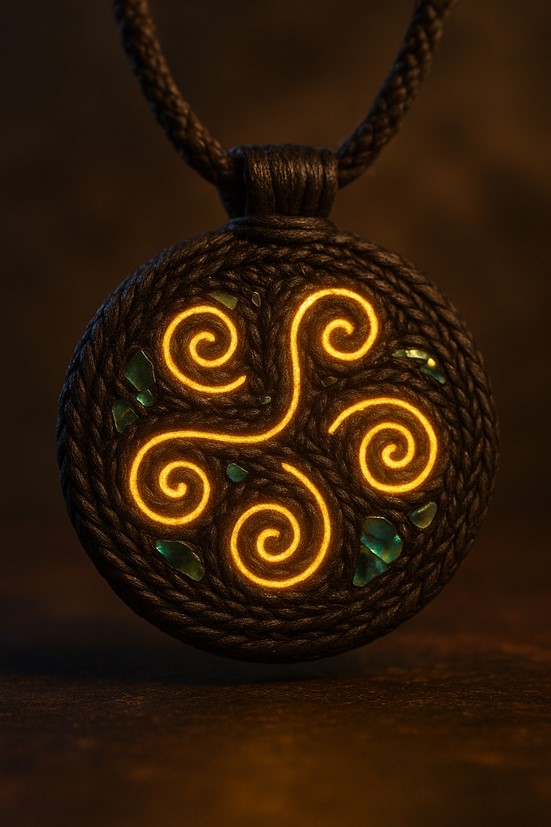
Perception of Activation:
User’s Perspective
Sight:
As the karakia is spoken, the four spiraling glyphs etched into the pendant begin to glow with a muted, golden light that pulses in rhythm with the words. The embedded pāua-shell fragments shimmer faintly, casting green-blue ripples that seem to ripple across the user’s peripheral vision.
Sound:
The chant returns to the user’s ears with layered echoes—each word repeated softly in four different dialects. A faint hum, harmonic and warm, thrums from the pendant itself, matching the rhythm of the speaker’s breath.
Smell:
A sudden surge of earthy, mineral scent—sun-warmed river stones, flax smoke, and clean morning mist—fills the nostrils. It is grounding, familiar, even nostalgic for those who’ve ever stood in a dawn market.
Touch:
The eelskin cord warms against the skin, while the pendant itself grows heavier, as though briefly anchoring the user’s spirit deeper into the world. The spirals vibrate in sync with the heartbeat, steady and slow.
Taste:
The mouth briefly tingles as if from inhaled mountain herbs—cool, bittersweet, and clean—giving a sensation of clarity or focus, like breathing in words before they are spoken.
Extra-Sensory Perceptions:
– A sudden glimpse of intent threads: soft lines extending from the user’s chest to nearby bartering partners, showing faint hues (pale green for curiosity, gold for honesty, rust-red for deceit).
– The feeling of being momentarily joined in a shared space with another’s spirit—both minds slightly aware of the other’s desire, though without full intrusion.
– A spiritual presence gently brushes the user’s awareness: a faceless watcher, ancient and neutral, judging the fairness of exchange.
Observer’s Perspective
Sight:
The pendant glows faintly from the glyphs and flashes subtly in pāua-shell patterns. The light seems to fold in on itself, like ink dispersing in water. No fire, but the warmth is visible in how the user’s shoulders straighten and how the air distorts slightly around them.
Sound:
Only the spoken karakia is heard, but to an attuned ear, it harmonizes unnaturally well with nearby background noise. Some syllables momentarily overlay others’ thoughts—making them forget what they were about to say.
Smell:
A faint scent like wet stone and braided rope may reach those within arm’s length, though most wouldn’t recognize it unless they’ve handled spiritual barter-charms before.
Touch:
Some observers standing close may feel a chill down their arms or a tug at their inner balance, as though asked silently if they would trade honestly in this moment.
Extra-Sensory Perceptions:
– Sensitive minds may feel the dampening of deception—the activation imposes an uncomfortable prickling upon lies or veiled motives.
– Some observers with spiritual training might glimpse fleeting silhouettes beside the user: ancestral shapes without faces, leaning in to witness the exchange.
Positives
- Enhances clarity of mind, particularly in tense or ambiguous exchanges.
- Momentarily aligns user and trade partner toward mutual comprehension.
- Can subtly disarm deception or hesitation without overt aggression.
- Spiritually protective in emotionally charged or diplomatically risky barter.
Negatives
- Causes spiritual strain if the user knowingly attempts to manipulate during the chant (mild nausea, false-starts in speech, or glyphs refusing to glow).
- Users with a history of broken promises may find the item resistant to activation, or its effects dulled.
- Attracts minor attention from spiritual beings that dwell near barter crossings or sacred trade routes—they may test the user’s honesty later.
- When used in conflict zones or markets where trust is extinct, the activation may provoke suspicion or superstition (e.g., accused of spell-cursing or trickery).
Crafting Recipe: Weaving of the Binding Tongues
To create a replica of the Karakia 112 of Binding Tongues—an amulet woven with ancestral chant and trade-born clarity
Materials Needed
• Blackened River-Flax Twine (1 skein)
– Harvested from riverbank flax aged in volcanic ash then smoke-cured
• Shattered Pāua Shell Fragments (at least 4 distinct shards)
– Gathered from estuarine shallows during low-tide barter moon
• Eelskin Cord (Softened) (1 loop, unbroken)
– Taken from a mature silver eel, respectfully processed with oil and chant
• Spiritual Glyph-Ink Resin (small vial)
– Made from rivergum sap, ash of broken oaths, and powdered shimmerstone
• Whispered Breath of a Tohunga (1 breath)
– Given freely by a spiritual guide or trader-elder, captured in a sealed jar
• Trade Tongue Etching Chalk (4 colors)
– Ochre-based, for drawing glyphs representing four major barter dialects
Tools Required
• Woven Loom-Disc Frame (small, circular)
• Etching Needle of Polished Bone
• Shell-Press for Inlay Seating
• Ritual Basin for Karakia Infusion
• Spoken-Wind Recorder (or simple breathcatch jar)
• Heated Glyph-Brand (spiral-form)
Skill Requirements
• Artisan Craft (Weaving or Cordwork): Intermediate
• Lore: Trade Languages or Cultural Glyphs: Basic
• Spiritweaving or Folk Magic Training: Novice level or supervised by a mentor
• Karakia Chant Recitation: Must be memorized with correct cadence; failure dulls enchantment
Crafting Steps
- Prepare the Weaving Frame:
Fasten the blackened flax twine into the loom-disc, spiraling tightly toward the center. Maintain tension and rotate with breath-synchronized rhythm. - Inlay the Pāua Shell Fragments:
Using the shell-press, insert the shards symmetrically around the spiral weave. They must not touch one another directly—spirit flow requires spacing. - Etch the Glyphs:
With the bone needle and etching chalk, inscribe the four glyphs of barter dialects—one for each cardinal direction. Apply spiritual glyph-ink resin to seal them into place. Let sit in moonlight for one night. - Bind with Eelskin Cord:
Loop the soft eelskin cord through the weave’s top opening. While threading, speak the initial line of the karakia with reverence. Do not knot—allow it to rest freely upon itself. - Infuse with Whispered Breath:
Break the breath jar or release the Spoken-Wind Recorder into the Ritual Basin. Recite the full karakia chant as the breath curls around the item. Continue until the glyphs begin to faintly glow. - Seal with Heat:
Press the heated glyph-brand lightly against the amulet’s reverse to complete the spiritual circuit. Smoke should spiral without rising—if it does not, begin again from Step 3. - Final Test:
Attempt to trade a token item while wearing the amulet. If the exchange feels imbalanced or the glyphs dull in tone, re-attune with an elder. If fair and resonant, the item is complete.
This recipe is often passed through oral instruction only, with the chant being the final test of sincerity. A flawed attempt may still function decoratively, but only a properly woven and sung pendant holds the spirit of true barter.
Bargain of the Shell-Sung One
—as remembered by the wind-menders of Ngāwai, translated many times from tongue to tongue, and first etched in salt-stone glyphs now worn thin by rivers and breath—
There was once, in the Long-Lost-Before-Time, a trader not-yet-born, nor of name, but of sound. They were known not by face but by the way they hummed when water boiled—Shell-Sung One, said the people, for their voice came like song from the spiral-homes of sea-things. They were neither from the river nor land nor sea but moved between the three like one who never chooses a home.
It came to pass in the time when rivers still listened and bargains walked beside the breath, that all markets fell into silence. Not a word passed. Not a coin turned. Not a hand moved for trade. The sky grew narrow. Mouths opened, but no sounds emerged. It was said that the Spirit of Fair Trade, ancient and blind, had curled away in grief, for all tongues had grown false. Traders spoke not to be understood, but to trick. Buyers no longer bartered but barked. Sellers sang only of shadow-gain.
So the Shell-Sung One walked. They crossed the Three Currents: first the river that flowed up instead of down, then the earth that shook but never moved, and lastly the air where stones whispered their prices into clouds. From each crossing they gathered a gift: a flax that had never burned, a shell that glowed in songless dark, a skin that remembered rain, and four glyphs forgotten even by the ancestors of speech.
They came to the market-isle of Ngāwai-o-te-Utu, where the people sat still as dried leaves, bartering only in glances and regret. There, atop a woven mat where no trade had stirred in seventy-two days, the Shell-Sung One sat and began to weave with breath.
They did not speak in words but in meanings:
“Give to receive, without forgetting what was given.”
“Know the hunger of another’s basket before filling your own.”
“Bind your tongue to your hands, and your hands to truth.”
“Let the price carry your spirit, not just your weight.”
The flax took the shape of a disc. The shell glimmered not from light, but from the recognition of watching eyes. The skin coiled round it like a promise not yet broken. And the four glyphs, though no tongue recalled them, remembered themselves, and began to glow.
At last, the Shell-Sung One sang—not from their throat, but from the karakia now living in the pendant.
“Wai tuku. Wai tango. Wai ora. Wai tātai.”
(Give water. Take water. Heal water. Lineage of water.)
A ripple passed through the air. The traders blinked. One stood and offered half a root in exchange for a smile. Another gave bread for a stone carved with a mother’s laughter. A third gave only silence, and received a tune.
Trade resumed. Not loudly. Not with clamor. But with a rhythm that matched the breath.
When asked if the Shell-Sung One would stay and teach, they only smiled.
“The chant is not mine,” they said.
“It is older than trade. I only listened closely enough to remember it.”
Then they vanished, as if bartered by the wind for a story.
The pendant remained. Passed from honest trader to honest trader, only when earned—not taken. Its glyphs glow only when fair breath fills the air.
Moral of the Story: To barter well is not to speak, but to listen. The truest trade begins when both hands are open, and neither tongue is loud.
Suggested conversions to other systems:
Call of Cthulhu (7th Edition)
Item Name: Karakia Amulet of Mutual Trade
Type: Folk Charm (Cultural / Supernatural Artifact)
Slot: Worn (Necklace)
Availability: Rare; usually requires cultural contact or anthropological access
Mythos Significance: Minor Folk Magic – Spirit of Trade Harmony
Effects:
- Language Insight (Passive): While worn, the user may automatically succeed at Language (Other) checks involving trade negotiation contexts or symbolic exchange. Does not grant full translation outside barter discourse.
- Appraisal Aid (Passive): +10% to Appraise when determining barter equivalency.
- Karakia Recitation (Active, 1/Day): Spend 1 Magic Point and succeed at a POW roll. If successful, user and target sense each other’s greatest trade desire in vague conceptual form (e.g., “medicinal plant,” “trust,” “quiet”). Duration: 10 seconds.
- Resonance Flaw (Active, 1/Day): If used to seal a trade, and the other party breaks the deal dishonorably, the object they took becomes slightly cursed (discoloration, mild sensory echoes, etc.) until resolved. No Sanity cost.
Drawback: If the user attempts to use the item dishonestly, reduce Persuade and Fast Talk by −10% for 1d6 hours.
Blades in the Dark
Item Name: Whisper-Knot of the Trade Chant
Item Type: Unusual Item (Counts as 1 Load)
Category: Arcane Implement / Cultural Relic
Tier: 1
Rarity: Common among riverfolk whisper markets; rare elsewhere
Mechanics:
- Passive: While worn, you gain increased effect on any Consort or Sway roll involving barter, mutual negotiation, or brokering.
- Active Use (1/Score): Recite the karakia mid-negotiation. Gain automatic Position shift from Risky to Controlled when trading, or add potency to uncover another party’s hidden wants.
- Whispers of Balance: If a trade agreement is broken, you may Flashback (1 stress) to declare the item was activated in advance—causing the object taken to subtly resist being used or sold until fairness is restored.
Special: Cannot be brought into hostile haggling without potential spirit backlash (GM may start a 4-clock “Dishonor Consequence”).
Dungeons & Dragons (5th Edition)
Item Name: Karakia 112 of Binding Tongues
Wondrous Item, Common (Requires Attunement)
Slot: Necklace
Passive Effects:
- Tongue of Trade: You can understand and speak any spoken language, but only for purposes of barter, trade, or fair negotiation.
- Insightful Exchange: You have advantage on Insight checks when determining the sincerity or fairness of a trade offer.
Activable Abilities:
- Mutual Want (1/Short Rest): As an action, you may chant the karakia. Choose one creature within 30 feet. You and the target instinctively sense each other’s strongest tradeable desire. Lasts 1 round. No save.
- Binding Chant (1/Day): As part of an item exchange, you may enchant the item. If either party breaks the deal in bad faith (DM’s discretion), the item visibly tarnishes and imposes disadvantage on any ability check using it until fairness is restored.
Curse Potential: Using the item to deceive causes you to suffer −1 on Charisma checks for 1 hour.
Knave (1st Edition)
Item Name: Karakia of Tongue-Binding
Type: Curio / Necklace
Slot: Worn
Encumbrance: 0
Properties:
- Trade Speech: You may speak and understand trade-based intention and haggling, regardless of language barriers.
- Fair Value Sense: Gain +1 bonus when determining item value or weighing barter exchanges.
- Karakia Use (1/Rest): Activate to determine what a merchant or NPC most desires in trade.
- Spirit-Sealed Deal (1/Day): If a trade is completed with mutual agreement, you may declare it sealed by karakia. If the item is used dishonorably, it becomes cursed (GM decides effect: e.g., sheds light, makes noise, becomes heavy).
Backlash: Dishonest use causes the amulet to fall cold and lose power for a day.
Fate Core System
Item Name: Binding Tongues Pendant
Aspect: “Voice of Fair Trade, Spirit of Honest Tongue”
Slot: Gear (Neck)
Stunt – Karakia of Mutual Want:
Once per scene, when engaged in any negotiation or trade, you may spend a Fate Point to instantly reveal what the other party desires most from a trade or barter. You gain +2 to Rapport or Empathy rolls when acting on this insight during that exchange.
Stunt – Spirit-Sealed Exchange:
Once per session, if you conclude a fair deal with another party using this item, you may invoke the pendant’s spirit to “seal” the agreement. If the deal is broken in bad faith, you may immediately create a situation aspect on the traitor (e.g., “Marked by the Broken Bargain”) with one free invoke.
Drawback:
If the user attempts to deceive or coerce while wearing the pendant, they gain a temporary aspect “Voice Turned Sour”, which may be compelled by the GM to hinder negotiation-related actions.
Numenera & Cypher System
Item Name: Karakia Pendant of Shared Want
Level: 3
Form: Worn item (necklace)
Rarity: Common cultural artifact
Crafted Type: Oddity (with Enabler properties)
Effect (Passive):
- Grants the ability to understand trade-based gestures, tones, and intent across all languages (only applicable in barter contexts).
- +1 asset to all Intellect-based tasks involving trade, negotiation, or assessing value.
Effect (Activable):
- Shared Want (1 Intellect Point, 1/hour): Choose one creature you can see and communicate with. For the next minute, both parties intuitively understand what the other desires most in trade.
- Binding Exchange (2 Intellect Points, 1/day): If a trade is completed in good faith, the pendant sanctifies the exchange. If the agreement is broken deceitfully, the object exchanged becomes flawed (GM determines specific minor complication or penalty).
Depletion: Does not deplete, but misuse (e.g., trickery) may cause the pendant to go dormant for 1d6 days.
Pathfinder (Second Edition)
Item Name: Karakia 112 of Binding Tongues
Item Type: Worn Item (Neck); Worn Magic Item
Level: 2
Price: 30 gp
Bulk: L (light)
Usage: Worn on neck; requires attunement during morning preparation or 10-minute ritual
Traits: Uncommon, Magical, Divination, Linguistic, Cultural
Passive Effects:
- You can understand and speak the bartering intent of any creature, even if you do not share a common language (only functions during negotiations or trade).
- +1 item bonus to Diplomacy checks to Make an Impression or Haggle when acting honorably.
Activate [One Action] (Concentrate, Divination):
Karakia of Mutual Want (1/Hour): You chant the spirit-language of the pendant, targeting one creature within 30 feet. You and the target each gain a brief sense (vague impression) of what the other most wants in trade. No save; effect is sensory and emotional, not linguistic.
Activate [Two Actions] (Concentrate, Divination, Emotion):
Binding Chant (1/Day): When you finalize a trade with a willing creature, you may cast a minor spiritual seal. If the other party breaks the terms in bad faith, the traded item becomes flawed (tarnished, slippery, noisy, etc., chosen by GM). This is a curse effect that persists until atonement or the item is returned.
Savage Worlds (SWADE Edition)
Item Name: Karakia of Binding Tongues
Type: Magic Item (Neck Slot)
Rarity: Uncommon
Gear Type: Worn Item (counts as 1 carried gear)
Rank: Novice
Cost: $250 or earned through roleplay/trade
Passive Abilities:
- Trade Whisperer: Gain +1 to Persuasion and Common Knowledge rolls when evaluating or engaging in barter.
- Lingua Spiritus: You may understand all trade-related speech and gestures, regardless of language. Does not work in combat or ritual contexts.
Activable Powers:
- Mutual Want (1/Session): Roll Spirit vs. the target’s Smarts. On a success, you intuit what they most desire from trade. On a raise, you also gain a +2 bonus to the next Persuasion roll involving them.
- Binding Exchange (1/Day): After completing a fair trade, you may declare it spiritually bound. If the other party betrays the agreement, the object they received becomes cursed (−1 penalty to all rolls involving it until penance or restoration). Requires a Spirit roll (TN 4) to activate successfully.
Drawback:
Any use of Deception or Intimidation while wearing the pendant causes it to lose its bonuses for 24 hours and alerts local spirits of barter.
Shadowrun (6th Edition)
Item Name: Karakia Pendant of Honest Flow
Type: Magical Item (Foci – Cultural Talisman)
Category: Sustaining Foci (Custom); Tradition: Māori or Equivalent Spirit-Linked
Availability: 6R
Cost: ¥2,500
Slot: Worn (Neck)
Mechanics:
- Passive (Linguistic Empathy): While worn, the user gains +2 dice to all Negotiation tests when engaged in barter, item-for-item exchange, or non-monetary trading.
- Language Intuition: Understands intent-based communication even if the language is unknown, provided it involves mutual exchange.
- Activable (1/Scene): Karakia of Shared Desire – Roll Magic + Charisma (Threshold 2). On a success, the user gains knowledge of the primary item or resource the target desires in trade.
- Spiritual Binding (1/Day): May bind the spirit of fair trade to a transaction. If the other party breaks the deal in bad faith (GM discretion), they suffer –1 to all social skill checks involving trade or finance for 24 hours, as the spirit marks them with dishonor.
Restriction: Loses all bonuses for 1d6 hours if used in a trade involving deliberate deceit or fraud.
Starfinder (Latest Edition)
Item Name: Karakia of Trade Alignment
Item Level: 3
Price: 1,400 credits
Slot: Neck
Bulk: L (Light)
Rarity: Uncommon Cultural Relic (Folk Magic)
Usage: Passive; 1/day activable
Aura: Moderate Divination
Passive Benefits:
- You gain a +2 circumstance bonus to Culture and Sense Motive checks when assessing trade values, interpreting symbolic offers, or detecting dishonesty in barter.
- You can understand the trade-intent of any creature within 30 ft. (functions as a limited comprehend languages but for negotiations only).
Activated Ability (1/day):
- Shared Intuition: As a standard action, you may invoke the karakia, targeting a creature within 30 ft. You each become aware of the other’s most pressing barterable desire or object of exchange. The effect lasts 1 minute, during which either party gains a +2 insight bonus to Diplomacy checks when proposing or accepting fair trade.
Curse Effect: If used to exploit or defraud another party, the pendant becomes dormant for 24 hours and imposes a –1 penalty to Diplomacy checks involving trade during that time.
Traveller (Mongoose 2e)
Item Name: Pendant of the Trade Tongue Spirit
Tech Level: 1 (Ancestral Tech, Folk Magic Equivalent)
Cost: Cr750
Weight: Negligible
Slot: Worn (Neck)
Availability: Uncommon; Cultural Artifact
Effects:
- Trade Intuition: Grants DM+1 to Broker and Streetwise checks when performing barter, haggling, or negotiating non-standard trades.
- Cultural Comprehension: The user can interpret nonverbal trade gestures and evaluate offers accurately, regardless of language.
- Spiritual Seal (1/day): After a fair deal is struck, the user may spend 1d6 minutes reciting the karakia chant. If the deal is later broken by the other party, they suffer a –1 DM on all social encounters involving trust or business for 1 week (GM discretion).
Drawback: If used while knowingly making a dishonest trade, the pendant becomes inert for 1d6 days and triggers a DM–2 penalty on future trades until purified by local ritual.
Warhammer (WFRP 4th Edition)
Item Name: Binding Tongues Fetish
Type: Magical Trinket – Minor Relic
Encumbrance: Negligible
Availability: Rare (River Traders, Distant Colonies)
Tradition: Folk Magic (Non-Imperial, Ancestral)
Passive Effects:
- Gain +10 to Haggle and Gossip tests involving barter or fair negotiation.
- You may interpret trade language, symbolic gestures, and basic dealmaking even from creatures or cultures you don’t share a language with (limited to commerce contexts).
- Counts as an amulet for superstition and spiritual rites.
Activable (1/day):
- Karakia of Mutual Exchange: Spend 1 Action and pass a Language (Trade Tongue) or Cool Test. On success, you and your interlocutor intuitively grasp each other’s desired trade goods or needs. For 1 minute, you gain +10 to further Haggle or Charm tests with that person.
Misuse Consequence: If used deceptively, roll a Willpower Test. On failure, suffer 1 Corruption and gain the Distrustful Reputation (Barter Circles) trait until proper amends are made.