
Lore In the early ages of Saṃsāra, after the disparate communities began to connect through trade, chaos reigned in the marketplaces. Barter was fraught with arguments, currencies from different lands had no trusted exchange, and a written promise was only as good as the brawn of the one who held it. A soul who, in a past life, had been a master of trade and calculation looked upon this disorder with dismay. He remembered the traditions of his ancestors, where commerce was a sacred trust, a weaving of destinies between two parties. He sought to bring this spirit of pono—of righteousness and balance—to the flow of wealth in this new world.
He spent years developing not just a new system of accounting, but a tool to enforce it. He took the principles of a simple abacus and imbued it with the magic of his Kahuna lineage, a magic concerned with truth, memory, and the binding nature of a promise. He crafted the first of these tools from the wood of a tall forest and the stones of a deep river, blessing it with chants that demanded fairness. The resulting device, The Honest Coin, could not only calculate numbers but could also weigh the intent behind a transaction. These abacuses became essential tools for the first true bankers, money-lenders, and guild masters. Possessing one was a public declaration of fair dealing, and its presence on a negotiating table was said to make lies taste like ash in the mouth.
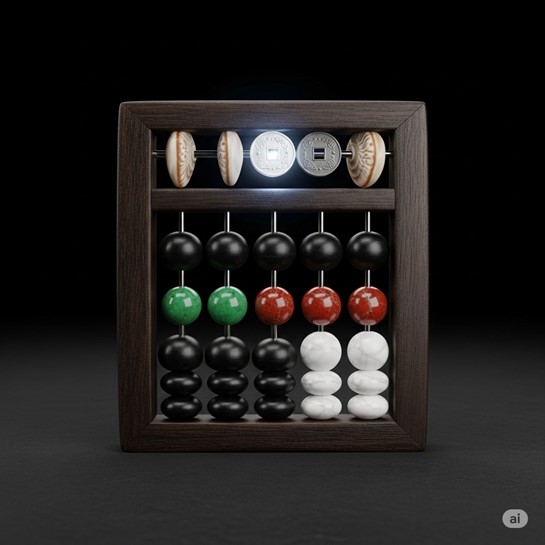
Description The Honest Coin is a small, personal-sized abacus, roughly the width of a hand and twice as long. Its frame is crafted from a dark, heavy, and exquisitely polished wood that seems to absorb light. It is fitted with five rods of a smooth, dark metal. The beads on the rods are what make the item truly unique. The top row consists of coin-shaped beads carved from seashell, which have a faint, pearlescent shimmer. The bottom four rows of beads are made of different, polished stones: matte black river stones, deep green jade, solid red jasper, and stark white marble. The beads move along their rods with a weighty, satisfying click that is unnaturally clear and distinct. The entire item is cool to the touch and emanates a faint scent of old wood, ink, and cold metal.
Detailed Stats
- Durability: 90/90
- Mind’s Eye Attunement: +2 to skills involving the appraisal of goods, numerical calculation, or the negotiation of contracts.
- Mental Fortitude: +1 to saves against magical effects that would cause confusion, greed, or impair judgment regarding financial transactions.
Passive Magics
- Whisper of Worth: When the user physically handles trade goods, currency, or raw materials while holding the abacus, they receive a subtle, intuitive sense of the item’s local market value. This is not a precise number, but a clear mental impression: a feeling of warmth for an undervalued item, a feeling of coldness for an overpriced one, and a neutral hum for an item priced fairly. This allows for a quick, instinctual assessment during haggling.
- Indelible Record: When The Honest Coin is present on a table where a ledger, contract, or other financial document is being written, it projects a minor, invisible ward onto the document. This enchantment subtly reinforces the ink, making it impervious to mundane fading from sunlight, running from moisture, or being smudged by casual handling. The records it oversees become incredibly durable and long-lasting.
Activable Magics
- Weigh the Bargain: Up to three times per day, the user may contemplate a specific deal, transaction, or contract while running their hands across the beads of the abacus. After a moment of focus, the user receives a single, distinct mental image that represents the metaphysical “balance” of the proposed deal. A perfectly level, steady scale indicates a fair and transparent bargain. A scale tilted to one side reveals an imbalance favoring one party. A scale that shudders or whose weights are shrouded in shadow indicates a deal with hidden costs, deception, or unknown variables.
- Seal the Accord: Once per unique agreement, when two or more willing parties come to a verbal or written consensus, the user may touch the abacus to the contract (or a representative item) while the other party makes physical contact. One of the seashell beads on the top row will glow with a soft, silver light for a moment and then fade. This act creates a minor spiritual link to the accord. Should any party who willingly participated in this sealing intentionally and knowingly break their end of the bargain, the specific seashell bead linked to that accord will instantly crack, producing a sharp snapping sound that only the user can hear and feel, alerting them to the broken promise regardless of distance or time.
Slot Handheld Tool
Tags Common, Tier 1, Kahuna, Banking, Tool, Handheld, Magic, Roleplay, Warded, Contractual, Merchant, Divination, Binding, Social, Guild, Abacus, Legal
In the world of Saṃsāra, the Kahuna 112 of the Honest Coin is not treated as a mere commodity. It is a specialized instrument, a tool of the trade for merchants, financiers, and guild functionaries. Its value is tied as much to its function as it is to the reputation it represents. As such, it is bought and sold in specific environments where trust, reputation, and the intricacies of commerce are well understood.
- The Certified Artisan’s Workshop
- Shop Type: These workshops are often located in the artisan or financial quarters of major cities, frequently sanctioned or directly licensed by a powerful Merchant’s Guild. The storefront is typically understated and professional, with a simple, elegant sign like “The House of Fair Measure” or “The Order of the Abacus.” The interior is quiet, meticulously clean, and smells of rare woods, polishing oils, and vellum. The artisans here are masters of their craft, viewing the creation of each Honest Coin as a profound responsibility.
- Method of Sale: One does not simply buy an Honest Coin here; one commissions it or proves oneself worthy of acquiring one. A potential buyer is often vetted. They may need to present a letter of reference from a guild master or demonstrate a sound understanding of commercial ethics. The sale is a formal, consultative process where the artisan explains the functions and the responsibilities that come with ownership. The transaction is recorded in a master ledger, and the item is often presented in a carved wooden case, its new ownership formally recognized.
- Typical Cost: The cost is standardized and non-negotiable, reflecting the quality and integrity of the maker. The price is typically set between 60 and 75 Shards. Payment is expected in official currency or via a letter of credit backed by a reputable guild. The price represents the labor and materials, not the magical potential, which is considered a public trust.
- The Gilded Brokerage House
- Shop Type: Found in the financial hearts of floating metropolises or subterranean trade hubs, these establishments deal in debt, investment, and high-value assets. A sign might read “The Gilded Scale Exchange” or “Iron Key Lending & Collateral.” These are the secondary markets for such tools. The atmosphere is one of immense security and quiet wealth, with polished stone floors, magically reinforced grilles, and silent, watchful guards. The proprietor is a shrewd financier or pawnbroker who has acquired an Honest Coin as collateral from a failed business venture or the estate of a deceased merchant.
- Method of Sale: The sale here is a pure, calculated business transaction. The broker fully understands the item’s practical and symbolic value. They will assess a potential buyer’s acumen and liquidity before even revealing such an item is for sale. The negotiation is sharp, precise, and documented with a magically binding contract. The broker is not selling a tool; they are liquidating an asset and will seek to extract the maximum possible value from it.
- Typical Cost: The price here is significantly higher due to market demand and the broker’s profit motive, typically ranging from 90 to 120 Shards. While the price may be negotiable, the broker will likely try to incorporate the sale into a larger financial arrangement, such as extending a line of credit to the buyer at a favorable rate for the house.
- The Dockside Emporium
- Shop Type: In the chaotic, sprawling markets of the great port cities, one might find an Honest Coin in the stall of a generalist merchant who deals in “Adventure Salvage” or “Miscellaneous Arcana.” These stalls are a riot of sights and smells, with goods from all 73 island nations piled high. The vendor is a fast-talking trader who has likely acquired the item from a desperate sailor or as part of a larger, mixed lot of cargo bought at auction.
- Method of Sale: The transaction is a gamble for both parties. The vendor may not fully grasp the abacus’s specific magical properties, knowing only that it’s “a lucky tool for merchants.” They will start with an inflated price and expect a lengthy haggling session. A discerning buyer must be wary of clever forgeries—mundane abacuses with a minor glamour cast upon them—or genuine articles that have been damaged, their magical properties cracked or unreliable. The sale is quick, based on instinct, and sealed with a handshake.
- Typical Cost: The price is wildly unpredictable. A vendor ignorant of its true nature might part with it for as little as 25 Shards. Another who has heard rumors of its power might ask for 150 Shards, hoping to find a wealthy and naive buyer. Barter is the preferred method of exchange, with the vendor accepting exotic goods, useful gear, or even reliable information as payment.
- The Master’s Inheritance
- Acquisition Method: Perhaps the most common way an Honest Coin changes hands is not through a sale at all, but through inheritance or apprenticeship. Within established merchant families or guilds, the abacus is a symbol of succession. It is bestowed upon a child taking over the family business or granted to an apprentice who has completed their training and proven their skill and integrity.
- The “Transaction”: This is a solemn, ceremonial affair. The master or parent will formally present the abacus to their successor, often accompanied by a recounting of its history and the legacy of its previous owners. The recipient is made to swear an oath to uphold the principles of fairness and trust that the item represents. This act binds the new owner not just to the tool, but to the reputation of their entire lineage or guild.
- Cost: There is no monetary cost. The price is the immense weight of responsibility, the duty to uphold a legacy, and a lifetime commitment to ethical commerce. In this context, the Honest Coin is not a possession but a mantle of office.
In the world of Saṃsāra, the Honest Coin is an instrument of financial and social maneuvering. Its use in “defense” and “offense” is not a matter of physical violence, but of strategic positioning, economic warfare, and the manipulation of trust. An avatar wielding this tool fights battles in the marketplace, the guild hall, and the back alley, where a broken contract can be more devastating than a broken blade.
- Defensive Roleplay Applications — Defensive use of the Honest Coin centers on protecting the user and their assets from fraud, deception, and unfair bargains. It is a shield of insight against the financially predatory.
- Environment: A Bustling Open-Air Bazaar — The avatar is Browse a stall where a charismatic merchant is selling “ancient artifacts.” The merchant presents a statuette, claiming it’s from a forgotten ruin, worth a fortune. Defensively, the avatar employs the Honest Coin. While engaging the merchant in conversation, they handle the statuette. The Whisper of Worth passive immediately gives the avatar a sharp, cold feeling in their mind—the unmistakable sensation of an item priced far beyond its actual value. They know, without needing to roll for appraisal, that the item is either a common replica or far less significant than claimed. Later, the same merchant offers a “too good to be true” deal on a crate of rare silks. The avatar takes a moment to contemplate the deal, activating Weigh the Bargain. In their mind’s eye, they see a scale with one side completely shrouded in shadow. This isn’t just an unbalanced deal; it’s a deal with a hidden, unknown variable. The silks are likely stolen, cursed, or infested with something unpleasant. Armed with this certain knowledge, the avatar can confidently decline, sidestepping a ruinous purchase and potential legal trouble.
- Environment: A Formal Guild Hall Negotiation — The avatar is representing their faction in a tense negotiation for shipping rights. A rival guild presents a multi-page contract, written in dense, legalistic language. Their Scribe talks through the details quickly, attempting to gloss over unfavorable clauses. The avatar places their Honest Coin on the polished table, a silent declaration of their commitment to fairness. This act alone can be a defensive measure, subtly unsettling those who have come with deceitful intentions. Before any agreement is reached, the avatar takes the time to review the contract, activating Weigh the Bargain. They get a clear mental image of a scale tilted sharply against them. They can now halt the proceedings. They don’t need to shout or accuse; they can calmly state, “There appears to be a significant imbalance in the section regarding liability for lost cargo. Let us review that again, more slowly.” They use the item’s insight to defend their faction’s interests with precision, turning a potential financial disaster into a display of unshakeable diligence.
- Environment: A Secretive Meeting with an Information Broker — In a dimly lit tavern, the avatar pays a significant sum for sensitive information. The broker is of dubious reputation. To defend against being sold false information or being betrayed after the fact, the avatar insists on formalizing the agreement. After payment is made, they use Seal the Accord, touching the abacus to the coin pouch and the broker’s hand. A contract of trust is now magically witnessed. If the broker later provides deliberately false information, or if they use the payment to hire thugs to ambush the avatar, the shell bead on the abacus will instantly crack with a sharp, psychic snap. This doesn’t prevent the betrayal, but it provides immediate, irrefutable confirmation of it. The avatar is no longer operating on suspicion; they know the information is bad or that an attack is imminent, allowing them to defend themselves by discarding the false intel or preparing for the ambush.
- Offensive Roleplay Applications — Offensive use of the Honest Coin is about proactively using its insights to gain leverage, expose weakness in others, and shape the financial battlefield to one’s own advantage.
- Environment: A High-Stakes Public Auction — The avatar is trying to acquire the deed to a valuable steam-factory, but a wealthy, arrogant rival is also bidding. The avatar uses the abacus offensively. First, they use Whisper of Worth to get a feel for several other, less important items up for auction. They then make a show of bidding aggressively on these items, projecting an image of reckless spending and deep pockets. This is a calculated bluff. When the factory deed comes up, the rival, now believing the avatar to be a spendthrift, aims to bleed them dry. The avatar makes a few initial bids, then activates Weigh the Bargain on the concept of their rival making the next bid. The vision is of a severely tilted scale—the rival is overextended and bidding on pure ego. Armed with this knowledge, the avatar can now cleverly stop bidding, letting the rival win the deed but at a catastrophically high price, crippling their finances for months to come. The abacus was used not just to value an item, but to assess and exploit an opponent’s financial and emotional weakness.
- Environment: A City Gripped by a Corrupt Financier — A ruthless money-lender is using magically confusing contracts to trap citizens in inescapable debt. The avatar decides to dismantle their operation. They set themselves up as a “community accountant,” offering to review loan documents for free with their “blessed abacus.” One by one, they use Weigh the Bargain on the citizens’ contracts, each time seeing the vision of a tilted, broken scale. They are gathering evidence. Offensively, they then use Seal the Accord to create new, fair loan agreements for these same citizens from a different, more ethical source, magically cementing a new economic alliance. Finally, they can confront the corrupt financier in a public forum, like a town hall or guild meeting. They can declare, “I have weighed your contracts, and they are found wanting!” They can present the testimony of the citizens, using their own reputation—bolstered by the symbolic power of the Honest Coin—to launch a social and economic attack that strips the financier of their credibility and clientele.
- Environment: Securing a Trade Monopoly — The avatar wishes to secure an exclusive contract for a rare resource from a cautious, neutral supplier. To do so, they must prove that the supplier’s current partner is untrustworthy. The avatar engineers a situation where they can witness and “bless” a minor contract between the supplier and the untrustworthy partner using Seal the Accord. The avatar, knowing the partner’s treacherous nature, is simply setting a magical trap. When the partner inevitably breaks the terms of the small contract to sell a portion of the goods on the black market, the bead on the avatar’s abacus cracks. They now have tangible, magical proof of dishonor. They can immediately go to the supplier and present the physically broken bead. “The spirit of your agreement is shattered. See for yourself. How can you trust them with your primary contract when they break a small promise for a pittance?” This act of offensive intelligence-gathering provides irrefutable proof, destroying the old partnership and allowing the avatar to swoop in and secure the monopoly.
Perception of Activation:
SIGHT
- User’s Perspective: As you touch the abacus to the document and the other party, your focus is drawn to the top row of seashell beads. One specific bead, representing this new accord, flares with a brilliant but contained silver light. For a moment, it is as bright as a newly minted coin in direct sunlight, illuminating the intricate patterns of the shell. The light then contracts and is absorbed into the bead, leaving it with a slightly deeper, more permanent pearlescent shimmer than its neighbors.
- Observer’s Perspective: A casual observer would likely see nothing at all. An attentive observer, looking directly at the abacus at the right moment, might catch a brief, subtle shimmer of silvery light, easily mistaken for a reflection from a nearby lamp or a trick of the eye. It is incredibly discreet.
- Positives: The activation is visually subtle, allowing a binding magical agreement to be sealed in a public place without drawing any unwanted attention. It provides a clear, unambiguous visual cue to the user.
- Negatives: The subtlety means that an ally across the room would have no visual confirmation that the accord has been sealed. In a brightly lit area, even the user might question if they truly saw the brief flash of light.
SOUND
- User’s Perspective: The normal, weighty clicks of the abacus beads are replaced by a single, sharp, and resonant chime. It is a pure, metallic note, like a tiny silver bell being struck once. This sound seems to emanate directly from the activated bead and resonates clearly in your ears, a distinct sound of finality.
- Observer’s Perspective: A nearby observer would only hear the normal ‘click’ of a bead moving on a rod. The magical resonance is only perceivable to those directly involved in the sealing (the user and anyone making physical contact with the abacus). To an eavesdropper, it sounds like nothing more than the user completing a mundane calculation.
- Positives: The sound provides a clear, private auditory confirmation to all willing parties involved in the contract, reinforcing the moment of agreement. Its mundane nature to outsiders preserves secrecy.
- Negatives: There is no overt auditory signal that could be used to alert an ally or prove to a third party that a magical sealing has taken place.
TOUCH
- User’s Perspective: As the bead chimes, you feel a concentrated pulse of warmth from it, a stark contrast to the coolness of the rest of the abacus. The warmth fades quickly, but the texture of that specific bead feels permanently changed under your thumb—it is now perfectly, unnaturally smooth, as if coated in a thin layer of invisible glass.
- Observer’s Perspective: An observer feels nothing. A willing participant who is touching the abacus or the user’s hand during the activation may feel a brief, surprising tingle of static electricity in their fingertips at the exact moment the deal is sealed.
- Positives: The change in texture provides the user with a permanent, physical record on the abacus of a sealed deal. The tingle felt by the other party acts as a physical confirmation that something tangible has occurred.
- Negatives: Without physically inspecting the abacus, there is no way for anyone else to know a change has occurred. The static tingle is so brief it could be easily dismissed by a skeptical participant.
SMELL
- User’spective: The familiar scent of old wood and cold metal is momentarily overpowered by a sharp, clean scent of ozone and hot metal, like the air after a lightning strike or the smell of a coining press striking a blank. It is the scent of creation and finality, a smell that cuts through all other aromas in the room before vanishing completely.
- Observer’s Perspective: This scent is extremely localized. Unless an observer is standing exceptionally close to the abacus, they will smell nothing out of the ordinary. A creature with a hyper-sensitive sense of smell might detect a strange, sharp scent but would have difficulty pinpointing its source.
- Positives: The distinct smell provides a powerful, private sensory confirmation for the user, linking the activation to a unique and memorable scent.
- Negatives: An observant creature with a keen nose could learn to associate this specific, unnatural smell with the user, potentially allowing them to track the user’s activities or identify their involvement in magically sealed contracts.
TASTE
- User’s Perspective: At the moment of activation, you experience a fleeting but distinct taste on your tongue. It is the dry, dusty taste of old parchment mingling with the sharp, metallic tang of fresh, wet ink. It is the very essence of a binding, written contract, a taste that is neither pleasant nor unpleasant, but absolute.
- Observer’s Perspective: There is no perceivable effect of taste for any observer.
- Positives: This offers a bizarre yet completely internal and personal layer of confirmation for the user, impossible for anyone else to detect.
- Negatives: The sudden, strange taste could be distracting, especially for a user who is not accustomed to it, potentially breaking their concentration during a critical moment of negotiation.
EXTRA-SENSORY PERCEPTION (AURA)
- User’s Perspective: Through your Mind’s Eye, you witness a luminous, silver filament of your own magical energy extend from the abacus. It gently touches the contract and the other participant, “stamping” a tiny, intricate glyph of a balanced scale onto the aura of both. The glyph shines for a moment before fading into the normal energy patterns, leaving a permanent, though hidden, mark.
- Observer’s Perspective: An observer with the ability to perceive magical auras would see the entire event clearly: the filament of light, the transfer of energy, and the application of the magical “seal” or glyph. They would recognize it as a form of binding or contractual magic.
- Positives: The magical signature can be verified by a trusted third party with the appropriate senses, proving that a contract was magically witnessed. It serves as an undeniable piece of evidence in a magical dispute.
- Negatives: A magically aware enemy can also see this signature. They could identify who is party to the contract, and could potentially target the magical glyph with dispelling or corrupting magics.
EXTRA-SENSORY PERCEPTION (CONCEPTUAL)
- User’s Perspective: You feel the abstract concept of the agreement solidify into a tangible mental weight. The promise is no longer just words; it is a real, defined object in your mind. You feel its specific gravity and the threads of obligation that now connect you to the other party.
- Observer’s Perspective: An observer feels nothing. However, a willing participant in the sealing will feel a similar sensation—a sudden, profound sense of seriousness and consequence. The deal “clicks” into place in their mind, feeling far more real and binding than it did a moment before.
- Positives: This reinforces the psychological importance and reality of the agreement for all involved parties, making them less likely to break the promise casually.
- Negatives: As a user seals more and more contracts, the cumulative mental weight of these obligations could become burdensome, like carrying a sack of invisible stones. Without strong mental discipline, this could become spiritually and mentally fatiguing.
Artisan’s Formula: The Abacus of Fair Reckoning
This document details the precise crafting process required to recreate an Abacus of Fair Reckoning, a vital tool for any merchant, banker, or guild official operating in the complex economic landscape of Saṃsāra. The creation is a meticulous blend of fine craftsmanship and focused magical imbuement, demanding both a steady hand and a mind that comprehends the true nature of value and trust.
Materials Needed
- One Block of Heart-of-Ironwood: The wood must be sourced from the dense core of an Ironwood tree that has stood for at least one hundred years. This ensures the frame possesses an inherent quality of stability and longevity. The block must be free of knots or imperfections.
- Five Rods of Steam-Quenched Steel: These are not ordinary steel rods. After being forged, they must be quenched in the misty exhaust of a magically-driven steam engine. This process imbues the metal with a unique resilience and attunes it to the hum of industry and commerce.
- Nine Beads of Lumina Seashell: These must be carved into the shape of coins from the shell of a Pearl-Maw Clam. This specific type of shell is known to have a nacre that refracts light with unusual clarity, said to be unable to reflect a lie.
- Four Sets of Stone Beads (Nine Beads per Set):
- Siltstone: Harvested from a riverbed that has lain dormant for a season, representing wealth that is stable and at rest.
- Veridian Heartstone: Mined from a cave system where magical energy flows tranquilly, not violently. This stone represents honest growth.
- Blood-Iron Jasper: Sourced from iron-rich clay deposits. Its deep red color symbolizes the weight and seriousness of a promise or debt.
- Quarried Alabaster: Cut from a pure, unblemished vein of white stone, representing the clarity and transparency required in fair dealings.
- One Coin of Sovereign Trust: A single, newly minted coin of silver or a greater value, issued by any officially recognized and respected authority (such as a major Guild or a stable country’s government). This coin will be consumed during the ritual.
Tools Required
- Master’s Woodworking Kit: A full set of sharp chisels, fine-toothed saws, hand-planes, and sanding blocks are necessary to shape the Ironwood frame with the required precision.
- Jeweler’s Hand-Drill: A delicate, manually operated drill with hardened steel bits is needed to bore holes through the stone and shell beads without shattering them.
- Metallurgist’s Crucible & Bellows: A small, heat-resistant ceramic crucible and a set of bellows are required for melting the Coin of Sovereign Trust into a pure, liquid state.
- Runic Inscription Needle: A hardened steel needle set into a wooden handle, with its point sharpened to an exceptionally fine tip. This is used not for writing, but for engraving the single, crucial magical focus rune.
Skill Requirements
- Fine Woodworking (Novice): The crafter must be capable of creating a perfectly dimensioned, smooth, and sturdy frame. Any wobble or imperfection in the frame will cause the final enchantment to fail.
- Lapidary (Novice): A delicate touch and understanding of stone is required to drill the beads. A single shattered bead can disrupt the entire process.
- Accountancy or Law (Basic): The crafter must possess a fundamental understanding of contracts, value, and ethical exchange. The magic requires the user to channel the concept of fairness, which is impossible if they do not truly grasp it.
- Mind’s Eye Attunement (Tier 1): The ability to perceive and guide magical energy is essential for the final and most important step of the imbuement process.
Crafting Steps
- Carving the Frame: The process begins with the physical form. The crafter painstakingly carves the Ironwood block into the abacus frame, ensuring every corner is true and every surface is sanded to a flawless, smooth finish. This step can take several days of focused work.
- Boring the Beads: With immense patience, the crafter uses the Jeweler’s Hand-Drill to bore a precise hole through the center of each of the 45 beads (9 seashell, 36 stone). The shavings from this process are carefully swept away and discarded.
- Engraving the Focus: The crafter takes the Runic Inscription Needle and carves a single, small rune onto the back of the frame, typically in the center. The most common rune is that of a perfectly balanced scale. This engraving must be done with intent, focusing the mind on the idea of justice and balance while carving.
- The Sacrifice of Value: This step marks the shift from physical crafting to magical ritual. The Coin of Sovereign Trust is placed into the crucible. The crafter uses the bellows to bring the heat to a precise temperature, melting the coin into a bead of pure, shimmering liquid metal. This act symbolizes the transformation of physical wealth into metaphysical principle.
- The Binding of Principle: This is the most critical step. The crafter must work quickly while the metal is still molten. They dip the very tip of the Runic Inscription Needle into the crucible, collecting a tiny droplet of the liquid silver. They then touch the needle to the center of the rune they carved on the frame. At this exact moment, the crafter must use their Mind’s Eye, channeling their full understanding of fairness, honesty, and just reckoning into the abacus. The droplet of silver will sizzle and permanently seal itself into the rune, acting as a magical “solder” that binds the concept of fairness to the physical object. A faint, chime-like sound will echo as the magic is set.
- Final Assembly: Once the frame has cooled, the rods are fitted, and the beads are threaded onto the rods in their correct order. The abacus is now physically complete. To fully awaken its powers, the crafter must perform a simple, honest calculation on it, such as “10 + 10 = 20,” moving the beads with purpose. This final act attunes the item to its function, and the Abacus of Fair Reckoning is ready for use.
First Reckoning
Listen, for the story is old, and the words are worn from their long travel from a forgotten tongue. In the time after the great scattering, a city grew by a smoking sea. It was a city of many hands and many tongues, and trade was its heart. But its heart was sick. A man’s word was a feather in the wind, and a written promise was a snake sleeping in the grass of the ear.
It came to be that a man arrived in this city. He was not young and not old. He is called the Man Who Weighed Words, for he was a keeper of the secret of true value. He saw the city’s sickness. He watched a great merchant, a man with a chest full of coins and a heart full of holes, take the land of a poor family. The family had made their mark on a word-skin, a contract, but the merchant’s words had been clever and crooked, and the word-skin took the family’s home while smiling.
The Man Who Weighed Words saw this and a great stillness came upon him. The problem, he saw in his thinking, was not a lack of wealth. The city flowed with wealth as a river flows with water. The problem was trust. The spirit of the bargain had a fever. He said to the sky, “One cannot heal a fever with a sword. One must make a cooling water.” He decided then to make a tool, not of war, but of clarity. A truth-teller, to be made of wood and stone and the spirit of a promise.
His journey began. For the body of the truth-teller, he needed the Wood of Witnessing. He walked from the city to a great forest where a single Ironwood tree stood. It was older than the memory of the people. It had watched generations of bargains, both fair and foul, made under its boughs. He asked the tree for a single branch, and the ancient tree, who knew his purpose was straight, dropped one for him.
For the counters of the truth-teller, he needed stones that held ideas in their hearts. He traveled to a dry riverbed and gathered black stones, for they were the color of the deep earth, the foundation upon which all things are built. He went to a high mountain and found green stones, for they were the color of new leaves, a sign of true growth. He found red stones in a clay pit, red like blood, for they would carry the weight of a promise made from the heart. He found white stones in a cave, white like the bone, for they would show the bare truth with no shadow. From a beach he gathered the shells of the Pearl-Maw, for it was known that its inner shine could not tell a lie.
He returned to the city with his findings. He went to the great Guild of Merchants and he asked them for a thing. “I need one coin,” he said. “It must be new. It must be perfect. It must be of pure silver.” The guild masters, men who loved coins, asked him why. “I will destroy it,” said the Man Who Weighed Words. They called him mad. To destroy wealth was a great wrongness. But he looked in their eyes and his gaze was heavy with purpose, and so they gave him the coin.
The crooked merchant who had taken the poor family’s land heard of this. He came to the market square and made a great laughing. “Behold!” he shouted. “This man will fight my clever words with wood and stones! He will cure a plague with a flower! He is a fool!”
The Man Who Weighed Words did not answer the shout with his own shout. He built a small forge in the center of the square. He showed the perfect silver coin to the people. “This is wealth,” he said. “You see it. You hold it. But wealth with no trust is a sick river that poisons the fields. I do not destroy wealth today. I make the riverbanks straight.” He placed the coin in the fire until it became a shining liquid tear.
While the people watched with open mouths, he took the branch of the Witnessing Tree and the stones of idea. He made the frame and the rods. He put the beads upon the rods. Then, he took a needle and dipped it in the shining liquid of the melted coin. He touched the needle to the wood of the truth-teller, and a great magic was sealed within it.
The crooked merchant, seeing the people were now quiet and watching, held up the word-skin he had used to steal the land. “My words are strong!” he bellowed. “This paper is my right! This abacus of twigs is a child’s toy!”
The Man Who Weighed Words took the word-skin from him. He did not read the words. He held his new abacus over the paper. “The words on this skin have a weight,” he said. “Now, we will see their measure.” He moved the beads, his hands making a soft clicking. Then he touched one of the beads made of seashell. With a sound like a bone snapping, the shell-bead cracked in two and fell from the abacus to the ground.
A great gasp was made by the crowd. The Man Who Weighed Words held up the abacus for all to see the broken place. “The promise is false,” he declared. “The spirit of this bargain is broken.”
The crooked merchant’s face became white like the bone-stone. His power was in the strength of his crooked words, but the simple abacus had shown them to be hollow. The people, seeing the truth with their own eyes, drove the man from their city. The Man Who Weighed Words stayed, and he taught others the making of the Abacus of Fair Reckoning, so that the city’s heart would not become sick again.
The Moral of the Story: The heaviest chains are not made of iron, but of promises that have been broken.
Suggested conversions to other systems:
Call of Cthulhu, 7th Edition
The Abacus of True Value
A heavy, dark wood abacus of unknown design, certainly not of European make. It features rods of a dark, unidentifiable metal and beads carved from seashell and various polished stones. It feels cool and solid, a remnant of some forgotten culture’s attempt to impose order on the chaos of human greed. Scholars who have examined it note that its construction follows no known terrestrial mathematics, yet it feels intuitively correct.
Game Mechanics:
- Appraiser’s Eye: The holder of the abacus gains one Bonus Die on all Appraise rolls made to determine the monetary value of an object or property.
- Weight of the Deal: Once per game session, an Investigator may spend one minute contemplating a specific business deal, contract, or financial proposal while manipulating the beads. At the end of that minute, the Investigator may make a Hard POW roll. If successful, the Keeper provides a single, truthful impression of the deal’s nature: “Fair,” “Unfair,” or “Deceptive.” The impression offers no further detail, only a stark, intuitive conclusion.
- The Solemn Accord: This is a psychological, non-magical effect. When two or more parties willingly shake hands over the abacus to finalize an agreement, they all feel a profound and unusual sense of gravity and commitment. For the remainder of the game session, if any of those parties knowingly and intentionally breaks the agreement, the other involved parties are entitled to a Psychology roll to get a distinct feeling of betrayal or duplicity, even if no direct evidence is present.
Blades in the Dark
The Whisper-Coin Calculator
A strange counting device, clearly ancient, made from wood as dark as the Void Sea and fitted with rods of cold iron. The beads are a mix of mother-of-pearl, quarried stone, and polished river rocks. It’s a favorite tool of information brokers and the treasurers of esoteric cults, said to not only count coin, but to weigh the truth of the promises made to earn it.
Game Mechanics:
This is a piece of Occult Gear.
- Keen Barterer: When you perform the Acquire Asset downtime activity, you may consult the calculator to guide your search for value. You may push yourself to add +1d to your roll for 1 Stress instead of the usual 2 Stress.
- Assess the Accord: When a deal is proposed or a contract is presented, you can use the calculator to gauge its nature. As an action, you can study the deal and suffer 1 Stress to ask the GM one of the following questions. The GM will answer truthfully.
- Is this deal basically on the level?
- Where’s the hidden leverage against me?
- How could I twist this to my advantage?
- Binding Promise: When you Consort to make a formal agreement with another faction, you can seal the pact over the calculator. If that faction later intentionally breaks the agreement, word of their magically-witnessed dishonor spreads. You may take +1d to your next roll to Acquire an Asset or Reduce Heat, as others are more willing to help you against the promise-breakers.
Dungeons & Dragons, 5th Edition
Abacus of the Honest Guild
Wondrous item, common
This small abacus is made of polished ebony, with rods of dark steel and beads of shell, marble, and jade. It is a tool often granted to new members of powerful merchant guilds to ensure they uphold the guild’s reputation for fair dealing.
- While holding this abacus, you have advantage on any Wisdom (Insight) check made to determine if a deal is fair or if someone is being deceptive in a financial transaction.
- You also have advantage on any Intelligence (Investigation) check made to appraise the value of gems, art objects, or other trade goods.
- As a ritual that takes 10 minutes, you can use the abacus to oversee the signing of a contract or written agreement. If you do so, the document becomes magically durable. It cannot be damaged by water and is immune to the effects of age, though it can still be destroyed by fire or torn apart.
Knave, 2nd Edition
Truth-Teller’s Abacus
A small but heavy abacus made of dark wood. Its beads are a mix of seashell and polished stones in four different colors. It takes up 1 inventory slot and has 1d6+2 “Promise Beads” (the seashell ones) remaining.
- Sense Value: When inspecting a trade good or treasure, you may make a Wisdom save. If you succeed, the GM will tell you if the item’s perceived worth is “fair,” “a swindle,” or “a steal.”
- Weigh a Deal: Once per day, you can spend your turn examining a contract or listening to a proposal. At the end of your turn, the GM will tell you if the deal is fundamentally “Honest” or “Dishonest.”
- Witness a Promise: When two parties make a deal, you can have them shake hands over the abacus. One of the Promise Beads visibly cracks and is spent. For the next week, if one of the parties intentionally breaks their promise, you intuitively know the moment it happens, regardless of distance. The abacus runs out of magic when all its Promise Beads are cracked.
Fate Core
The Abacus of Inviolate Oaths
This is an Extra, representing a significant artifact that is central to your character’s methods. It costs one point of Refresh to obtain. It is a dark, heavy wooden abacus whose beads of stone and shell are unnaturally silent when moved. It is a tool for those who believe a promise is the most valuable currency.
Game Mechanics:
This item grants your character a new Item Aspect: Bearer of Inviolate Oaths.
- Invoke for Insight: Once per session, you can invoke the Bearer of Inviolate Oaths for free to gain a +2 bonus or a re-roll on a Create an Advantage action. This action must involve assessing the true value of an object, discerning the fairness of a contract, or sensing deception in a negotiation.
- The Weight of a Promise: When you use the abacus to formally witness an agreement between two parties (which can include yourself), you can spend a Fate Point to Declare a Story Detail: “The agreement is now magically bound by the abacus.”
- The Echo of Betrayal: If an agreement bound by the abacus is intentionally broken, you can later Declare a Story Detail for free: “The abacus has just alerted me to the betrayal.” This allows you to act on the knowledge immediately and provides a strong narrative justification, even if you are miles away. It does not tell you the specifics, only that the oath has been broken.
Numenera & Cypher System
Contractual Veracity Calibrator
This artifact from a prior world is a handheld device made of polished, dark synth-wood. It has five metallic rods upon which crystalline nodules of various colors slide. The device analyzes conceptual data related to promises and exchanges, converting abstract trust into tangible information. It feels cool to the touch and occasionally emits a low, soft chime.
Level: 4 Form: Handheld device. Effect: This artifact has a constant passive effect and two activatable functions, the second of which consumes the device’s limited resources.
- Constant Effect: The device constantly whispers conceptual data about value to the user. Any task to appraise an item, artifact, or piece of iotum is eased by one step.
- Activation (Assess Deal): As an action, the user can focus the device on a specific proposed transaction or contract. For the next minute, the difficulty of any task to discern the deal’s true nature (whether it is fair, unfair, or contains hidden deception) is reduced by two steps.
- Activation (Bind Concept): When two willing parties make an agreement, the user can press the device against a document or have the parties shake hands over it. The user must accept 1 point of Intellect damage (ignoring Armor) as the device siphons their focus to create a conceptual bond. One of the crystalline beads on the device begins to glow softly. The device has 1d6 of these beads. If a party who was part of the binding intentionally breaks the agreement, the corresponding glowing bead instantly shatters with a sharp crack, alerting the user. Once all beads are shattered, the device loses this function.
Depletion: — (The device’s use is limited by its finite number of beads).
Pathfinder, 2nd Edition
Abacus of the Gilded Promise ITEM 3 UNCOMMON DIVINATION INVESTED MAGICAL Usage held in one or two hands; Bulk L
Description This abacus is carved from a single piece of dark ironwood, with rods of polished steel. Its upper beads are carved to resemble tiny, shimmering seashells, while the lower beads are made of polished jade and jasper. It is used by guild masters and arbiters to ensure that contracts are honored in both letter and spirit.
After you have invested the item, you gain the following benefits:
- You gain a +1 item bonus to skill checks to Decipher Writing of a legal or financial nature.
- You gain a +1 item bonus to your Perception DC against attempts to Lie to you during a negotiation about a specific price or trade.
Activate [one-action] (concentrate, divination); Frequency once per 10 minutes; Effect You focus on a single object you can see and use the abacus to calculate its material worth. You learn its approximate value in a common currency. This does not reveal any magical properties or historical significance.
Activate [one-action] to [three-actions] (concentrate, divination); Frequency once per day; Effect You spend the chosen number of actions to contemplate a single proposed contract, deal, or exchange.
- 1 Action: You learn whether the deal is materially fair, or if it favors one party over the other.
- 2 Actions: In addition to the above, you also learn if there is an intentional, hidden deception within the deal.
- 3 Actions: In addition to the above, you also gain a brief flash of insight into the likely long-term outcome of the deal if it were completed, receiving a vision of either “prosperity,” “ruin,” or “stagnation.”
Savage Worlds Adventure Edition
The Merchant-King’s Calculator
An ornate abacus made of dark wood and inlaid with polished river stones and seashell markers. Legend claims it was the personal tool of a merchant-king from a lost island nation who could supposedly weigh a man’s honesty as easily as a sack of grain.
Requirements: Novice, Smarts d8+ Game Mechanics:
- Eye for a Bargain: The owner gets a +2 bonus on Common Knowledge or Notice rolls made to appraise the value of goods or detect forgeries.
- Deal Sense: When another character (including an Extra) makes a business proposition to you, you may make an opposed Notice vs. Persuasion roll. With a success, you know if the deal is fundamentally unfair to you. With a raise, you also get a general sense of how it is unfair (e.g., hidden costs, faulty goods, etc.).
- The Binding Bargain: Once per session, when two parties make a significant, binding agreement, the user may call upon the calculator to witness the oath. The parties shake hands over the device. If one of the participants later intentionally and willfully breaks that oath, the GM should grant the slighted party’s player a Benny. Furthermore, the oathbreaker is considered “Marked by Misfortune.” The next time they would draw a Joker from the Action Deck for any reason, they are instead treated as if they drew the Two of Clubs and cannot use Bennies to soak any damage from that turn’s actions. This “curse” is then lifted.
Shadowrun, Sixth World
Honest Broker’s Focus
In the shadows, a man’s word is worth less than the credstick it’s recorded on. This device is an attempt to address that. It appears to be a high-end, archaic desk toy—an abacus made from sterile, polished blackwood and chrome, with beads of cultured pearl and other precious stones. To the magically active, however, its aura is one of pure, unassailable logic and order. It is an Analytical Focus, designed not to help sling spells, but to dissect the most complex and treacherous of deals.
Type: Analytical Focus Rating: 2 Activation: Always active while bonded. Bonding Cost: 2 Karma
Game Mechanics:
This focus must be bonded to be used. Once bonded, it provides the following benefits:
- Deal Analysis: The focus’s logic engine aids in dissecting financial arrangements. The user gains a +2 dice pool bonus to any Negotiations test specifically made to argue the price of goods, services, or information.
- Contractual Loopholes: The focus also applies its +2 dice pool bonus to any Electronics or Academics test made to search a digital or physical contract for hidden clauses, exploits, or legal loopholes.
- Whisper of Value: The first time you encounter a new piece of gear, cyberware, or other commodity in a scene, the GM must make you aware of its approximate current street value (e.g., “about 5,000 nuyen,” “a high-end piece,” “a cheap knock-off”).
Starfinder
Pactmaker’s Abacus
Level 3 Price 1,400 credits Bulk L
DESCRIPTION This device appears to be a relic of a bygone era, a functional abacus made of a lightweight, dark metallic alloy with rods that hum with a low energy. The beads are a mix of crystalline minerals and polished asteroid fragments. Originally a tool used by the Acquisitives, a now-defunct merchant species, the Pactmaker’s Abacus contains complex psychometric circuitry that can analyze the intent behind a promise and the true value of an object.
GAME MECHANICS This hybrid item is held in one hand.
- The user gains a +4 insight bonus on Culture checks to appraise the value of goods and on Sense Motive checks to discern if a creature is being truthful about a financial matter.
- Witness Pact (Su): Once per day as a standard action, the user can touch the abacus and designate one other creature. For the next 24 hours, the abacus creates a minor psychic link to the designated creature based on the terms of any verbal agreement made at that time. If the creature intentionally and knowingly breaks the pact, the abacus’s central bead flashes with a bright blue light, and the user immediately knows that the pact has been broken. This ability does not function on creatures that are immune to mind-affecting effects.
Traveller, Mongoose 2nd Edition
Zhodani “Truth Calculator” (Zho-Cal-7)
Tech Level: 11 Mass: 0.5 kg Cost: Cr 45,000 (Uncommon, often restricted)
Description: An official piece of equipment used by Zhodani trade envoys and administrators. It appears to be a sleek, black datapad with a holographic display that projects a functional, three-dimensional abacus. The user can manipulate the holographic beads with their fingers. The device contains a powerful expert system cross-referenced with Zhodani psionic ethics and interstellar trade law. It is designed to ensure all transactions are conducted with maximum clarity and truthfulness, as defined by the Zhodani Consulate.
Game Mechanics:
- Value Assessment: The device can perform a full spectral and market analysis on any common good or material. This takes one minute and provides the user with the item’s exact composition and its average market value in the current subsector, granting DM+2 on any subsequent Broker check to negotiate a price for it.
- Contract Analysis: A digital contract can be uploaded to the device for analysis. The device will provide a report highlighting any clauses that are deceptive, ambiguous, or legally disadvantageous to the user, granting DM+2 on any Admin or Legal check related to that contract.
- Psionic Imprint: The device can be used by a Psion when finalizing a contract. The Psion may make a Telepathy (INT) check with DM+1. On a success, they place a “psionic watermark” on the agreement. If any party to the agreement later intends to break it, the Psion is alerted moments before the breach occurs, as they receive a telepathic impression of the impending betrayal.
Warhammer Fantasy Roleplay, 4th Edition
Marienburg Guilder’s Reckoner
Encumbrance: 10 Availability: Very Rare Price: 120 GC
An ornate, yet grimy, abacus made from polished dark wood and brass. Its beads are ivory and real jade. This is a tool of the great merchant houses of Marienburg, who trust no one, least of all each other. The Reckoner is said to be able to smell a single clipped penny in a vault of a thousand gold crowns and to hear the whisper of a lie spoken over the din of the busiest market square. This magic, born of pure commerce and suspicion, is powerful but notoriously fickle.
Game Mechanics:
- Avaricious Eye: The owner of the Reckoner gains a +10 bonus to all Evaluate Tests. They can also make an Evaluate Test to determine if a specific coin or piece of currency is counterfeit.
- Master of Commerce: The owner is considered to have the Etiquette (Guilds) and Etiquette (Nobles) skills. If they already have one or both, they may re-roll any failed Test for those skills once per session.
- The Peril of the Deal: The Reckoner is magically bound to the abstract spirit of commerce. When the owner willingly enters into a deal that they know to be significantly unfair to the other party (at the GM’s discretion), the Reckoner becomes “offended.” For the next full day, the item’s bonuses do not function, and instead, the owner suffers a -10 penalty to all Charm and Fellowship Tests as they radiate an almost palpable aura of untrustworthiness.