
From: Shivarath
Lore: The Staff of Transcendence is a legendary artifact with a rich history within the faith of Shivarath. According to ancient lore, it is believed to have been a gift bestowed by Samvarta, the deity of Shivarath, to an ancient high priest who demonstrated unwavering devotion and exceptional wisdom. The staff is said to possess immense magical power, serving as a conduit for channeling divine energy. It has been revered by generations of priests and mages as a symbol of authority, enlightenment, and connection to the divine. Legends also speak of the staff granting its wielder limited foresight, allowing glimpses into the potential outcomes of their actions.
Tier One Stats:
- Divine Channeling: The Staff of Transcendence enhances spellcasting abilities. When the staff is used as a focus for casting spells, it grants a +1 bonus to spell attack rolls and increases the spell’s saving throw DC by 1. This augmentation represents the staff’s ability to channel divine energy into the wielder’s magical prowess.
- Healing Touch: The staff possesses the ability to heal the wounded. Once per day, the wielder can channel the staff’s energy to cast the spell “Cure Wounds” at its minimum level, restoring 1d8+2 hit points to a target creature. This ability can be used to tend to injuries and aid allies during or after combat.
- Foresight Glimpses: Through attunement with the Staff of Transcendence, the wielder gains limited foresight. Once per day, they can tap into the staff’s power to gain advantage on a single ability check or saving throw. This heightened awareness provides insights into the potential outcomes of their actions, granting a better chance of success.
- Channeling Barrier: The staff can be used defensively in combat. As a reaction, the wielder can channel the staff’s energy to create a temporary magical barrier that grants resistance against a single spell or magical effect targeting them. This resistance lasts for one round and can be used once per day.
Cost: The Staff of Transcendence is a highly sought-after and revered artifact, known for its immense magical power and connection to Samvarta. Its value is estimated to be around 800 gold coins, reflecting its rarity, the demand among the faithful, and the mystical properties it possesses.
Requirements: To effectively use the Staff of Transcendence, the wielder must possess proficiency in either Arcana or Religion skill, indicating a deep understanding of magical or religious principles. Additionally, attunement to the teachings and devotion to the faith of Shivarath are required. The staff is typically wielded by individuals who have demonstrated exceptional magical or spiritual aptitude and are trusted custodians of Shivarath’s wisdom.
Tags:
- Legendary: The Staff of Transcendence is a legendary artifact with significant historical and magical importance.
- Magical: The staff possesses potent magical abilities and serves as a focus for channeling divine energy.
- Staff: It is a staff-like object, typically made of sacred or enchanted materials, and acts as a symbol of authority and wisdom.
- Channeling: The staff serves as a conduit for channeling divine energy, enhancing spellcasting abilities and providing other mystical benefits.
- Additional: Divine, Artifact, Shivarath, Foresight, Healing, Defensive, Rare, Religious, Conduit
The Staff of Transcendence, being a revered and highly valued artifact, is not commonly sold in traditional marketplaces. Instead, it is typically acquired through specialized channels within the magical and religious communities.
The staff may be obtained from reputable magical item merchants who specialize in rare and powerful artifacts. These merchants often have connections to magical academies, temples, or sanctuaries dedicated to Shivarath. It is within these environments that the staff is most found and distributed.
In terms of usage, the Staff of Transcendence is primarily employed within the religious and magical practices of the Shivarath faith. It serves as a powerful tool for those who possess the knowledge and skill to wield it. Typically, the staff is used in the following environments:
- Temples and Sanctuaries: The staff finds its most significant usage within the sacred spaces of Shivarath, such as temples or sanctuaries. Here, high-ranking priests, esteemed mages, or chosen individuals of great devotion and wisdom employ the staff during rituals, ceremonies, and other religious practices.
- Magical Academies: Within magical academies or institutions focused on fire-based magic or pyromancy, the staff may be used as a teaching tool or symbol of authority. Professors and skilled practitioners utilize it to demonstrate advanced magical techniques, share knowledge, or guide students in their studies.
In combat scenarios, the Staff of Transcendence exhibits the following applications:
- Spellcasting Enhancement: The staff enhances the wielder’s spellcasting abilities, serving as a focus for channeling divine energy. In combat, it allows the wielder to cast spells with increased accuracy and potency, granting a bonus to spell attack rolls and increasing the spell’s saving throw DC. This increased effectiveness makes the wielder’s spells more difficult to resist or evade.
- Healing Support: The staff possesses healing capabilities that can aid the wounded in combat situations. By channeling its energy, the wielder can cast the “Cure Wounds” spell, restoring a moderate amount of hit points to an injured ally. This ability allows the wielder to provide healing support during or after battles, helping to sustain their allies and prolong their effectiveness in combat.
- Defensive Measures: The staff can be employed defensively in combat. By channeling its energy, the wielder can create a temporary magical barrier that grants resistance against a single spell or magical effect targeting them. This ability serves as a protective measure, reducing the impact of incoming magical attacks and providing a momentary advantage in combat.
It’s important to note that the Staff of Transcendence’s combat usage is primarily associated with its magical properties. It is wielded by individuals proficient in Arcana or Religion skill and deeply attuned to the teachings and devotion of Shivarath. The staff enhances the wielder’s magical abilities, supports healing, and provides defensive capabilities, allowing them to be a versatile and potent force in combat situations.
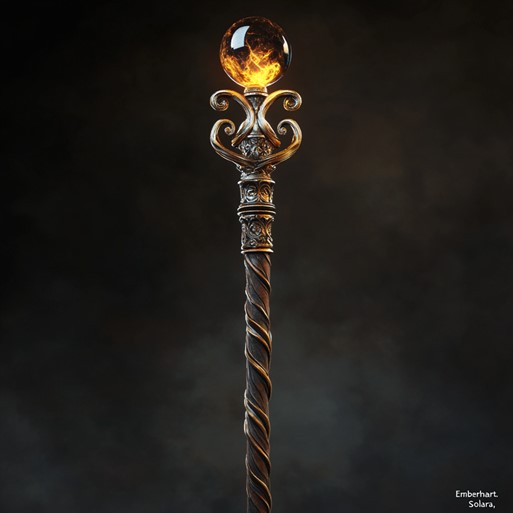
Perception of Activation:
- User’s Perspective:
- Sight: Upon activation, the Solara crystal at the staff’s head flares with a brilliant, warm golden light. The intensity varies with the power being channeled, ranging from a soft, ember-like glow for minor effects to a blinding radiance for major spells or abilities. The silver inlays in the Emberheart wood shimmer intensely, seeming to flow like molten metal. The user may briefly see faint images or symbols related to Shivarath or Samvarta within the light, almost like fleeting visions.
- Hearing: A resonant, deep humming sound emanates from the staff as it is activated. This sound is not harsh but rather feels like a vibration that resonates within the user’s bones. For more powerful activations, the humming might be accompanied by a crackling sound, like a bonfire igniting, or a low, sustained chord similar to that of a large temple gong.
- Touch: The staff immediately warms to the touch upon activation, sometimes becoming almost too hot to hold comfortably during intense uses. The user feels a palpable vibration or thrumming sensation that travels up their arms. There’s a sensation of power flowing into them, invigorating but also potentially overwhelming. The texture of the staff’s carvings might feel more pronounced, as if the runes themselves are rising slightly.
- Smell: A faint scent of burning wood, incense, and ozone accompanies activation. This is not an acrid or unpleasant smoke, but rather a warm, clean smell, reminiscent of a sacred fire or a forge. For stronger activations, the scent might intensify, with hints of sulfur or molten metal.
- Taste: A subtle metallic taste might manifest in the user’s mouth upon activation, akin to the sensation of touching a coin or being near a lightning strike. This is a side effect of the magical energy coursing through the staff and the user’s body.
- Extra-Sensory (Mind’s Eye): The user experiences a sudden rush of clarity and focus. Their mind feels sharpened, and they can access information gleaned through the Mind’s Eye with greater ease. They might receive brief, intuitive flashes of insight related to the task at hand—a glimpse of a potential outcome, a weakness in an enemy, or a hidden path. There’s a strong sense of connection to something greater, a feeling of being a conduit for divine power. The user’s own memories, especially ones tied to knowledge from past lives, also can come to mind.
- Extra-Sensory (Emotional): A surge of confidence and righteous zeal accompanies the staff’s activation. The user feels emboldened, empowered, and deeply connected to the principles of Shivarath. However, this can also manifest as a sense of detachment from worldly concerns, a feeling of being “above” the mundane. There’s a potential for overconfidence or recklessness.
- Observer’s Perspective:
- Sight: Observers see the most dramatic visual display: the blazing Solara crystal, the glowing silver inlays, and potentially a visible aura of heat or energy shimmering around the staff and its wielder. Depending on the power level, this can range from a noticeable glow to a dazzling spectacle that illuminates the surrounding area.
- Hearing: The humming, crackling, or gong-like sounds are clearly audible to anyone nearby. The intensity of the sound corresponds to the visual display, providing an auditory cue to the staff’s power level.
- Smell: The scent of burning wood, incense, and ozone is noticeable, though less intense for observers than for the user.
- Extra-Sensory (General): People with a sensitivity to magic might feel a palpable “pressure” or “weight” in the air when the staff is activated. There’s a sense of heightened energy, a feeling that something significant is happening. Those attuned to the Shivarath faith might feel a sense of reverence or awe.
- Extra-Sensory (Mind’s Eye): Other’s with the Mind’s Eye ability would see the staff’s stats increase dramatically.
- Positives:
- Intimidation: The visual and auditory display is highly intimidating to foes, potentially causing fear or hesitation.
- Inspiration: Allies might be inspired by the sight and sound of the staff’s activation, boosting morale and courage.
- Clarity: The user’s heightened senses and mental focus provide a significant advantage in combat and problem-solving.
- Divine Connection: The feeling of connection to a higher power can provide comfort, guidance, and a sense of purpose.
- Negatives:
- Attention-Grabbing: The dramatic display makes the user an obvious target, drawing enemy attention.
- Overwhelming: The sensory input can be overwhelming, especially for inexperienced users, potentially leading to distraction or mistakes.
- Emotional Imbalance: The surge of confidence can lead to overconfidence or recklessness, blinding the user to potential dangers.
- Energy Drain: Using the staff’s power can be physically and mentally taxing, leading to fatigue after prolonged use.
- Pain: If the wielder is not of the correct level, pain can occur.
Recipe: Replication of the Staff of Transcendence — This recipe details the extraordinarily difficult process of creating a staff that emulates the legendary Staff of Transcendence. True replication is impossible, as the original is a divine artifact, but this process aims to create a powerful magical staff with similar properties.
- Materials Needed:
- Emberheart Wood Core:
- Source: A single, flawless length of Emberheart wood, at least six feet long and three inches in diameter. This must be harvested from a living Emberheart tree during a volcanic eruption or a naturally occurring magical firestorm, imbuing it with raw elemental power. The tree must be at least 500 years old.
- Quantity: 1
- Solara Crystal:
- Source: A flawless, uncut Solara crystal, approximately four inches in diameter. This crystal must be found naturally formed, not synthesized. The best Solara crystals are found in areas where powerful ley lines intersect, particularly those associated with solar or fire energy.
- Quantity: 1
- Silver Ingot (Magi-Conductive):
- Source: Silver that has been alchemically treated to enhance its magical conductivity. This requires the silver to be purified to 99.999% purity and then subjected to a ritual involving focused solar energy and specific incantations.
- Quantity: 5 pounds
- Volcanic Ash (Consecrated):
- Source: Ash collected from the site of a recent volcanic eruption that has been consecrated by a high priest of Shivarath within 24 hours of the eruption. The ash must be collected from an area where lava flowed, signifying the direct touch of elemental fire.
- Quantity: 1 pound
- Phoenix Tears (Synthetic):
- A magically created substance that mimics the properties of true phoenix tears. This requires a complex alchemical process using rare herbs, gemstones, and a source of intense magical heat. (True phoenix tears are, for all practical purposes, unobtainable.)
- Quantity: 1 vial (approximately 1 ounce)
- Dragon Scales (Red or Gold):
- Source: Scales shed naturally from an adult red or gold dragon. These scales carry residual elemental fire energy.
- Quantity: 7 scales
- Sacred Incense of Shivarath:
- A blend of rare herbs, resins and spices.
- Quantity: 1 pound.
- High Quality Charcoal:
- A blend of compressed charcoal.
- 1 pound
- Emberheart Wood Core:
- Tools Required:
- Masterwork Woodcarving Tools: A set of exceptionally fine and sharp woodcarving tools, including chisels, gouges, knives, and rasps. These tools must be made of a magically-resistant material, such as dragon bone or magically-treated steel.
- Gemcutting Tools: Precision tools for shaping and polishing the Solara crystal. These must be diamond-tipped or similarly hard.
- Silversmithing Tools: A crucible, tongs, hammers, anvils, and molds suitable for working with molten silver. These must be heat-resistant and capable of withstanding extreme temperatures.
- Mortar and Pestle (Obsidian): A large, heavy mortar and pestle made of polished obsidian, for grinding and mixing ingredients.
- Alchemical Apparatus: A full set of alchemical equipment, including beakers, flasks, retorts, condensers, and a controlled heat source (magical or mundane).
- Enchanting Focus: A powerful magical focus, such as a large, flawless crystal or a consecrated altar, to aid in the enchantment process.
- Ritual circle materials Chalk or salt.
- Skill Requirements:
- Master Woodcarver (20+ ranks): The carving of the Emberheart wood requires exceptional precision and artistry.
- Master Gemcutter (20+ ranks): Shaping the Solara crystal without shattering it is a delicate and demanding task.
- Master Silversmith (20+ ranks): Working with the magi-conductive silver requires both metallurgical skill and an understanding of magical properties.
- Expert Alchemist (15+ ranks): Creating the synthetic phoenix tears and preparing the silver for enchantment requires advanced alchemical knowledge.
- Expert Enchanter (15+ ranks): Imbuing the staff with its magical properties requires a deep understanding of enchantment principles.
- Expert in Religion or Arcana (15+ ranks): The crafter must possess a thorough understanding of the principles of Shivarath and the nature of divine magic.
- Crafting Steps:
- Preparation (1 week): The crafting process must begin during a solar eclipse or a period of heightened solar activity. The crafter must fast and meditate for three days prior to beginning, purifying their body and mind. The workshop must be ritually cleansed and consecrated to Shivarath.
- Emberheart Shaping (4 weeks): Carefully carve the Emberheart wood into the desired staff shape. This involves removing excess wood, creating the intricate flame and rune patterns, and hollowing out a perfectly spherical cavity at the top to hold the Solara crystal. The carving must be done with extreme care to avoid damaging the wood’s magical properties. The carving must be bathed in the sacred incense smoke.
- Solara Shaping (2 weeks): Shape and polish the Solara crystal into a perfect sphere. This process is incredibly delicate, as any flaw could cause the crystal to shatter during the enchantment process.
- Silver Preparation (1 week): Melt the magi-conductive silver and use it to create thin wires and inlays for the staff’s carvings. This involves carefully pouring the molten silver into molds and then drawing it into fine wires. The silver must be constantly exposed to consecrated volcanic ash during this process.
- Inlaying (2 weeks): Carefully inlay the silver wires into the carved patterns on the Emberheart wood. This requires immense precision and a steady hand.
- Phoenix Tear Infusion (1 day): While chanting prayers to Shivarath, carefully infuse the Emberheart wood with the synthetic phoenix tears. This will enhance the wood’s natural magical properties and bind the silver inlays more securely. This must be done under direct sunlight, if possible.
- Crystal Mounting (1 day): Using a mixture of finely ground dragon scales, consecrated volcanic ash, and synthetic phoenix tears, create a setting for the Solara crystal at the top of the staff. Carefully place the crystal into the setting, ensuring it is secure and aligned perfectly with the staff’s axis.
- Enchantment Ritual (7 days): This is the most critical and dangerous step. The crafter must perform a complex, seven-day ritual, drawing upon the power of Shivarath and channeling it through the enchanting focus into the staff. This ritual involves continuous chanting, precise movements, and the burning of specific incense blends. Any interruption or mistake during this ritual could result in the staff’s destruction or, worse, a catastrophic magical backlash. The ritual must be performed within a properly constructed magic circle, inscribed with runes of power and protection.
- Final Polishing and Consecration (1 week): Once the enchantment is complete, carefully polish the staff to a high sheen. A final consecration ceremony, performed by a high priest of Shivarath, is required to fully awaken the staff’s powers and bind it to the principles of the faith.
This recipe is extremely challenging, requiring not only immense skill but also access to rare and dangerous materials. The resulting staff, while powerful, will still be a replica, lacking the full divine essence of the original Staff of Transcendence. It is a testament to the original’s power that even approaching its capabilities is a monumental undertaking.
Ballad of Flickering Light and the Staff of Ages
Hark, gather ’round, ye seekers of forgotten lore, and lend thine ears to a tale spun from threads older than the oldest mountain, a story mangled by the tongues of countless generations, a whisper from a time when gods walked the earth and mortals brushed against the divine. This… this is the ballad, poorly remembered, of Flickering Light, and the Staff… of Ages, some call it. Others, the Walking Stick of the Sun. Still others… the Pointy Stick of Ouch. The names, like the story, are… fractured.
Long, long ago, before calendars were carved, before cities were more than mud huts huddled in fear, there was… a girl. Or maybe a boy. The scrolls are… unclear. They were called Flickering Light, for their spirit was… unsteady. One moment, full of fire and fury, the next, timid as a mouse. A child of the sun, some said, touched by Samvarta… or maybe just prone to sunburns. The texts differ.
This Flickering Light, they lived in a village. A small village. Very small. Possibly just three huts and a grumpy goat. This village, it was plagued. Plagued by… shadows. Not metaphorical shadows, mind you. Literal shadows. Big, nasty, hungry shadows that crept from the… Shadow Place. A place of darkness, obviously. These shadows, they ate… things. Goats, mostly. Sometimes laundry. Occasionally, a slow-witted villager.
The villagers, they were… unhappy. Understandably. They tried… things. They threw rocks at the shadows. This… did not work. They tried shouting at the shadows. This… also did not work. They tried offering the shadows… better goats. This… worked, a little, but the shadows, they were… greedy.
Flickering Light, though small and… flickery… had an idea. A bad idea, most agreed. They would go to the… Sun Place. The place where Samvarta… maybe… lived. Or vacationed. The details are… hazy. This Sun Place, it was… high. On a mountain. A very high mountain. With… stairs. Lots of stairs. And… possibly… a dragon. Or maybe a very large, scaly lizard. The scrolls… disagree.
Flickering Light, they climbed. And climbed. And climbed. They ate… berries. Possibly poisonous berries. They slept under… rocks. Possibly haunted rocks. They befriended a… squirrel. Or maybe it was a very small bear. The translations are… problematic. This squirrel-bear, it gave Flickering Light… advice. Bad advice, probably.
Finally, after much climbing, and berry-eating, and squirrel-bear-befriending, Flickering Light reached the… Sun Place. It was… bright. Very bright. And there was… something. A… thing. Shining. Glowing. Warm. It was… the Staff. The Staff of… something. Ages? Transcendence? Abjursday? The original word is… lost.
This Staff, it was… powerful. Obviously. Flickering Light, they… grabbed it. This was… probably… not allowed. The Sun Place, it… rumbled. Or maybe that was the dragon-lizard. Or Flickering Light’s stomach, after all those berries.
Suddenly, from thin air (well, it was very thin up there), a voice boomed. It was… Samvarta? Or maybe a very grumpy groundskeeper. The voice said… something. The gist of it was: “Hey! Put that back! That’s… important!”
Flickering Light, they… panicked. They ran. They ran down the mountain. Much faster than climbing up. They tripped. A lot. The squirrel-bear… laughed. Or maybe it was mourning. Hard to tell.
Back in the village, the shadows were… having a party. A goat-eating, laundry-snatching party. Flickering Light, they… pointed the Staff. The… Pointy Stick of… whatever. And… light. A great, big, blinding light. The shadows… screamed. Or maybe they whimpered. The scrolls… contradict each other. The shadows… vanished. Poof. Gone.
The villagers, they were… happy. Very happy. They cheered. They threw… flowers. Possibly at Flickering Light, possibly at the Staff. Possibly at the goat that didn’t get eaten.
Flickering Light, they… stayed. They protected the village. They used the Staff. For… good. Mostly. Sometimes, they used it to… toast marshmallows. Or to… find lost socks. The Staff, it was… versatile.
But… the voice. The voice from the Sun Place. It… returned. In Flickering Light’s… dreams. Or maybe it was indigestion from the possibly-poisonous berries. The voice said… something. Something about… balance. Something about… returning what was taken. Something about… late fees.
Flickering Light, they… knew. They had to… give it back. The Staff. The… Thingy of… Power. They climbed the mountain. Again. The squirrel-bear… watched. Sadly, this time. Probably.
At the Sun Place, Flickering Light… returned the Staff. The voice… was pleased. Or maybe it was just relieved. It gave Flickering Light… a gift. A… smaller staff. A… Less-Pointy Stick of… Slightly-Less-Ouch. And… knowledge. The knowledge of how to… use it. And… maybe… a recipe for non-poisonous berry jam.
Flickering Light, they… went back. They protected the village. With the… less-powerful staff. They taught others. They… shared. They… mostly… stopped using magical artifacts for… trivial tasks.
And the Staff? The big Staff? The Staff of… you know… It stayed. In the Sun Place. Waiting. For… someone. Someone… worthy. Or… someone… foolish enough to try and steal it again.
Moral of the Story: Borrowing powerful magical artifacts without asking is generally frowned upon, even if you do save a village from shadow-monsters. Also, maybe don’t eat strange berries on mountains. And always listen to… squirrels? Bears? Squirrel-bears? Listen to… something. And, return what you take!
Suggested conversions to other systems:
Call of Cthulhu (7th Edition)
Staff of Transcendent Horror
- (Artifact)
- This staff, radiating an unsettling warmth, is covered in carvings that seem to shift and writhe when not directly observed. The Solara crystal at its head pulses with a sickly yellow light. Prolonged contact with the staff instills a deep sense of unease and paranoia, as well as flashes of incomprehensible cosmic truths.
- POW Multiplier: x5 (This means the staff has significant magical power, impacting the potency of spells cast through it.)
- Magic Points: Holds 1d20+10 Magic Points. These are not replenished naturally. When depleted, the staff becomes inert until recharged through a horrific ritual (see below).
- Sanity Cost: 1d6/1d20 Sanity loss to attune to the staff. Each time the staff is used to cast a spell, the wielder loses 1d3 Sanity.
- Spells (Contained): The staff contains the following spells, which can be cast by expending Magic Points from the staff. The cost is as listed in the Keeper Rulebook, but the caster uses their own POW, modified by the staff.
- Contact Deity (Samvarta): (Highly corrupted version). Instead of granting boons, this spell brings the caster closer to the terrifying reality of Samvarta, inflicting additional Sanity loss (1d10) and potentially attracting unwanted attention.
- Heal: The staff may cast the Heal Wounds.
- Banishment: If attuned to the staff, Banishment may be attempted.
- Dominate If attuned to the staff, Dominate may be attempted.
- Channeling Barrier: Expend 5 magic points to gain a +20% bonus to a Dodge roll against a magical attack. This consumes the user’s reaction for the round.
- Recharging Ritual: To recharge the staff, a ritual must be performed involving human sacrifice (at least one victim), the chanting of blasphemous texts in Aklo, and prolonged exposure to the light of a specific, unhealthy star (determined by the Keeper). This ritual costs 1d10 Sanity and 1d4 POW to all participants and has a significant chance of attracting Mythos entities.
- Lore: The staff will impart great horror and insight. If the staff user is fluent in Aklo they can gain an additional 3d6 Cthulhu Mythos and lose 3d6 Sanity.
- Investigator Adaptation: The Staff is fundamentally an anti-Investigator artifact. It is far more likely to be wielded by a cultist or sorcerer seeking forbidden power. Investigators who encounter it should be deeply wary of its corrupting influence. Using the staff will lead to madness and ruin, but it might be the only way to temporarily combat a greater threat. The decision to wield it should be a desperate, morally compromising one.
Blades in the Dark
The Emberheart Staff
- (Ritual Implement, Potent, Volatile)
- This staff, crafted from blackened volcanic wood and topped with a pulsing, heat-radiating crystal, is a potent tool for rituals and a dangerous weapon in its own right.
- Quality: 4 (This represents the overall quality and effectiveness of the staff).
- Usage: The staff is primarily used to enhance Rituals. When used as a focus for a Ritual, it grants +2d to the Ritual roll. However, due to its volatile nature, any complications resulting from the Ritual roll are increased in severity.
- Harm: When used as a weapon, the staff inflicts harm as a heavy weapon (3-harm), and the harm is fiery. Targets struck by the staff may catch fire (see the rules for fire in Blades in the Dark).
- Properties:
- Potent: The staff significantly enhances the power of rituals.
- Volatile: Using the staff is risky, increasing the chance of severe consequences.
- Terrifying: The staff’s appearance and aura are unsettling, granting +1d to Intimidate rolls when brandished.
- Attunement: To attune to the staff, a character must perform a Ritual involving meditation, self-inflicted harm (at least 2-harm), and communion with spirits of fire or shadow. Once attuned, the character suffers a -1d penalty to Resist rolls against fear or despair, reflecting the staff’s corrupting influence. The attunement can also take stress.
- Lore: This staff increases ritual power by two dice.
- Crew Adaptation: The Staff is best suited for a Cult crew or a crew that frequently deals with the supernatural. It’s a high-risk, high-reward tool. The crew might acquire it during a score involving a forgotten temple, a powerful sorcerer, or a dangerous spirit. The staff’s volatile nature should encourage careful planning and consideration of consequences. It could be the key to achieving a major goal, or it could lead to the crew’s downfall.
Dungeons & Dragons (5e)
Staff of Transcendence
- (Artifact, Requires Attunement by a Cleric, Paladin, or Sorcerer with a Divine Soul)
- This staff is made of dark, heat-resistant wood, etched with glowing silver runes, and topped with a radiant, sun-like crystal.
- Properties:
- Spellcasting Focus: The staff can be used as a spellcasting focus for divine spells.
- Divine Empowerment: While attuned to the staff, you gain a +2 bonus to spell attack rolls and the saving throw DCs of your divine spells.
- Spells: The staff has 10 charges. While holding it, you can use an action to expend some of its charges to cast one of the following spells (spell save DC 18): Cure Wounds (1 charge per spell level, up to 4th), Guiding Bolt (1 charge), Wall of Fire (5 charges), or spend 10 charges to fully heal.
- Foresight: Once per long rest, you can use your reaction to gain advantage on an attack roll, ability check, or saving throw.
- Divine Barrier: Once per long rest, when you are targeted by a spell or magical effect, you can use your reaction to gain resistance to all damage from that spell or effect.
- Recharge: The staff regains 1d6 + 4 expended charges daily at dawn. If you expend the last charge, roll a d20. On a 1, the staff loses its magical properties and becomes a nonmagical quarterstaff.
- The wielder may spend 10 charges to fully heal.
- Lore: This staff increases a spell’s attack roll and saving throw DC by 2.
- Campaign Adaptation: The Staff is a powerful artifact that could be a central object in a campaign. It might be the lost relic of a forgotten deity, the key to stopping a demonic incursion, or the object of a pilgrimage for a devout character. Its power should be balanced by significant challenges in obtaining and keeping it. Powerful factions, both good and evil, might seek to control it.
Knave
Staff of the Sun-Touched
- A staff of blackened wood, inlaid with silver, topped with a glowing crystal.
- Bonus: +2 to rolls made to cast spells.
- Abilities (Roll 1d6 each time the staff is used for a spell):
- Healing Touch: Heals the target for 1d6 HP.
- Blinding Flash: All creatures within 10 feet must make a Defense roll or be blinded for one round.
- Burning Strike: The staff deals an additional 1d6 fire damage on a successful melee attack (this use does not trigger another ability roll).
- Foresight: Gain advantage on your next roll.
- Divine Shield: Gain +2 to Defense until the start of your next turn.
- Overload: The staff glows intensely. On the next spell cast using the staff, add +1d6 to the roll, but the staff becomes unusable until a long rest is taken. The staff deals 1d6 damage to the wielder.
- If the wielder is of the appropriate level they may spend a full round channeling to gain full heath.
- Drawback: Each time the staff is used, there is a 1 in 6 chance that it attracts the attention of hostile extraplanar entities (GM’s discretion).
- Character Adaptation: In Knave, characters are defined by their items. The Staff of the Sun-Touched immediately makes a character a powerful spellcaster, but also a target. The random nature of its abilities adds an element of unpredictability, encouraging players to be creative and adaptable. The drawback reinforces the idea that powerful magic comes with risks. The GM should be prepared to introduce complications related to the staff’s use, such as rival spellcasters, cults seeking to reclaim the artifact, or planar beings drawn to its power.
- Lore: The staff provides a +2 bonus on spell casting attempts.
Fate (Core/Condensed)
Staff of Transcendent Authority
- (Artifact)
- This staff, a symbol of the Shivarath faith, resonates with divine power. Its Emberheart wood is warm to the touch, and the Solara crystal pulses with inner light.
- Aspects:
- High Concept: Artifact of the Sun God’s Chosen
- Trouble: Draws Unwanted Attention (from rivals, cults, the devout, etc.)
- Other Aspects: Blazing Symbol of Shivarath, Warmth of the Inner Flame, Whispers of Prophecy
- Skills:
- Provides a +2 bonus to overcome obstacles or create advantages related to the Shivarath faith, fire magic, or divine knowledge.
- Can be used to forcefully attack using Lore (instead of Fight), representing the staff’s divine power. This attack inflicts stress as normal, but the stress track it targets (physical or mental) depends on the target’s nature (mundane creatures take physical stress, while spirits or beings of pure thought take mental stress).
- Stunts:
- Healing Touch: Spend a Fate point to remove a mild or moderate consequence from a target, representing the staff’s healing power. The consequence must be related to physical injury.
- Barrier of Faith: Spend a Fate point to create a “Shielded by Divine Light” situation aspect with two free invokes, protecting the wielder from magical attacks.
- Glimpse of the Future: Spend a Fate point to declare a specific detail about the immediate future (e.g., “The archer will miss,” “The door is trapped”). This acts as a declaration, making the statement true.
- Consequences: The staff can be used to absorb consequences, but doing so can corrupt the staff (and the wielder). Each time a consequence is absorbed, add a “Tainted by Shadow” aspect to the staff. These aspects can be invoked by enemies, and the GM can compel them to create complications.
- Lore: The staff will impart great power and understanding of the god’s will.
- Character/Campaign Integration: The Staff is best used in a game where faith, prophecy, and divine power are central themes. The player should work with the GM to define the specific tenets of the Shivarath faith and how the staff interacts with them. The staff’s aspects and consequences encourage a narrative focus, emphasizing the boons and burdens of wielding such a powerful artifact.
Numenera/Cypher System
Staff of the Transcendent Flame
- (Artifact, Level 7)
- This ancient staff, crafted from materials unknown in the Ninth World, hums with barely-contained energy. The crystal at its head emits both light and heat.
- Level: 7 (This determines the difficulty of using the staff and the potential power of its effects).
- Form: Staff (can be used as a weapon, dealing 4 points of damage).
- Effect:
- Channeling: The staff reduces the Intellect cost of using any fire- or light-based abilities (including cyphers, esoteries, and other artifacts) by 2 points (minimum 1).
- Foresight: The wielder can spend 3 Intellect points to gain a +3 bonus to their next action. This represents a brief glimpse into the immediate future.
- Divine Flare (Action): The wielder can spend 5 Intellect points to unleash a blast of searing energy. This inflicts 7 points of fire damage to all targets within short range and has a 50% chance of setting flammable objects on fire.
- Healing Light (Action): Spend 3 points from any of the wielder’s stat Pools to restore 5 points to that same Pool for any creature.
- Depletion: 1 in 1d20 (each time an ability other than the basic staff attack is used). If depleted, the staff becomes inert and must be recharged through a complex process involving exposure to a specific type of energy source (e.g., a data sphere containing ancient knowledge, a particular type of numenera device, a nexus of ley lines).
- Lore: The staff will impart great understanding of the god it belonged to.
- Character/Campaign Integration: The Staff fits well into the weird and wondrous world of Numenera. Its origin should be mysterious, perhaps hinting at a lost civilization or a higher power. The depletion mechanic encourages resource management and provides opportunities for exploration and discovery as the players seek out ways to recharge the staff. The GM can use the staff as a plot hook, drawing the characters into conflicts related to its past or its potential future.
Pathfinder (Second Edition)
Staff of Transcendence
- (Artifact)
- This staff is a potent symbol of divine authority, crafted from rare, magically-infused materials.
- Usage: held in 2 hands; Bulk: 1
- Traits: Artifact, Divine, Evocation, Fire, Light
- Properties:
- Spellcasting: The staff can be used as a divine spellcasting focus.
- Divine Empowerment: While holding the staff, you gain a +2 item bonus to spell attack rolls and the DCs of your divine spells that deal fire damage or have the light trait.
- Healing Light: The wielder can cast Heal as an innate spell once per day.
- Spells: The staff has 10 charges. While holding it, you can expend charges to cast the following spells:
- Burning Hands (1 charge)
- Fireball (3 charges)
- Wall of Fire (4 charges)
- Foresight: Once per day, you can gain a +2 circumstance bonus to a single attack roll, skill check, or saving throw. You must declare you are using this ability before rolling.
- Divine Protection: Once per day, as a reaction when you are targeted by a spell or magical effect, you can gain a +4 circumstance bonus to your saving throw against that effect.
- Recharge: The staff regains 1d4+1 expended charges daily at dawn. If you expend the last charge, roll a d20. On a 1, the staff loses its magical properties and becomes a nonmagical quarterstaff.
- Lore: This staff is a powerful symbol of divine authority that would be appropriate for a high-level campaign.
- Campaign Integration: The Staff could be a major quest item, the focus of a religious schism, or a powerful tool used by a villain. Its divine nature makes it relevant to clerics, paladins, and other divinely-powered characters. The GM should consider the implications of introducing such a powerful item into the campaign and adjust challenges accordingly.
Savage Worlds (Adventure Edition)
Staff of Transcendence
- (Artifact)
- This imposing staff radiates heat and light, a testament to its divine origins.
- Device Type: Staff (can be used as a weapon, dealing Str+d6 damage, and is considered a Heavy Weapon).
- Powers: The staff grants access to the following powers, with a Power Point cost as indicated. The user must have the appropriate skill (usually Spellcasting) to use these powers. The user may use their own Power Points or those of the staff.
- Bolt (1 PP, fire/light trapping)
- Smite (1 PP, on the staff itself, adds +2d6 fire damage to the staff’s melee attacks for one round)
- Healing (3 PP)
- Divination (2 PP, grants a reroll on a single Trait roll, representing foresight)
- Protection (2 PP, provides +2 Parry and Toughness against magical attacks for one round)
- Blast (3 PP, fire/light trapping, centered on the user)
- Power Points: The staff has 15 Power Points. It regenerates 1d6 Power Points every hour it is exposed to direct sunlight.
- Notes: The staff is considered a holy (or unholy, depending on the wielder’s actions) item. It grants +2 to Intimidation rolls against those who recognize its significance.
- Lore: This staff will impart great power to the owner.
- Campaign Integration: The Staff works well in a setting with a strong divine or magical element. It could be a relic of a lost civilization, a gift from a god, or the weapon of a powerful cult leader. The staff’s powers should be balanced by its limitations (Power Points, the need for sunlight to recharge) and the potential for social consequences (reactions from those who recognize the staff’s significance). It makes a good “signature weapon” for a powerful Wild Card NPC or a long-term goal for a PC.
Shadowrun (6th World Edition)
Emberheart Staff
- (Focus, Force 6)
- This staff, crafted from dark, heat-resistant wood and capped with a strangely glowing crystal, is a potent magical focus. It hums with barely contained power, radiating a palpable aura of heat.
- Type: Power Focus (This means it enhances all magical abilities, not just specific ones).
- Force: 6 (This determines the maximum number of dice added to magical tests, and the staff’s overall power level).
- Availability: 24F (This is extremely restricted and illegal. Obtaining it would require significant contacts and a high price, or a dangerous run).
- Cost: 240,000¥ (A very high price, reflecting its rarity and power).
- Effects:
- +6 Dice: Adds +6 dice to all magical skill tests (Spellcasting, Ritual, Summoning, Binding, Banishing, etc.) while the staff is held.
- Fire Aura: The staff constantly radiates heat. This provides a visual signature (easily detectable by thermal vision) and can ignite flammable materials with prolonged contact. The aura inflicts a -2 dice pool modifier to anyone attempting to grapple or physically restrain the wielder.
- Foresight: Once per combat turn, the wielder can spend a point of Edge before making a roll to gain a +2 dice pool modifier on that roll. This represents a brief glimpse of the immediate future.
- Drain Resistance: The staff provides +2 dice to resist Drain when using magic.
- Lore: The mage that uses this staff will have all their magical rolls increased.
- Bonding: To bond with the staff, a magician must spend 6 Karma. If the bond is ever broken (e.g., by another magician bonding with it), the former owner immediately suffers 3 boxes of Stun damage and is disoriented (-2 to all actions) for 1d6 combat turns.
- Runner/Campaign Adaptation: The Emberheart Staff is a top-tier magical item, suitable for a powerful mage character or a high-threat NPC. Its acquisition would likely be the focus of a major run or even an entire campaign arc. The staff’s obvious magical nature makes it difficult to conceal, attracting attention from corporations, law enforcement, and other magical groups. Its power should be balanced by the risks associated with wielding it.
Starfinder
Staff of Transcendence
- (Hybrid Item, Level 15)
- This staff, constructed from materials not found on any known Pact World, pulses with an otherworldly energy. The crystal at its head emits both heat and light, and the runes carved into its shaft seem to shift and rearrange themselves.
- Level: 15
- Price: 175,000 credits
- Bulk: 1
- Weapon Properties:
- Damage: 2d8 F (Fire damage)
- Critical: Burn 2d6
- Special: Arcane (can be used as a spellcasting focus for Technomancers and Mystics), Boost 2d6 (can expend 1 Resolve Point as a swift action to add 2d6 fire damage to the staff’s melee attacks for one round)
- Hybrid Properties:
- Spellcasting Focus: Provides a +2 enhancement bonus to caster level checks for spells with the fire or light descriptor.
- Foresight: Once per day, as a move action, the wielder can gain a +2 insight bonus to their next attack roll, skill check, or saving throw. This must be used within 1 minute.
- Healing Surge: Once per day, as a standard action, the wielder can touch a creature (including themselves) and restore 4d8 Hit Points.
- Energy Resistance: The wielder gains fire resistance 10.
- Lore: The Mystic that uses this staff will have all their spells increased.
- Character/Campaign Integration: The Staff is a high-level item appropriate for a powerful spellcaster or a technologically adept character. Its origins should be mysterious, perhaps tied to a lost civilization, a distant star system, or even another dimension. It could be a reward for a challenging quest, a piece of recovered ancient technology, or the key to unlocking a greater mystery.
Traveller (Mongoose 2nd Edition)
Ancient Staff
- (Unique Artifact)
- This staff, seemingly made of polished volcanic rock and topped with a luminous crystal, radiates a faint warmth. Its origins are unknown, and it defies easy analysis.
- Tech Level: TL-? (Beyond current technological understanding)
- Weight: 2 kg
- Cost: Priceless (effectively unobtainable through normal means)
- Effects:
- Weapon: Can be used as a melee weapon, inflicting 2D+2 damage.
- Psionic Enhancement: If the wielder has any psionic talent, the staff adds +2 DM to all psionic skill checks.
- Foresight: Once per day, the wielder can gain a +2 DM to any single skill check, representing a brief glimpse of the immediate future.
- Healing Touch: Once per day, the wielder can touch a creature (including themselves) and restore 2D+2 to all characteristics.
- Unknown Properties: The GM is encouraged to add additional, mysterious properties to the staff, reflecting its alien origins. These could include limited telekinesis, energy projection, or even the ability to open temporary rifts in space-time.
- Lore: The person that uses the staff to perform psychic abilities have a +2 modifier.
- Obtaining the Staff This staff is extremely rare and would require a full campain.
- Character/Campaign Integration: The Ancient Staff is best used as a central artifact in a campaign focused on exploration, ancient mysteries, and the unknown. It’s a powerful tool, but its true potential should be shrouded in mystery, gradually revealed over the course of the game. The GM should use the staff to drive the narrative, creating situations where its powers are needed and where its origins can be investigated.
Warhammer Fantasy Roleplay (4th Edition)
Emberheart Staff
- (Magical Item, Artifact)
- This staff, made from the blackened wood of a tree struck by divine fire, is warm to the touch. A pulsing crystal, said to contain a spark of Aqshy, the Wind of Fire, is mounted at its head.
- Encumbrance: 1
- Availability: Extremely Rare (effectively unique)
- Properties:
- Magic Item: The staff is a magical item and can be used as a focus for channeling magic.
- Aethyric Attunement: The staff adds +2 SL (Success Levels) to any Channelling tests made by the wielder.
- Lore of Fire: The staff allows the wielder to cast any spell from the Lore of Fire that they know as if they had one additional ingredient. This does not stack with other ingredient-reducing effects.
- Foresight: Once per day, the wielder can gain a +10 bonus to any single test. This represents a brief glimpse of fate.
- Burning Touch: As an action, the wielder can touch a creature or object and inflict 1d10 + Willpower Bonus damage, ignoring Armour Points. This has the Flame quality.
- Unstable Power: Each time the staff is used to cast a spell or activate its Burning Touch ability, roll a d10. On a 1, the staff unleashes a surge of uncontrolled magical energy. The GM determines the effect, which could range from a minor miscast to a catastrophic explosion.
- Lore: Mages will find their channeling increase by +2 levels.
- Character/Campaign Integration: The Emberheart Staff is a powerful artifact, suitable for a high-level wizard or a significant NPC. It is strongly associated with the Lore of Fire and would be particularly potent in the hands of a Bright Wizard. The staff’s unstable nature adds an element of risk to its use, reflecting the volatile nature of Aqshy. It could be a lost relic of a powerful mage, a gift from a fire god, or a dangerous artifact sought by multiple factions.