
Definition: The Timberwrights Guild is a society or association formed by timber workers and sawmill operators who share a common interest and purpose in the harvesting, processing, and utilization of timber resources. This guild serves as a platform for collaboration, skill development, and the responsible management of forests and woodlands.
The Timberwrights Guild brings together individuals from various backgrounds within the timber industry, including loggers, lumberjacks, sawyers, and craftsmen. Members within the guild contribute their expertise, craftsmanship, and commitment to sustainable timber practices.
Within the Timberwrights Guild, members engage in regular meetings, workshops, and training programs to enhance their timberworking skills, share best practices, and stay updated on industry advancements. They collaborate on projects aimed at responsibly harvesting timber, processing logs into lumber, and producing high-quality wood products.
The Timberwrights Guild places a strong emphasis on sustainable forest management, the utilization of renewable resources, and the preservation of woodland ecosystems. Members strive to ensure the long-term health and productivity of forests, promoting selective harvesting, reforestation, and the protection of sensitive habitats.
Additionally, the Timberwrights Guild provides support and resources to its members, including access to specialized tools, training facilities, and educational programs. The guild offers apprenticeships and mentorship opportunities to develop the next generation of skilled timberworkers, promoting the transfer of traditional woodworking techniques and knowledge.
The guild also acts as an advocate for sustainable timber practices, collaborating with environmental organizations, landowners, and government agencies to shape policies that support responsible forestry, protect biodiversity, and ensure the equitable distribution of timber resources.
The Timberwrights Guild is an association formed by timber workers and sawmill operators who come together to advance sustainable timber practices, promote responsible forest management, and ensure the efficient utilization of timber resources. Through collaboration, skill development, and advocacy, the guild strives to maintain the balance between human needs and ecological stewardship, providing a supportive community for individuals dedicated to the art and science of timberworking.
Tags: Timber Harvesting, Sustainable Forestry, Woodcraft, Sawmill Operations, Forest Management, Skill Development, Reforestation, Habitat Protection, Apprenticeships, Environmental Advocacy
Joining the Timberwrights Guild
To join the Timberwrights Guild, prospective members must demonstrate a genuine commitment to sustainable timber practices and a passion for timberworking. The process typically involves:
- Submitting an application detailing their experience, skills, and dedication to sustainable forestry.
- Undergoing an interview or evaluation process conducted by senior members to assess their alignment with the guild’s values and goals.
- Participating in an apprenticeship or mentorship program to gain hands-on experience and training under the guidance of skilled timberworkers.
Benefits of Membership
Members of the Timberwrights Guild enjoy various benefits, including:
- Access to Specialized Tools and Training: Members gain access to high-quality tools, training facilities, and educational programs to enhance their skills and knowledge.
- Networking Opportunities: The guild provides a platform for members to connect with other timberworkers, sawmill operators, and craftsmen, fostering collaboration and knowledge exchange.
- Professional Development: Members can participate in workshops, seminars, and certification programs to stay updated on industry advancements and best practices.
- Advocacy and Support: The guild advocates for sustainable timber practices and provides resources and support to members, including assistance with navigating regulations and accessing funding for sustainable projects.
- Community and Mentorship: The guild offers a supportive community where members can share their experiences, seek advice, and mentor the next generation of timberworkers.
Controlled Resources
The Timberwrights Guild controls various resources, including:
- Forests and Woodlands: The guild manages designated forests and woodlands, ensuring sustainable harvesting and reforestation efforts.
- Sawmills and Processing Facilities: Members have access to guild-operated sawmills and processing facilities equipped with advanced machinery and technology.
- Training Centers: The guild maintains training centers and workshops where members can learn and practice timberworking techniques.
- Educational Materials: The guild possesses a wealth of educational materials, including manuals, guides, and research on sustainable forestry and woodworking.
Limitations of the Faction
The Timberwrights Guild faces several limitations, such as:
- Resource Constraints: Managing sustainable forestry practices requires significant resources and funding, which can be challenging to secure consistently.
- Balancing Economic and Environmental Goals: The guild must balance the economic demands of the timber industry with the need to protect and preserve forest ecosystems.
- Resistance to Change: Some traditional timberworkers may resist adopting new sustainable practices and technologies, posing a challenge to the guild’s mission.
Leadership Concerns
The leadership of the Timberwrights Guild is primarily concerned with:
- Ensuring Sustainable Practices: Maintaining the long-term health and productivity of forests through responsible harvesting and reforestation efforts.
- Protecting Ecosystems: Safeguarding sensitive habitats and biodiversity from the impact of timber harvesting.
- Advocating for Policies: Influencing policies and regulations that support sustainable forestry and protect timber resources.
Secret Motivations and Hidden Agendas
While the public face of the Timberwrights Guild emphasizes sustainability and responsible timber management, some hidden agendas may include:
- Securing Timber Rights: Ensuring access to valuable timber resources and negotiating favorable terms with landowners and government agencies.
- Influencing Markets: Shaping timber markets to favor sustainably sourced wood products, potentially increasing the guild’s influence and profitability.
- Expanding Influence: Extending the guild’s reach and control over larger areas of forested land and expanding their role in environmental policymaking.
Pass Phrases, Codes, and Identifying Gestures
Members of the Timberwrights Guild may use certain pass phrases, codes, or gestures to identify each other, such as:
- Pass Phrases: “The forest provides” or “In harmony with the trees.”
- Identifying Gestures: Touching the brim of their hat or raising a hand in a gesture resembling the shape of a tree.
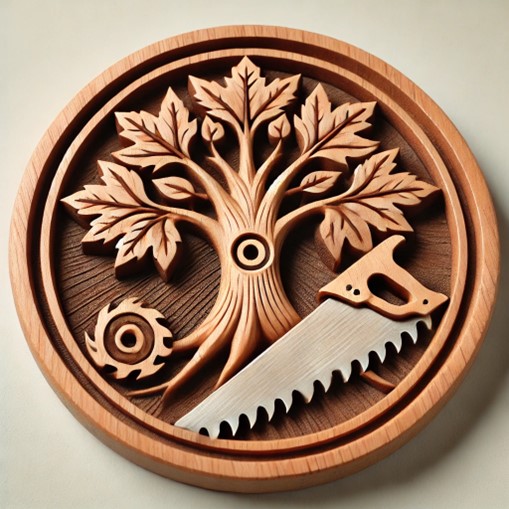
- Symbolic Items: Wearing a small wooden token or emblem representing a tree or saw.
Friendly Groups
The Timberwrights Guild maintains friendly relationships with several other groups, including:
- Druidic Circles: Groups dedicated to the protection and preservation of natural environments, sharing a common interest in sustainable forestry.
- Environmental Organizations: NGOs and advocacy groups focused on conservation, biodiversity, and ecological protection.
- Artisan and Craft Guilds: Organizations of woodworkers, carpenters, and artisans who value high-quality, sustainably sourced timber.
- Academic Institutions: Universities and research centers studying forestry, ecology, and sustainable resource management.
Ranks and Jobs within the Timberwrights Guild
The Timberwrights Guild has a structured hierarchy that allows members to advance based on their skills, experience, and contributions to the guild’s mission. Here are the ranks, jobs, and advancement criteria within the guild:
Ranks and Jobs
- Apprentice
- Job: Assist senior members, learn basic timberworking skills, and participate in training programs.
- Advancement Criteria: Completion of a basic training program and demonstration of foundational skills in timberworking and sustainable practices.
- Journeyman
- Job: Perform skilled timberworking tasks, operate sawmill equipment, and participate in sustainable harvesting and reforestation projects.
- Advancement Criteria: Mastery of intermediate timberworking techniques, active participation in guild projects, and completion of a journeyman certification exam.
- Craftsman
- Job: Lead timberworking projects, mentor apprentices and journeymen, and contribute to the development of new techniques and practices.
- Advancement Criteria: Demonstrated leadership in guild projects, innovation in timberworking techniques, and recommendation from senior guild members.
- Master Timberwright
- Job: Oversee major guild initiatives, manage sawmill operations, and ensure adherence to sustainable forestry practices.
- Advancement Criteria: Proven expertise in advanced timberworking, successful management of large-scale projects, and significant contributions to the guild’s mission.
- Guild Elder
- Job: Provide strategic guidance, represent the guild in external affairs, and mentor the next generation of leaders.
- Advancement Criteria: Longstanding dedication to the guild, exceptional leadership and mentorship skills, and election by the guild council.
- Guildmaster
- Job: Lead the guild, make high-level decisions, and ensure the overall health and direction of the organization.
- Advancement Criteria: Election by the guild elders, proven leadership, and a vision for the future of the guild.
Advancement within the Guild
Advancement within the Timberwrights Guild is based on a combination of skill mastery, contributions to guild projects, leadership abilities, and peer recognition. Members progress through the ranks by:
- Training and Certification: Completing training programs and certification exams tailored to each rank.
- Project Participation: Actively participating in and leading guild projects that demonstrate their skills and commitment to sustainable practices.
- Mentorship: Receiving mentorship from higher-ranking members and, in turn, mentoring those below them.
- Peer Recommendation: Being recommended for advancement by senior guild members based on their performance and contributions.
Badge Description: Members of the Timberwrights Guild wear a distinctive badge that signifies their rank within the faction. The badge is a circular wooden emblem with the guild’s symbol: a tree with interlocking branches and a saw blade at its base, representing the harmony between nature and timberworking.
Badge Symbols and Rank Insignia
- Apprentice
- Badge: Simple wooden emblem with the tree and saw blade symbol, no additional adornments.
- Color: Light brown wood.
- Journeyman
- Badge: Wooden emblem with the tree and saw blade symbol, accented with silver paint on the saw blade.
- Color: Medium brown wood with silver accents.
- Craftsman
- Badge: Wooden emblem with the tree and saw blade symbol, accented with gold paint on the saw blade and interlocking branches.
- Color: Dark brown wood with gold accents.
- Master Timberwright
- Badge: Wooden emblem with the tree and saw blade symbol, adorned with an intricate border and inlaid with a small emerald at the tree’s base.
- Color: Rich mahogany wood with gold accents and an emerald inlay.
- Guild Elder
- Badge: Polished wooden emblem with the tree and saw blade symbol, surrounded by a silver ring and inlaid with a small emerald and sapphire at the tree’s base.
- Color: Deep walnut wood with silver and gemstone accents.
- Guildmaster
- Badge: Exquisitely carved wooden emblem with the tree and saw blade symbol, encircled by a platinum ring and inlaid with emerald, sapphire, and ruby gemstones at the tree’s base.
- Color: Ebony wood with platinum and gemstone accents.
The badge serves as a symbol of the member’s rank and dedication to the guild’s values of craftsmanship, sustainable forestry, and ecological stewardship.
Enemies and Rivals of the Timberwrights Guild
- Enemies:
- The Ironhand Syndicate
- Description: A faction of industrialists and mechanized loggers who prioritize profit over sustainability. They employ aggressive logging techniques that lead to deforestation and environmental degradation.
- Conflict: The Timberwrights Guild and the Ironhand Syndicate clash over the methods of timber harvesting. The guild’s focus on sustainable practices directly opposes the Syndicate’s destructive techniques.
- Interaction: Interactions are often hostile, with the Timberwrights Guild trying to expose the environmental damage caused by the Syndicate. This includes protests, legal battles, and attempts to halt unsustainable logging operations.
- Consequences: These conflicts can result in damaged ecosystems, legal disputes, and heightened tensions between environmental advocates and industrial loggers. The Syndicate’s actions can lead to loss of biodiversity and long-term harm to forest health, while the guild’s efforts may slow down logging operations and impact the local economy.
- The Darkwood Cabal
- Description: A secretive group that harvests rare and magical woods for illicit trade and dark rituals. Their activities often involve poaching protected trees and desecrating sacred groves.
- Conflict: The Timberwrights Guild views the Cabal’s activities as a direct threat to forest conservation and ecological balance. The guild works to protect endangered and magical tree species from exploitation.
- Interaction: The guild conducts covert operations to disrupt the Cabal’s activities, including espionage, sabotage, and collaborating with law enforcement and magical protectors to safeguard sacred groves.
- Consequences: These interactions often result in dangerous confrontations, risking the lives of guild members and the ecological integrity of forests. Successful guild actions can protect rare species and ecosystems, but failure can lead to the loss of irreplaceable natural and magical resources.
- The Ironhand Syndicate
- Rivals:
- The Steelbark Consortium
- Description: A faction of skilled timberworkers and sawmill operators who prioritize technological innovation over traditional methods. They often compete with the Timberwrights Guild for resources and market dominance.
- Conflict: The rivalry centers around differing philosophies on timberworking and resource management. The guild emphasizes sustainable, traditional techniques, while the Consortium focuses on efficiency and modernization.
- Interaction: Interactions are competitive but not necessarily hostile. Both factions vie for contracts, resources, and skilled workers, leading to an ongoing competition for market influence.
- Consequences: This rivalry can drive innovation and improvement in timberworking techniques, but it can also lead to resource depletion if not managed sustainably. It creates a dynamic market environment, pushing both factions to excel in their respective approaches.
- The Verdant Enclave
- Description: A group of druids and environmental activists who believe in strict preservation of natural habitats and minimal human interference. They often see any form of timber harvesting as harmful.
- Conflict: The guild’s sustainable harvesting practices sometimes clash with the Enclave’s strict preservationist ideals. The Enclave argues that even selective logging can disrupt ecosystems.
- Interaction: The guild and the Enclave engage in debates and negotiations, trying to find common ground on forest management practices. They occasionally collaborate on conservation projects but frequently disagree on the extent of permissible human activity in forests.
- Consequences: This relationship can lead to constructive dialogue on conservation, but also to tension and protests when the guild’s activities are perceived as too intrusive. Successful collaboration can result in innovative sustainable practices, while failure to reach consensus can stall conservation efforts.
- The Steelbark Consortium
Consequences of Conflicts
- Environmental Impact: Conflicts with factions like the Ironhand Syndicate and the Darkwood Cabal can lead to significant environmental damage, including deforestation, habitat loss, and biodiversity decline. The guild’s efforts to combat these factions help mitigate these impacts, but the struggles often come at a cost to the environment.
- Economic and Social Tensions: The rivalry with the Steelbark Consortium and the Verdant Enclave creates economic and social tensions within communities that rely on timber resources. While competition can drive innovation, it can also lead to resource conflicts and differing community priorities.
- Legal and Political Ramifications: Ongoing conflicts and rivalries can result in legal battles and influence policymaking. The guild’s advocacy for sustainable practices may lead to stricter environmental regulations, while opposition from industrial factions can shape policies in favor of economic interests.
- Cultural and Ideological Clashes: These conflicts highlight the broader cultural and ideological divides regarding resource management, conservation, and technological advancement. The guild’s commitment to tradition and sustainability often puts it at odds with factions prioritizing modernization or strict preservation.
Interaction Dynamics
- Diplomacy and Negotiation: The Timberwrights Guild engages in diplomacy with rival factions to find common ground and negotiate sustainable practices. This involves regular meetings, discussions, and collaborative projects.
- Advocacy and Awareness Campaigns: The guild conducts awareness campaigns to educate the public and policymakers about the importance of sustainable timber practices, aiming to garner support and influence regulations.
- Covert Operations and Sabotage: In extreme cases, the guild undertakes covert operations to disrupt the activities of hostile factions like the Darkwood Cabal, employing espionage and sabotage to protect forests.
- Collaboration and Compromise: Despite conflicts, the guild occasionally collaborates with rivals on projects that align with mutual goals, such as reforestation efforts and habitat protection.
By navigating these complex interactions, the Timberwrights Guild strives to uphold its mission of sustainable timber management and ecological stewardship while contending with the challenges posed by its enemies and rivals.
Saga of the Wise Timberwright
In olden days, when Saṃsāra land was wild and untamed, there was formed a brotherhood of woodworkers and sawmen, called the Timberwrights Guild. This tale, passed from tongue to ear over countless ages, is known as “The Saga of the Wise Timberwright.”
Once upon a time, in forest deep and vast, there lived an elder timberwright, wise and noble, named Halmar. He knew the secrets of the trees, could speak to their spirits, and understand the language of the wood. His hands crafted wonders from timber, yet he took only what forest gave freely, never more.
One day, as the sun rose blood-red over the horizon, a dark menace arrived. The Ironhand Syndicate, with their roaring machines and steel claws, began to fell trees in great swaths, caring not for the forest’s whispering cries. Trees ancient and young alike fell, and the forest wept.
Halmar, the wise timberwright, saw the sorrow of the woods and vowed to protect them. He gathered the members of the Timberwrights Guild, each a master of their craft, and spoke, “We must stand against the Ironhand, for the forest is our kin, and we its guardians.”
The guild, with hearts of oak, set to work. They wove traps from vines, enchanted the groves with protective spells, and carved totems that sang songs of warning. When the Ironhand’s machines approached, they were ensnared by roots and vines, their engines silenced by the magic of the wood.
Yet, the Ironhand Syndicate did not relent. Their leader, a man of iron heart named Kargoth, challenged Halmar to a duel. “If I win,” Kargoth said, “the forest shall be mine to plunder. If you win, we shall leave and never return.”
The duel was fierce, a battle of brawn against wisdom. Kargoth swung his mighty axe, but Halmar moved like the wind, swift and graceful. With a final act of cunning, Halmar led Kargoth to the heart of the forest, where an ancient tree, wise and powerful, stood. The tree, recognizing Halmar’s pure heart, lent its strength to him.
With this borrowed power, Halmar struck a blow that shattered Kargoth’s axe and his will. Defeated, Kargoth honored his word, and the Ironhand Syndicate left the forest, their machines silent, their greed halted.
Peace returned to the woods, and the Timberwrights Guild was hailed as heroes. Halmar, though weary, knew that vigilance was the price of harmony. He taught the guild to always respect the balance of the forest, to take only what was needed, and to give back with care.
Moral of the Story: The Saga of the Wise Timberwright teaches that true guardianship lies in balance and respect for nature. By standing against destruction and honoring the spirits of the wood, we ensure harmony and life for generations to come.