
Lore: In the intricate world of Saṃsāra, the Pactweavers emerge as a unique and powerful faction. Rooted in the art of bargaining, negotiation, and deals, this enigmatic organization wields the intricate threads of agreements and pacts to shape destinies and influence the course of events.
Ideology: The Pactweavers believe that every interaction is an opportunity for influence, and every agreement can be leveraged to reshape destinies. They see the world as a tapestry of interconnected relationships, each thread representing a promise waiting to be woven into the grand design. To the Pactweavers, negotiation is a form of art, and a well-crafted deal can alter the paths of individuals and realms alike.
Major Concerns: The faction is deeply concerned with maintaining the delicate balance between power and vulnerability in their interactions. They strive to ensure that no single party gains too much advantage in a bargain, as such imbalances can lead to unintended consequences and disruptions within the tapestry of fate.
Imperatives:
- Equitable Weaving: The Pactweavers seek to ensure that the terms of agreements are fair and just, preventing exploitation or manipulation.
- Guided Compacts: They aim to guide individuals and groups toward deals that align with the greater harmony of Saṃsāra, using their skills to subtly influence negotiations.
- Guardians of Oaths: The faction values the sanctity of oaths and contracts, keeping ancient texts and records that hold the weight of promises made.
Grand Strategy and Goals: The grand strategy of the Pactweavers involves shaping the world through strategic negotiations, forging alliances, and brokering deals that lead to positive outcomes. They seek to prevent conflicts, facilitate cooperation, and encourage the sharing of resources, all while upholding the balance of power and fostering a harmonious Saṃsāra.
Public Motivations and Agenda: Publicly, the Pactweavers present themselves as diplomats, negotiators, and peacemakers, working to resolve conflicts, establish trade agreements, and mediate disputes. Their agenda emphasizes the importance of maintaining equilibrium through equitable negotiations and fostering relationships that benefit all parties involved.
Means and Methods: The Pactweavers use a combination of keen insight, persuasive communication, and their own magical abilities to influence negotiations. They can sense the intentions and desires of individuals involved in a deal, allowing them to tailor their approach to guide the outcome. Subtle enchantments woven into their words can influence decisions and subtly nudge participants toward agreements that align with the faction’s vision of harmony.
Tags: Bargaining, Negotiation, Diplomatic Skills, Equitable Agreements, Influence, Pact Records, Strategic Alliances, Faction Ranks, Conflict Resolution, Hidden Agendas
Joining the Faction: To join the Pactweavers, individuals with a natural inclination for negotiation, diplomacy, and understanding the intricacies of human nature are scouted. Once identified, they are invited to participate in a series of tests that assess their ability to read people, analyze situations, and formulate compelling arguments. Those who demonstrate potential are then offered training in the art of bargaining and negotiation.
Benefits: Members of the Pactweavers gain access to a network of skilled negotiators and diplomats who share their values and skills. They receive training in the art of crafting agreements, understanding body language, and using their own inherent magical talents to influence discussions. The faction also provides access to archives containing records of past pacts and agreements, which can offer insights into strategies and potential pitfalls.
Controlled Resources: The Pactweavers control a network of diplomatic enclaves and negotiation chambers spread across different realms. These locations serve as hubs for diplomatic activity, information exchange, and recruitment. The faction also possesses a repository of ancient texts and scrolls detailing the history of pacts and agreements, which is guarded closely.
Limitations: Despite their abilities, the Pactweavers must navigate the complexities of human emotions, power dynamics, and shifting allegiances. They cannot control the actions or decisions of individuals outright; they can only influence and guide negotiations. Additionally, their own limitations lie in situations where emotions run high or when the other party is unwilling to engage in good faith.
Leadership Concerns: The leadership of the Pactweavers worries about maintaining the integrity of agreements and ensuring that their influence remains subtle. They fear that overstepping their bounds or pushing too aggressively in negotiations could lead to backlash, damaging the faction’s reputation and credibility.
Secret Motivations and Hidden Agendas: While publicly advocating for equitable negotiations and harmonious relationships, the Pactweavers’ secret motivation is to consolidate power through the control of strategic agreements. They seek to forge alliances that serve their own interests while appearing to benefit all parties involved. Their hidden agenda involves guiding Saṃsāra toward a world where they hold influence over major decisions and play a pivotal role in shaping the future.
Pass Phrases, Codes, and Identifying Gestures: Members of the Pactweavers might use specific phrases related to agreements and bargains as pass phrases to identify themselves to one another. Subtle hand gestures, like interlocking fingers to symbolize unity or brushing a hand over one’s heart to convey sincerity, could serve as identifying gestures.
Friendly Groups: The faction maintains a positive relationship with the Court of Sages, a group of wise scholars and advisors. The Court’s expertise in various subjects complements the Pactweavers’ diplomatic skills, often leading to mutually beneficial collaborations. Additionally, the Celestial Diplomats, a group of celestial beings who observe and interact with different realms, appreciate the Pactweavers’ efforts to maintain harmony and are often willing to provide insights into cosmic negotiations.
Ranks and Jobs:
- Negotiation Novice:
- Negotiation Novices are newly initiated members who display potential in the art of bargaining and diplomacy.
- They undergo training in negotiation techniques, active listening, and understanding the motivations of different parties.
- Novices assist more experienced Pactweavers in diplomatic missions and gather information on potential negotiation opportunities.
- Dealbroker:
- Dealbrokers have completed their initial training and demonstrated proficiency in crafting agreements that satisfy all parties involved.
- They take on more independent negotiations, working to establish trade agreements, resolve disputes, and foster alliances.
- Diplomatic Arbiter:
- Diplomatic Arbiters specialize in mediating complex disputes between factions and realms, often involving high stakes.
- They possess the ability to navigate intricate power dynamics and defuse tense situations through their expert negotiation skills.
- Emissary of Accord:
- Emissaries of Accord are skilled leaders who oversee large-scale diplomatic missions and negotiations.
- They represent the Pactweavers in major inter-realm conferences and have the authority to shape significant agreements.
Advancement: Advancement within the Pactweavers is based on a combination of skill, experience, and successful negotiations. Members must demonstrate the ability to handle increasingly complex negotiations and navigate challenging scenarios. Progression through ranks involves completing negotiation assignments, successfully resolving disputes, and showing a deep understanding of the faction’s values.
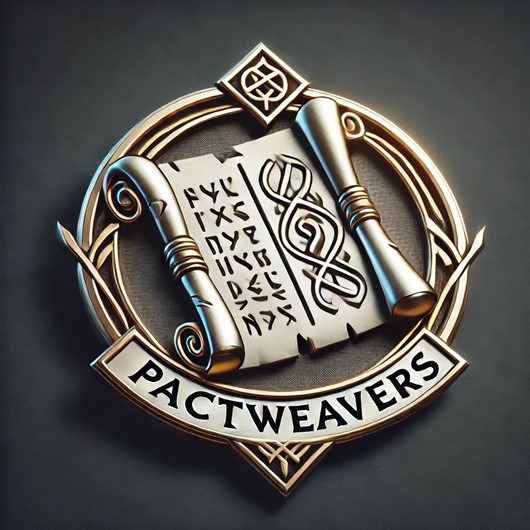
Badge and Rank Symbol: The badge worn by members of the Pactweavers is an intricate pin in the shape of an open scroll, symbolizing the agreements and pacts that the faction specializes in. The scroll is adorned with delicate runes representing the words and intentions behind the deals.
- Negotiation Novice: The badge of a Novice features an open scroll with a single rune inscribed upon it, symbolizing their initiation into the art of negotiation.
- Dealbroker: Dealbrokers wear a badge with multiple runes neatly arranged along the scroll, representing their growing expertise in crafting multi-faceted agreements.
- Diplomatic Arbiter: Diplomatic Arbiters’ badges have the scroll adorned with intertwined runes, depicting their mastery in navigating intricate disputes.
- Emissary of Accord: The badge of an Emissary of Accord features the scroll with elaborate runes that form a harmonious pattern, symbolizing their ability to shape significant agreements.
Each badge is unique to the individual member, often enchanted with minor magical effects related to communication, empathy, or influencing negotiations.
Enemies and Rivals:
- The Mercantile Guild:
- The Mercantile Guild is a powerful faction driven by profit and economic dominance.
- Conflict arises due to the fundamental clash between the Pactweavers’ focus on equitable agreements and the Guild’s pursuit of maximizing gains.
- The Sovereign Envoys:
- The Sovereign Envoys are a group of diplomats who prioritize the interests of rulers and powerful entities above all else.
- Conflict emerges from the differing priorities of the Pactweavers, who aim for balance, and the Envoys, who seek to advance the agendas of their patrons.
Conflicts: The conflicts between the Pactweavers and their enemies stem from the differing values and motivations of each faction. The Pactweavers’ emphasis on fairness and harmony clashes with the profit-driven agenda of the Mercantile Guild, while their commitment to balanced agreements contradicts the Sovereign Envoys’ loyalty to powerful rulers. These differences lead to confrontations during negotiations and diplomatic endeavors.
Interactions: Interactions between these factions are often marked by tense negotiations and strategic maneuvering. Pactweavers might find themselves in challenging situations where they need to navigate both the economic pressures imposed by the Mercantile Guild and the political influences wielded by the Sovereign Envoys. Meetings between these factions can involve both subtle verbal sparring and overt displays of power.
Consequences: The conflicts between these factions have far-reaching consequences for the world of Saṃsāra. The tension between the Pactweavers and the Mercantile Guild can lead to economic imbalances and exploitation, as well as disruptions in trade and resource allocation. Conflicts with the Sovereign Envoys can result in strained diplomatic relations, political instability, and the manipulation of realms for the benefit of powerful figures. The outcomes of these conflicts shape the balance of power and the direction in which Saṃsāra evolves, influencing both individual lives and the broader tapestry of destiny.
The Unbreakable Pact
Tale of the Pactweavers
In the intricate world of Saṃsāra, where destinies are woven through the threads of agreements and promises, there exists a tale that embodies the essence of negotiation and the power of a well-crafted pact. This is the story of the Pactweavers.
Many centuries ago, in a time of great turmoil and conflict, the realms of Saṃsāra were on the brink of war. Disputes over resources, territory, and power had reached a boiling point, and it seemed inevitable that the world would be plunged into chaos. Amidst this tension, a mysterious figure known as Seraphis emerged. Seraphis, a master negotiator and diplomat, saw an opportunity to use the art of bargaining to bring about peace and stability.
Recognizing the need for a faction dedicated to maintaining balance through agreements, Seraphis founded the Pactweavers. This faction comprised individuals who possessed an innate talent for understanding the intricacies of human nature and the power dynamics of negotiation. They believed that every interaction was an opportunity to influence outcomes and that a well-crafted deal could alter the paths of individuals and realms alike.
The most renowned tale of the Pactweavers centers on “The Unbreakable Pact,” a legendary agreement forged by Seraphis during the height of the conflict. As tensions reached their peak, Seraphis called for a grand summit, inviting leaders from all the warring factions to a neutral ground. The summit took place in the Great Hall of Mirrors, a majestic and reflective space where truths could not be hidden, and intentions were laid bare.
For days, Seraphis mediated intense negotiations, listening to each faction’s grievances and aspirations. Using their keen insight and persuasive abilities, Seraphis began to weave a complex tapestry of promises and compromises. They ensured that no single party gained too much advantage and that the terms of the agreement were fair and just. Through subtle enchantments woven into their words, Seraphis guided the leaders towards a consensus, fostering a spirit of cooperation and mutual respect.
The culmination of the summit was the signing of the Unbreakable Pact, a monumental agreement that bound the factions to terms of peace, resource sharing, and mutual defense. The pact was inscribed on an enchanted scroll, imbued with magic that ensured its terms could not be broken without dire consequences. This powerful enchantment symbolized the sanctity of oaths and the importance of upholding one’s word.
With the Unbreakable Pact in place, the realms of Saṃsāra entered a new era of harmony and prosperity. The Pactweavers, under Seraphis’s leadership, continued to play a vital role in maintaining this balance, guiding negotiations and brokering deals that prevented conflicts and encouraged collaboration.
The tale of “The Unbreakable Pact” became legendary, a testament to the power of negotiation and the skill of the Pactweavers. It is said that the Great Hall of Mirrors still stands, a sacred place where agreements are forged, and destinies are shaped.
Moral of the Story: In a world where conflicts and ambitions often clash, the art of negotiation and the power of a well-crafted agreement can bring about peace and stability. Through fairness, understanding, and the sanctity of promises, even the most dire situations can be transformed into opportunities for harmony and cooperation. The legacy of the Pactweavers reminds us that true influence lies not in domination, but in the ability to shape destinies through equitable and just agreements.