
From: Lineage 5821 of the Kaelic Veilweavers
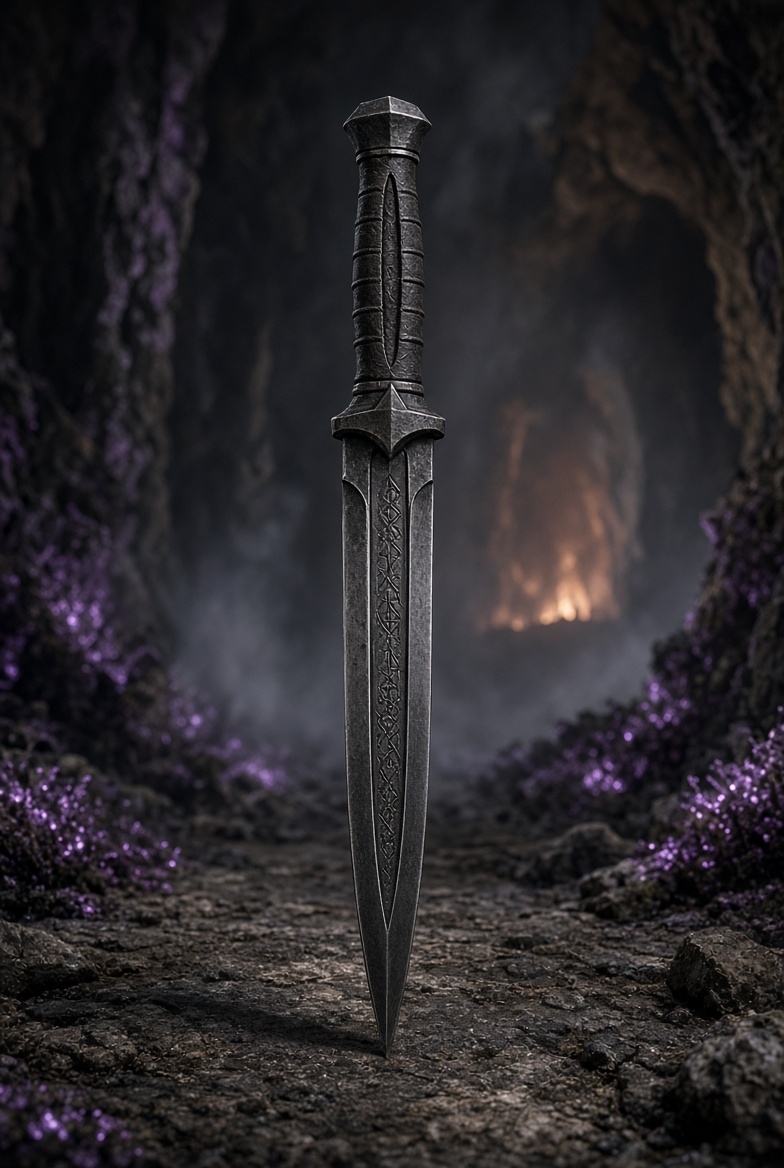
This short blade measures approximately eighteen inches in length with a tapered point and a reinforced tang that joins a contoured grip. The cutting edge is formed from shadow-infused metal that accepts fine Tar-Mark carvings along the fuller. The grip includes a recessed channel for the avatar’s elongated fingers during minor biological adaptation allowing stable control while the nictitating membranes remain clear. When held the weapon supports Tar-Sef articulation for minor guidance of the point toward a studied target. Base damage follows the fundamental rules of a simple edged implement with the tier one die of one d4 passing through on a successful roll to hit. The item’s resilience contributes to its hit points calculation as avatar maximum plus resilience times tier and it unattunes if struck while held. Construction draws on Renaissance-era refinement of ancient Sef-Kal tanged points adapted for steam-forge finishing.
Precision Tar-Blade 4719 was refined in the steam forges of Shadowdeep from the earlier tanged stone and bone points of the Sef-Kal. The eighteen-inch length and tapered point were retained so that the blade could serve both as a close implement and as a focus for directed Tar-Sef phrases. Shadow-infused metal replaced earlier materials after Renaissance artisans learned to set the alloy so that fine Tar-Mark sequences could be carved along the fuller without weakening the edge. The reinforced tang was shaped to lock into a contoured grip that included a recessed channel sized for the temporary elongation of Verran fingers. This channel allowed the wearer to maintain a stable hold during minor biological adaptations while the nictitating membranes stayed clear for visual tracking. The blade was finished so that a spoken Tar-Sef sequence could produce a minor guidance effect on the point toward a target the wielder had already studied. Testing in cavern passages and on barge decks confirmed that the weapon remained balanced for the lithe Verran frame and that the guidance effect functioned without requiring additional attunement beyond the act of holding. The design stayed fully practical and free of excess ornament that would catch on cavern stone or dock fittings.
• Tier one stats place the item at Common rank with a resilience of six. Hit points equal the possessing avatar’s maximum hit points plus six. Base damage is that of a simple edged implement with the tier one die of 1d4 passing through on a successful roll to hit. The blade is a held weapon and becomes attuned automatically while gripped. It unattunes if struck while held or if released. It does not occupy a worn armor slot and does not count against the ten-attuned-item limit in the same manner as worn pieces while actively held. Armor Check contribution is zero.
• Skills gained while openly worn or held include two temporary points in Tar-Sef Articulation and one temporary point in Precision Crafting. These points remain active only while the blade is held and do not count against the character’s maximum trained skill level of six at tier one. The points support directed guidance phrases and fine control of the point during use.
• Multiple passives magic consist of continuous readiness of the Tar-Mark carvings so that a spoken sequence can influence the point without a separate preparation action. A second passive maintains the grip channel in a state that accepts elongated fingers without shifting the balance of the blade. A third passive keeps the edge aligned for the tier one damage die to pass through cleanly on a hit.
• Multiple activatable magics include a once-per-turn ability to speak a short Tar-Sef phrase that grants minor guidance to the next attack roll made with the blade against a studied target. A second activatable requires an action to adjust the grip channel through bio-alchemical feedback so that the hold remains stable during a simultaneous form adaptation for one minute. A third activatable permits the wielder to focus for six seconds and refresh the Tar-Mark alignment granting the guidance effect on the following attack even if the prior phrase was interrupted with the effect lasting until the next long rest.
• Specific slot is the held weapon slot. The blade occupies one hand while in use and may be sheathed at the waist or back without occupying an armor slot when stored. Only one such primary blade is carried in active readiness.
Tags: Tar-Blade, Shadow Metal, Fuller Mark, Finger Channel, Point Guide, Tanged Tang, Steam Finish, Sef-Kal Refine, Held Focus, Edge Pass, Grip Stable, Eighteen Inch, Tapered Tip, Reinforced Join, Recessed Hold, Membrane Clear, Studied Target, Die Pass, Forge Alloy, Balance Keep, Phrase Ready, Cavern Practical
Acquisition and Commerce of Precision Tar-Blade 4719
• The Precision Tar-Blade 4719 is produced in Shadowdeep steam forges by artisans who finish shadow-infused metal and carve Tar-Mark sequences along the fuller. An avatar obtains one by completing downtime assistance with tang setting and grip channel forming then receiving the finished blade from the supervising smith after a guidance test against a practice target. Crown or guild tasks that require close precision work sometimes issue the blade as equipment retained after the report or sample is delivered. Lineage members who have deposited a conduit may request a personal blade in exchange for additional etching work on other tools. These routes depend on standing and completed labor rather than immediate coin payment.
• Family shops in the upper cavern levels and along the arteries stock blades made by resident metal workers. These shops occupy rooms adjoining small forges where the proprietor and relatives shape and mark the edges. An avatar purchases by presenting coin or World Bank transfer after the seller notes any lineage seal. Suggested values in interior locations commonly range from fifteen to thirty gold after the one percent World Bank fee with the amount set by stock and demand from close-action users. City entry adds the one percent island tax and state borders add the five percent levy.
• Coastal shops in Ironfang Harbor and Hydra’s Embrace are run by relocated forge workers. These outlets sit near docks and display blades with other short implements. Purchase follows standard payment. Suggested values rise with transport and typically fall between twenty-five and forty gold after fees and the three percent city tax. Sellers may request a brief handling demonstration. Cove stalls on the Obsidian Coast occasionally offer blades from outside normal channels and accept only physical gold at full or higher rates without bank records.
• Resale occurs at the same shops or with road merchants. The receiver inspects the edge Tar-Marks and grip channel then offers a return based on remaining keenness and local need for guided short blades. Interior shops commonly return eight to fifteen gold after fees and taxes. Coastal shops return lower amounts due to transport costs and may decline blades if recent forge output has increased supply. All exchanges follow sellers’ market conditions with no fixed price by tier and with the figure set by the proprietor’s judgment of availability.
Roleplay Applications of Precision Tar-Blade 4719 Across Environments
• In the deep cavern passages and forge approaches of Shadowdeep the blade supports defensive action by allowing a Tar-Sef phrase to guide the point toward an approaching figure whose movement has already been registered through other senses. The wielder may speak the short sequence and meet the closing distance with a controlled thrust while the nictitating membranes remain clear. The grip channel keeps the hold stable if a minor form adaptation occurs during the exchange. Offensively the same guidance effect permits a precise strike against a studied target in low light or mist once the phrase is completed. The tier one die passes through on a successful hit. The blade can be returned to a waist sheath within the same action sequence if needed.
• Along river barge decks and loading edges the blade functions amid motion and spray. Defensive use involves the guided point to intercept a reaching arm or tool while the wielder maintains balance on the shifting surface. The recessed channel accepts elongated fingers without loss of control. Offensively a studied crew member or shore figure can be engaged with the phrase providing minor assistance to the attack roll before the die is applied. The short length keeps the weapon practical in the confined space between cargo and rail.
• On the Mistral Uplands and rocky approaches the blade serves in more open but uneven ground. Defensive application includes a guided parry or short thrust against a closing resilient creature or patrol member whose position was confirmed by prior observation. The balance of the tang and grip supports quick recovery after the action. Offensively the phrase and point combination allows a measured strike once the target has been studied from a rise or behind cover. The weapon remains fully manageable for the lithe frame during movement across the plateau.
• In the coastal districts of Ironfang Harbor and the platforms of Hydra’s Embrace the blade operates among crowded or wet stone areas. Defensive roleplay centers on the guided point to deter or meet a close approach between stacks or under lifts. The clear membranes and stable grip aid in tracking during the brief exchange. Offensively the same features support a precision action against a studied individual once the Tar-Sef phrase is spoken. All uses remain within tier one limits the action economy in which the attack and any sheathing occur appropriately and the fundamental rule that the tier die passes through on a hit.
Perception of Activation:
• User’s Perspective registers as a light alignment along the fuller when the Tar-Sef phrase is spoken. The point feels a subtle directional pull toward the studied target that does not override the wielder’s own arm motion. The recessed grip channel firms slightly if fingers elongate during the same moment keeping the hold consistent. Extra-sensory impressions include a brief silver line extending from the tip to the target visible through the Mind’s Eye and a clear numerical sense of the tier die readiness. The nictitating membranes stay clear and visual tracking of the target remains steady. The refresh focus produces a short settling vibration in the tang that confirms the carvings are prepared for the next use.
• Observer’s Perspective shows no large visual change in the dark metal though the Tar-Mark carvings may catch a faint edge of light during the phrase. The blade moves with the wielder’s arm in a controlled arc or thrust. No sound beyond the spoken clicks is produced by the weapon itself. Extra-sensory observers with relevant senses note a minor sharpening of the point’s path. Those using true sight perceive a brief ultraviolet trace along the fuller that fades after the attack. The blade does not alter the wielder’s exposed skin or overall stance beyond normal weapon use.
• Positives include the minor guidance that assists the attack roll against a previously studied target without requiring a separate full action beyond the phrase. The grip channel maintains control during simultaneous minor form adaptations. The tier die passes through cleanly on a successful hit. The weapon remains balanced and practical in confined cavern or deck spaces. The membranes stay unobstructed for continued visual confirmation of the target.
• Negatives include the requirement that the target must already have been studied for the guidance to apply. The phrase must be completed without interruption or the effect does not occur. Overlapping the guidance with a rapid grip adjustment can produce a momentary uncertainty in the point’s path until the channel settles. The extra-sensory silver line fades immediately after the attack and leaves a residual lightness in the wrist until the next action. Repeated uses in a short period reduce the clarity of the guidance so that later phrases provide less directional assistance.
Recipe for Precision Tar-Blade 4719
• Materials needed consist of a length of shadow-infused metal sufficient for an eighteen-inch blade with tapered point and tang. Material for a contoured grip that can be shaped with a recessed channel. Fine tools or prepared sequences for carving Tar-Mark along the fuller. A small measure of forge flux or setting compound for the tang join. Mineral residue if used in the final steam finish.
• Tools Required include a steam forge or equivalent heat source for shaping and finishing the metal. Cutting and grinding implements for the point edge and tang. A carving stylus for the Tar-Mark sequences. Clamps and forms for setting the grip. Measuring guides for length and balance. A test surface or practice target for final guidance check.
• Skill Requirements call for a minimum of six points in Precision Crafting to form the edge tang and channel. Four points in Tar-Sef Articulation to set and test the guidance carvings. Two points in related metal or weapon finishing. Access to a functional steam forge. The crafter must produce a blade that accepts the tier one damage transmission.
• Crafting Steps begin with forging the shadow-infused metal into the tapered blade and reinforced tang under controlled steam heat. The fuller is ground and the Tar-Mark sequences are carved while the metal is still workable. The contoured grip is formed and the recessed channel is cut to accept elongated fingers then joined securely to the tang. The edge is finished and balanced for the intended length. A spoken Tar-Sef sequence is tested against a practice target to confirm minor guidance occurs. Final inspection ensures the point tracks cleanly and the grip remains stable. The completed blade is then ready for use as a held weapon.
Short Blade That Knew Studied Place
In the time before the forges counted their heat and the stone points had only begun to take the bright metal there was a shaper of edges whose hands were called by the old ones the Carver of the Knowing Point. This one worked where the steam first touched the beaten metal and the light was low. The Carver took the length of shadow metal that would hold an edge and the material for the hold that would fit the changing fingers and the sequences that could be set into the fuller. These the Carver laid on the flat rock and spoke the short clicks that the striking stone made when it met the mark.
For many cycles the Carver worked. The metal was drawn to the length of a forearm and a half and brought to the tapered point. The tang was set strong so that the hold would not shift. The channel was cut in the grip so that the fingers could lengthen and the blade would still track. The sequences were carved along the fuller so that a spoken click would turn the point a small measure toward a place the eyes had already held. When the blade was given to a young hunter the hunter studied the shape on the far stone and spoke the clicks. The point moved with the arm and met the place more cleanly than the arm alone had done. The blade stayed and the membranes of the eyes remained clear.
Other hands tried the shaping. Some made the point too long and the balance failed in the narrow hollow. Some cut the channel too deep and the grip turned when the fingers changed. Some carved the sequences in the wrong order and the point pulled away from the studied place. These blades were set in the side cracks where the steam gathered and no one carried them. The Carver watched. Only when new hands repeated the drawing and the cutting and the carving in the same order did the Carver allow another blade to leave the rock.
The word of the short blade that knew the studied place moved through the hollows and onto the barges. A watcher used one and the point met the reaching hand more surely after the clicks were spoken. A hunter on the high grass used one and the dart-like thrust found the beast after the shape had been held in the eyes. Each time the spoken sequence brought the small guidance and the tier measure passed through when the point arrived.
Then a group in a deep hollow thought the blade could be made to know a place that had not been studied and to pull harder than the arm. They carved extra sequences and they spoke the clicks longer and louder. The blade they made shone along the fuller. They gave it to their surest changer and sent the changer against a shape that had not been watched. The point pulled. The arm followed too far. The changer struck the stone beside the shape and the return shook the hold. The blade remained in the hand and the changer did not strike true again in that place.
The others found the blade and carried it to the upper rock where the Carver had worked. They spoke no more clicks over it. From that day the shapers used only the measure of sequences the Carver had used. They taught the young ones to study the place first and to speak the short clicks and never to ask the point to know what the eyes had not held or to pull beyond the arm’s own reach.
The blade that had pulled too far was left on the rock. Later when the forges were many and the air-ships passed above the mountains the rock was still there. Travelers said that if one stood close a faint tug would be felt in any short blade held nearby and that the tug warned of any attempt to strike a place not first studied. None carried the blade. The story was told whenever a new Tar-Blade was finished so that the hands which carved the fuller would remember the measure of the studied place.
The moral of the story is that the short blade which knows the studied place will serve only while the hands that make it keep to the first measure and do not ask the point to find what has not been held in the eyes or to move beyond the reach of the arm that holds it.
Suggested conversions to other systems:
Call of Cthulhu Seventh Edition Adaptation
Guided Point Knife
This item is an eighteen-inch short blade with a contoured grip. While held it grants a bonus die on Fighting Brawl rolls made against a target the wielder has already observed closely in the current scene. The blade deals 1D4 plus damage bonus damage. Once per scene the wielder may spend a point of Luck to gain an additional bonus die on a single attack against that studied target. The knife has 6 hit points and is destroyed if reduced to zero while held. It counts as a standard melee weapon for encumbrance and may be sheathed normally. Benefits apply only while the weapon is in hand.
Blades in the Dark Adaptation
Marked Edge
This is a fine quality short blade that provides +1d to any Skirmish roll made against a target the wielder has had the opportunity to study. The blade may be held in one hand. While equipped the wielder may push themselves on an attack that uses the guidance without additional stress. Once per score the wielder may activate the markings to ignore the first level of complication on a precision strike against a studied opponent. The item has a quality rating of fine and follows standard weapon damage and repair rules. It occupies a normal weapon load.
Dungeons and Dragons Fifth Edition Adaptation
Tar-Marked Shortsword
Weapon common. This shortsword deals 1d6 piercing damage. While held the wielder gains a +1 bonus to attack rolls made against a creature they have observed for at least one minute during the current encounter. Once per short rest the wielder may use a bonus action to speak a guiding phrase and gain advantage on the next attack roll made with the blade against that studied target. The weapon has AC 12 and 15 hit points. It is destroyed if reduced to 0 hit points. It weighs 2 pounds and may be drawn or sheathed as part of an attack action. Benefits apply only while wielded.
Knave Second Edition Adaptation
Studied Point Blade
This is a one-handed blade with a damage value of d6. While held the wielder adds their Intelligence modifier to attack rolls made against a target they have studied in the current scene. Once per day the wielder may spend an action to focus and gain advantage on the next attack against that target. The item has 6 item hit points and is destroyed if reduced to zero. Repair costs half the original value. The blade occupies one hand and one inventory slot when sheathed. Benefits require it to be held.
Fate Core Adaptation
Knowing Edge
This is an aspect-bearing short blade that may be invoked when the wielder is attacking a target they have had the chance to study. The blade is held in one hand. While equipped it provides a free invoke once per session on any Fight roll against a studied opponent. The wielder may spend a fate point to gain an additional benefit on a single precision attack against that target. The item has a stress track of one box. If marked it is damaged and loses the free invoke until repaired with a Crafts overcome. Repair requires a scene and materials. The blade follows normal weapon stress rules when used in conflicts.
Numenera and Cypher System Adaptation
Markguided Knife
Level 3 artifact or light weapon. This short blade depletes on a roll of 1 on a d6 after each use of the active guidance. While held it grants an asset on any Speed attack task made against a target the wielder has studied in the current encounter. As an action the wielder may activate the markings to gain an additional asset on the next attack against that target. The item occupies one hand and follows standard weapon damage. Benefits end if the blade is no longer held or is depleted. Recharge requires a crafting task with metal and marking components.
Pathfinder Second Edition Adaptation
Precision Tar Blade
Item 3 weapon. This shortsword deals 1d6 piercing damage and has the agile and finesse traits. While wielded the wielder gains a +1 item bonus to attack rolls against a creature they have observed for at least one minute in the current encounter. Once per day as a single action the wielder may focus and gain a +2 circumstance bonus on the next attack roll against that target. The weapon has Hardness 4 and 12 Hit Points. It is destroyed at 0 Hit Points. It has a Bulk of L and may be drawn as part of an attack. Benefits apply only while held.
Savage Worlds Adventure Edition Adaptation
Guided Short Blade
This is a short blade that deals Str+d4 damage. While held the wielder gains a +1 bonus to Fighting rolls made against a target they have studied in the current scene. Once per session the wielder may spend a Benny to gain an additional +2 on a single attack against that studied target. The item has Toughness 4 for targeting purposes and is destroyed if it takes a Wound while held. Repair requires a Repair roll and materials. The blade occupies one hand and follows standard melee weapon rules.
Shadowrun Sixth World Adaptation
Marked Precision Blade
This is an Availability 6 item with a cost of 1,500 nuyen. It is a short blade that deals (STR/2 + 1)P damage. While held the wielder gains a +1 dice pool bonus to Close Combat tests made against a target they have observed closely in the current scene. As a Simple Action once per scene the wielder may focus to gain an additional +2 dice pool bonus on the next attack against that studied target. The item has a Structure rating of 4 and is destroyed if reduced to zero while held. It may be sheathed normally and follows standard melee weapon rules. Benefits apply only while the blade is in hand.
Starfinder Adaptation
Tarpoint Knife
This is a level 3 one-handed weapon that deals 1d4 piercing damage. While wielded the wielder gains a +1 insight bonus to attack rolls against a creature they have studied for at least one minute in the current encounter. Once per day as a move action the wielder may activate the markings to gain a +2 bonus on the next attack against that target. The weapon has 12 hit points and hardness 3. It is destroyed at 0 hit points. It has a bulk of L and may be drawn as part of an attack. Benefits apply only while held.
Traveller Second Edition Adaptation
Guided Short Blade
This is a melee weapon with a cost of Cr 300 and a mass of 0.5 kg. It deals 1D damage. While held the wielder gains a DM+1 on Melee checks made against a target they have observed in the current scene. Once per day the wielder may focus as a minor action to gain an additional DM+1 on the next attack against that studied target. The item has 6 hits and is destroyed at zero. Repair requires a basic Mechanic or Gunsmith-equivalent check. It occupies one hand and follows standard blade rules. Benefits require it to be held.
Warhammer Fantasy Roleplay Fourth Edition Adaptation
Studied Edge Knife
This is an Average quality short blade with an Encumbrance of 0. It deals SB+2 damage. While held the wielder gains a +10 bonus to Melee Tests made against a target they have studied in the current encounter. Once per day the wielder may spend an Action to focus and gain an additional +10 bonus on the next attack against that target. The item has 5 Wounds and is destroyed at zero. Repair requires a Trade Test. It may be sheathed at the belt and functions only while wielded.