
Lore
- In the maritime skirmishes between the coastal states of Banpo and Badarian, skirmishers often struggled to coordinate attacks with two separate weapons while maintaining defensive balance. Traditional martial traditions required extensive physical coordination, often leaving the off-hand weapon clumsy, delayed, or out of tempo. An eccentric weaver-artisan versed in ancient Seiðr traditions observed that a seamstress effortlessly directs two hands across warp and weft simultaneously while in a rhythmic trance. Adapting this metaphysical insight, the artisan forged a pair of balanced parrying daggers designed to function as an interconnected spiritual loom. By entering a shallow Seiðr meditation during combat, the wielder perceives the trajectories of both hands as parallel threads woven into the fabric of battle. The twin blades harmonize their motion through ambient planar currents, allowing an entry-tier adventurer to wield both weapons in complete synchronization without their strikes colliding or their defenses opening. Over generations, these matched blades became cherished training implements and sidearms for scouts, duelists, and vanguard skirmishers across the archipelago.
Description
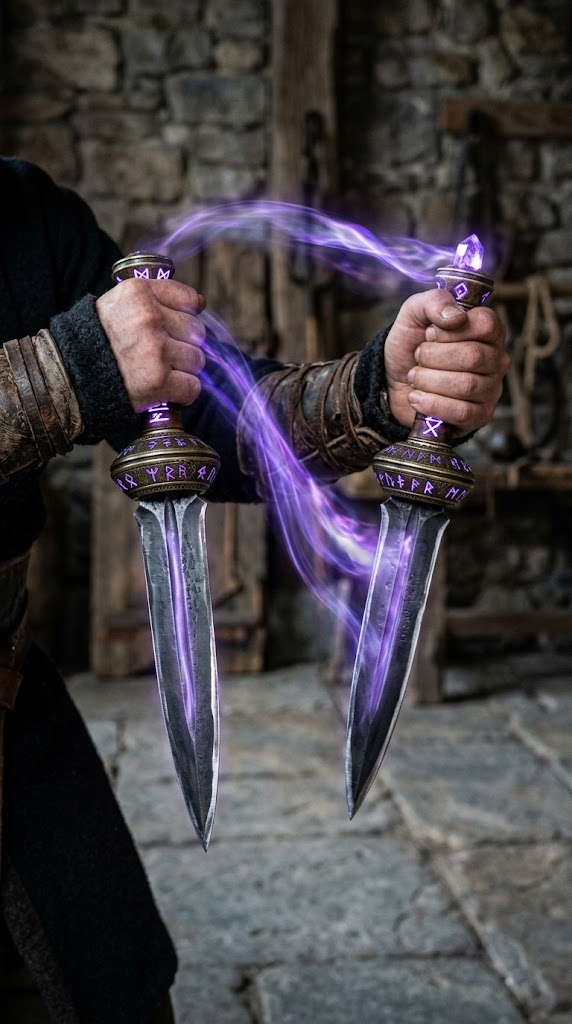
- The item consists of a matched pair of eleven-inch straight-edged parrying daggers forged from folded bog-iron, with edges ground to a keen, leaf-shaped taper. Rather than standard crossguards, each hilt features a solid brass drop-spindle whorl that acts as a weighted counter-balance, etched with spiraling northern Seiðr runes. Inlaid fine silver wire travels up both grip wraps and along the central fuller of each blade, terminating near the points. Embedded in the pommel cap of the primary blade is a coin-sized, coin-weight Tier 1 magic crystal, linked to its twin dagger by a faint, translucent tether of purple-violet planar mist that extends between the pommels when drawn. When held together in a fighting stance, the blades emit a soft, continuous humming sound reminiscent of two spinning wheels turning at identical speeds, accompanied by a faint scent of dry cedar and ozone.
Detailed Stats
- Item Tier: Tier 1
- Item Rarity: Common
- Item Resilience: 10
- Item Health Points: Avatar maximum hit points plus 10
- Armor Check: +1 Armor Check while actively wielding both blades in separate hands (capped within Tier 1 limits)
- Weapon Base Damage: 1d4 piercing or slashing per blade plus character Tier Die
- Weight: 2 pounds total (1 pound per dagger)
- Operational Lifespan Check: When an activated magical ability is concluded, roll 1d20; on a roll of 1, the internal crystal shatters into crystal shards of equivalent weight.
- Attunement Requirement: Held attunement is instantaneous upon grasping both hilts; otherwise requires a simple attunement duration of 1 minute.
- Commercial Valuation: Suggested trade benchmark is 15 silver coins for the matched pair, subject to localized seller discretion, regional weapon availability, and merchant haggling.
Specific Slot
- Hand Slot (Left and Right Hand Slots; occupies both hands as a matched set)
Passive Magic
- Rhythmic Weft Cadence: While both blades are held openly in the avatar’s left and right hands, the user enters a passive Seiðr equilibrium that eliminates off-hand awkwardness. The wielder’s secondary arm mirrors the strength, precision, and agility of the primary arm, treating both limbs with equal dominant proficiency during two-weapon combat.
- Harmonized Guard Deflection: When both daggers are held in a defensive stance, the silver runic conduits create a subtle magnetic-like resonance between the blades. Crossing or angling the twin edges naturally guides incoming melee strikes into the reinforced brass whorls, granting the avatar a passive +1 Armor Check bonus against physical attacks.
- Thread-Tether Retention: The metaphysical planar cord connecting the two pommels prevents disarming. If one dagger is knocked or pulled from the wielder’s grip, it snaps back into the wielder’s open hand at the end of the current action, provided the opposing dagger remains firmly held.
Activable Magic
- Twin-Spindle Flurry: The avatar spends one full action chanting a two-word rhythmic incantation, entering an accelerated three-second Seiðr trance. The wielder executes a synchronized double strike, attacking with both the primary and secondary blades in a single fluid motion. The first strike applies full damage (base weapon plus Tier 1 tier die), while the synchronized second blade hits as part of the same action at half damage, without requiring a separate weapon retrieval or sheathing sequence.
- Cross-Spindle Snare: When targeted by an incoming melee weapon strike, the avatar spends an action to prepare a reaction, entering a focused defensive focus. When the triggering blow lands, the avatar catches the enemy weapon between the intersecting fuller grooves of the twin blades with an audible brass chime. If the user’s opposed check succeeds, the attacker’s weapon is momentarily bound in the runic lattice, reducing the attacker’s available actions by one on their next turn.
- Loom-Severing Cleave: By expending one full action and chanting a focused verse of thread-cutting lore, the avatar sweeps both blades outward in an scissor-like crosscut. The edges discharge a concentrated wave of planar force in a five-foot frontal arc. Hostile entities caught within the path take normal weapon base damage plus Tier 1 tier-die damage, and any mundane ropes, entanglement nets, or webbing within the strike area are instantly severed.
- Unison Feint Alignment: The user concentrates for one action while engaging an opponent in melee, using the Mind’s Eye to divine the foe’s defensive reaction to the primary dagger. The wielder leads with a theatrical flourish of the primary blade to draw the target’s parry, while the off-hand dagger shifts along a complementary trajectory to strike the exposed flank. The avatar gains advantage on the resulting attack roll against the target.
Tags
- blades, brass, daggers, dual-wielding, martial, melee, off-hand, parry, runes, seiðr, spindle, twin, ambidexterity, bog-iron, combat, coordination, dueling, fuller, guard, offhand, synchronization, tactics, weapons
Commercial Outlets, Trade Venues, and Pricing for the Twin-Spindle Loom-Blades
- Duelists’ Armories and Fencing Ateliers:
- Located within the refined upper districts, academy plazas, and tournament squares of major city-states like Banpo and Badarian.
- These bespoke weapon halls cater to formal duelists, courtly champions, and martial students seeking precision sidearms rather than heavy battle axes. The masters of these shops are veteran sword-dancers and retired arena combatants who appreciate the metaphysical synchronization of paired blades.
- Buying Here: The daggers are displayed within velvet-lined glass cases, marketed as an elite paired set for ambidextrous martial forms. Due to the high prestige, precision edge honing, and custom leather scabbards included, the purchase price ranges from 18 to 22 silver coins. If the purchasing avatar holds a recognized title or membership in a recognized dueling guild, a standard faction discount reduces the cost to around 16 silver coins.
- Selling Here: The weaponsmith examines the balance, tests the tension of the silver runic inlay, and checks the bog-iron edge for micro-fractures. Because atelier masters maintain high standards for resale, they will offer an appraisal payout of 11 to 12 silver coins, deposited directly to the seller’s World Bank ledger.
- Frontier Garrison Armories and Mercenary Supply Posts:
- Situated along contested coastal borders, perimeter fortresses, and waystation garrisons along dangerous caravan routes.
- These rugged, practical depots supply vanguard scouts, light skirmishers, and frontier mercenaries who need versatile close-quarters weapons that double as defensive parrying tools in narrow trenches or dense forest skirmishes.
- Buying Here: The blades are sold unpolished in oilcloth wraps as functional military surplus. Because frontier supplies rely on irregular trade caravans, the price fluctuates between 14 and 16 silver coins. Quartermasters prefer payment in standard silver coinage or practical trade scrip.
- Selling Here: Frontier quartermasters are eager to purchase matched dual-wielding sidearms to equip light scouts. They assess the functional condition of the Tier 1 pommel crystal and the brass whorls, offering 10 to 11 silver coins in cash or store credit toward military rations and ammunition.
- Seiðr Weavers’ Lodges and Mystic Craft Sanctuaries:
- Tucked away in quiet coastal fishing villages, rural stone enclaves, or holy grove compounds where traditional northern trance arts are practiced.
- Run by elder seidr-wives, ritual artisans, and rune-carvers, these sanctuaries produce weapons treated as sacred instruments of rhythmic balance rather than mere implements of bloodshed.
- Buying Here: Avatars seeking the blades must demonstrate respect for northern ritual crafts. The keepers do not mark up goods for raw profit, offering a freshly bound pair at the standard benchmark of 14 to 15 silver coins. They will often waive a portion of the coin cost in exchange for rare craft materials such as fine silver wire or seasoned ashwood billets.
- Selling Here: If an avatar brings in a pair of loom-blades, the artisan uses their Mind’s Eye to ensure the spiritual resonance between the two pommels remains unbroken. An undamaged set will fetch 10 to 12 silver coins in direct trade, particularly if accompanied by spare Tier 1 crystal catalysts.
- Harbor Fences and Smugglers’ Bilges:
- Concealed in dockside tavern basements, derelict hulks moored in pirate coves, or shadowed alleys near international shipping wharfs.
- These illicit dealers trade in salvage taken from captured merchant sloops, raided outposts, and privateers who favor fast, concealable blades for tight-quarters shipboard boarding actions.
- Buying Here: Smugglers appreciate the tether retention magic, which prevents blades from being dropped into the sea during rough-water brawls. They demand a steep markup for untracked weapons, charging between 20 and 25 silver coins (or 2 gold coins) in physical coin, strictly refusing official bank transfers.
- Selling Here: Black-market brokers buy paired daggers quickly because they are easy to smuggle and highly sought after by cutpurses and deck skirmishers. A seller will receive 8 to 10 silver coins in untraceable, hand-to-hand silver coin.
- Municipal Bazaars and Curio Pawnshops:
- Located within central urban trade plazas, general flea markets, and pawnbroker stalls near city gates.
- These chaotic general trade stalls deal in mixed secondhand arms, estate liquidations, and miscellaneous items sold by desperate travelers needing passage fare.
- Buying Here: Blades found here are often sold mismatched or dusty, sometimes misidentified by the pawnbroker as eccentric carving knives or weaving shuttles. Depending on the merchant’s awareness of Seiðr enchantment, a sharp buyer can pick up the pair for a bargain price of 12 to 14 silver coins.
- Selling Here: Pawnbrokers drive hard bargains to maximize profit margins and cover stall licensing taxes. A seller will typically be offered only 7 to 9 silver coins, transferred to their ledger once terms are agreed upon.
Combat Tactics and Environmental Applications of the Twin-Spindle Loom-Blades
- Confined Urban Alleys and Crowded Taverns:
- Environmental Context: Narrow cobbled lanes, tenement stairwells, and tavern common rooms are choked with overturned tables, hanging laundry lines, low ceilings, and tight crowds where broadswords or polearms catch upon the scenery.
- Defensive Roleplay: Trapped against a brick wall or jammed into a corner by thugs, the wielder holds the daggers close to the chest in a mirrored high-low guard. When a ruffian thrusts with a short sword or swings a broken bottle, the avatar executes the Cross-Spindle Snare. The heavy brass whorls catch the incoming strike within the intersecting fuller grooves with a ringing chime, binding the opponent’s weapon arm and pinning it against a doorframe to strip away their follow-up action.
- Offensive Roleplay: Operating in spaces too confined for wide swings, the avatar enters the shallow trance of the Twin-Spindle Flurry. Because the Rhythmic Weft Cadence eliminates all off-hand delay, the wielder slips inside the guard of an over-extended brawler, driving the primary point beneath the ribs while the secondary blade slices the forearm in a single, simultaneous rush that bypasses close-quarters crowding penalties.
- Swaying Ship Decks, Rigging, and Coastal Wharf Skirmishes:
- Environmental Context: Slippery, wave-tossed timber decks, wind-whipped rope rigging, and wet dock pilings present continuous hazards of tripping, disarming, and falling overboard into churning salt water.
- Defensive Roleplay: While balancing along the gunwale of a pitching cutter during a storm, the avatar relies on the Thread-Tether Retention. When a boarding harpoon or heavy cutlass strikes the avatar’s off-hand with enough force to jar fingers loose, the dagger does not tumble into the sea; the violet planar tether instantly snaps the hilt back into the open palm before footing is lost. The wielder crosses the blades against incoming halberds to engage Harmonized Guard Deflection, turning the momentum of rolling waves into leverage that pushes boarders backward.
- Offensive Roleplay: When defending against raiders boarding via grappling lines or weighted boarding nets, the wielder triggers the Loom-Severing Cleave. Sweeping the twin blades forward like open shears, the discharged arc of planar energy shears through heavy hemp lines, wet netting, and canvas ropes simultaneously, sending climbing raiders splashing into the sea while cutting a path through the vanguard.
- Dense Bramble Forests and Murky Swamps:
- Environmental Context: Tangled mangrove roots, hanging creeping vines, thick thorn thickets, and knee-deep mud bog down footwork and foul traditional weapon draw cuts.
- Defensive Roleplay: Ambushed in a swamp thicket by leaping marsh stalkers or constricting serpents, the avatar brings both blades together to present an impassable barrier. The subtle magnetic hum between the blades deflects grasping claws toward the thick brass whorls rather than vulnerable forearms, maintaining high defensive stability even when the wielder’s boots are sunk deep into soft peat.
- Offensive Roleplay: As predatory vines, strangler weeds, or aquatic monstrosities attempt to wrap around party members, the avatar steps forward with the Loom-Severing Cleave, clean-cutting fibrous tendrils that ordinary slashing weapons fail to sever. To overcome the camouflage of shifting foliage, the user executes the Unison Feint Alignment, feinting a high jab with the primary blade to force the beast to tilt its chitinous shell, then slipping the balanced off-hand dagger into the soft throat beneath.
- Subterranean Chasms and Narrow Mine Shafts:
- Environmental Context: Dark, claustrophobic limestone galleries and vertical mine ladders feature damp air, sudden cave-ins, and blind predators climbing rock faces.
- Defensive Roleplay: Fighting while ascending a wooden ladder or shimmying along an underground ledge, the avatar keeps both daggers drawn without losing balance. When burrowing horrors lunge from side crevices, the avatar angles the blades into a wedge; the Harmonized Guard Deflection redistributes the shock of the strike across both shoulders and arms equally, keeping the fighter from being dislodged from precarious perches into bottomless pits.
- Offensive Roleplay: When subterranean stalkers rely on echolocation or vibration to anticipate incoming strikes, the avatar uses the Rhythmic Weft Cadence to break predictable attack rhythms. The wielder moves in an eerily smooth, continuous loop like thread through a shuttle, striking simultaneously from diametrically opposed angles so that the cave-beast parries one blade only to take the full kinetic bite of the second directly into its unarmored underbelly.
- Formal Duels in High-Court Marble Chambers:
- Environmental Context: Polished stone halls, echoing audience chambers, and palace terraces governed by aristocratic combat codes, strict etiquette, and watching nobility.
- Defensive Roleplay: Facing an arrogant court champion armed with a long rapier or dueling sabre, the wielder maintains an upright, theatrical posture. When the opponent executes an aggressive lunge meant to disarm or embarrass, the avatar activates Cross-Spindle Snare, catching the thin rapier blade cleanly at the junction of the twin brass whorls. With a sharp twist of the wrists, the opponent’s blade is locked immobile, leaving the rival exposed to immediate judicial surrender before the court.
- Offensive Roleplay: Under the eyes of observing monarchs and judges, the wielder demonstrates the supreme martial refinement of Seiðr by executing the Unison Feint Alignment. Drawing the opponent’s attention with an elaborate, humming arc of the primary blade’s fuller, the avatar effortlessly slips the off-hand bog-iron dagger through the defender’s guard to shear a ceremonial tassel or draw a bloodless scratch across their doublet, proving absolute dominance without causing lethal injury.
Perception of Activation:
User’s Perspective
- Sight: As the grip settles into the hands, the inlaid silver runes within the fullers and across the brass spindle whorls flare with a continuous, cold violet-indigo radiance. A shimmering, translucent tether of purple-violet planar mist bridges the pommels, looping through the air in direct response to the distance between wrists. In the user’s peripheral vision, lines of trajectory trace outward from both blade tips like shimmering gossamer threads, highlighting incoming strikes and exposed gaps in enemy guards before they fully develop.
- Hearing: A low, melodic hum vibrates through the palms, sounding like two heavy drop spindles spinning in unison at high velocity. Each slice and parry rings with a crisp, dual-harmonic chime as the brass counterweights resonate together, resembling the clean strike of a weaver’s shuttle against a taut wooden loom.
- Smell: A sudden, clean scent flares around the user’s face, carrying the sharp tang of atmospheric ozone, cold bog-iron, and dried mountain cedar shavings, completely suppressing the ambient stench of swamp muck, battlefield sweat, or damp stones.
- Taste: A dry, faintly metallic tang of copper and cold well-water coats the roof of the user’s mouth, accompanied by a clean, lingering sensation on the teeth that sharpens focus and banishes dry-mouth during exertion.
- Touch: The balance of both weapons shifts instantaneously; the off-hand blade loses all perceptual weight and awkwardness, feeling identical in grip, lever-arm, and mass to the dominant weapon. A subtle gyroscopic pull within the rotating brass whorls naturally stabilizes the wrists, aligning the fullers into a unified defensive lattice without straining tendons.
- Extra-Sensory Perceptions:
- Weft-Sight Spatial Awareness: The user’s consciousness expands into a shallow Seiðr trance, perceiving the entire skirmish area as a woven tapestry where combatants move along intersecting warp lines, allowing intuitive timing without conscious calculation.
- Pommel Harmonic Tether: A direct empathetic pulse links the user’s mind to the Tier 1 crystal, providing constant awareness of both blades’ exact spatial orientation and velocity even if sight is obscured.
- Bimanual Kinetic Symmetry: The user experiences a profound dissolution of bodily asymmetry; neural commands flow into both arms simultaneously as though operating a single, cohesive dual-limbed instrument.
Observer’s Perspective
- Sight: Witnesses see the two daggers suddenly illuminate with a sharp violet glow along their central spines, crowned by the gem-like glare of the Tier 1 pommel crystal. A luminous, ribbon-like arc of violet mist stretches between the two pommels, curling and flexing as the blades weave through the air without tangling or obstructing the wielder’s movement.
- Hearing: Companions and opponents hear a continuous, rhythmic whirring drone that matches the cadence of a spinning wheel, punctuated by ringing metallic harmonics whenever the daggers cross or deflect a strike.
- Smell: Those standing within five to ten feet detect a crisp breeze smelling of cedar resin and post-storm ozone, briefly cutting through the surrounding air.
- Taste: Nearby combatants close enough to clash weapons notice a faint, static tang of iron on their tongues as the blades discharge their resonance.
- Touch: Anyone exchanging blows with the wielder feels an unnatural magnetic resistance along their own weapon blade; parries slide helplessly into the brass whorls as if guided by an invisible groove.
- Extra-Sensory Perceptions:
- Loom-Weave Resonance: Mystic practitioners nearby sense a sudden tightening of the local ambient weave, as if two chaotic kinetic streams have been pulled into parallel, ordered threads.
- Mirrored Intent Aura: Observers with psychic sensitivity perceive the wielder not as an attacker with two independent hands, but as a balanced dual entity striking with unified, simultaneous focus.
Positives
- Total Off-Hand Harmonization: Eradicates the physical and neurological delay of two-weapon fighting, granting identical dominant-hand precision, speed, and leverage to both arms.
- Enhanced Defensive Stability: The magnetic resonance of the brass spindle whorls creates an effortless defensive guard, deflecting heavy melee blows without breaking the wielder’s stance.
- Disarm Security: The planar mist tether actively prevents the loss of either weapon; if one blade is knocked free, the metaphysical link snaps it immediately back into the wielder’s grip.
- Tactical Severing and Crowd Control: The activated cleave discharges clean planar force capable of instantly slicing ropes, nets, and entanglement hazards while damaging multiple adjacent foes.
Negatives
- 5% Catastrophic Failure Risk: Every activation of an active magical ability triggers a 1d20 check, carrying a permanent risk on a roll of 1 that the pommel crystal shatters into inert shards, neutralizing all enchantments.
- Both Hands Occupied: Operating the set requires committing both hands entirely to the daggers, preventing the simultaneous use of shields, spellcasting foci, items, potions, or climbing gear.
- Conspicuous Visual and Audio Signature: The brilliant violet glow and humming resonance eliminate any chance of stealth or surprise in darkness, immediately identifying the wielder as an active martial threat.
- Fragile Off-Hand Dependence: If one dagger is physically pinned, trapped in a stone fissure, or magically severed from the pair, the resonance collapses, abruptly returning the off-hand to its standard non-dominant clumsiness mid-combat.
Crafting Recipe: Forging the Twin-Spindle Loom-Blades
Materials Needed
- 2 billets of folded bog-iron (each 14 inches long and weighing approximately 1.5 pounds, suitable for drawing into straight eleven-inch parrying daggers)
- 2 cast brass drop-spindle whorls (disk-shaped counterweights, bored through the center to seat snugly over the blade tangs as integral guards)
- 1 intact Tier 1 magic crystal (coin-sized and coin-weight, to be fitted into the primary blade’s pommel cap as the focal catalyst)
- 8 feet of drawn fine silver wire (purity grade suitable for chiseling into the fullers, grip wraps, and rune conduits)
- 4 strips of oil-cured leather or split hide (for wrapping the grips beneath and between the silver wire bindings)
- 1 ounce of refined pine pitch or mountain amber mastic (for sealing the crystal socket and anchoring the brass whorl fittings)
- 1 sacrificial magical consumable: 1 minor potion of cat’s grace, quickness draught, or balance tincture (consumed during the process to transfer its harmonizing kinetic enchantment into the crystal matrix)
- 2 fluid ounces of distilled high-mountain stream water or quenching brine (harvested via a fluid collector)
Tools Required
- 1 charcoal forge and bellows (capable of sustaining steady folding and welding heats for bog-iron)
- 1 smithing anvil, forging hammers, and hot-cut chisels (for drawing out the tapers, flattening tangs, and cutting fuller grooves)
- 1 fine engraving chisel set and chasing hammer (for cutting rune channels into the brass whorls and blade spines)
- 1 wire-drawing mandrel and jeweler’s pliers (for inlaying and burnishing the silver conduits)
- 1 Fluid Collector (for drawing, measuring, and administering the distilled quenching and enchanting liquids)
- 1 small brass melting crucible and solder torch (for seating pommel caps and securing counterweight joints)
Skill Requirements
- Blacksmithing / Weaponsmithing: Level 3 or higher (ensures identical balance, matching blade weights, and proper heat-treatment of the bog-iron tapers)
- Arcane Crafting / Runework: Level 2 or higher (required to engrave and seat the unbroken Seiðr runic pathways linking the pommel crystal through both blades)
- Weaving / Loom Arts: Level 1 or higher (necessary to understand the dual-spindle tension lines and align the harmonic resonance of the off-hand tether)
Crafting Steps
- Forging the Matched Bog-Iron Blades: Heat the two bog-iron billets in the charcoal forge to a bright cherry red. Hammer out two straight, leaf-shaped blades, each measuring exactly eleven inches in blade length with identical three-inch tangs. Draw out matching central fullers along both faces of each blade. Ensure the physical weight of both blades matches within a fraction of an ounce before quenching.
- Shaping the Spindle-Whorl Guards: Turn and bore the two solid brass drop-spindle whorls to fit tightly over the blade tangs. Using the fine engraving chisels, carve spiraling Seiðr thread-runes around the outer circumference of both brass whorls, ensuring the patterns mirror one another.
- Chiseling and Inlaying the Runecraft Conduits: Cut delicate, continuous channel grooves along the fullers of both blades, leading down through the shoulders and into the tangs. Lay the drawn fine silver wire into the grooves and hammer-burnish it flush with the iron, forming a low-resistance conduit for planar flow.
- Mounting the Guards and Grips: Slide the engraved brass whorls down over the tangs until they lock securely against the blade shoulders. Wrap the tangs in oil-cured leather strips. Wind the remainder of the silver wire around the leather in an alternating criss-cross lattice, securing the grip wraps while connecting the silver wire directly to the brass guards.
- Fashioning the Apex Pommel Socket: Forge two brass pommel caps. On the primary dagger’s cap, hollow out a round, coin-sized socket lined with fine silver grounding pins. On the secondary dagger’s cap, carve an inverted receiving rune designed to attract and mirror the crystal’s planar discharge.
- Infusing the Catalyst Reagent: Place the sacrificial potion of quickness or balance draught into a clean crucible and blend it with two ounces of distilled mountain water. Heat the mixture until it begins to vaporize. Using the Fluid Collector, draw the vaporized essence and inject it directly into the open grain of the primary pommel socket and the fuller runework while the iron is still warm from the forge.
- Seating the Tier 1 Crystal: Place the refined mountain mastic into the primary pommel socket. While tacky, press the Tier 1 magic crystal firmly into the bed, making sure the silver grounding pins make direct contact with the stone’s base. Thread and braze both pommel caps onto their respective tangs, locking the assemblies into permanent balance.
- Harmonic Edge-Balancing: Rest both daggers across two fingers at their points of balance. Adjust the weight of the brass whorls with fine rasps until both weapons tilt at identical angles and rotate smoothly around the whorl axis without wobbling.
- Conducting the Seiðr Loom-Binding Ritual: Lay both daggers parallel on a clean work table with points facing forward and pommels touching. Enter a focused, rhythmic Seiðr trance lasting at least fifteen uninterrupted minutes, chanting the cadence of the twin spinning wheels. As the trance deepens, draw the blades apart slowly. A visible, shimmering thread of violet-purple planar mist will emerge between the two pommels, accompanied by a soft, sustained hum and the scent of ozone and dry cedar. When the blades chime in perfect harmonic pitch as their edges cross, the tether is locked, completing the creation.
Intertwined Iron Needles and Two-Handed Daughter of Salt Wharf
Hear now the telling that was scraped upon the soft slate tablets when the great water-swelling had not yet departed from the bays of Badarian. In that age of world-turning, the great celestial belly VaporSphere did hang above the earth like a heavy lung filled with steam, and the ground-mother Gaialilith had only recently taught the river-otters how to hold stones within their fore-paws. The people of the outer spit of land were fish-cleavers and reed-binders, dwelling in wicker roundhouses where the tides came up to wet their door-sills twice in every twelve hours.
In the place where the salt foam hits the grey mud, there lived a maiden whose carving-name was Signe of the Fish-Barrow. She was not the child of a helmet-wearer, nor did she sit upon the high carved benches of the hall. Her mother was a washer of gut-nets, and her father was a man who pulled the oar until his palms were like dry shoe-soles. Signe was born with a strange twisting of the blood: her left thumb had the exact strength of her right thumb, and when she did shell the river-clams, both her hands moved across the baskets like two crabs running over a wet rock, neither waiting for the other to take the stone knife.
The folk of the fish-gutting paths did say she was touched by the Seiðr breath. When the evening mist blew in from the drowned islands, Signe would sit upon the upturned hull of an old row-boat, closing her nostrils against the fish-grease and breathing through her throat with the rhythmic rattling sound of an ashwood loom-shuttle. In this inward slumber, she looked not with the round meat of her eyes, but with the bone-eye that sits behind the forehead. She saw that all fighting, all running, and all drawing of blood upon the earth were only threads of red and black wool, caught in a giant frame that had neither top nor bottom.
Now the lord of that shoreline was a violent man named Brokk of the Red Oar. Brokk was possessed of three high sea-barges with carven dragon-snouts, eighty short-spearmen with boiled-hide shirts, and an arm as thick as a swine’s thigh. On a certain Transmuday in the month of the Harvest-Plunge, when the star Helios had hid his golden hair behind the fog at sixteen of the clock, the long-horns did blow from the high lookout tower.
From across the gray water came forty raiders out of the sunken rocks of Fauresmith. These were men of bad heart, who bound their beards with dried kelp and carried iron sea-scythes that had three teeth like sharks. They came ashore upon the gravel beach, shouting with harsh wind from their gullets, overturning the salting-troughs and driving the net-weavers into the cold surf.
Brokk of the Red Oar leaped down upon the shingle, roaring like a bull that has trodden upon a thorn. He drew his broad chopping-sword with his right hand, and in his left hand he took a thick wooden buckler plated with pig-iron. He fought with great fury, cleaving two raiders through their shoulder-straps. But alas, the sea-men of Fauresmith were cunning in the arts of crooked skirmishing; one raider did cast a heavy hook of lead through Brokk’s wooden shield, dragging his left shoulder down into the stones, while another raider leaped behind him and struck the chief across the back of the knee with an ashwood club.
Brokk fell upon his face in the mud. The buckler was torn from his dead fingers, and the raiders gathered about him with their three-toothed scythes, laughing with the sound of gulls fighting over fish-heads.
“Is there no man of the village with two arms to stand before my knees?” shouted Brokk through the foam of his mouth, as the blood of his nose mingled with the salt tide.
Then Signe the Net-Girl came down from the fish-barrow. She did not carry a shield of oak-planks, for she was slender as a dry reed and could not lift forty pounds of wood upon her forearm. In her right hand she held a pointed parrying knife of folded bog-iron, eleven inches long, which her grandfather had beaten out of the ore dug from the beaver-ponds. In her left hand she held its twin, identical in taper, fuller, and heft.
Upon the hilts of both daggers were not crossbars of bronze, but heavy circular whorls of sea-brass, such as women use to weigh the drop-spindles when they spin the fleece of the marsh-goats. Through the central fullers ran thin wires of beaten white silver, hammered into the iron in the shapes of running spiders. And upon the pommel-knob of the right-hand dagger sat a small purple crystal, pale as a bruise, which she had found inside the belly of a three-eyed codfish five winters before.
The raiders laughed until their belly-straps rattled. “Behold!” cried the leader of the kelp-beards. “The chief has fallen, and they send forth a spinning-wench with two kitchen-spits to salt our meat!”
A huge skirmisher with teeth filed sharp like pike-bones lunged forward, swinging a heavy iron boat-scythe toward Signe’s neck with both hands.
Signe did not leap backward into the surf. She did not raise a shield of wood to be smashed. She drew her breath in three short gulps and blew it out between her clenched teeth, dropping into the deep Seiðr trance of the dual-loom.
In that quiet seeing, the world became slow like dripping resin. She saw the iron boat-scythe not as a weapon of death, but as a clumsy, crooked thread of heavy grey yarn swinging through the empty air. She saw her own two daggers not as iron knives, but as two swift ashwood shuttles, meant to cross and bind the yarn before it spoiled the pattern.
A visible ribbon of violet mist, cold and thin as spider-silk, snapped into being between the pommels of her daggers, humming like a swarm of angry midges.
With her left hand, Signe raised the secondary dagger; with her right hand, she crossed the primary blade across its belly, forming an ‘X’ of gleaming bog-iron. When the heavy sea-scythe struck the daggers, there was no sound of splintering bone or breaking iron. There was only a clear, high chime of ringing brass, like a temple-bell rung across a frozen lake.
The heavy scythe-blade did not slide off to wound her side; the magnetic runework within the two spinning-whorls caught the iron tooth cleanly between the intersecting fullers. The kinetic force of the giant’s two-handed blow was absorbed into the brass discs, spinning the energy away harmlessly into the sand. The giant strained, his veins standing out upon his temples like writhing worms, but his weapon was locked tight, bound in the invisible metaphysical weft of the crossed spindles.
“The yarn is snagged,” said Signe. Her voice sounded far away, as though she spoke from the bottom of an empty stone cistern. “Now the shears must bite.”
Before the giant could pull back his hands, Signe’s arms moved. There was no hesitation in the left elbow; there was no delay in the left wrist. Her two hands moved together like two birds diving into a wave.
She twisted her left wrist downward to rip the scythe from the giant’s grasp, while her right hand drove the primary blade forward in an upward thrust that sliced through his boiled-hide collar. In the very same breath, without pausing to reset her footing, the left dagger whipped back around, slicing across the giant’s forearm in a smooth, continuous figure-of-eight loop that no fighter with one dominant hand could ever execute.
The giant fell backward into the salt-foam, howling and clutching his ruined tendons.
Three more raiders rushed upon her together, their three-toothed scythes whistling through the ocean fog. One leaped to the left; one charged the center; the third swept low to cut her ankles from beneath her.
Signe did not turn her neck. The Seiðr link between the twin pommels gave to her mind the total vision of the spinning disc. She entered the complete rhythm of the Twin-Spindle Flurry.
Her daggers became two streaks of purple fire. Where ordinary warriors strike with one blade and then wait for the off-hand to recover, Signe’s knives struck like the clatter of a high-speed treadle. Clang! Clang! Clime! The brass whorls caught the low swing and tossed it aside into the sand; the off-hand blade slashed across the middle attacker’s belly; the right-hand point pierced the eye-hole of the third raider’s kelp-mask.
One raider made a desperate sweep with a barbed gaff-pole, striking Signe’s left wrist with enough force to snap the grip. The off-hand dagger flew from her fingers, tumbling end over end toward the gray waves where the sea would have swallowed it forever.
The raiders gave a shout of triumph: “The girl is half-broken! Kill the right arm!”
Yet the dagger did not hit the water. In mid-air, five paces away, the violet ribbon of planar mist connecting the two pommels pulled tight like a drawn bowstring. With an audible snap that sounded like a cord breaking on a harp, the flying dagger halted in the air, reversed its path, and leaped backward through the fog directly into Signe’s outstretched left palm. Her fingers closed upon the oil-cured leather without a single dropped heartbeat, and she swung the recovered blade instantly into the collarbone of the leaping raider.
Seeing their champions cut down like unspun flax by a girl who moved her two arms as though they were twin engines of an ancient ship, the remaining raiders of Fauresmith lost their courage. They threw their scythes into the mud, dragged their wounded back into their sea-skiffs, and rowed into the mist with such terror that two of their oars snapped against the harbor rocks.
Brokk of the Red Oar rose from the blood-stained pebbles, leaning upon his broken sword. He stared at the net-girl with round, frightened eyes, for he had seen twenty kings and sixty duels, but he had never seen two hands strike at the self-same instant without one getting in the way of the other.
“By the salt-tears of Gaialilith,” breathed the chieftain, wiping the gray slime from his chin. “You have no shield upon your shoulder, woman, yet you have broken four men whose spears were longer than your body. Come into my high hall! I will make you my chief shield-sworn, and you shall have twenty golden rings and a cloak of scarlet wool from the central islands.”
Signe wiped the bog-iron blades upon the skirt of her coarse apron. The violet mist between the pommels vanished like dew upon a hot skillet; the soft hum of the brass drop-whorls died away into silence, leaving only the dull grey metal and the smell of cold sea-stones.
“The great bull may keep his scarlet cloaks,” replied Signe, and her voice was once more only the voice of an ordinary net-girl who carried heavy baskets. “A shield is a heavy door that a man holds before his face because he does not know where the next blow falls. But my hands are sisters who were spun from the same distaff; they need no door to hide behind, for they know how to weave the steel so that the cloth remains unbroken.”
And she walked back up the shingle to the fish-barrow, carrying her two iron spindles in her belt-sashes, while the villagers came down to pick up the dropped iron scythes of the raiders to beat them into hoe-blades for the spring barley.
Moral of the Story: He who relies upon a heavy shield only builds a wall behind which his own strength remains half-idle; but he who teaches his two hands to move in equal harmony can turn the heaviest fury of the world aside, weaving defense and offense into a single, seamless garment of victory.
Suggested conversions to other systems:
Call of Cthulhu (7th Edition)
Name: The Loom-Spindles of Weft and Warp
- Classification: Arcane Weapon Pair / Enchanted Focus
- Skill: Fighting (Brawl)
- Damage: 1d4 + 2 + Half Damage Bonus per dagger (Piercing / Impaling or Slashing)
- Base Range: Touch (Melee)
- Attacks per Round: 2 (One strike per blade within a single round without off-hand penalty)
- Appraisal Sanity Loss: 0 Sanity points
- Activation Sanity Cost: 0 (1 Sanity point if invoking the Loom-Cleave arc)
- Magic Point Cost: 1 Magic Point per combat encounter to activate the tether; 3 Magic Points to execute the Loom-Cleave arc
- Physical Description: A matched pair of 11-inch bog-iron daggers featuring heavy, rune-inscribed brass drop-spindle whorls in place of standard crossguards. Fine silver wires run through the fuller of each blade, connecting to an amber-set quartz crystal resting on the primary dagger’s pommel. When drawn together, a faint violet-indigo mist forms a metaphysical cord between the two pommels.
Artifact Mechanics and Operational Syntax:
- Bimanual Synchronization (Passive): As long as both daggers are held in separate hands, the investigator ignores all off-hand penalties. The user may attack twice per round (once with each dagger) or dedicate one dagger entirely to a parrying reaction while attacking with the other, receiving a Bonus die on Dodge or Fighting (Brawl) rolls made specifically to parry incoming non-firearm melee strikes.
- Tether Retention: If one dagger is knocked away or dropped during combat, the metaphysical cord instantly snaps the weapon back into the wielder’s open hand at the end of the round, provided the other dagger remains gripped.
- Cross-Spindle Snare (Reaction): When an investigator successfully parries an incoming melee weapon attack using Fighting (Brawl), they may expend 2 Magic Points to trap the attacker’s weapon between the crossed fullers. The opponent must succeed on an Opposed Extreme STR roll; failure means their weapon is locked in the runic lattice, disarming them or leaving them unable to attack on their next action.
- Loom-Cleave (Active): By spending 3 Magic Points and 1 Sanity point as a full attack action, the wielder sweeps both blades forward in a scissor motion. The daggers discharge a 5-foot arc of planar force that deals 2d6 damage to up to two adjacent targets and instantly severs non-magical ropes, nets, or entanglements. Rolling a fumble (96–100, or 100 on a skill over 50) shatters the pommel crystal, rendering all magical traits inert.
Blades in the Dark
Name: Bog-Iron Weft-Daggers
- Item Load: 2 Load (Equipped as a matched pair across two hands)
- Quality Rating: Tier I Fine Melee Weapon Pair (Arcane Dual Daggers)
- Stress Cost: 0 to 1 Stress
- Harm / Resistance Interaction: Can be used to resist consequences related to disarming, being outflanked, or physical entanglement.
System Mechanics and Operational Syntax:
- Ambidextrous Cadence (Passive): When engaging in close-quarters combat while wielding both daggers, you suffer no positioning or effect penalties for using your off-hand. When you take a Skirmish action against multiple melee opponents, your dual-wielded defense naturally improves your position (e.g., from Desperate to Risky, or from Risky to Controlled).
- Cross-Spindle Bind (1 Stress): When you suffer a melee attack or weapon strike from an enemy, you can spend 1 Stress to parry and trap their weapon between your brass spindle whorls. You gain +1d to your resistance roll or immediately reduce the incoming Harm by one level as you bind their weapon arm in the runic cross.
- Ethereal Snapback: If disarmed or forced to throw one of the daggers during a score, the tether of planar mist instantly yanks the loose weapon back into your grasp at the conclusion of the action.
- Loom-Severing Flurry (1 Stress): You push your trance to unleash a synchronized double-strike that discharges an arc of cutting energy. You gain +1 Effect when using Skirmish to cut your way through a cluster of foes, or when using Wreck to slice through security ropes, reinforced mooring cables, or entrapment nets.
Dungeons & Dragons (5th Edition, 2024 Revision)
Name: Twin-Spindle Loom-Blades
- Item Type: Weapon (Pair of Daggers)
- Item Rarity: Common
- Attunement: Requires Attunement
- Damage: 1d4 piercing or slashing (Finesse, Light, Thrown [20/60 ft.])
- Weight: 2 lbs. total (1 lb. per dagger)
Item Traits and Operational Mechanics:
- Seiðr Ambidexterity: While wielding both daggers, you add your ability modifier to the damage roll of the bonus action attack granted by the Light weapon property, even if you do not have the Two-Weapon Fighting fighting style.
- Harmonized Guard: While you hold a loom-blade in each hand and are wearing light armor or no armor, you gain a +1 bonus to your Armor Class against melee weapon attacks.
- Planar Retention: If you throw one of the daggers or are disarmed while holding its twin, the displaced dagger flies back to your open hand immediately after the attack or at the end of the current turn (no action required). If your hand is full, it drops safely at your feet.
- Cross-Spindle Snare (Recharge 5–6): When a creature within 5 feet of you misses you with a melee weapon attack, you can use your Reaction to lock their weapon within the intersecting fullers of the crossed blades. The attacking creature must make a Strength saving throw (DC 13). On a failed save, the creature’s weapon is pinned, and it has Disadvantage on attack rolls until the start of its next turn.
- Loom-Cleave Arc (Action): As an action, you slash both daggers forward, expelling a 15-foot cone of sharp planar mist. Each creature in the area must make a Dexterity saving throw (DC 13), taking 2d4 slashing damage on a failed save, or half as much on a successful one. Mundane ropes, nets, and webs in the area are automatically cut. When this action ends, roll 1d20; on a roll of 1, the pommel crystal shatters, reducing both weapons to non-magical daggers.
Knave (Second Edition)
Name: Twin Spindle-Daggers
- Item Slots: 2 Slots (Occupies both hand slots as a matched weapon set)
- Item Type: Paired Light Melee Weapons
- Damage: 1d6 (Slashing or Piercing)
- Hands: 2 (Requires both hands equipped to gain traits)
- Durability: 3 / 3
Item Traits and Operational Mechanics:
- Flurry Cadence: When attacking with both daggers in melee, you make your attack roll with a +1 bonus to hit. If you roll an unmodified 15 or higher on the d20, both daggers strike the target simultaneously, dealing an additional 1d4 damage.
- Runic Deflection: While actively wielding both daggers, your Armor increases by +1 against melee attacks, as the heavy brass whorls deflect incoming blades.
- Tethered Recall: If one dagger leaves your hand due to a throw or a disarm combat maneuver, the violet tether pulls it back into your grasp at the start of your next turn, provided your other hand remains on its twin.
- Scissor Cleave: Once per delve during a combat encounter, you may spend an action and sacrifice 1 point of Durability from the weapons to sweep both daggers outward in a cutting arc. All enemies directly engaged with you in melee must make an Agility save. On a failed save, they suffer 1d6 damage and are knocked back 5 feet. Any non-metal ropes, nets, or webs binding you or your companions within arm’s reach are instantly severed. If the item’s Durability is reduced to 0, the pommel crystal shatters and the brass whorls crack, rendering them mundane 1d4 daggers with no special properties.
Fate (Fate Condensed)
Name: Synchronized Spindle-Blades of the Weft
- Aspect: Harmonic Twin Bog-Iron Loom Daggers
- Item Type: Paired Martial Weapon Set (Extras / Weapon Stunt-Granting Focus)
- Cost: 1 Refresh (as an Extra)
Stunts and Mechanical Rules:
- Bimanual Weft Cadence: Because you wield the Synchronized Spindle-Blades of the Weft, your off-hand suffers no delay or coordination penalty. When you attack an opponent in close combat with both blades held in hand, you gain a +2 bonus to your Fight roll to Create an Advantage relating to pinning an opponent’s weapon, flanking their guard, or establishing flow aspects like Seamless Off-Hand Flurry.
- Tethered Snare and Deflection: While actively wielding both daggers, you may use Fight instead of Athletics to defend against close-quarters weapon attacks as the brass whorls catch incoming strikes. Once per scene, when you succeed with style on a defense roll against a melee weapon attack, you may spend a Fate Point to immediately trap the attacker’s blade between your crossed fullers, inflicting the situational aspect Disarmed and Bound on the target with one free invoke.
- Planar Snapback: If either dagger is dropped, thrown, or knocked from your grasp during a physical conflict, the metaphysical violet cord instantly snaps the weapon back into your open hand at the conclusion of the current exchange at no Fate Point cost.
Cypher System & Numenera (Cypher System Rulebook / Numenera Discovery)
Name: Resonating Weft-Poniards
- Level: 2 (Target Number: 6)
- Item Form: Artifact (Matched pair of eleven-inch folded bog-iron daggers with brass disc-whorl crossguards, runic silver wire conduits, and an amber-mounted crystalline pommel node)
- Depletion: 1 in 1d20 (Check upon executing the planar cleave)
Artifact Traits and Mechanical Rules:
- Item Characteristics: Paired light weapons that deal 2 points of damage each. While wielding both weapons in separate hands, the bearer gains an asset to all Speed defense rolls against melee weapon attacks as the brass whorls create a resonant magnetic parrying shield.
- Harmonized Flurry (Passive): The user suffers no penalty for dual-wielding. When making a standard melee attack, the bearer attacks with both blades as a unified maneuver; if the attack succeeds, it deals 4 points of total damage instead of the standard 2 points for a light weapon.
- Tether Retention (Passive): The violet energy tether connecting both pommels prevents loss. If one poniard is thrown or wrested from the user’s hand, it instantly returns to the user’s open grasp at the end of their turn as an ambient action.
- Loom-Cleave Arc (Active): By expending 1 point from your Speed Pool, you sweep both poniards outward in an intersecting scissor-slash. A planar arc of force cuts through a 5-foot (1.5 m) arc in front of you. All targets in the area take 3 points of damage that ignores armor, and any mundane ropes, entanglement nets, or fibrous web snares within the strike zone are instantly severed. Check for Depletion immediately after resolving this action.
Pathfinder (Pathfinder Second Edition, Remaster Core)
Name: Twin Loom-Blades of the Seiðr Weave
- Item Traits: Uncommon, Magical, Transmutation
- Item Level: 1
- Price: 15 gp (for the matched pair)
- Usage: held in 2 hands (one dagger in each hand); Bulk: L per dagger (1 Bulk total)
- Weapon Statistics: Dagger (Damage: 1d4 piercing or slashing; Agile, Finesse, Light, Thrown 10 ft., Versatile S)
Description: These paired eleven-inch bog-iron daggers feature heavy brass drop-spindle whorls in place of crossguards, traced with silver runic wire that anchors to a pale Tier 1 crystal in the primary blade’s pommel. When drawn together, a faint tether of purple mist links the weapons in a continuous harmonic hum.
Activated Abilities:
- Harmonized Parry [one-action] (Concentrate); Requirements: You are wielding a loom-blade in each hand; Effect: You raise both daggers in an intersecting guard. You gain a +1 circumstance bonus to AC against melee attacks until the start of your next turn.
- Twin-Spindle Flurry [one-action] (Flurry, Manipulate); Frequency: once per turn; Requirements: You are wielding a loom-blade in each hand; Effect: You make two melee Strikes against a single target, one with each dagger. Both attacks count toward your multiple attack penalty, but the penalty doesn’t increase until after you’ve made both Strikes.
- Thread-Tether Recall [free-action] (Magical, Manipulate); Trigger: A loom-blade is knocked from your grip or thrown, and you still hold its twin; Effect: The planar cord snaps the free dagger back into your open hand immediately.
- Cross-Spindle Snare [reaction] (Manipulate); Trigger: A creature within your reach misses you with a melee weapon Strike while your Harmonized Parry is active; Effect: You catch the foe’s weapon between the crossed fullers. Attempt an Athletics check to Disarm that opponent without needing a free hand. You gain a +1 item bonus to this check.
- Loom-Cleave [two-actions] (Evocation, Magical); Effect: You slash both daggers across each other to project a 15-foot cone of planar cutting mist. Creatures in the area take 2d4 slashing damage (DC 15 basic Reflex save). All mundane ropes, nets, and webs in the cone are severed. After the Strike resolves, roll 1d20; on a result of 1, the pommel crystal shatters, reducing both daggers to non-magical weapons.
Savage Worlds (Savage Worlds Adventure Edition – SWADE)
Name: Bog-Iron Spindle Daggers
- Item Type: Matched Arcane Melee Weapons
- Damage: Str+d4 per dagger, AP 1
- Weight: 2 lbs (1 lb per dagger)
- Minimum Arcane Rank: Novice
- Power Points: 5 (Recharges at a rate of 1 point per hour)
Device Mechanics and Trapping Rules:
- Arcane Trapping (Planar Mist & Brass Resonance): The daggers hum with harmonic vibrations that create a faint violet cord of energy between the pommels, leaving behind the clean scent of cedar and ozone.
- Harmonized Parry (Passive): While actively wielding both daggers, the character gains a +1 bonus to their Parry score as the rotating brass whorls guide incoming strikes away from the body.
- Ambidextrous Weft (Passive): The user treats both hands as dominant when wielding this paired set, completely ignoring the standard -2 off-hand penalty when making attacks with the secondary blade.
- Tether Retention (Passive): If a dagger is disarmed or thrown, the metaphysical planar cord pulls it back into the user’s hand at the end of their turn as a free action, provided the opposing dagger remains gripped.
- Cross-Spindle Bind (1 Power Point): As a reaction when an enemy melee attack fails to beat the wielder’s Parry, the user may catch the attacker’s weapon in the fullers. The user makes an opposed Athletics or Fighting roll against the attacker. With success, the target’s weapon is locked, leaving them Distracted; on a Raise, the opponent is Distracted and Vulnerable, or may be disarmed of their weapon entirely.
- Loom-Cleave Arc (2 Power Points): The user expends an action to sweep both blades outward in a scissor cut, releasing a Cone Template of planar cutting energy from the tips. Targets within the cone must make an Agility roll or suffer 2d6 damage. Mundane webs, nets, and ropes caught in the cone are automatically sliced apart.
Shadowrun (Sixth World)
Name: Bog-Iron Weft-Blades
- Item Type: Enchanted Weapon Focus (Paired Blades)
- Force Rating: Force 1
- Karma Binding Cost: 3 Karma (Binds both blades as a unified paired focus)
- Item Availability: 3 (Legal)
- Cost: 2,500 nuyen (for the matched set)
- Damage Value (DV): 2P per blade
- Attack Rating (AR): Close 8, Near 2
- Physical Description: A matched pair of 28-centimeter bog-iron parrying knives fitted with heavy, runic brass spindle discs as crossguards. Conductive silver filaments weave through the grips and fullers, anchoring to a small, cut quartz crystal mounted in the primary pommel. An ethereal violet cord of mana bridges the grips when unholstered.
Game Mechanics and System Syntax:
- Bimanual Synchronization (Passive): When wielding both blades in separate hands, the runner ignores the standard off-hand dice pool penalty. When taking the Multiple Attacks Minor Action to strike with both blades simultaneously, reduce the split pool penalty by 1 die.
- Harmonic Gyro-Parry (Passive): The counter-rotating momentum of the brass spindle whorls creates an ambient kinetic buffer. While both blades are held in an active guard, the user adds +1 to their Defense Rating (DR) in close combat.
- Thread-Tether Retention (Passive): The metaphysical tether prevents disarming. If one blade is knocked from the runner’s hand or thrown, it snaps back into the wielder’s open grip at the end of the combat turn as a free action, provided the opposing dagger remains gripped.
- Cross-Spindle Snare (Reaction): When an opponent misses the runner with a close-combat melee strike, the runner may spend 2 Minor Actions to cross the fullers and trap the incoming weapon. Make an immediate Close Combat + Agility test opposed by the attacker’s Close Combat + Strength. If the runner wins, the attacker’s weapon is entangled in the runic lattice, reducing the attacker’s available actions by one Minor Action on their next turn.
- Loom-Cleave Arc (Major Action): The runner spends a Major Action to execute a synchronized scissor cut, discharging an arc of planar cutting force. The runner makes a Close Combat + Agility attack targeting up to two adjacent opponents within 2 meters. The attack deals 3P damage (resisted with Body + Armor), and any non-monofilament ropes, composite nets, or fiber cables in the strike path are instantly severed. Following this attack, roll 1d20; on a roll of 1, the pommel crystal shatters, reducing both daggers to non-magical knives.
Starfinder (Second Edition)
Name: Magitech Loom-Stilettos
- Item Level: 1
- Price: 125 credits (for the matched pair)
- Bulk: Light (L) per blade (1 Bulk total for the pair)
- Hands: 2 (Held in left and right hands)
- Item Traits: Agile, Finesse, Magical, Tech, Thrown 10 ft., Versatile S
- Damage: 1d4 piercing or slashing per blade
Description: Forged from slag-iron alloys and fitted with machined brass gyroscopic whorls, these twin daggers channel planar Seiðr force through silver micro-filaments connected to an amber-hued crystalline capacitor in the primary pommel.
Activated Abilities:
- Harmonized Parry [one-action] (Concentrate); Requirements: You are wielding a loom-stiletto in each hand; Effect: You angle the twin brass whorls into an intersecting defense. You gain a +1 circumstance bonus to AC against melee attacks until the start of your next turn.
- Twin-Spindle Flurry [one-action] (Flurry, Manipulate); Frequency: Once per turn; Requirements: You are wielding a loom-stiletto in each hand; Effect: You make two melee Strikes against a single target within reach, one with each dagger. Both attacks count toward your multiple attack penalty, but the penalty does not increase until after both Strikes have resolved.
- Tether Recall [free-action] (Magical, Manipulate); Trigger: A loom-stiletto leaves your hand due to being thrown or disarmed, and you still hold its twin; Effect: The ionized energy cord contracts, snapping the loose dagger instantly back into your grasp.
- Loom-Cleave Discharge [two-actions] (Evocation, Magical); Effect: You sweep both blades outward in a scissor crosscut, projecting a 15-foot cone of ionizing planar mist. Targets within the area take 2d4 slashing damage (DC 15 basic Reflex save). All non-metallic ropes, synthetic netting, and fibrous snares in the cone are cleanly severed. After resolving this effect, roll 1d20; on a roll of 1, the crystal capacitor overloads and shatters, rendering both weapons mundane daggers.
Traveller (Mongoose Traveller 2nd Edition)
Name: Model-9 Resonant Dueling Daggers
- Tech Level: TL 12 (Specialized Martial Utility / Close Quarters System)
- Mass: 1.0 kg (0.5 kg per dagger)
- Power: Micro-gravitic induction link powered by an internal micro-cell (indefinite standby; recharges via weapon harness in 30 minutes)
- Cost: Cr 600 (for the pair)
- Damage: 1d6+1 per dagger
Item Rules and Technical Syntax:
- Bimanual Inertial Balancing: The weighted brass whorls act as gyroscopic micro-stabilizers linked through an electro-gravitic field. When a traveler wields both daggers simultaneously, they suffer no DM penalty for using an off-hand weapon in melee. When taking an action to attack, the traveler rolls Melee (Blade) with a DM of +1.
- Cross-Parry Trap: When the wielder is attacked in close quarters and takes the Parry reaction, the magnetic resonance between the brass discs draws the opponent’s weapon into the central fuller grooves. If the traveler’s opposed Melee (Blade) roll succeeds, the attacker’s weapon is temporarily bound, imposing a DM of -2 on the opponent’s next combat check.
- Micro-Tether Recall: An integrated micro-gravimetric tether connects the two pommels. If either dagger is dropped, thrown, or knocked free, the internal field snaps the displaced weapon back into the traveler’s open hand at the end of the round, provided the other dagger remains gripped.
- Resonant Cable Shear: Once per combat engagement, the wielder may spend an action to cross the blades and discharge a concentrated high-frequency pulse. This action deals 2d6 damage to an adjacent target and automatically cuts through all non-armored composite cables, hazard cords, and containment nets within 1.5 meters.
Warhammer 40,000 (Wrath & Glory)
Name: Sanctioned Weft-Daggers of the Loom
- Tier: 1
- Value: 3 (Uncommon / Paired Melee)
- Keywords: IMPERIUM, ASTRA MILITARUM, MELEE
- Rarity: Uncommon
- Damage: 4 + 1 ED
- AP: -1
- Range: Melee
- Traits: Balanced, Parry, Special (Ambidextrous Tether, Loom-Cleave)
- Weight: 1.0 kg (0.5 kg each)
Item Traits and System Syntax:
- Balanced Dual-Wield: When the bearer wields both daggers simultaneously, they suffer no multi-action or off-hand penalties when dividing their dice pool to execute a Multi-Attack against one or more opponents in close combat.
- Harmonic Gyro-Parry: The heavy brass spindle discs are etched with warding litanies that resonate with each deflection. The bearer gains a +1 bonus to their Defense score against melee attacks while holding both blades.
- Ambidextrous Tether: The faint psychic-attuned tether linking both pommels prevents the user from being disarmed. If one blade is knocked from the bearer’s grasp, it instantly snaps back into the free hand at the end of the current combat turn as a free reaction.
- Cross-Spindle Snare: When an enemy misses the bearer with a melee attack, the bearer may spend their Reaction to make an opposed Weapon Skill test against the attacker. If successful, the attacker’s weapon is pinned within the crossed fullers, rendering the attacker Vulnerable until the start of the bearer’s next turn.
- Loom-Cleave (Combat Action): The bearer expends a Combat Action and spends 1 point of Glory to sweep both daggers forward in an intersecting scissor strike. The blades release a wave of sanctified cutting energy that deals 6 + 2 ED damage to all enemies engaged within melee range, and automatically destroys all non-carapace entanglements, webbing, and restraining lines. Roll a d20 immediately after resolving the attack; on a roll of 1, the pommel crystal shatters, stripping both weapons of their Special traits permanently.