
Lore
In the frozen expanses and rocky barrows of Saṃsāra’s northern rim, the dead are laid to rest beneath layers of permafrost, packed shale, and glacial gravel. Excavators, grave-tenders, and tunnel-pioneers could not rely on mundane iron alone to carve into the unforgiving soil. Northern runecasters bound early excavation implements with glyphs invoking the raw crushing power of primeval stone, the enduring foundation of the earth, and the sacred permission of ancestral dirt. The Barrow-Delver’s Spud Spade was created for miners, schanzers, and barrow-wardens whose craft requires parting the stone-choked soil quickly, bracing trench walls against sudden collapse, and divining stable veins through solid earth.
Description
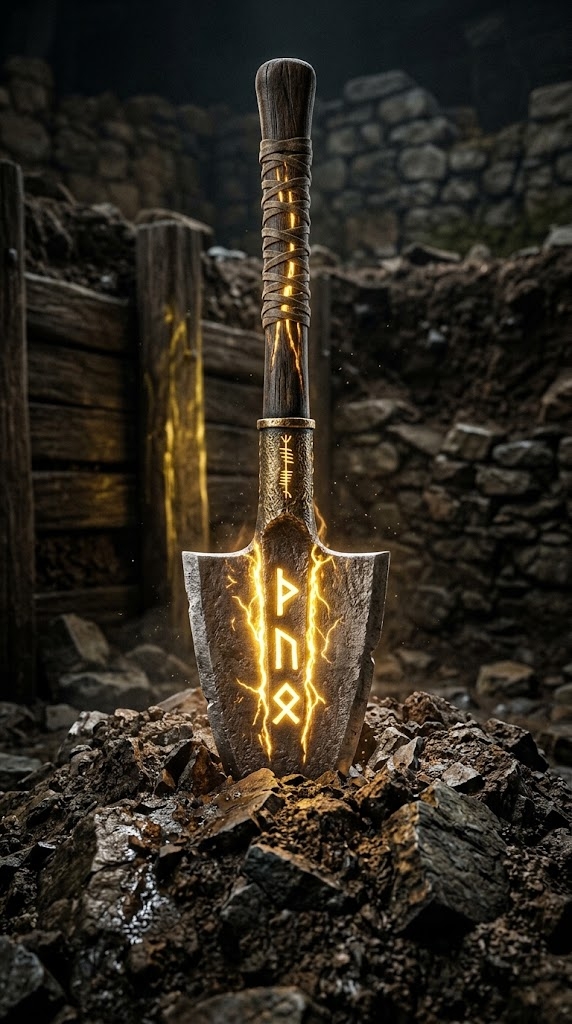
A heavy, three-foot-long entrenching spade with a narrow, thick-spined wedge blade made of hand-hammered bog iron and cold-hardened bronze. The haft is carved from dense heart-ash, bound with cross-laced rawhide for a secure two-handed grip. Along the center ridge of the wedge blade are etched three Elder Futhark runes—Thurisaz (the shattering thorn/giant), Uruz (the unyielding muscle of the ox), and Othala (ancestral land and native earth)—infilled with crushed yellow sulfur and powdered river-slate. A ring of small ogham-style staves is stamped into the bronze socket collar to anchor the handle against shock when striking bedrock.
Slot
Held in 2 hands (or strapped to Pack / Tool Harness Slot)
Detailed Stats
- Item Tier / Rarity: Tier 1 / Common
- Weight: 4.5 lbs
- Durability: 35/35
- Attunement: Requires 10 minutes of quiet concentration while kneeling upon undisturbed soil, rubbing loose dirt along the blade’s runic fullers, and driving the spade three times into the ground while intoning the name of Thurisaz.
- Proficiency Required: Excavation / Mining / Masonry / Runic Divination (Tier 1)
Passive Magic
- Thorn-Bite of Thurisaz: The wedge-shaped blade parts packed gravel, hard clay, dry shale, and frozen permafrost with the ease of wet loam. When digging through non-magical earth, stone-soil, or dense sediment, the bearer clears volume at three times the speed of a mundane spade and ignores blisters, hand strain, and tool-vibration recoil.
- Trench-Anchor of the Ancestral Clod: Freshly excavated trenches, foxholes, tunnel ceilings, or earthen pits dug with this spade gain structural stability. Loose dirt and gravel along the cuts naturally lock together, preventing soil slippage, washouts, and minor trench collapses within 10 feet of the excavation.
Activable Magic
- Galdr of the Shattered Flint (Action): The user drives the point of the spade into a solid boulder, subterranean stone slab, or bedrock seam and speaks the sharp, guttural chant of Thurisaz.
- Effect: A shockwave of runic torque fissures the stone, cracking a five-foot cube of natural bedrock or stone masonry with a web of deep fractures. This weakens the structure’s hardness, breaking it into manageable, shovelable rubble within 1 round.
- Cooldown: 3 times per Short Rest.
- Grave-Soil Divination (Action): The user drives the spade perpendicular into the soil, rests their forehead against the ash-wood pommel, and channels the rune Othala.
- Effect: For 1 minute, the user senses the subterranean composition up to 30 feet directly beneath or ahead through the earth. The user instinctively detects hidden subterranean hollows, unstable sinkholes, buried stone vaults, water seams, or dense metal deposits.
- Cooldown: 1 use per Long Rest.
Tags
- Tool, Spade, Shovel, Digger, Miner, Excavator, Barrow, Norse, Runic, Thurisaz, Uruz, Othala, Earth, Soil, Trencher, Level 1,Excavation, Permafrost, Shoring, Entrenching, Tunneling, Geology, Barrowcraft, Quarry, Bedrock, Fortification, Sapping
Acquisition and Trade of the Barrow-Delver’s Spud Spade
- Quarry Guild Depots and Stone-Carver Yards: Located at the edges of slate quarries, granite cuts, and open-pit bauxite mines, these cluttered yards smell of crushed limestone, linseed oil, and wet slag. Guild masters evaluate the spade by striking its wedge blade against a slab of dressed fieldstone; if the ash filled with sulfur rings clear without flaking and the point bites clean into the grain, it passes inspection. An itinerant quarry hand or miner selling an authentic runic spade receives an equipment buyout of 14 silver pieces. Sapping crews, rock-cutters, and foundation masons looking to purchase a certified barrow tool can buy one for 18 silver pieces.
- Frontier Pioneer Exchanges and Barrow Outposts: Operating in wind-scoured frontier settlements near ancient burial fields, glacial ridges, and timber camps, these trading posts cater to prospectors, homesteaders, and grave-wardens. The post-factor inspects the handle’s rawhide binding and tests the socket collar over a peat flame to check for structural stress. An adventurer offloading a recovered spade receives an outright trade credit of 12 silver pieces in staple supplies. Settlers needing to break through permafrost or trench defensive revetments before winter freezes the earth must pay 16 silver pieces.
- Military Sapper Logistical Depots and Siege Pantries: Situated inside garrisoned forts, fortified earthwork bulwarks, and siege encampments, these quartermaster armories deal strictly in tactical ditch-clearing and trench-digging gear. An armorer verifies the rune Thurisaz by having a conscript drive the spade into packed ditch-clay, measuring the rate of soil separation. A scavenger or mercenary selling a captured spade receives a direct payment of 15 silver pieces. Legion sappers, field engineers, and mercenary pioneer captains procuring the spade to speed up breastwork fortification pay 20 silver pieces.
- Antiquarian Curio Vaults and Necropolis Pawns: Tucked into the shadowy alleys surrounding old cathedral sepulchers and necropolis gates, these dimly lit establishments trade in ancestral relics, crypt keys, and grave-tending equipment. The broker rubs the blade’s fuller with lamp oil to check the vibrancy of the slate inlay and tests the rune Othala for grounding. Selling a recovered barrow spade here yields 11 silver pieces in coin. Unscrupulous tomb explorers, scholarly archaeologists, and night-soil scavengers can purchase the tool for 22 silver pieces.
- Subterranean Smuggler Warrens and Cutpurse Saps: Operating in hidden cellar networks, sewer vaults, and underground mining hollows beneath the reach of city watches, these illicit hideouts cater to tunnel thieves, prison-break conspirators, and vault-burglars. Smugglers value a tool that cracks foundation stone without alerting guards. The gang boss tests the spade by cleaving through a subterranean mortar seam. A deserter or subterranean rogue selling a spade can command a quick underground price of 19 silver pieces. Anyone seeking to purchase the tool to dig breach-holes through vault walls pays an elevated black-market price of 25 silver pieces.
Tactical and Environmental Applications of the Barrow-Delver’s Spud Spade
- Frozen Glacial Scree and Permafrost Tundras: Across the brittle, wind-blasted northern reaches where the earth is frozen as hard as iron, standard entrenching tools bounce harmlessly off the crust. Defensively, when caught in an open field by sudden blizzards or whiteout gale winds, the delver uses Thorn-Bite of Thurisaz to rapidly cut a deep shelter-trench into the permafrost in minutes. The runic stabilization of Trench-Anchor of the Ancestral Clod keeps the frozen walls from fracturing under howling wind shear, providing immediate cover against frostbite and blizzard-borne predators. Offensively, when dealing with burrowing ice-wyrms or frost-dwelling scavengers that stalk the party from beneath the hard snowpack, the delver sinks the blade into the frozen crust to perform Grave-Soil Divination. Tracking the acoustic vibrations and subterranean voids, the digger anticipates exactly where a beast will breach, allowing the team to prepare held strikes, or triggers Galdr of the Shattered Flint to collapse an ice shelf directly onto an ascending monster.
- Besieged Earthworks, Sapping Trenches, and Breached Forts: Within active siege lines, earthworks and deep revetments dictate life and death against archer volleys and catapult shot. Defensively, when an incoming artillery bombardment threatens an exposed squad, the pioneer uses the spade to deepen firing steps, throw up instant breastworks, and stabilize crumbling parapets. The spade’s ancestral locking magic prevents shoring timbers from giving way and keeps shrapnel-weakened ditch walls from caving in upon the soldiers. Offensively, during a forward sapping assault toward an enemy fortress, the sapper utilizes the spade’s rapid excavation to tunnel under the curtain wall undetected. Reaching the foundation, the delver strikes the load-bearing cornerstone with Galdr of the Shattered Flint, spider-webbing the masonry and causing a catastrophic structural breach that drops the enemy’s defensive tower into the moat.
- Subterranean Crypts, Ancient Barrows, and Collapsing Mines: In forgotten burial vaults and unstable cave networks where loose shale and dead-falls present constant lethal cave-in hazards, excavation must be surgically precise. Defensively, when a corridor begins to groan under structural stress or a trigger trap releases tons of falling rock, the barrow-warden wedges the spade vertically between floor and fractured ceiling. The Trench-Anchor rune locks the immediate ten-foot radius of stone and dirt in place, buying precious seconds for companions to escape a crushing deadfall. Offensively, when pursued down narrow stone tunnels by subterranean horrors or undead guardians, the digger turns around and strikes a critical choke-point with Galdr of the Shattered Flint. A single channeled strike shatters the rock archway into heavy rubble, sealing the passage behind the party, burying pursuing foes, and denying enemy reinforcements access to the corridor.
- Sinking Swamps, Quagmires, and Silt-Heavy Bogs: In waterlogged mires where wet silt, peat mud, and quicksand swallow heavily armored adventurers, solid footing is nonexistent. Defensively, the delver drives the spade into shifting muck along the edge of an encampment. The magic of Othala and the Trench-Anchor draws cohesion into the saturated soil, binding the silty slush into firm, walkable peat that will not wash out or collapse under the weight of armored boots, preventing the camp from sinking into the mire overnight. Offensively, when ambushed by amphibious raiders or bog abominations lurking in shallow water, the digger uses the spade to divert natural drainage channels, rapidly digging a trench to drain a predator’s mud-wallow or using Grave-Soil Divination to map out underwater sinkholes and deceptive barrows, intentionally baiting lunging attackers into deep, swallowing quicksand pockets.
- Sun-Baked Arid Canyons and Dry Scree Washes: Beneath baking desert suns where flash floods rip through dry canyon washes and crumbly sandstone bluffs offer zero natural purchase, loose terrain can turn lethal in an instant. Defensively, when caught in a low wash as a flash flood roars down-canyon, the digger uses Thorn-Bite of Thurisaz to rapidly carve handholds and footholds into brittle, vertical sandstone cliffs, letting companions scale out of the torrent’s path while the Trench-Anchor prevents the soft stone steps from sheering away under their weight. Offensively, when cornered beneath an overhanging canyon ledge by desert bandits or territorial beasts, the delver executes Galdr of the Shattered Flint against the base of an unstable scree slope above the enemy position. The concussive runic shockwave triggers a targeted rockslide, burying the hostile firing line under tons of loose scree while the party remains safe behind their braced earthen berm.
Perception of Activation:
- Sight:
- User’s Perspective: As the blade bites into the stone or earth, the crushed sulfur and slate inlay within Thurisaz, Uruz, and Othala flashes into searing, jagged veins of brilliant amber-gold lightning. Fractures in the surrounding rock glow with molten, subterranean luminescence, revealing fault lines and hollows as bright, branching networks against the dark earth.
- Observer’s Perspective: Observers witness the spade’s heavy iron head flare with sharp, kinetic brilliance. When struck into the ground, a localized pulse of gold-yellow light discharges through the dirt, tracing glowing geometric runes across the soil before fading into low, simmering fissures.
- Positives: The radiant amber glow illuminates pitch-black mine shafts and collapsed trenches without requiring open torches or handheld lanterns.
- Negatives: The stark flash of subterranean light pierces the gloom of caves and nighttime worksites, making stealthy excavation or clandestine sapping impossible against vigilant lookouts.
- Hearing:
- User’s Perspective: The impact yields no hollow ring of metal on stone; instead, a bone-rattling, percussive crack resonates up the ash haft, sounding like a lightning bolt cleaving a granite peak. This is followed by a continuous, deep acoustic rumble—the heavy groaning of stone yielding to immense tectonic pressure.
- Observer’s Perspective: Nearby companions hear a sharp, whip-like detonation followed by a grinding, gravelly crunch as solid rock instantly shatters into loose, shifting scree.
- Positives: The acoustic concussive blast naturally disorients subterranean tunneling pests, bats, and small vermin, scattering them from the immediate dig site.
- Negatives: The explosive cracking sound echoes loudly through caverns and enclosed crypts, potentially alerting sentries or triggering sympathetic cave-ins down unstable corridors.
- Smell:
- User’s Perspective: An immediate, pungent burst of hot yellow brimstone, scorched river-slate, and cracked flint fills the nostrils, underscored by the damp, rich aroma of newly exposed glacial loam and primeval peat.
- Observer’s Perspective: A sharp, mineral tang of superheated rock and ozone washes outward, smelling like a dry mountain cliff struck by lightning during a summer storm.
- Positives: The acrid burst of sulfur and ozone cuts through suffocating swamp damp, corpse-rot, and noxious sewer fumes in forgotten barrows.
- Negatives: The distinctive odor of scorched sulfur lingers heavily in enclosed, poorly ventilated tunnels, clinging to clothing and gear.
- Taste:
- User’s Perspective: An intense, dry mineral bite settles on the tongue, reminiscent of licking powdered slate, ground granite dust, and raw, iron-heavy well water, leaving the mouth feeling parched and alkaline.
- Observer’s Perspective: Anyone standing downwind tastes a faint grit of pulverized shale and metallic copper along their lips as airborne dust settles from the shattered rock.
- Positives: Sharpens the digger’s sensory palate to identify the metallic taste of subterranean water leaks or poisonous gas pockets bleeding from cracked rock strata.
- Negatives: Causes a dry, coughing rasp and an immediate urge to drink water, rapidly draining personal waterskins during heavy labor.
- Touch:
- User’s Perspective: The ash haft delivers a violent, tingling kinetic snap to the palms that instantly levels out into a steady, vibrating warmth. The spade feels almost weightless as it cuts, while the user feels their boots anchor into the dirt with the absolute, immovable solidity of deep bedrock.
- Observer’s Perspective: Those standing nearby feel a sharp, concussive tremor shake the soles of their feet, followed by the reassuring sensation of the loose gravel settling and firming beneath their boots.
- Positives: The kickback of striking solid stone is magically absorbed by the haft, completely eliminating wrist sprains, blisters, and bone bruises from excavation.
- Negatives: The lingering vibrational tremor leaves the operator’s hands feeling buzzing, calloused, and slightly numb for several minutes after prolonged digging.
- Extra-Sensory Perceptions:
- Tectonic Lithic Sense:
- User’s Perspective: The delver’s awareness sinks through the spade’s blade and fans outward into the surrounding bedrock like a web of roots. Solid granite feels dense and heavy, air pockets in hidden vaults register as hollow absences of mass, and subterranean water veins thrum as cool, flowing pulses through the stone.
- Observer’s Perspective: Watching companions perceive an uncanny, stony stillness in the digger, as though the worker’s posture had momentarily turned to carved basalt.
- Positives: Grants the digger flawless spatial awareness of structural stress, load-bearing arches, hidden crypt walls, and deadly sinkhole pockets up to 30 feet away.
- Negatives: Overwhelming sensory feedback can cause sudden disorientation or lithic vertigo if the blade strikes an immense subterranean fault or empty abyss.
- Echo of the Ancestral Cairn:
- User’s Perspective: A stoic, solemn weight presses upon the user’s mind—the collective memory of ancient barrow-builders and grave-tenders who buried fallen chieftains beneath glacial hills. A primal certainty asserts that the earth is not an enemy, but a resting place that yields to respectful toil.
- Observer’s Perspective: Allies in the trench feel a sudden dampening of panic; claustrophobia and the primal terror of being buried alive are replaced by a quiet, stoic resolve to brace the ground and dig forward.
- Positives: Suppresses subterranean claustrophobia and panic effects caused by tremors or low-oxygen environments.
- Negatives: Instills a somber, brooding melancholy that makes urgent communication feel heavy and emotionally muted.
- Tectonic Lithic Sense:
Forging Protocol 58: The Barrow-Delver’s Spud Spade
- Materials Needed:
- Four pounds of smelted bog-iron billets and one pound of tin-bronze alloy.
- One straight, knot-free stave of seasoned mountain heart-ash (three feet in length, two inches in diameter).
- Two ounces of powdered brimstone (elemental yellow sulfur).
- Two ounces of ground dark river-slate (calcined and pulverized into fine silt).
- Half-pint of cold-pressed linseed oil and pine tar mix (for wood sealing).
- Six feet of split rawhide thonging (cured in tallow and woodsmoke).
- One pint of quench-water drawn from a subterranean well or cave pool.
- Tools Required:
- One charcoal forge with twin leather bellows.
- One stone-face or heavy iron blacksmithing anvil.
- One cross-peen forging hammer and hot-cut chisel.
- One drawknife and round rasp (for haft shaping).
- One hardened-steel engraving burin or diamond-ground punch.
- One horn burnishing rod and heavy rawhide mallet.
- Skill Requirements:
- Blacksmithing / Cold-Forging: Rank 2 or higher.
- Woodcraft / Haft-Turning: Rank 1 or higher.
- Runic Vitki / Galdr Inscription: Rank 1 or higher.
- Crafting Steps:
- Heat the bog-iron billets to a bright cherry-red in the charcoal forge, folding and hammering the metal three times to drive out slag and establish a dense, resilient grain.
- Forge-weld the tin-bronze alloy along the core of the socket collar, shaping a tapered conical socket to absorb percussive shock.
- Draw out the bog-iron head into a heavy, narrow wedge spade with a pronounced central spine, beveling the cutting edge down to a thick, chisel-grind taper.
- Use a hot-cut chisel to cut a deep central fuller along the spine of the wedge blade while the iron rests at a working heat.
- Using the hardened burin, deeply engrave the Elder Futhark runes Thurisaz, Uruz, and Othala into the recessed fuller, ensuring the incisions bite securely into the metal.
- Stamp the socket collar with the protective ogham staves using an iron punch while chanting the binding stave of stone-cleaving.
- Blend equal measures of pulverized yellow sulfur and fine slate silt into a thick paste with boiled pine tar, then pack the slurry tightly into the carved rune channels until flush with the spine.
- Bring the blade to a dull red heat to fuse the resin-mineral matrix into the iron, then quench the tool directly in subterranean cave water to harden the cutting point.
- Shave the three-foot heart-ash stave using the drawknife and rasp until it matches the socket’s taper, rubbing the wood with the linseed-tar mix until fully saturated against rot and damp.
- Drive the ash haft securely into the bronze-collared socket with the rawhide mallet, locking it with two flush-cut iron wedges through the crown.
- Cross-lace the upper section of the ash haft with the smoke-cured rawhide thonging, buffing the grip and the finished iron head with tallow while speaking the Galdr of the Unyielding Earth.
Iron-Tooth that Did Eat Frozen Ridge, Wherein Barrow-Father Broke Skull of Mountain-Giant and Laid Bones of Chieftains in Warm Shale
In that old time upon the great turning world of Saṃsāra, when the hills were yet soft like wet curd and the mountain-thorns had not finished growing up out of the stone-skin, there was a black winter that did freeze the very blood in the worms beneath the soil. The sky was an iron lid, and the earth was a kettle turned upside down, and all men went about with blue fingers, groaning because the dead could find no resting pit.
For upon the high crags of the fjord called Steinn-Vollr, there reigned a great carl of war whose name was Jarl Halvar Horse-Breaker. He was a breaker of bronze neck-rings and a cutter of whale-gut, having slain nineteen men in a peat-ditch and burned eleven sea-sledges with hot tallow. When his ninety-year winter did take him by the neck-sinews, he fell upon his elk-couch and died like a dry ash-tree.
Then spake his sons, even the nine brothers of the Wolf-Coat: “Our father was an ox of great deeds! He must not rot upon the floorboards among the dog-spit; nor shall he be burned in wood-smoke, for the timber is all wet with frost-dew. He must be buried beneath forty spans of black shale upon the Ridge of the Giant’s Rib, that his shadow may stand upon the salt sea and watch for the sail-clans until the moon cracketh!”
Now upon the Ridge of the Giant’s Rib, the permafrost was thick as twelve walrus-shields, and beneath the ice lay the grey bedrock of the mountain-thurs, which no copper pick could scratch.
First went forth the thirty thralls of the copper-mine. They took thirty iron picks and forty sledge-hammers of hard green basalt. They struck upon the ridge from the cock-crow until the smoke of evening. But lo! The frost did laugh at the iron! The basalt hammers split like dried hazel-nuts; the copper picks were blunted until their noses were round like sheep-droppings; and when the men struck the stone, fire flew into their eyes and made them blind, but the soil was not opened by so much as the thumb of a child.
Then came the second son, Torstein the Quarrier. He was an ox-man who could lift a bullock into a hay-cart. He took a heavy iron crowbar of six stone weight, which had been tempered in seal-oil by the dwarven smiths of the lower fjord. Torstein spat upon his red hands and leaped upon the permafrost, driving the iron spike downward with the fury of a rutting elk.
A great sound was heard, like the snapping of an oar in a sea-eddy!
The iron bar did not pierce the shale; nay, the cold granite of the thurs did strike backward through the metal, and the iron shock went up through Torstein’s wrists, cracking the bones of his forearms like dry firewood, so that he dropped into the snow-crust howling like a wounded badger, and the crowbar fell into three pieces upon the grey ice.
Then did the nine sons weep upon their beards: “Our father shall lie unhoused upon the scree! The ravens will eat his thumbs, and his ghost will wander through our sleeping-benches, rattling his iron rings and cursing our seed because we could not dig him a barrow against the frost-demon!”
Now there was an old barrow-schanzer whose name was Father Bodvar the Mole. He was crooked in the back like a bent pine that hath grown under a snow-slide, his beard was full of dry peat-dust, and his nails were thick like the horn-shods of a mountain-goat. He carried neither basalt sledge nor iron crow, but only a three-foot entrenching spud fashioned of cold bog-iron and bronze, with an ash haft wrapped in smoked goat-hide, having its spine grooved with three ancient marks—the thorn-giant Thurisaz, the horned wild-ox Uruz, and the hearth-land Othala—filled with yellow brimstone from the fire-vent and powdered slate from the deep river-bed.
The nine sons of the Jarl laughed with their teeth: “Look upon the ditch-scratcher! He cometh with an ash-stick to shave the beard of the mountain-giant! Torstein hath broken his iron rod of six stone weight, yet this old earth-beetle bringeth a spade no wider than an elk’s ear!”
Father Bodvar did not lift his eyes to their bronze spears. He went to the place where the Jarl’s body lay cold in the wool wrappings. He took a handful of the dirt that had stuck to the Jarl’s boots and rubbed it into the yellow sulfur runes upon the iron blade. He knelt upon his bent knees, laid his wrinkled forehead against the ash pommel of the tool, and whispered into the stone the ancient galdr of the Deep Mother, which is the song of the mole that parteth the rock without teeth.
Then did the runes wake upon the iron spine!
The yellow sulfur did glow like the belly of a horn-wasp; the rune Thurisaz spat forth an amber spark that smelled of thunder-fire; and the ash haft thrummed like a bow-string when a sea-bear is struck!
Father Bodvar arose and touched the tip of the spud spade to the blue permafrost of the ridge.
He did not swing it with the great fury of the berserkers; he did not heave with his back like an ox in the furrow. He simply pressed the iron wedge into the shale with the sole of his hide boot.
A wonder was seen by the nine brothers!
Where the iron touched, the permafrost did shiver and sigh like fat dropped upon a warm stone! The black bedrock, which had broken the dwarven crowbar, did part to the left and to the right like soft porridge before a horn ladle. The yellow-lightning spark ran down the iron fuller and through the deep strata, cracking the basalt into little square stones of the size of a loaf of bread, all clean-cut and square, without any splintering!
Father Bodvar pushed the spud; he tossed out the frozen clods; he cut the grey slate as a dairy-girl cutteth the yellow cheese with a wet wire. In three turns of the hourglass, while the sons stood with their mouths hanging open like dead codfish upon the shingle, the old schanzer had carved a square chamber seven cubits deep, four cubits broad, and nine cubits long into the unyielding stone of the Giant’s Rib!
And lo! When the wind blew down from the glacier with the weight of forty storms, the walls of the trench did not crumble, nor did the loose gravel roll back into the pit; for the rune Othala held the dirt together like woven wool, and the trench-sides stood upright and smooth like the timbered walls of a longhouse!
Then did the nine sons carry the great Halvar Horse-Breaker into the deep, warm chamber of shale. They laid his iron ring-coat upon his breast; they laid his broadsword beside his thigh; they put forty skins of sour beer and twelve dried tongues of reindeer about his feet, and they closed the pit with the square-cut stone slabs that the spade had parted.
When the Jarl was hidden from the cold sky, the sons ran to Father Bodvar with arm-rings of silver and cups of horn-grease, saying: “Take this silver, old mole! Teach us the song that breaketh the mountain, and give us the iron spud, that we may dig down into the earth-hollows and take the gold-hoards of the dead kings!”
Father Bodvar wiped the yellow brimstone dust from his blade with his wool sleeve and thrust the ash haft into his belt-rope.
“Keep your silver rings to buy splints for Torstein’s broken wrists,” spake the barrow-warden. “The earth openeth not to the pride of the conqueror, nor to the fury of the iron-breaker who striketh her with anger. The stone will break its teeth against the axe of the warrior who cometh to plunder, but it melteth like spring tallow before the servant who knoweth how to ask permission of the dust. He who knoweth the measure of the earth shall carve his resting-place where he pleaseth; but he who thinketh to conquer the rock with fury shall have his own bones scattered upon the cold scree for the crows to peck.”
And Father Bodvar went down the mountain-scarp with his ash-spud upon his shoulder, while the snow fell upon his hood of sheepskin; and from that day forth, in all the northern valleys of Saṃsāra, no man took an iron crow to the high permafrost until he had first asked the blessing of the runic spade and sung the stave of the three stones.
Moral of the Story: The brutal force of the warrior and the unyielding fury of iron only shatter themselves against the stubborn bedrock of the world; for true mastery over the enduring earth cometh not through violent contention, but through the patient wisdom of right grounding, lawful measure, and the humble craft of knowing how to unmake the stone from within.
Suggested conversions to other systems:
Call of Cthulhu (7th Edition)
Barrow-Delver’s Spud Spade
Runic Relic of Earth-Cleaving and Subterranean Divination
- Description:A heavy, three-foot-long entrenching spade with a narrow, wedge-shaped bog-iron and bronze blade. Etched into its spine are the Elder Futhark runes Thurisaz, Uruz, and Othala, infilled with sulfur and slate. Used by northern grave-wardens, excavators, and occult archaeologists to cut through frozen ground, stabilize tunnels, and sense subterranean cavities.
- Characteristics & Usage:
- Sanity Loss to Attune: 0 (Grounding folk talisman).
- Magic Points to Activate: 1 MP for stone-shattering; 2 MP for subterranean divination.
- Weapon Profile (Used in Combat): Fighting (Brawl) or Fighting (Axe); Damage: 1d6 + Damage Bonus; Base Range: Touch; Attacks per Round: 1.
- Mechanics:
- Thorn-Bite of Thurisaz (Passive): The spade ignores the structural resistance of packed clay, frozen permafrost, and dry shale. An investigator using the tool excavates earth and rocky soil at three times normal speed and receives a Bonus Die on CON rolls to resist physical exhaustion, blistering, and strain during heavy labor.
- Trench-Anchor of the Ancestral Clod (Passive): Trenches, foxholes, or mine tunnels cleared using this spade naturally resist cave-ins. Any soil or loose rock within 10 feet of the excavation gains supernatural cohesion, granting a Bonus Die on rolls to avoid tunnel collapse, mudslides, or structural cave-ins.
- Galdr of the Shattered Flint (Active): By spending 1 Magic Point and striking a natural rock face, boulder, or stone masonry block, the investigator causes a localized runic shockwave. A 5-foot cube of natural stone spiderwebs with deep fissures, crumbling into easily cleared rubble over the next round.
- Grave-Soil Divination (Active): By spending 2 Magic Points, driving the spade into undisturbed ground, and resting their head against the ash pommel for 1 full minute, the user senses subterranean topography up to 30 feet in any direction. The keeper secretly rolls the investigator’s Archaeology, Geology, or Occult (with a Bonus Die); on a success, the investigator intuitively detects hidden hollows, crypt chambers, water veins, or metal caches.
Blades in the Dark
The Barrow-Delver’s Spud Spade
Arcane Implement / Heavy Breaching Tool (1 Load)
- Description:A heavy, rune-inlaid entrenching spud with a narrow iron wedge blade. Favored by tunnel-rats, sappers, and tomb-delvers working beneath the city streets, canal beds, or out in the deathlands.
- Mechanics:
- Thorn-Bite of Thurisaz (Passive): When digging through stone-choked earth, masonry mortar, or permafrost, you gain potency on your action rolls. Excavation efforts that would normally take hours take only minutes.
- Trench-Anchor (Passive): Walls, trenches, and earthen tunnels you dig are supernaturally braced. The GM will not introduce unintended cave-ins, mud collapses, or wall-slips as a complication on your digging actions unless catastrophic external force is applied.
- Galdr of the Shattered Flint (Active): Spend 1 Stress and slam the spade against a solid stone wall, foundation block, or bedrock face. You create an immediate breaching breach-hole or shatter a 5-foot section of masonry into loose gravel without alerting nearby guards with echoing hammer rings. Take +1d to Wreck when targeting stonework.
- Grave-Soil Divination (Active): Spend 1 Stress and drive the spade into raw ground while attuning to the deep earth. You sense underground hollows, secret cellar vaults, hidden sewers, or buried metal up to 10 paces through the earth, gaining +1d to your next Attune or Survey action involving subterranean navigation.
Dungeons & Dragons (2024 Edition)
Barrow-Delver’s Spud Spade
Weapon (Simple, Melee), Common (Requires Attunement by a creature proficient with Mason’s Tools, Miner’s Picks, or Athletics)
- Combat Profile:
- Damage: 1d6 Piercing or Slashing (user’s choice).
- Properties: Versatile (1d8), Two-Handed for excavation.
- Weight: 4.5 lbs.
- Properties:
- Thorn-Bite of Thurisaz (Passive): When you use this spade to dig through nonmagical earth, mud, clay, gravel, or permafrost, you clear soil at three times the normal rate. While digging, you have Advantage on Constitution saving throws to avoid exhaustion caused by heavy manual labor.
- Trench-Anchor of the Ancestral Clod (Passive): Any trench, pit, or tunnel excavated with this spade is magically reinforced. Soil, gravel, and unworked rock within 10 feet of the dug area do not collapse or wash away due to mundane weather or nonmagical shifting ground for 24 hours.
- Galdr of the Shattered Flint (Action): You drive the spade into a nonmagical stone surface, boulder, or masonry structure within reach and speak the runic word of Thurisaz. A 5-foot cube of the target stone shatters into manageable rubble. You can use this property three times, and you regain all expended uses when you finish a Short or Long Rest.
- Grave-Soil Divination (Action): You drive the blade into the earth, rest your brow against the pommel, and concentrate (as if concentrating on a spell) for 1 minute. You learn the location of any subterranean hollows, tunnels, buried stone chambers, or large metal deposits within 30 feet of you through solid ground or stone. Once used, this property cannot be used again until you finish a Long Rest.
Knave (Second Edition)
Barrow-Delver’s Spud Spade
Item / Breaching Tool & Weapon, 2 Slots, 3/3 Quality
- Item Properties:Occupies 2 inventory slots. Functions as an entrenching tool, crowbar, and a heavy melee weapon (d8 damage, two-handed).
- Thorn-Bite (Passive):Clears packed earth, clay, and permafrost at three times normal speed. The wielder is immune to fatigue caused by digging or trenching.
- Trench-Anchor (Passive):Pits, saps, and tunnels excavated with this tool never suffer nonmagical cave-ins, mudslides, or sudden wall collapses within 10 feet of the excavation.
- Shatter Flint (Action):Up to three times per dungeon exploration turn (10 minutes), the bearer may strike a solid natural rock face or masonry seam to shatter a 5-foot section into loose, easily cleared rubble without producing deafening noise.
- Grave-Soil Divination (Action):Once per day, the user may plant the spade into the floor and concentrate for 1 minute. The user instinctively detects hidden subterranean rooms, false walls, buried sarcophagi, or water seams within 30 feet through solid stone or dirt.
Fate (Fate Condensed / Core)
The Barrow-Delver’s Spud Spade
Unique Extra / Earth-Cleaving Breaching Tool
- Aspects:
- Function Aspect: Runed Entrenching Spud of the Northern Barrow-Schanzers
- Flaw Aspect: Heavy and Demands Two Sturdy Hands on the Haft
- Skills:
- Grants an effective rating of Fair (+2) to Crafts or Notice exclusively when shoring earthen fortifications, clearing rock collapses, or sensing underground structural hollows.
- Stunts:
- Thorn-Bite of Thurisaz (Passive): You gain a +2 bonus to overcome actions using Physique or Crafts when cutting through permafrost, packed clay, scree, or natural bedrock. When digging defensive trenches, you complete the task in one-third the usual scene time.
- Trench-Anchor of the Ancestral Clod (Passive): Trenches, foxholes, or tunnels you excavate gain the situational aspect Runic Wall Reinforcement. You can invoke this aspect once for free to prevent collapses, cave-ins, or hostile attempts to undermine your earthen works.
- Galdr of the Shattered Flint: Once per scene, when striking an obstacle of natural stone, masonry, or bedrock, you may spend a Fate Point to immediately overcome a stone barrier without an action roll, shattering a five-foot section into cleared rubble and attaching the aspect Choked with Broken Rubble to the zone.
- Grave-Soil Divination: When you drive the spade into native soil and attune your senses, gain a +2 bonus to create an advantage using Notice or Lore to detect hidden chambers, subterranean vaults, or buried mineral veins within the immediate area.
Numenera & Cypher System
Barrow-Delver’s Resonant Spud
Level 3 Artifact (Depletion: 1 in 1d20)
- Form: A three-foot wedge spade forged from dense bog-iron and bronze, its spine inscribed with angular runes filled with an amber-yellow sulfurous compound.
- Effect:
- Thorn-Bite of Thurisaz (Passive): Tasks involving digging, trenching, or clearing through clay, packed scree, and permafrost are eased by two steps. The user ignores any Might depletion or penalties resulting from prolonged excavation labor.
- Trench-Anchor (Passive): Any trench, tunnel, or foxhole dug with this spade gains supernatural structural cohesion; tasks to resist cave-ins, wall collapse, or shifting earth within 10 feet of the excavation are eased by two steps.
- Galdr of the Shattered Flint (Action): The user expends 1 point from their Might Pool and strikes a solid boulder, rock face, or stone wall. A 5-foot (1.5 m) cube of non-magical stone shatters into loose, shovelable gravel within 1 round.
- Grave-Soil Divination (Action): The user drives the spade into the soil and expends 2 points from their Intellect Pool while resting their brow on the pommel. For 1 minute, the user senses the earth up to 30 feet (9 m) around and below, automatically discovering hollow spaces, vaults, buried metal deposits, or subterranean aquifers.
Pathfinder (Second Edition / Remaster)
Barrow-Delver’s Spud Spade
Item 1 | Uncommon, Earth, Magical, Primal
- Price: 20 gp
- Usage: held in 2 hands; Bulk: 1
- Description: This three-foot wedge spade features a hand-hammered iron blade infilled with powdered slate and yellow sulfur runes (Thurisaz, Uruz, and Othala). Built for barrow-wardens and combat sappers, it cleaves through frozen earth, reinforces excavation walls, and divines subterranean cavities.
- Combat Profile: Can be wielded as an improvised two-handed simple melee weapon that deals 1d8 bludgeoning or piercing damage (group: club / pick).
- Thorn-Bite of Thurisaz (Passive): You excavate loose earth, clay, and permafrost at three times normal speed. You gain a +1 item bonus to Fortitude saves against fatigue and exhaustion incurred from heavy manual labor.
- Trench-Anchor of the Ancestral Clod (Passive): Trenches, earthen berms, and tunnels excavated with this tool possess magical structural integrity. Shifting soil, rain washouts, and non-magical collapses do not occur within 10 feet of the dug area for 24 hours.
- Galdr of the Shattered Flint [two-actions] (Concentrate, Earth, Manipulate, Primal); Frequency: 3 times per day:
- Effect: You strike a 5-foot cube of unworked natural stone, solid boulder, or masonry wall. The spade channels concussive runic torque, dealing 3d6 bludgeoning damage that ignores the stone’s Hardness (up to Hardness 10). If this reduces the section to 0 Hit Points, it shatters into loose, easily cleared rubble.
- Grave-Soil Divination [ten-minutes] (Concentrate, Divination, Exploration, Primal):
- Frequency: Once per day
- Effect: You drive the spade into natural ground and listen to the vibrations of the earth. You detect the presence and approximate direction of any subterranean voids, hollow crypts, underground waterways, or dense mineral deposits within 30 feet.
Savage Worlds (Adventure Edition)
Barrow-Delver’s Spud Spade
Minor Arcane Item (Novice)
- Item Profile:
- Damage: Str+d6 (Two-Handed, AP 1 against constructs or targets made of stone/earth)
- Weight: 4.5 lbs
- Min Str: d6
- Description: A rune-inlaid entrenching spud crafted from cold-hardened iron and mountain ash. Favored by frontier sappers, tomb scavengers, and grave-wardens needing to breach permafrost, shore up earthen trenches, and detect hidden vaults.
- Arcane Mechanics:
- Thorn-Bite of Thurisaz (Passive): The user excavates packed earth, gravel, and frozen soil at three times normal digging speed. The user gains a +2 bonus to Vigor rolls made to resist Fatigue from prolonged physical labor.
- Trench-Anchor (Passive): Earthen walls, revetments, and tunnel ceilings dug with this spade automatically gain reinforced stability. Any check to resist cave-ins, mudslides, or collapsing earthworks within 2 inches (4 yards) of the spade’s excavation gains a +2 bonus.
- Galdr of the Shattered Flint: As an action, the user strikes a solid rock face, bedrock floor, or masonry wall. The runic concussion causes a 1-inch (2-yard) section of stone to crack into manageable rubble. Can be used up to three times per encounter or game day.
- Grave-Soil Divination: By planting the tool in undisturbed dirt and concentrating for 1 full minute, the user makes a Notice roll at +2 to detect subterranean voids, hidden tombs, or metal seams within 5 inches (10 yards) through solid earth or stone.
Shadowrun (Sixth World)
Barrow-Delver’s Runic Spud SpadeTalismanic Excavation Tool
- Item Statistics:
- Availability: 3 (Legal)
- Cost: 1,200 nuyen
- Concealability: +3 (Carried in a heavy gear sack, strapped to an armored pack, or slung on a tool harness)
- Weight: 2.1 kg
- Reach: 1 (Melee Profile)
- Damage: (STR + 2)P (Melee Profile, Armor Penetration: -2)
- Description: A three-foot-long, heavy entrenching tool crafted from hand-hammered, cold-tempered iron and archaic bronze, with a dense ash shaft wrapped in cured goat hide. This is not a product of modern industrial metallurgy or smart-linked engineering. Engraved along the spine of the wedge blade are the Elder Futhark runes Thurisaz, Uruz, and Othala, inlaid with sulfur and powdered slate. Carried by northern shamans, eco-activist sappers, and fringe smugglers who prefer low-tech solutions, it uses latent mana to breach permafrost, shore up clandestine tunnels, and divining hidden vaults without power cells or matrix connection.
- Game Mechanics:
- Thorn-Bite of Thurisaz (Passive): When the user is digging through packed earth, shale, permafrost, or heavy sediment, the spade ignores the structural resistance of non-magical, non-reinforced terrain. The user clears soil and debris at three times the standard speed and receives a +1 dice pool bonus to Body tests to resist physical fatigue or blistering from the manual labor.
- Trench-Anchor (Passive): While the spade is driven into the dirt or actively used to clear an earthen fortification (such as a trench, foxhole, or sap), the ground gains mana-imbued stability. Loose gravel, mud, or shifting soil within 5 meters of the excavation naturally cohesionates, preventing mudslides, sudden wall collapses, or water washouts due to mundane weather or physical vibration.
- Galdr of the Shattered Flint (Action): The user drives the spade point into a natural rock face, boulder, or masonry structure while speaking the guttural runic chant of Thurisaz. A concussive shockwave of runic torque instantly fractures a 1-meter cube of natural stone into loose, manageable rubble, which can be cleared easily. This power requires 1 minute (20 combat rounds) of focused labor and chanting and cannot be used in active combat. It can be used three times per Long Rest.
- Grave-Soil Divination: Once per day, by driving the spade into undisturbed native soil and resting their brow against the ash pommel for 1 full minute, the user attunes to the deep earthen foundation. Make an Arcana + Intuition [Physical] test; success means the user intuitively senses the composition of the subterranean terrain up to 30 meters beneath or ahead, detecting hidden hollows, subterranean vaults, large metal deposits, or seismic faults.
Starfinder (Second Edition)
Barrow-Delver’s Runic Spud SpadeItem 1 | Magical, Primal, Tool
- Price: 15 credits
- Usage: held in 2 hands; Bulk: 1
- Description: This three-foot-long entrenching spud features a heavy, narrow wedge blade carved from hand-forged iron and bronze, its spine inscribed with angular runic glyphs—Thurisaz, Uruz, and Othala—inlaid with contrasting sulfur and slate dust. Carried by exploratory terraformers, low-tech colony saps, and fringe-world scavengers, it cleaves through the icy rock of primitive moons, reinforces the walls of improvised shelters, and divining resources without relying on electronic sensors or powered industrial equipment.
- Game Mechanics:
- Thorn-Bite of Thurisaz (Passive): When you use this spade to dig through nonmagical earth, mud, clay, gravel, or permafrost, you clear non-reinforced soil at three times the normal rate. While digging, you have Advantage on Constitution saving throws to avoid exhaustion caused by heavy manual labor.
- Trench-Anchor of the Ancestral Clod (Passive): Any trench, pit, berm, or tunnel excavated with this spade possesses magically reinforced structural stability. Loose soil, gravel, and unworked stone within 10 feet of the dug area do not collapse, cave-in, or wash away due to mundane weather or physical shifting ground for 24 hours.
- Galdr of the Shattered Flint [three-actions] (Concentrate, Manipulate, Primal); Frequency: 3 times per day:
- Effect: You drive the spade into a nonmagical stone surface, boulder, or masonry structure within reach. The spade channels concussive runic torque, instantly shattering a 5-foot cube of natural stone into loose rubble.
- Grave-Soil Divination [ten-minutes] (Concentrate, Divination, Exploration, Primal); Frequency: Once per day:
- Effect: You plant the spade blade into undisturbed natural ground, rest your brow against the pommel, and listen to the vibrations of the earth composition. You instinctively detect the presence and approximate direction of any subterranean voids, hollow crypt chambers, buried stone vaults, or large mineral deposits within 30 feet of you through solid ground or stone.
Traveller (Mongoose Second Edition)
Archaic Runic Horn SpadeTL 2 / Bio-Talismanic Excavation Tool
- Item Specifications:
- Tech Level: 2 (Carved ram horn, bone-ash inlay, natural pine resin seal, bronze collar)
- Skill: Survival, Jack of All Trades, or Broker
- Mass: 2 kg
- Cost: Cr 200 (Common on TL-2 worlds, agricultural outposts, or low-tech frontier colonies)
- Description: A three-foot-long, heavy-headed entrenching spud, crafted not from industrial metal but from the curved horn of a mountain-dwelling mega-fauna, likely a tundra ox or heavy-horned ram, native to a low-tech northern world. The narrow, thick wedge blade is hardened via specific non-industrial processes, capped with archaic bronze, and inscribed with symbolic runic patterns Thurisaz, Uruz, and Othala inlaid with a sulfur-calcite paste. It is a prized tool among low-tech saps, frontier grave-tenders, and resource prospectors who require a reliable means to breach permafrost, stabilize tunnels, and locate hidden aquifers or mineral veins without relying on electronics or fragile modern tools.
- Game Mechanics:
- Thorn-Bite of Thurisaz (Passive): When the user is performing heavy excavation through packed clay, rocky scree, permafrost, or hardened sediment (up to TL 2 resistance), the spade functions with optimized efficiency. The user clears soil and debris at three times the standard rate and receives +1 DM to all Survival or END checks made to resist fatigue, dehydration, or blistering during prolonged digging.
- Trench-Anchor (Passive): Any trench, foxhole, sap, or earthen fortification excavated with this tool gains reinforced stability. The surrounding 5 meters of loose soil naturally lock together, granting +2 DM on any roll to avoid tunnel collapse, wall-slip, or mudslide due to mundane seismic vibration or severe weather.
- Galdr of the Shattered Flint: Once per day, by planting the spade point against bedrock, boulder, or non-reinforced masonry and focusing concentration (not usable in combat), the user utilizes the archaic chemical process of the inlays to crack the stone. A 1.5-meter cube of natural stone shatters into loose, manageable rubble. This process takes 10 minutes of controlled work and preparation.
- Grave-Soil Divination: Once per day, by driving the spade into native soil and attuning to the deep earth foundation for 10 minutes, the user makes a Survival (INT) check. On a success, the user instinctively detects hidden subterranean hollows, underground aquifers, mineral veins, or seismic faults up to 30 meters through the earth, gaining +1 DM to subsequent checks involving subterranean navigation or resource location in the immediate area.
Warhammer 40,000 Roleplay (Wrath & Glory)
Fenrisian Iron-Spud of the BarrowImperial Gear (Common / Sanctified Archaic Curio)
- Item Profile:
- Keywords: Imperium, Fenris, Archaic, Sanctified
- Value: 2
- Rarity: Common
- Weight: 2.3 kg
- Description: A three-foot-long, heavy-wedge trenching spade forged from dense bog-iron and archaic bronze, with a thick ash-wood shaft wrapped in smoke-cured grox-hide. Etched along the spine of the heavy iron head are the protective Elder Futhark runes of Fenris—Thurisaz, Uruz, and Othala—inlaid with ground sulfur and pulverized native slate. While to the uninitiated it appears to be a rustic feral world tool, this sanctified curio is used by Astra Militarum sappers, void-ship mess stewards, and frontier excavators to cleave through permafrost, stabilize earthen fortifications against enemy artillery, and divining hidden vaults without power cells or cogitator assistance.
- Game Mechanics:
- Thorn-Bite of Thurisaz (Passive): When you use this spade to dig through nonmagical earth, mud, clay, gravel, or permafrost, you clear soil at three times the standard rate. While actively digging, you gain +1 bonus die to Toughness tests made to resist fatigue or exhaustion caused by manual labor.
- Trench-Anchor of the Ancestral Clod (Passive): Any trench, foxhole, sap, or earthen fortification excavated with this spade is sanctified against collapse. Loose soil, gravel, and unworked stone within 10 meters of the dug area do not collapse, wash away due to severe weather, or cave-in due to nonmagical shifting ground for 24 hours.
- Galdr of the Shattered Flint [Action]; Frequency: Once per Regroup (not usable in active combat):
- Effect: You drive the sanctified spade into nonmagical stone, a boulder, or a non-reinforced masonry structure. The spade channels primal warding energy, instantly shattering a 5-foot cube of the target stone into loose, easily cleared rubble.
- Grave-Soil Divination [Action]; Frequency: Once per day:
- Effect: You drive the blade into undisturbed natural ground, rest your brow against the pommel, and focus your senses for 10 minutes. You instinctively detect the presence and approximate direction of any subterranean voids, hollow crypt chambers, buried stone vaults, large metal deposits, or aquifers within 30 meters of you through solid ground or stone.