
Lore: The Resonant Edge of Verse 214 is a singular masterpiece born from a convergence of three legendary disciplines within Saṃsāra: the metallurgical genius of the Forgehaven Foundry, the aerial mysticism of the Windwalker nomads, and the soulful artistry of the Elysian bards. History records that a descendant of Theron Forgehaven, seeking to create a weapon that was not merely a tool of war but an instrument of expression, fused a pristine Forgehaven blade with the enchanted Windwalker’s Cord using the alchemical fires described in the Ballad 47 of Elysian Craft. The result is a weapon that remembers its wielder’s rhythm, light as a feather but striking with the weight of a mountain, constantly humming the verses of creation. It is said that to wield this blade is to paint upon the canvas of battle with strokes of wind and steel.
Description: This weapon appears as a graceful longsword crafted from Aether-Tempered Steel that possesses an almost liquid sheen. The hilt is tightly wrapped not in leather, but in the silvery, glowing strands of the Windwalker’s Cord, which seem to pulse with a soft rhythmic light. Etched along the fuller of the blade are the shifting, luminescent runes of the Ballad 47, written in Mystic Inks that change color based on the wielder’s emotional state. When swung, the blade does not whistle; it sings a harmonic chord, and faint, ethereal brushstrokes trail behind the edge, momentarily coloring the air with vibrant energy. Despite its length and material, it feels weightless, as if the air itself is holding it aloft.
Stats Name: Resonant Edge of Verse 214 Tier: 3 Rarity: Legendary Damage: +6 (Magical Slashing/Sonic) Durability: Indestructible (Repairable only through artistic rituals) Balance: +5 Enchantment Slots: 0 (Integrated Fusion) Value: Market dependent, typically valued in Platinum.
Tags: Grandmaster Craftsmanship, Aeromancy, Bardic Resonance, Sonic Weapon, Artistic Focus, High Mobility, Technomagic, Legend-Forged, Ethereal, Harmony, Synergistic Fusion, Blade-Song, Air-Aspected, Runic Empowerment, Prestige, Conductor, Resilient, Aural Focus, Kinetic Resonance
Multiple Passive Magics
- Artisan’s Flow: The wielder gains a permanent +10 bonus to all Performance and Acrobatics checks. The weapon acts as a universal artistic tool; the wielder can use the blade to carve, paint, or conduct as effectively as a master’s brush or chisel.
- Zephyr’s Buoyancy: The Windwalker’s Cord integrated into the hilt neutralizes the weapon’s weight and extends this lightness to the wielder. The user’s movement speed is increased by 15 feet, and they are immune to falling damage as air currents automatically catch them.
- Ancestral Memory: The blade retains the muscle memory of the wielder. If the user misses a melee attack, the blade remembers the error; the user gains advantage on their next attack roll against the same target.
- Harmonic Defense: The blade hums a low frequency that disrupts incoming physical projectiles, granting a +2 bonus to defensive maneuvers or AC against ranged attacks.
Multiple Active Magics
- Aria of the Gale: Three times per day, the wielder can sweep the blade in a grand arc, releasing a wave of sonic energy and compressed air. This mimics the effects of a forceful wind blast combined with thunderous sound, knocking back enemies within a 30-foot cone and dealing sonic damage.
- Tableau of the War-Dance: Once per day, the wielder can activate the Ballad inscribed on the steel. For one minute, ethereal duplicates of the wielder (appearing as painted figures made of light) strike in unison with the user. This grants two additional attacks per action cycle that deal force damage.
- Verse of Transposition: By singing a specific line from the Ballad 47 while slashing the air, the user can teleport up to 60 feet to an unoccupied space they can see. The destination must be marked by a “brushstroke” of wind (a location the user has looked at with artistic intent).
- Inspirational Resonance: The wielder can use an action to strike the blade against the ground or a shield, causing it to ring out the pure notes of the Elysian Craft. All allies within 50 feet gain temporary hit points and a bonus to their next skill check or attack roll equal to the wielder’s artistic proficiency.
Specific Slot Weapon (Main Hand – Martial Longsword)
Item Integrity & Disabling Magic
Item Hit Points (Magical Resonance): 60 HP Damage Threshold (DT): 15
Because the Resonant Edge of Verse 214 is a fusion of Aether-Tempered Steel and bound elemental energy, it is exceptionally difficult to damage. To disable the item’s magic, an attacker must specifically target the weapon (called a Sunder attempt or targeted object attack).
- The Threshold: The item possesses a Damage Threshold of 15. Any attack dealing 15 damage or less is harmlessly deflected by the wind currents and the density of the masterwork steel; the damage is ignored completely.
- Disabling the Magic: If the item takes damage exceeding the threshold, that damage is subtracted from the item’s 60 HP.
- At 30 HP (Fractured Harmony): The Active Magics (Aria of the Gale, Tableau, etc.) cease to function. The runes on the blade flicker and dim.
- At 0 HP (Silenced): The item does not physically shatter (due to the Indestructible nature of the physical Aether-Tempered Steel), but the Magic becomes Dormant. All Passive Magics cease. The sword functions only as a standard, high-quality longsword with no weight reduction or bonuses until repaired.
Repairing the Resonant Edge
Because the item is a fusion of physical metallurgy and intangible song, it cannot be repaired by a simple hammer or the Mending spell. The magic must be “re-tuned.”
The Ritual of Resonant Restoration To repair the magic of the Resonant Edge, the wielder (or a hired artisan) must perform a ritual that combines Smithing with Performance (Music/Oratory).
- Environment: The repair must be performed in a location with high acoustic qualities (e.g., a glass hall, a canyon, or a specifically designed sound chamber).
- Materials: The artisan requires Mystic Inks (Moonfloral and Sapphire dust, cost approx. 200 Gold) to re-trace the faded runes.
- The Process: The artisan must physically strike the blade with a tuning hammer to the rhythm of Ballad 47.
- Mechanical Check: Requires a successful mixed skill check of Smithing and Performance (Difficulty Tier 3).
- Restoration Rate: Each hour of the ritual restores 10 HP to the item.
- Crit Success: If the check is passed with a critical success, the item is fully restored in half the time, and the wielder gains “Inspired” status for 24 hours.
- Failure: If the check fails, the ink smears, and the repair cannot be attempted again for 24 hours.
In the world of Saṃsāra, a Tier 3 Legendary item like the Resonant Edge of Verse 214 is not found in common general stores or typical blacksmithies. It is a high-value asset, often treated as a piece of fine art as much as a weapon of war.
Here are three types of establishments where this item might be bought and sold:
1. The Gilded Galleries of Martial Art
Location: Found in cultural metropolises, High-Elf capitals, or the floating districts of major cities. Atmosphere: These shops resemble museums more than armories. Weapons are displayed on velvet cushions inside glass cases that hum with preservation magic. The air smells of polished wood and expensive incense. Customers are served tea by constructs or attendants while they view the “collection.” Silence is maintained so buyers can “listen” to the resonance of the enchanted items. Sales Method: Private appointment or Commission. One does not simply walk in and buy; one must prove they have the artistic soul or martial lineage to wield such a blade. Cost: 12,000 Gold (1,200 Platinum).
- Note: The premium price here reflects the authentication, the pristine condition, and the “finder’s fee” charged by the gallery curators.
2. The Iron-Song Auctions
Location: Industrial hubs, near major foundries like Forgehaven, or within the trade districts of dwarven strongholds. Atmosphere: Chaotic, loud, and energetic. These are high-stakes events held in reinforced auditoriums. Steam-powered lifts display heavy crates, and items are demonstrated live by professional duelists or bards who show off the weapon’s capabilities (such as the Aria of the Gale active magic). The smell of coal smoke, ozone, and hot metal hangs in the air. Sales Method: Competitive Bidding. Wealthy mercenary commanders, collectors, and adventurers bid against each other. The highest bidder takes the item immediately. Cost: 8,500 – 10,500 Gold (850 – 1,050 Platinum).
- Note: The price fluctuates based on the crowd’s excitement. A skilled demonstration of the sword’s “singing” capability can drive the price up significantly.
3. The Aeromancer’s Exchange
Location: High-altitude outposts, spires on the backs of giant floating creatures, or Windwalker nomadic camps. Atmosphere: Open-air platforms exposed to the sky, surrounded by wind chimes and fluttering silks. The shop is often just a rug laid out on a cloud-stone platform. The merchants here value the Windwalker’s Cord component of the fusion above all else. They judge a buyer by how the wind reacts to them. Sales Method: Barter and Coin. While they accept currency, they often prefer a mix of gold and “favors” or rare materials (like bottled lightning or Griffin feathers). They may refuse to sell if the wind “rejects” the buyer. Cost: 9,000 Gold (900 Platinum).
- Note: They may offer a discount (dropping the price to 7,500 Gold) if the buyer can perform the Ballad 47 flawlessly or demonstrate mastery of Aeromancy.
Summary of Value
As a Tier 3 Legendary item, the base market value typically hovers around 9,000 Gold. However, due to its unique fusion of art and war, the price is highly volatile depending on whether the buyer values it as a weapon (lower end) or a historical artifact (higher end).
The Resonant Edge of Verse 214 is not wielded like a standard weapon; it is played like an instrument and conducted like a baton. Its fusion of wind, steel, and song dictates a combat style that relies on rhythm, flow, and the manipulation of the environment.
How the item functions in roleplay across three distinct environments found in Saṃsāra:
1. The Urban Sprawl (Rooftops, Alleys, and Marketplaces)
In the tight, vertical confines of a city, the wielder acts as an Aerial Acrobat. The blade’s Zephyr’s Buoyancy turns the architecture into a playground, while its precision minimizes collateral damage.
- Defensive Roleplay (The Unreachable Dancer):
- Gravity Defiance: When knocked off a ledge or forced to jump from a spire, the wielder doesn’t fall. The Windwalker’s Cord in the hilt catches the air, allowing them to drift downward like a feather or glide across a gap to an adjacent roof.
- Harmonic Shielding: In narrow alleyways where dodging is difficult, the Harmonic Defense passive creates a low-frequency hum. Thrown projectiles (like daggers or bolts) that enter this sonic aura wobble and lose momentum, dropping harmlessly before they strike the wielder.
- Offensive Roleplay (The Precision Artist):
- Verse of Transposition: Instead of running through a crowd to reach a target, the wielder “paints” a rune of wind in the air toward a balcony. With a slash of the blade, they vanish in a swirl of color and reappear instantly at the destination, bypassing guards.
- Ancestral Memory: When dueling a skilled opponent, the blade actively learns. If the wielder is parried, they roleplay the blade gently tugging their wrist, correcting the angle for the next strike. A missed thrust is immediately followed by a miraculous, impossibly fast riposte that finds the opening the user missed.
2. The Open Wilderness (Plains, Mountains, and High Seas)
Here, the wielder becomes a Conductor of Storms. With no walls to contain the sound or wind, the weapon’s power expands, controlling the battlefield with wide, sweeping effects.
- Defensive Roleplay (The Wind-Wall):
- Aria of the Gale: When facing a charge of beasts or bandits, the wielder doesn’t block with steel. They swing the blade in a wide, horizontal arc. A visible distortion of compressed air and sonic force slams into the attackers, knocking them prone 30 feet away, buying the party time to regroup.
- Evasion via Flow: On open ground, the Artisan’s Flow allows the user to move with unnatural grace. They roleplay dodging attacks not by jerking away, but by swaying like grass in the wind, the blade humming a soft melody that seems to guide their feet around obstacles.
- Offensive Roleplay (The Tableau of War):
- Tableau of the War-Dance: Against a large group, the wielder activates the Ballad 47. As they fight, glowing, painted silhouettes of themselves peel off from their body. These “light clones” strike at enemies on the periphery, making it look as though the wielder is an entire squad of dancers moving in perfect unison.
- Sonic Breaker: Against heavily armored targets (like a rock creature or a knight), the blade’s sonic properties shine. The wielder strikes the armor, and instead of a clang, a deafening ringing noise erupts. The vibration travels through the armor to damage the target inside, ignoring the physical toughness of the shell.
3. The Echoing Depths (Dungeons, Caverns, and Ruins)
In enclosed, quiet spaces, the wielder is the Lead Soloist. The acoustics of stone halls amplify the blade’s sonic magic, making it a beacon of light and sound in the darkness.
- Defensive Roleplay (The Radiant Anchor):
- Inspirational Resonance: When the party is battered and surrounded in the dark, the wielder drives the tip of the blade into the stone floor. A pure, bell-like note rings out, echoing perfectly off the cavern walls. The runes on the blade flare with light, banishing magical darkness and filling allies with a sudden surge of hope (Temp HP) and clarity.
- Aural Warning: The Resonant Echoes (passive perception) allow the wielder to feel the blade vibrate when unseen enemies move nearby. They can roleplay this as the sword “humming a warning note” before an ambush is sprung.
- Offensive Roleplay (The Thunderous Strike):
- Amplified Acoustics: In a small room, the Aria of the Gale is less about wind and more about sound. Unleashing it here creates a concussive blast that can shatter glass potions, crack stone pillars, or deafen echolocating monsters (like bats or cave horrors).
- The Final Verse: When delivering a finishing blow, the wielder recites a line from the Ballad. As the blade strikes, the magical ink momentarily stains the air, leaving a floating, glowing “scar” of light in the darkness that marks where the enemy fell.
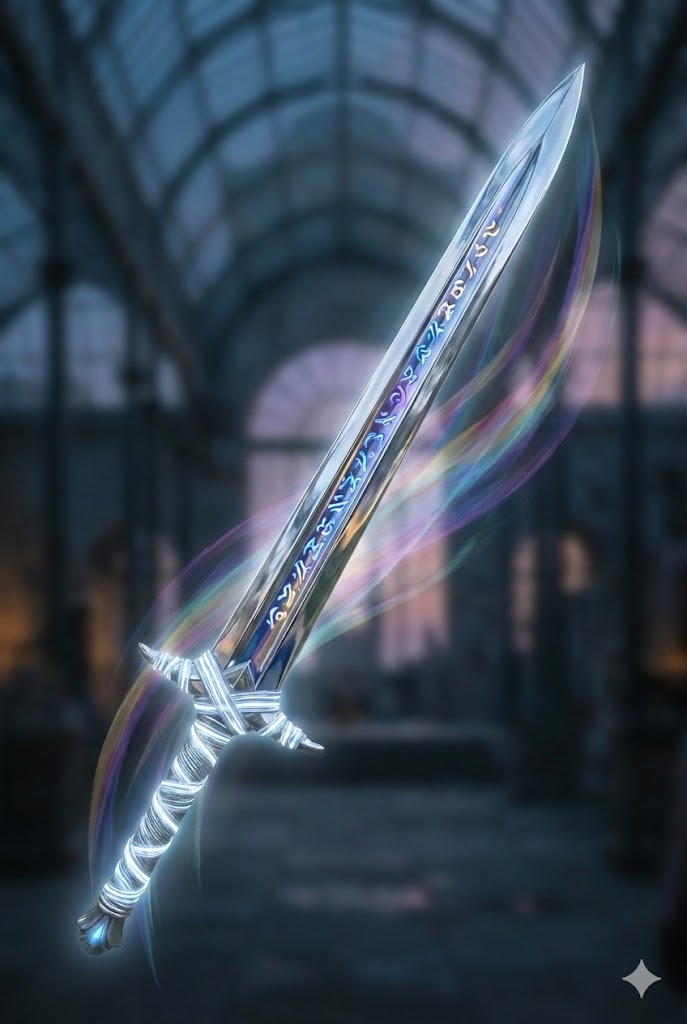
Perception of Activation: Resonant Edge of Verse 214
User’s Perspective The moment your hand tightens around the silvery Windwalker’s Cord wrapping the hilt, the physical weight of the steel vanishes, replaced by a sensation of buoyant uplift, as if the sword is trying to pull you into the sky. A surge of raw, unshaped emotion floods your chest—the artistic impulse of the Ballad 47 seeking expression. You feel a rhythmic thrumming in your palm, not like a machine, but like the beating heart of a living creature composed of wind and song. As you swing, the motion feels less like a martial strike and more like a conductor’s baton slicing through silence, with the air itself rushing to support your wrist, correcting your angle with a gentle, invisible pressure.
Observer’s Perspective To an onlooker, the activation is a spectacle of light and sound. The sword does not simply reflect light; it seems to bleed color into the air. As the wielder moves, trails of luminescent “ink” hang suspended in space for fleeting seconds, painting the path of the blade in vibrant hues of gold, azure, or violet depending on the intensity of the swing. The air around the wielder distorts with heatless ripples, and instead of the sharp hiss of steel cutting air, a resonant, multi-tonal chord rings out—a sound that is simultaneously mournful and triumphant, audible even over the din of battle.
Sensory Breakdown
Sight Perceived: The runes etched along the fuller ignite with shifting liquid light. Description: Trails of ethereal “brushstrokes” follow the blade, lingering in the air like light-paintings. The Aether-Tempered Steel glimmers with an impossible, oil-slick sheen that seems to possess depth. Positives: Creates a dazzling display that can distract or mesmerize opponents; provides light in darkness. Negatives: Makes stealth impossible; the visual trails clearly telegraph the arc of the attack to skilled duelists.
Sound Perceived: A constant, low-frequency hum that rises to a singing crescendo when swung. Description: The blade harmonizes with the environment. A parry sounds like a crashing cymbal; a thrust sounds like a flute’s high note. The Aria of the Gale manifests as a thunderous, operatic bass drop. Positives: The harmonic resonance can rattle enemy armor and intimidate beasts. Negatives: The constant “singing” prevents silent communication and can mask subtle environmental cues like footsteps.
Touch Perceived: A paradoxical mix of forge-heat and high-altitude chill. Description: The hilt feels cool and wrapped in silk (Windwalker essence), while the crossguard radiates a steady, stabilizing warmth (Forgehaven essence). Positives: Keeps the hands warm in winter and cool in summer; the vibration keeps muscles loose and reactive. Negatives: The constant vibration can cause numbness in the fingers after prolonged use (several hours).
Smell Perceived: A sharp, invigorating scent. Description: It smells of ozone (lightning), fresh parchment, and the crisp, thin air found at mountain peaks, masking the scent of blood or sweat. Positives: Clears the sinuses and sharpens mental focus. Negatives: The scent of ozone is distinct and can reveal the wielder’s position to creatures with keen scent tracking.
Taste Perceived: A metallic tang mixed with sweet ambrosia. Description: The air around the blade tastes charged, like the atmosphere before a summer storm, but with a lingering sweetness of exotic ink. Positives: Refreshing; reduces the sensation of thirst during combat. Negatives: Can leave a cloying, metallic aftertaste that interferes with tasting potions or food.
Extra-Sensory Perceptions
Synesthetic Echoes Perceived: Hearing colors and seeing sounds. Description: The wielder perceives the flow of combat as a piece of music. Enemy attacks appear as discordant notes or “wrong” colors, allowing for intuitive defense. Positives: heightened reaction times; allows the user to predict attacks based on the “rhythm” of the fight. Negatives: Can be disorienting in chaotic battles with too much noise, leading to sensory overload.
Aeromantic Intuition Perceived: A physical sensation of air currents on the skin, even through armor. Description: The wielder can “feel” the movement of air caused by moving objects within 30 feet, effectively granting 360-degree awareness of movement. Positives: Prevents being flanked; allows fighting in blind conditions (fog/darkness). Negatives: Strong natural winds (storms) can “deafen” this sense, creating a static-like interference.
Empathic Resonance Perceived: The sword projects emotions into the wielder. Description: The blade “remembers” the intent of the Ballad. It pushes the wielder toward dramatic, heroic, or artistic actions, discouraging cowardly or pragmatic, boring strikes. Positives: Grants immunity to fear effects, as the blade’s “artistic passion” overrides terror. Negatives: May compel the wielder to take unnecessary risks for the sake of “style” or a dramatic finish.
The Muse’s Whisper Perceived: Faint, unintelligible whispering at the edge of consciousness. Description: The combined spirits of the Windwalker nomads and the Elysian bards whisper inspiration. Positives: Occasionally provides flashes of insight on how to bypass an enemy’s guard or solve a puzzle. Negatives: The whispers can be distracting during moments requiring absolute silence or meditation.
Recipe: The Great Composition (Forging the Resonant Edge)
Items Merged
- Forgehaven Blade (Tier 1): Serves as the physical vessel and structural core.
- Spirit 17 of the Windwalkers Cord (Tier 1): Serves as the binding agent and source of aerodynamic magic.
- Palette of Elysian Verses (containing Ballad 47) (Tier 1): Serves as the catalyst for the enchantment and the source of the item’s “soul.”
Additional Materials Needed
- Vial of Captured Thunder (1x): A sealed glass vial containing the sonic energy of a storm, used to wake the latent magic in the steel.
- Solvent of Unmaking (3 oz): A volatile alchemical acid used to dissolve the physical wood of the Palette, turning the Ballad 47 into pure liquid magic without destroying the verses.
- Dust of the Prismatic Echo: Ground gemstones that have been exposed to bardic magic for a century, used to stabilize the visual effects of the blade.
- Flux of Weightlessness: An alchemical paste made from crushed griffon feathers and mercury.
Tools Required
- Harmonic Anvil: A specialized anvil cast from bell-bronze that rings with a pure tone when struck, ensuring the magic settles rhythmically into the steel.
- Aetheric Forge (High-Temperature): Must be capable of melting the solvent and steel simultaneously.
- Runesmith’s Tuning Fork: Used to test the pitch of the blade during the folding process.
Skill Requirements
- Master Smithing (Tier 3): Required to manipulate the Aether-Tempered Steel without breaking the delicate Windwalker threads.
- Expert Performance (Singing/Oratory): The crafter (or an assistant) must be able to sing the Ballad 47 perfectly during the critical fusion phase.
- Advanced Alchemy: To safely handle the Solvent of Unmaking.
Crafting Steps
- Liquefaction of the Verse: Place the Palette of Elysian Verses into a crucible. Pour the Solvent of Unmaking over it. Do not apply heat yet. As the wood dissolves, the mystic inks will float to the surface, glowing brightly. Collect this “Liquid Verse” in a crystal vial; this is the distilled essence of the Ballad.
- The Aerial Binding: Heat the Forgehaven Blade in the Aetheric Forge until it glows a dull cherry red. Coat the Spirit 17 of the Windwalkers Cord in the Flux of Weightlessness. Carefully wrap the cord around the tang and lower blade of the heated sword. The heat will not burn the cord; instead, the flux causes the celestial spider silk to fuse directly into the metal, turning the steel a shimmering silver-white.
- The Rhythmic Fold: Place the fused blade onto the Harmonic Anvil. Begin hammering the steel. With every strike, the crafter must sing a line from Ballad 47. The strikes must match the rhythm of the song. As the metal folds, pour the “Liquid Verse” into the fuller of the blade. The ink will not boil off; it will seep into the micro-fissures of the steel, creating the glowing runic script.
- The Sonic Quench: When the blade reaches critical resonance (it begins to hum on its own), unstopper the Vial of Captured Thunder and pour the sonic energy directly onto the edge. The blade will scream—a high-pitched vibration. Plunge the blade immediately into a cooling trough of holy water mixed with Dust of the Prismatic Echo.
- Awakening the Muse: Remove the blade. It will appear grey and dull. Strike the flat of the blade once with the Runesmith’s Tuning Fork. The grey outer layer will shatter like glass, revealing the Resonant Edge of Verse 214 beneath, glistening with its liquid sheen and humming its eternal song. The three items are now one.
Singing Sharpness and Three-Blood-Binding
Translation Note: Fragment retrieved from the Sunken Library of the 7th Epoch. Syntax preserved for authenticity. Many terms for “Magic” and “Music” appear interchangeable.
In the Time of Wet Ash, before the Great Drying of the lands, there was the Separate Three. The world was deaf, for the iron did not know how to sing, and the wind did not know how to bleed.
The first was the Iron-With-Memory. It was birthed by the Fire-Father (believed to be Theron) in the house of loud banging. This Iron was proud. It tasted the red-water of many warriors. It judged the hand that held it. If the hand was weak-heart, the Iron became heavy as a guilt-stone. If the hand was strong-heart, the Iron became light as a promise. But the Iron was sad, for it could only cut; it could not speak the dream.
The second was the Rope-of-Ghost-Spiders. It belonged to the Sky-Walkers, the people who refused the ground. This rope was fed on wind-meat and leaf-spirit. It was the enemy of the Down-Pull (gravity). It wanted to float, to dance, to be away from the dirt. But the Rope was foolish, for it had no spine. It drifted like a lost thought. It needed a bone to hold.
The third was the Wood-of-Nine-Mouths (The Palette). It was carried by the Paint-Man who fought the dragon-lizard with a song. Upon this wood was scratched the Forty-Seven-Chants. It held the wet-colors of the soul. It was the trap for beauty. But the Wood was soft. Fire could eat it. Time could rot it. It had the song, but not the teeth to defend the song.
Then came the Silence-Beast. The Void-That-Eats. It came to the mountain to swallow the noise of the world.
The Grandson of the Fire-Father looked at the Beast. His hammer was useless. The Sky-Walker looked at the Beast. Her rope was useless. The Paint-Man looked at the Beast. His song was quiet.
They said, “We must make the One-Thing.”
They went to the Anvil-That-Hums. It was a time of great pain for the objects.
The Paint-Man took the Wood-of-Nine-Mouths. He poured the Sour-Water (acid) upon it. The wood screamed and died, but the ink did not die. The ink became the Liquid-Soul. It floated like oil on water. It was the blood of the verse.
The Fire-Father took the Iron-With-Memory. He put it in the star-fire until it was soft as clay. He did not let it sleep. He hit it with the rhythm of the heart. Bang-hum-bang-hum.
The Sky-Walker took the Rope-of-Ghost-Spiders. She dipped it in the Paste-of-Feathers. She wrapped the hurting Iron with the laughing Rope. The Iron tried to burn the Rope, but the Rope hugged the Iron. They became married in the heat.
Then, the Liquid-Soul was poured into the cracks. The Iron drank the verse. The Rope drank the color.
The Anvil broke. The mountain shook. The Sharp-Singer was born.
It was not a sword. It was a solidified scream of beauty. When the Hero lifted it, the ground rejected him. He was pulled by the sky. He swung the Sharp-Singer, and the air bled color. The Silence-Beast tried to eat the hero, but the hero was not there—he was a painting of wind. He struck the Beast, and the blade did not cut the flesh; it cut the silence. It filled the Beast with the loud-song until the Beast burst into a thousand echoes.
The hero did not walk. He flowed like ink. He did not kill. He corrected the shape of the world.
The Sharp-Singer remembers this day. It hums the Two-Hundred-Ten-Four noises (Verse 214?). It waits for the hand that is Artist, the hand that is Warrior, the hand that is Wind.
Moral of the Story: To be strong is good, to be free is good, to be beautiful is good; but the greatest power is found when the Stone learns to Fly and the Steel learns to Sing.
Suggested conversions to other systems:
Call of Cthulhu (7th Edition)
Unique Name: The Sword of Singing Silence (Artifact)
Description: An ancient blade that feels unnervingly light, appearing to be made of liquid quicksilver and woven spider silk. It hums with a frequency that causes teeth to ache and glass to crack. To wield it is to invite the alien rhythms of the “Wind-Walkers” into one’s mind.
Weapon Class: Melee (Sword) Skill: Fighting (Brawl) or Art/Craft (Conducting) Damage: 1d8 + 4 + db (Magical/Sonic) Malfunction: 00 (Never jams, but on a fumble, the blade screams, deafening the wielder for 1d4 rounds)
Special Powers:
- The 47th Verse (Active): By spending 10 Magic Points (MP) and 1d6 Sanity (SAN), the wielder can swing the blade to release a Breath of the Deep (equivalent to a localized hurricane). All targets in a 10-yard cone must succeed on a CON roll (Hard) or be knocked backward 20 feet and suffer 2d6 damage from sonic pressure.
- Aetheric Step (Active): By spending 5 MP, the user may move vertically as if walking on solid ground for 1 minute.
- Malleable Reality (Passive): The sword is capable of damaging creatures that are immune to mundane weapons.
Cost of Attunement: To awaken the blade, the user must study the runes for one week and succeed on a Hard Cthulhu Mythos or Extreme Art/Craft roll. Failure results in the permanent loss of 5 POW as the sword feeds on the user’s creative spark.
Blades in the Dark
Unique Name: The Verse-Blade Item Type: Fine Melee Weapon (Tier III)
Load: 1 (Archived per user rule: merged items occupy minimal space) Tags: Fine, Arcane, Sharp, Resonant
Mechanics:
- Quality: This item counts as Tier III for the purpose of effect. When used in combat (Skirmish or Finesse), it has Great Effect against standard physical armor due to its sonic resonance shattering plates and mail.
- Edge: The Windwalker’s Buoyancy. The wielder gains Potency on agility-related rolls (Prowl/Finesse) involving climbing, jumping, or falling. You may mark 1 Stress to glide across a gap or descend safely from any height.
- Special Ability: The War-Tableau. You may mark 2 Stress to activate the Ballad 47. For the next few moments, you move with supernatural speed, leaving afterimages of light. You may take the Push yourself action for combat (gaining +1d or +Effect) without taking the usual 2 stress cost (the sword pays the cost for you).
Drawback:
- Loud. The blade hums constantly. It is impossible to carry this weapon while remaining completely silent. All Stealth rolls involving silence have Reduced Effect or Desperate Position.
Dungeons & Dragons (5th Edition)
Unique Name: Resonant Edge of Verse 214 Type: Weapon (Longsword), Legendary (Requires Attunement by a Bard, Fighter, or Rogue)
Description: A blade of Aether-Tempered Steel wrapped in glowing silk. It has the Finesse property despite being a longsword.
Stats:
- Damage: 1d8 (1d10 versatile) Slashing + 1d6 Thunder
- Modifier: You gain a +3 bonus to attack and damage rolls made with this magic weapon.
Passive Properties:
- Zephyr’s Grace: While holding this weapon, your walking speed increases by 10 feet, and you are immune to falling damage.
- Artistic Focus: This weapon counts as a Spellcasting Focus for Bards. You gain a +2 bonus to Performance checks.
Active Abilities (Charges): The sword has 7 Charges and regains 1d6+1 charges daily at dawn. If you sing a verse of the ballad (no action required), you can expend charges to perform the following:
- Verse of Transposition (1 Charge): As a bonus action, you cast Misty Step. The teleportation leaves a streak of colorful ink in the air.
- Aria of the Gale (3 Charges): As an action, you cast Shatter (Save DC 17) centered on a point you strike with the blade. The damage is Thunder.
- Tableau of War (4 Charges): As a bonus action, you cast Mirror Image. The duplicates appear as painted figures of light.
Sentience: The Resonant Edge is a chaotic neutral sentient weapon with an Intelligence of 12, Wisdom of 15, and Charisma of 18. It communicates by transmitting emotions and musical chords to the wielder. It craves artistic expression in battle and may suppress its own magic (denying charges) if the wielder fights in a boring or cowardly manner.
Knave (2nd Edition)
Unique Name: Singing Blade of the 214th Verse
Slot: 1 (Occupies 1 Hand) Durability: 6 (Masterwork/Magical)
Mechanics:
- Damage: d10 damage (Versatile, can be used 1 or 2 handed).
- Masterwork Quality: On a successful attack, you may choose to push the target 10 feet away with a blast of wind instead of dealing damage.
- Intelligent Item: The sword can hum to alert the wielder of ambushes (counts as a Watchman).
Magic (Relic Abilities): The sword contains the trapped essence of a Bardic spellbook. It does not use the wielder’s item slots for spells, but uses its own internal Durability as fuel.
- Fly (1 Durability): The wielder can fly at their normal movement speed for 1 turn (10 minutes).
- Thunderclap (1 Durability): All enemies in near range must make a CON save or be deafened and take d6 damage.
- Mirage (1 Durability): Creates 1d4 illusory duplicates of the wielder that last for 1 combat round. Attacks against the wielder have a 50% chance of hitting a duplicate (destroying it) instead.
Repair: This item cannot be repaired with standard whetstones. It must be “tuned” by a craftsman making a successful INT (Art/Music) check during a rest, consuming a ration of expensive incense or ink.
Fate Core / Condensed
Unique Name: Resonant Edge of Verse 214 Type: Extra (Arcane Artifact)
Description: A legendary longsword fused with wind magic and bardic verse. It sings when swung and paints the air with light.
Permissions: Must possess an Aspect related to Martial Mastery or Artistic Performance. Cost: 4 Refresh (reflecting its immense power as a Tier 3 item).
Aspects:
- Main Aspect: The Singing Blade of Wind and Steel
- Trouble Aspect: Demands a Grand Performance (The GM can compel this if the wielder tries to be stealthy or fights in a boring, pragmatic way, causing the blade to falter).
Stats (Weapon Rating):
- Weapon: 3 (Legendary). Attacks with this weapon deal +3 shifts of physical stress on a successful hit due to the sonic vibration and razor wind.
Stunts:
- Zephyr’s Buoyancy: The wielder ignores all scene aspects related to difficult terrain or precarious footing (e.g., Slippery Ice, Crumbling Ledge). Additionally, the wielder cannot fall unless they choose to.
- Aria of the Gale: Once per scene, the wielder can create an advantage called Deafening Sonic Blast on a zone. This places the aspect on the zone and gives the wielder a free invoke. Any enemy in that zone must overcome a Great (+4) difficulty or be pushed into an adjacent zone.
- Ancestral Memory: When the wielder Defends with Fight against a melee attack and succeeds with style, they may immediately create a situational aspect on the attacker named Read Like Sheet Music with a free invoke, representing the blade predicting the enemy’s next move.
Numenera & Cypher System
Unique Name: The Resonant Edge Level: 8 (Artifact)
Form: A longsword made of liquid-like steel wrapped in glowing silk. It constantly hums a low, pleasant chord. Depletion: 1 in 1d20 (Check per day of active use).
Effect:
- Asset: The weapon is perfectly balanced and light. It provides an Asset to all Speed-based melee attacks and defense rolls.
- Damage: It functions as a Heavy Weapon but deals 8 points of damage (Physical/Sonic) due to the high-frequency vibration.
- Flight: While holding the hilt, the user can levitate and fly a short distance each round (Move: Long) as if weightless.
Active Abilities (Cost to User’s Intellect Pool):
- Sonic Burst (3 Intellect): The user swings the blade, releasing a cone of sound. All creatures within immediate range take 5 points of ambient damage and are moved to short range.
- Dimensional Step (4 Intellect): The user cuts a hole in space and teleports to a location they can see within long range.
- Tableau of Light (5 Intellect): The user creates three illusory duplicates of themselves painted in light. This functions as an asset to Speed defense for one minute, or until the duplicates are destroyed.
VR/GM Intrusion:
- Discordant Feedback: On a natural 1, the blade screeches violently. The user is Deafened and moves one step down the Damage Track due to the sonic backlash.
Pathfinder (2nd Edition)
Unique Name: Resonant Edge of Verse 214 Item Level: 17 Price: 14,500 gp Usage: held in 1 hand; Bulk: L (Light)
Description: This +3 greater striking thundering longsword is crafted of Aether-Tempered Steel and wrapped in celestial silk. It sings a constant melody.
Base Stats:
- Damage: 3d8 Slashing + 1d6 Sonic (Thundering rune)
- Traits: Rare, Magical, Evocation, Sonic, Versatile P.
Activation:
- Cast a Spell (Interact); Frequency: Once per day; Effect: You cast Mirror Image (5th level). The images appear as stylized, glowing paintings of yourself.
- Envision (Interact); Frequency: Once per hour; Effect: You cast Dimension Door, but you must arrive at a location you can see, and the path is marked by a trail of colorful ink.
Passive Abilities:
- Aeromantic Buoyancy: While holding the drawn weapon, you are under the constant effect of Air Walk. You ignore difficult terrain caused by wind or uneven ground.
- Bardic Resonance: The sword counts as a virtuoso musical instrument. You gain a +3 item bonus to Performance checks. If you are a Bard, this item acts as a repertoire expansion, allowing you to prepare one additional spell of 6th level or lower from the Occult list, provided it has the [Sonic] or [Visual] trait.
Critical Hit Effect (Thundering): On a critical hit, the target must succeed at a DC 35 Fortitude save or be permanently Deafened. The target takes an additional 3d8 sonic damage.
Savage Worlds (Adventure Edition)
Unique Name: Resonant Edge of Verse 214 Type: Legendary Magic Weapon
Weight: 2 lbs Cost: Not typically for sale (Value: $80,000+)
Gear Stats:
- Damage: Str+d10 (The blade is incredibly sharp and vibrates to cut matter).
- AP: 4 (Aether-Tempered Steel slices through armor).
- Parry: +2 (The blade pulls the wielder’s hand to block automatically).
- Notes: Min Str d6.
Arcane Device Mechanics: The sword has its own reservoir of 15 Power Points (PP) which recharge at a rate of 5 per hour. The wielder uses their Spirit or Performance die to activate these powers (or Faith/Spellcasting if they have an Arcane Background).
Powers (Trappings):
- Fly (2 PP): Trapping: Windwalker’s Glide. The wielder floats on air currents. (Duration: 5 rounds).
- Havoc (2 PP): Trapping: Aria of the Gale. A cone of sonic force knocks enemies prone and pushes them back.
- Teleport (3 PP): Trapping: Verse of Transposition. The user vanishes in a swirl of ink and reappears up to 12″ away.
- Deflection (3 PP): Trapping: Harmonic Shield. The blade spins and hums, deflecting incoming projectiles (-2 to be hit).
Drawback (Major Hindrance – Quirk):
- Loud: The item constantly hums. The wielder suffers a -4 penalty to Stealth rolls. If the wielder rolls a Critical Failure on any Trait roll while using the sword, the sword sings an insulting verse about the failure, alerting all enemies within 20″ (sound).
Shadowrun (Sixth World / 6e)
Unique Name: The Aria-Blade (Alchera / Weapon Focus)
Description: A Dual-Natured artifact that appears as a blade of quicksilver and fiber-optic light. It hums on the astral plane, masking the user’s signature with a “background noise” of chaotic music.
Type: Exotic Melee Weapon (Blade) Availability: 24F (Unique) Cost: N/A (Priceless / Estimated 250,000¥ street value)
Stats:
- Damage: (STR + 4)P
- Attack Rating (AR): 14 / – / – / – / –
- Armor Penetration (AP): -5 (Sonic vibration shatters ceramic plating)
- Reach: 1
Wireless/Magical Bonuses:
- Focus: This weapon acts as a Force 6 Weapon Focus for the purpose of dice pools and astral combat.
- Zephyr Glide (Minor Action): The wielder can activate the spirit-magic woven into the hilt to gain the Levitate power (Force 6) for movement only. This allows vertical ascent or gliding over gaps.
- Sonic Boom (Major Action): Once per combat scene, the wielder can slash the air to create a blast of sound. Use the Exotic Melee skill to attack a target up to Medium Range. Damage is 8S (Stun), AP -2, with the Blast (3m) effect.
- Holo-Distortion: The light trails provide a +2 Dice Pool bonus to Defense tests as they confuse attackers.
Drawback:
- Astral Beacon: The blade sings constantly in Astral Space. The wielder cannot use the Stealth skill against Assensing tests; they stand out like a neon sign.
Starfinder (1st Edition)
Unique Name: Verse-Pattern Resonant Edge Item Level: 14 Price: 75,000 Credits
Description: A Hybrid (Magic/Tech) advanced melee weapon. The blade is composed of a nanocarbon-aether weave that vibrates at resonant frequencies capable of destabilizing molecular bonds.
Stats:
- Weapon Type: Advanced Melee (Two-Handed or One-Handed with -2 penalty)
- Damage: 6d6 S & So (Slashing and Sonic)
- Critical: Deafen (DC 22)
- Bulk: L (Light – seemingly defies gravity)
- Special Properties: Analog, Powered (Capacity 40, Usage 2/round), Operative.
Mechanics:
- Aeromantic Thrusters: While held, the weapon functions as a Jetpack (Armor Upgrade) with average maneuverability, consuming 1 charge per round of flight.
- Holo-Clone Circuit: As a move action, you can expend 5 charges to generate a Mirror Image effect (caster level 14) that functions as the spell. The images appear as 2d4 painted silhouettes.
- Transposition Algorithm: Once per day, as a standard action, you can expend 10 charges to replicate the effects of Dimension Door.
- Bardic Interface: The weapon can interface with personal comm units to project music. You gain a +4 insight bonus to Profession (Musician) checks while wielding it.
Traveller (Mongoose 2nd Edition)
Unique Name: Psionic Blade “Verse 214” TL (Tech Level): 16 (Ancient/Psionic)
Description: A relic of a Precursor civilization. The blade is not solid matter but a coherent field of force and suspended sound waves, projected from a hilt wrapped in unknown organic filaments.
Weapon Stats:
- Skill: Melee (Blade)
- Damage: 4D+4 (Ignores the first 6 points of Armor)
- Kilograms: 0.5 kg
- Cost: MCr 2.5 (2,500,000 Credits) – Illegal/Restricted
- Traits: AP 8, Zero-G (No penalty in low gravity).
Psionic Features: To access the blade’s active features, the wielder must have a PSI characteristic of 6+ or the Telekinesis talent.
- Flight: The wielder may fly at Medium speed as if wearing a Grav Belt. This costs 1 PSI point per minute.
- Kinetic Shield: Incoming ranged attacks suffer a DM-2 due to the sonic displacement field generated by the sword’s hum.
- Teleport: The wielder may spend 4 PSI points to instantly relocate to any visible location within Medium range (approx. 50 meters).
Radical Instability: If the wielder rolls a natural 2 on an attack check (Snake Eyes), the sonic field destabilizes. The wielder takes 2D damage (ignoring armor) as the handle vibrates violently.
Warhammer Fantasy Roleplay (4th Edition)
Unique Name: The Singing Blade of the Aether-Wind Type: Hand Weapon (Magical)
Description: A masterwork sword of Elven or Dawi make, shimmering with the winds of Hysh (Light) and Ghyran (Life). It is never silent, humming a tune that matches the heartbeat of the wielder.
Stats:
- Encumbrance: 0 (Magically weightless)
- Availability: Exotic (Unique)
- Reach: Long
- Damage: +SB + 5
- Qualities: Precise, Fast, Impact, Unbreakable.
Runic Properties:
- Rune of the Zephyr: The wielder gains the Flight trait (Movement 4) but must end their turn on solid ground or gently descend. They ignore penalties for difficult terrain.
- Rune of the War-Chant: On a successful Charm or Entertain (Singing) test in combat, the wielder gains the Inspiring Talent rating 3 for the duration of the encounter.
- Rune of Multiplicity: Once per session, the wielder can spend a Fortune Point to make the blade vibrate so fast it appears to be in three places at once. For one round, the wielder gains +3 Attacks.
Flaw:
- The Chorus of War: The blade hates stealth. Any Stealth test taken while the blade is unsheathed automatically fails as the blade sings a battle hymn. Even sheathed, it hums, imposing a -20 penalty to Stealth.
Comments
One response to “Resonant Edge of Verse 214”
[…] Resonant Edge of Verse 214: The primary physical vessel; provides the Aether-Tempered Steel, the Windwalker’s Cord, and the sonic/aeromantic core. […]