
From: Lineage 801 of the Va Korrum
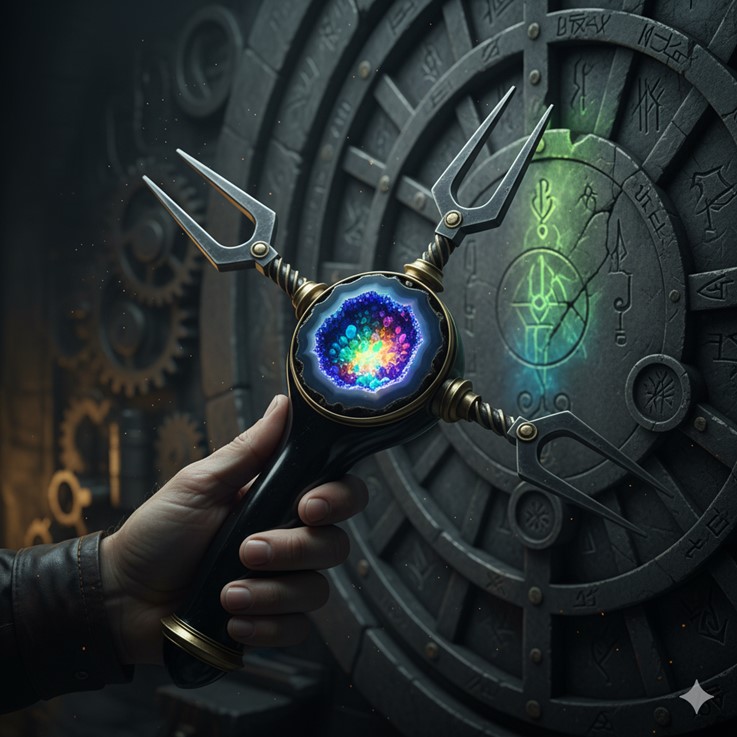
This apparatus is a handheld diagnostic tool essential for any Va-Korrum artificer. It consists of a polished obsidian handle from which three articulated, metallic arms extend. Each arm ends in a different-sized, metallic tuning fork. At the center of the device is a fist-sized, hollow geode lined with resonating crystals. To use it, the wielder touches one of the tuning forks to an object or structure. The device then channels the Kwe-Sar’s innate Lithic Resonance sense, translating the subtle vibrations into a visual pattern of light within the central geode. By interpreting these patterns, the user can precisely identify material compositions, detect hidden structural weaknesses, find stress fractures in metal, or even analyze the resonant frequency of an unknown magical enchantment.
Lore
The Harmonic Resonance Calibrator is not a standalone invention but a direct result of the Va-Korrum lineage’s attempts to mechanically replicate the legendary sensory abilities of the blind artisan, Val-Kesh. While her Resonant Lenses allowed a user to perceive the “truth” of the world, they were a singular masterpiece, an un-reproducible work of art. The Calibrator is the engineering solution: a diagnostic tool that translates the world’s vibrations into a language an artificer can read. Sar-Elun himself constructed this device as a necessary prerequisite to his other works; he believed that to build a better machine, he first had to build a better ruler.
The “447” designates it as his 447th prototype. The breakthrough in the design was the discovery of a “sympathetic geode”—a rare geode formation that, when hollowed, would passively mimic the resonant frequencies of nearby materials. The three tuning forks are forged from unique alloys, each one specifically calibrated to a different vibrational spectrum: the deep, slow resonance of stone and earth; the sharp, complex hum of worked metals and gears; and the fine, high-frequency vibrations of active magical enchantments. To a Va-Korrum artificer, this tool is the key to understanding the “Stone-Song”—the language of substance itself—allowing them to diagnose the health of a mountain or the flaw in a single gear with equal precision.
Item Values and Mechanics
- Tier One Stats: +1 Intelligence, +1 Wisdom
- Skills Gained: Grants Skill Proficiency in Investigation and Arcana.
- Specific Slot: Handheld Tool
- Passive Magic
- Material Acuity: The geode at the center of the device glows with a soft, white light. This light subtly shifts in hue and intensity based on the primary material the calibrator’s forks are touching, allowing the wielder to instantly identify common substances like iron, stone, or wood without a check.
- Flaw Detection: The calibrator is always “listening” for imperfections. The geode’s light will flicker erratically when the device is within 5 feet of a significant structural weakness, such as a crumbling wall, a compromised support beam, or a poorly forged piece of metal.
- Harmonic Distortion: The device emits a constant, low-level multi-frequency hum that is imperceptible to most creatures. Creatures that rely on tremorsense or echolocation have disadvantage on Perception checks made to detect the wielder.
- Activatable Magic
- Deep Analysis (Action): By pressing the calibrator against an object or structure and concentrating for 1 minute, you can perform a detailed diagnostic scan. Upon completion, you learn comprehensive details about the target: its exact material composition and approximate age; any hidden internal mechanisms, compartments, or structural flaws; and the school, strength, and general effect of any magical enchantments currently on it. This ability can be used once per short or long rest.
- Resonant Tuning (Action): You can use the calibrator’s forks to find and replicate a specific vibrational frequency. You can target a single non-magical object or construct made of stone, metal, or crystal. For the next minute, you can cause that object to vibrate, creating a loud humming or ringing noise. If used on a mechanism with a vibrational or sonic trigger (like a trap or lock), you gain advantage on the next check made to interact with or disable it.
- Tags: Kwe-Sar, Va-Korrum, Tool, Diagnostic, Investigation, Arcana, Divination, Resonance, Crystal, Non-Combat, Utility, Investigation, Arcana, Diagnostic Tool, Non-Combat, Utility, Divination, Resonance, Crystal, Handheld, Sensory Device, Analysis
The Harmonic Resonance Calibrator 447 is not a weapon or a piece of armor, but a highly specialized diagnostic tool. Its value is immense, but only to a select few: master artificers, geological surveyors, enchanters, and those who specialize in infiltration. It would be traded in circles where information and precision are prized above raw power.
1. The Technoculum Exchange (Sar-Kwe, Acheulean)
The Shop and Location: This is the official guild store and research exchange for the Technoculum, Acheulean’s premier engineering academy. The environment is clean, academic, and professional, smelling of ozone and clean machine oil. Tools, rare components, and schematics are traded here among licensed artificers and scholars. An item like the Calibrator would be kept under lock and key, treated as a sensitive piece of research equipment.
The Transaction: To buy a Calibrator, a client would need to be a guild-member in good standing or present a letter of commission from a major industrial or political entity. The sale would be a formal process, including a lengthy manual of operation and a required training session to ensure the user understands its complex readings.
Selling Sar-Elun’s original “Model 447” here would be a major event. The academics would be fascinated by the prototype’s unique design and would pay a premium to acquire it for study, viewing it as a significant piece of the Va-Korrum’s developmental history.
The Cost:
- To Buy (a newer, standardized model): 600 Rhodium. The price is high, reflecting its status as a masterwork scientific instrument essential for high-level crafting and engineering.
- To Sell (the original Model 447): 400 Rhodium. A strong, academic price offered for the prestige and research value of acquiring a famous artificer’s prototype.
2. The Gem-Cutter’s Eye (High-End Trade Metropolis)
The Shop and Location: A quiet, luxurious, and heavily secured shop in a wealthy trade city, “The Gem-Cutter’s Eye” specializes in the appraisal and sale of priceless gems and jewelry. The owner is a master jeweler who relies on absolute precision. The shop is silent, with items displayed on velvet cushions under magical lighting.
The Transaction: The owner might have acquired the Calibrator in a trade for a rare jewel, recognizing its incredible value for their own profession. They would market it as the “ultimate appraiser’s tool.” The sale would be a discreet affair in a private back room. The owner would demonstrate its ability to detect the slightest internal fracture in a diamond or differentiate between mundane and magical metals.
Selling the Calibrator to the jeweler would be a straightforward business deal. The owner would be an eager buyer, as the device would save them countless hours and guarantee the authenticity and quality of their wares.
The Cost:
- To Buy: 550 Rhodium. The jeweler knows the item is valuable for their trade but may not grasp its full potential for magical or structural analysis, hence the slightly lower price.
- To Sell: 350 Rhodium. A solid, no-nonsense price based on the clear, immediate profit and efficiency the tool would bring to their business.
3. The Shadow Ledger (Thieves’ Guild Quartermaster)
The Shop and Location: This is not a shop but the clandestine office of the quartermaster for a powerful intelligence and infiltration syndicate. The location is a secret, and the meeting would take place in a “dead room,” a chamber magically silenced and shielded from all forms of scrying.
The Transaction: The Calibrator would be considered a “master key” of legendary potential. Its ability to detect hidden mechanisms in vaults, find structural weaknesses in fortress walls, and analyze magical trap frequencies makes it one of the most valuable espionage tools imaginable. The guild would almost never sell such an item for mere coin to an outsider. They would trade it for a service of equal or greater value.
Selling the Calibrator to the guild would be a tense but lucrative affair. They would pay a very high price to ensure such a tool is in their hands and not a rival’s. Payment would likely be in untraceable, high-value goods like flawless gems or rare alchemical reagents.
The Cost:
- To Buy: Not for sale for money. The price would be an act of legendary espionage—stealing a rival spymaster’s codebooks, planting false information with a head of state, or retrieving another unique artifact for the guild.
- To Sell: 450 Rhodium in flawless, untraceable diamonds. The guild pays a premium to acquire a tool that so perfectly aligns with their operational needs.
The Harmonic Resonance Calibrator 447 is a tool of pure information. It has no direct offensive or defensive capabilities. Its roleplaying use is that of a “problem solver,” allowing the wielder to analyze a situation, identify hidden weaknesses or dangers, and provide the crucial intelligence their allies need to act effectively.
1. Against a Crystal Golem in a Resonant Cavern
In this environment, where both the enemy and the surroundings are made of stone and crystal, the Calibrator is in its element.
Defensive Roleplay
- The Situation: The massive Crystal Golem slams its fists on the ground, causing the entire cavern to shake violently. Stalactites begin to crack and fall from the ceiling.
- How it’s Used: While others are dodging and bracing, Sar-Elun is reading the environment. The Calibrator’s Flaw Detection passive flares to life.
- Roleplay Description: “As the cavern trembles, the geode in Sar-Elun’s calibrator, which he holds constantly, flashes with an erratic red light. He doesn’t look at the falling rocks, but at the shifting patterns of light in the device. ‘Shift right! The western wall is unstable!’ he barks, pointing with the tool. A moment later, a huge section of the cavern wall collapses exactly where the party was standing. He didn’t guess; he felt the catastrophic failure of the rock’s structure through the tool just before it happened, turning a deadly environmental hazard into a near miss.”
Offensive Roleplay
- The Situation: The party’s weapons are glancing harmlessly off the golem’s perfectly-faceted crystalline hide. It seems indestructible.
- How it’s Used: Sar-Elun recognizes this is not a problem of force, but of physics. He uses Deep Analysis to find the golem’s hidden weakness.
- Roleplay Description: “Sar-Elun orders his allies to keep the golem distracted. ‘I need to find its resonant frequency.’ For a full minute, he circles the creature, holding the Calibrator out, its tuning forks humming. The geode in his hand displays a complex, shifting latticework of light. Finally, it settles. ‘The core!’ he shouts, pointing at the golem’s chest. ‘The central crystal is flawed! It resonates at a dissonant frequency to the rest of its body. A single, powerful sonic attack or a perfectly-timed hammer blow to that spot will create a resonance cascade. Shatter the core, and the entire structure will fail!’”
2. A Tense Standoff on a High-Tech Mechanical Bridge
Here, the environment is a complex machine. The Calibrator becomes a tool for hacking and structural sabotage.
Defensive Roleplay
- The Situation: The party is halfway across a massive clockwork bridge when their enemy, an artificer on the far side, throws a lever. With a groan of grinding gears, the bridge begins to retract and fall apart.
- How it’s Used: While others prepare to jump, Sar-Elun uses Deep Analysis and Resonant Tuning to find a last-second engineering solution.
- Roleplay Description: “As the bridge shudders, Sar-Elun jams one of the calibrator’s forks into the main gear housing. The geode flares with information. ‘Sabotage. The primary drive gear is designed to shatter.’ He scans frantically. ‘But the emergency maintenance brake is still intact!’ He strikes one of the tuning forks, producing a high-pitched, pure tone. He presses the vibrating fork to a specific, unmarked bolt on the railing. The tone resonates through the structure, and with a deafening CLANG, a secondary locking mechanism engages, momentarily halting the bridge’s collapse and giving the party a few precious seconds to scramble to safety.”
Offensive Roleplay
- The Situation: The enemy artificer is safely on a control platform on the far side of the chasm, taking potshots at the party.
- How it’s Used: Sar-Elun cannot reach him, so he attacks the structure supporting him. He uses Deep Analysis to find the weakest point.
- Roleplay Description: “Ignoring the incoming fire, Sar-Elun spends a full minute scanning the enemy’s platform with the Calibrator. The geode in his hand slowly builds a structural diagram out of light. ‘Predictable design,’ he mutters. He then points to a single support strut beneath the enemy’s feet, a spot indistinguishable from any other to the naked eye. ‘That strut has a micro-fracture from the initial installation. A single, powerful arrow or a well-aimed kinetic blast to that exact point will trigger a structural failure.’ He has turned the enemy’s fortified position into a deathtrap.”
3. Infiltrating a Heavily Trapped Treasure Vault
In an environment designed to kill intruders with hidden mechanisms, the Calibrator is the ultimate key.
Defensive Roleplay
- The Situation: The party stands before a massive, seamless vault door, knowing it is protected by a complex series of deadly traps.
- How it’s Used: This is the Calibrator’s primary function. Sar-Elun uses Deep Analysis to completely map out the vault’s defenses before a single lock is picked.
- Roleplay Description: “Sar-Elun places his hand on the vault door, holding the Calibrator against it. He closes his eyes and spends a full minute in concentration. The geode displays a shifting, multi-layered diagram of light that only he can interpret. He opens his eyes. ‘The system is comprehensive. The floor panel before the door is pressure-sensitive, triggering a poison dart volley from the ceiling. The lock itself is connected to a magical glyph of silence. A secondary mechanism will release a corrosive gas if the lock is tampered with by force.’ He then points to a small, unmarked stone to the left of the door. ‘However, the entire system is controlled from a single resonant relay behind this panel. If we can tune it correctly, we can disable everything at once.’”
Offensive Roleplay
- The Situation: The vault is open, but the treasure rests on a pedestal surrounded by a seemingly impenetrable network of magical energy beams.
- How it’s Used: Brute force is useless. He uses Deep Analysis to find the single point of failure in the magical defense grid.
- Roleplay Description: “He holds the Calibrator near the glowing beams, its forks humming in response to the magical energy. The geode displays the weaving patterns of the abjuration magic. ‘A closed loop,’ he confirms. ‘The grid is impenetrable.’ He slowly scans the room. ‘…but it’s inefficiently designed. The entire network is powered by a single, focused emitter crystal hidden in that ceiling ornament.’ He points upwards. ‘The beams are just projections. Destroy the emitter, and the entire grid will collapse.’ His “offensive” action is to render the enemy’s perfect defense completely obsolete.”
Perception of Activation:
User’s Perspective (Sar-Elun)
- Somatic & Auditory: The activation is almost entirely internal and silent. As you press a tuning fork against a surface, you feel a faint, high-frequency vibration travel up your arm, a sensation that changes in pitch and complexity depending on the material. There is no sound, only an intense feeling of mental focus, similar to reading a dense, multi-layered schematic. The polished obsidian handle of the device remains cool and steady in your hand.
- Visual: Your focus is drawn entirely to the hollow geode at the center of the device. As the analysis begins, the crystal fills with a complex, three-dimensional, shifting latticework of soft light. You are not just seeing light; you are reading a visual language. Steady blue lines represent dense metals, a deep and resonant grey pattern indicates solid stone, while a chaotic, flickering red signifies the presence and school of an active magical enchantment.
- Extrasensory (Thermal Sense): The device integrates your natural thermal sense into its analysis. The patterns of light within the geode are overlaid with a faint heat map, allowing you to see the warm glow of a hidden power conduit or the cold void of a hollow space within the structure you are scanning.
- Extrasensory (Lithic Resonance): This is the primary sense being channeled. You feel the “song” of the object—its internal structure, its history of stress, its very substance—as a complex symphony of vibrations. The Calibrator acts as a perfect translator, turning this symphony into the clear, visual data displayed in the geode. It is a deeply connected process of “listening” to the story the object is telling.
- Extrasensory (Arcane Perception): You perceive the flow of magical energy not as a raw force, but as a specific, readable frequency or “color” within the geode’s display. You can feel the distinct “texture” of each school of magic—the rigid structure of Abjuration, the chaotic hum of Evocation, the subtle whisper of Divination.
Observer’s Perspective
- Auditory: The activation is completely silent. The device makes no noise that can be heard by an observer.
- Visual: The only perceivable effect is the geode at the center of the tool. It begins to glow with a soft, internal, multi-colored light. An observer looking closely can see a complex, shifting hologram of lines, patterns, and symbols forming and dissolving within the crystal. The user becomes completely still, their eyes unfocused as they stare intently into the device, their expression one of deep, unbroken concentration.
- Somatic: There is no emission of heat, force, static, or any other energy. The process is entirely self-contained and passive.
- Extrasensory (Arcane Perception): A magically sensitive observer would perceive a very subtle, focused probe of Divination magic emanating from the device. It is not a powerful spell, but a delicate, almost undetectable “reading” of the target object. It would feel like a faint whisper or the lightest of touches in the magical spectrum.
Positives
- Extreme Subtlety: The activation is almost completely undetectable to anyone without advanced magical senses. It is silent, emits no energy, and has no flashy visual effects beyond the device itself. This makes it the perfect tool for gathering intelligence without alerting guards, magical wards, or the target of the analysis.
- Unparalleled Information: The perception is not a simple “yes” or “no,” but a rich stream of complex, multi-layered data. It provides a level of insight—into structural flaws, hidden mechanisms, and magical properties—that is impossible to gain by other means, allowing for perfect, elegant solutions to complex problems.
- Non-Destructive: The process is entirely passive. It analyzes without altering, making it perfectly safe to use on volatile magical items, delicate ancient artifacts, or unstable structures without any risk of damaging them.
Negatives
- Requires Total Concentration: The one-minute activation time requires the user’s complete, unbroken focus. During this time, they are effectively oblivious to their surroundings, making them extremely vulnerable to ambush or any other sudden change in the environment.
- Impractical in Haste: The lengthy activation time makes the Calibrator almost useless in a fast-paced or dangerous situation like active combat. It is a tool for careful deliberation and planning, not for split-second reactions.
- Requires Expertise: The data displayed in the geode is complex and abstract. Interpreting the shifting patterns of light and color requires a high level of intelligence and training (represented by skill proficiencies). A less skilled user might misinterpret the data, leading to a disastrously wrong conclusion, such as believing a trapped chest is safe or a load-bearing wall is hollow.
Schematic: Va-Korrum Diagnostic Calibrator, Series 400
This document outlines the masterwork process for creating a diagnostic tool capable of interpreting the fundamental “Stone-Song” of the world. The creation is less about brute force and more about achieving perfect harmony between materials. It is a task for an artisan who is part engineer, part musician, and part mystic.
Materials Needed
- 1x Uncut Sympathetic Geode: The heart of the device. This must be a geode harvested from a location known for its unusual resonant properties, such as a silent cavern or a magnetically charged mountain peak.
- 1x Ingot of Resonant Alloy (Stone): A specialized alloy of lead and adamantine, forged to resonate perfectly with the low-frequency vibrations of rock and earth.
- 1x Ingot of Resonant Alloy (Metal): A specialized alloy of silver and orichalcum, forged to resonate with the complex, high-frequency hum of worked metals and gears.
- 1x Ingot of Resonant Alloy (Magic): A specialized alloy of mithral and quicksilver, forged to resonate with the ethereal, often dissonant frequencies of raw magical energy.
- 1x Flawless Obsidian Billet: To be carved into the insulated, non-interfering handle.
- 3x Runic Wafers (Blank): Thin, polished slices of crystal suitable for scribing the complex “translation” software for the device.
- A Spool of Phase Spider Silk: Used for internal dampening and insulation within the geode housing.
Tools Required
- Masterwork Artificer’s Tool Set: Includes both Tinker’s and Smith’s tools of the highest possible quality.
- Acoustically Shielded Workshop: Essential for the tuning process, this space must be free from all external vibrations and sounds.
- Resonance Forge: A specialized forge capable of creating the precise metallic alloys and tuning them to specific harmonic frequencies.
- Runic Scribing Stylus: A magically-attuned needle required for the precise inscription of the runic wafers.
- Geode Lathing System: A delicate, high-precision tool for hollowing out the sympathetic geode without shattering its crystalline structure.
Skill Requirements
- Mastery in Tinker’s Tools: The assembly of the device’s delicate internal components requires a level of precision bordering on artistry.
- Expertise in Arcana: Necessary to program the runic wafers and handle the magical alloys without disrupting their resonant properties.
- Proficiency with Smith’s Tools: Required for the difficult process of forging and tuning the three distinct resonant forks.
- Trait Requirement: Must possess natural Lithic Resonance. The calibrator is an amplifier, not a source. The crafter must be able to “hear” the Stone-Song to properly tune the instrument that translates it.
Crafting Steps
- Geode Preparation (1 Day): The process begins with the most delicate task. Within the Acoustically Shielded Workshop, the crafter uses the Geode Lathing System to carefully hollow out the sympathetic geode, creating a perfect, smooth inner chamber. The interior is then lined with a fine mesh of Phase Spider Silk for dampening.
- Forging the Forks (2 Days): At the Resonance Forge, the crafter forges each of the three resonant alloys into a perfectly balanced tuning fork. This is a painstaking process of heating, hammering, and quenching, followed by hours of testing and minute adjustments until each fork vibrates at the exact frequency required for its target material (stone, metal, or magic).
- Runic Programming (1 Day): The crafter must enter a meditative state and focus their Lithic Resonance. Using the Runic Scribing Stylus, they inscribe the complex translation matrices onto the Runic Wafers. This “software” is what allows the device to turn the raw vibrations it picks up into the coherent visual patterns displayed in the geode.
- Final Assembly (1 Day): The Obsidian Billet is carved and polished into the final handle shape. The three tuned forks are carefully mounted onto the handle, their bases connected to the programmed Runic Wafers. This entire assembly is then integrated with the hollowed geode, creating the final, complete tool.
- Initial Calibration (8 Hours): The final step requires the crafter to attune the device to their own unique Lithic Resonance signature. They must spend hours in the silent workshop, touching the calibrator to various materials and making micro-adjustments to the runic wafers until the patterns of light in the geode are perfectly clear, stable, and accurate. The device is now ready for use.
Whisper of Unseen Crack
This telling is a difficult one, for the words are not the true words. They are but the shape of words, taken from the runic carvings on a broken geode, whose own story is lost to the river of time. The meaning may be a winding path.
And it was so, in the days of the great expansion, the Kwe-Sar of Acheulean did build a great bridge. The scrolls name it the Iron-Spine, for it was a marvel of engineering, a link between the city of Sar-Kwe and the quarries of the western mountains. Its stones were perfectly cut, its iron braces were forged by the Hammer-Brothers, and its foundations were set deep in the bedrock of the river. It was a thing of great pride, a symbol of the strength that is stone and the will that is iron.
For a hundred years, the Iron-Spine stood. Then, a sickness came upon it. It began as a low hum, a wrong note in the song of the stone that only the most sensitive Kwe-Sar could feel in their feet. Then, the hum became a groan, and the groan became a shudder. Small cracks, like the lines on an old man’s face, began to appear in the great stone blocks.
The Greybeards of the Masons were summoned. They looked with their eyes, which were sharp, and they saw the cracks. “The bridge is weary from its long service,” they declared. “We will give it a new skin of iron.” And so, great plates of iron were bolted to the bridge’s sides, a thick and heavy armor. But the shuddering did not cease. The groaning grew louder, and new cracks appeared through the iron itself.
Then the Master-Smiths of the forge were called. They looked with their eyes, which were keen, and they saw the failing iron. “The braces are weak,” they said. “We will give the bridge new bones of steel.” And so, massive new supports of steel were forged and wedged beneath the great arches. But the sickness was deep, and the steel bones did only creak and groan with the bridge’s pain. The Iron-Spine was dying, and no one could see the wound.
Then came the young artificer, Sar-Elun, who was called the Flaw-Finder by some, and the Gear-Counter by those who mocked him. He did not bring a hammer. He did not bring a trowel. He brought a strange device, a thing of polished obsidian, with three metal fingers like tuning forks, and a hollow crystal at its heart that shone with a soft, sleeping light.
The Greybeards saw his strange toy. “Do you come to sing the bridge to sleep, boy?” they jeered. “We need strong arms and true stone, not a diviner’s bauble.”
Sar-Elun did not answer their scorn. He went to the center of the great, groaning bridge. He placed one of the metal fingers of his device, the Calibrator, against the stone. He closed his eyes. The world of sight was of no use to him now. He began to listen.
He listened not with his ears, but with his hands, and with the deep Earth-Feeling of his Kwe-Sar blood. The device did drink the shuddering of the bridge, and the sleeping light in the crystal did wake. It was not a steady light, but a chaotic dance of jagged lines and angry colors. It was a picture of pain. The Flaw-Finder walked the length of the bridge, his tool pressed to the stone, his eyes fixed on the screaming light within the geode. He was not looking at the bridge; he was reading its fevered soul.
For a day and a night, he walked and listened. The elders watched him, their scorn turning to wonder, and then to unease. Finally, Sar-Elun stopped. He stood at the very end of the bridge, on the solid earth of the riverbank. He pointed not at the mighty arches or the cracked stones, but down, at a single, unremarkable foundation block, half-buried in the mud of the river.
“The sickness is not in the bones or the skin,” he said, and his voice was quiet. “It is in the heart.”
The Greybeards were confused. “That is the First-Stone,” said the chief mason. “It is the strongest of all, set upon the bedrock itself.”
“Your eyes see its strength,” Sar-Elun replied. “But my tool has heard its song. And its song is a lie.”
He showed them the geode. Within it, the chaotic light had focused. It showed the image of the great bridge, a beautiful web of harmonious blue light. But from the place where the First-Stone sat, a single, jagged line of angry red pulsed, a dissonant note that sent shudders through the entire web. The stone was flawed from within, a thing no eye could see. It had been cracked in its setting a hundred years ago, and its unseen vibration was slowly, patiently, shaking the entire masterpiece to ruin.
The masons and smiths did the hard work of diverting the river and replacing the single, flawed stone. When the new stone was set, a great quiet fell upon the Iron-Spine. The groaning ceased. The shuddering was still. The sickness was healed. The Flaw-Finder had saved the bridge not by adding strength, but by finding the one true weakness.
The Moral of the Story: The mightiest structure can be brought to ruin not by a great force, but by the one small flaw that no one thought to look for.
Suggested conversions to other systems:
Dungeons & Dragons (5th Edition)
Calibrator of True Resonance
Wondrous item, rare (requires attunement by a creature proficient with at least one type of artisan’s tools)
This handheld device consists of a polished obsidian handle from which three articulated, metallic tuning forks extend. At its center is a fist-sized, hollow geode lined with crystals that emit a soft, sleeping light.
While holding this device, you gain the following benefits:
- You gain a +2 bonus to Intelligence (Investigation) and Intelligence (Arcana) checks.
- Flaw Detection. The geode’s light flickers erratically when you are within 10 feet of a non-magical structural trap (like a pressure plate or tripwire) or a significant structural weakness in a wall or ceiling.
Deep Analysis. As an action, you can touch one of the tuning forks to a structure or an object and begin a one-minute analysis. This process cannot be interrupted. At the end of the minute, you learn the following information about the target:
- Its precise material composition and any significant flaws (cracks, weaknesses, etc.).
- The location and general function of any hidden internal mechanisms.
- The school of magic for any enchantments on the object, if any.
Once you use this feature, you cannot use it again until you finish a short or long rest.
Call of Cthulhu (7th Edition)
The Miskatonic Harmonic Analyzer
A prototype device from the Miskatonic University physics department, this strange apparatus purports to translate the resonant frequencies of matter into a visual medium. It consists of a polished obsidian handle, three metallic tuning forks, and a hollow geode filled with what appears to be a lattice of quartz crystals. It is cool to the touch and emits a barely perceptible, high-frequency hum.
Function: By touching one of the forks to an object, an investigator can attempt to analyze its composition and properties. This is a complex and mentally taxing process.
- Basic Analysis: Using the Analyzer requires a Hard (–20) Science (Physics) or Hard (–20) Engineering roll and takes one minute of concentration. A success reveals the object’s precise material composition and any mundane structural weaknesses or hidden mechanisms.
- Mythos Resonance: If the investigator attempts to analyze an object of Mythos origin or one bearing an active spell, the process is more dangerous. It still requires the Hard (–20) Science roll.
- On a success, the investigator learns the general purpose of the Mythos artifact or the nature of the spell, but the horrifying, non-Euclidean vibrations they witness cost 0/1D4 Sanity points.
- On a Fumble, the feedback loop is overwhelming. The investigator suffers a bout of intense vertigo and nausea, taking 1D3 points of physical damage, and the device cannot be used again for 24 hours. They also lose 1/1D6 Sanity points from the alien geometries they perceived.
Blades in the Dark
The Whisper-Geode
A strange, pre-cataclysmic device; part scientific instrument, part ghost-tech. It’s a handheld tool with three tuning forks and a hollow, crystal-lined geode. When you press a fork to a surface, the geode’s light translates the structure’s “whispers”—its weaknesses, its secrets, its hidden heart.
This is a rare piece of special gear.
- Fictional Permissions: You are equipped with a masterwork diagnostic tool. You can analyze structures for weaknesses, find hidden mechanisms in vaults, and detect the hum of active electroplasmic wards.
- When you Study a location or a complex machine to find a weakness or secret, you get +1 effect.
- When you Tinker to bypass a trap, open a lock, or disable a mechanism that you have previously studied with the Whisper-Geode, you get +1d to your roll.
- Sense the Spirit-Song: You can spend 1 Stress to attune the device to the ghost field. For a few moments, the geode shows you a visual representation of the flow of spiritual energy in the immediate area, allowing you to easily spot ethereal targets or hidden spirit wells.
Knave (2nd Edition)
Resonance Meter
A handheld tool with three metal forks and a glowing crystal. It hums when touched to a surface, revealing its secrets.
- Slots: Takes up 1 inventory slot.
- Passive: You have advantage on saves made to notice or avoid structural traps, like pressure plates and collapsing floors.
- Active (1 use per day): You may spend 10 minutes of uninterrupted concentration while holding the meter against an object (such as a chest or a door) or a section of a structure (such as a 10ft section of wall). At the end of this time, the GM will tell you the following:
- Its primary material composition.
- The location of one hidden mechanism or structural weakness.
- If it is magical, and if so, what its general purpose is (e.g., “It’s a magical trap that shoots fire,” or “It’s an enchanted lock”).
Fate Core System
The Calibrator of Resonant Truth
This is an Extra, representing a highly specialized and powerful diagnostic tool.
- Aspects:
- High Concept: Masterwork Diagnostic & Analytical Tool
- Trouble: Requires Uninterrupted Concentration
- Other: It Hears the Song of the Stone
- Stunts:
- Flaw Detection: Because the calibrator is always listening for imperfections, you gain a +2 bonus to Create an Advantage when you use your Investigate skill to find a physical weakness, hidden mechanism, or structural flaw in an object or building.
- Deep Analysis: Once per scene, you can take a full exchange to perform a detailed scan on one object or structure. This action cannot be interrupted. If successful, you automatically discover all of the target’s relevant situational aspects (both known and hidden) related to its physical nature, and you gain one free invocation on one of those aspects.
- Arcane Resonance: When you use the calibrator to examine a magical item, you can use your Investigate skill instead of Lore to identify its properties.
Numenera & Cypher System
The Harmonic Resonance Scanner
This is a complex and delicate artifact, likely from a civilization that had mastered vibrational physics and matter analysis.
- Level: 6
- Form: A handheld device with an obsidian handle, three metallic tuning forks, and a hollow, crystal-lined geode.
- Effect:
- Passive: The user is trained in all tasks involving geology, structural engineering, and identifying material compositions.
- Active (Detailed Analysis): Action; The user spends one full minute in uninterrupted concentration while touching the device to a single object or structure. At the end of the minute, the user learns up to three key details about the target, such as its exact material composition, any hidden mechanical components, one major structural weakness, or the presence and general purpose of any esoteric energies (magic, psionics, etc.).
- Active (Resonant Frequency): Action; The user can tune the device to a specific object’s resonant frequency. For the next minute, any task attempted by anyone to repair, disable, or destroy that specific object is eased.
- Depletion: 1 in 1d20 (Check for depletion only when the Detailed Analysis ability is used).
Pathfinder (2nd Edition)
Harmonic Calibrator
Item 11 Rare, Magical, Divination, Invested Usage held in 1 hand; Bulk L
This handheld device consists of a polished obsidian handle and three articulated tuning forks surrounding a hollow, crystal-lined geode that glows with a soft, internal light.
Passive The calibrator is a set of master’s crafting tools for the purpose of identifying materials and flaws. You gain a +2 item bonus to Crafting, Engineering Lore, and Arcana checks.
Activate [three-actions] Deep Analysis (Concentrate, Manipulate, Revelation) Frequency once per 10 minutes; Effect You touch the calibrator to an object or structure and concentrate. You learn the target’s precise material composition and its highest-level magical aura, if any. You also learn about one of the following of your choice: any structural weaknesses or hidden mechanisms within the object, or the nature of one other magical aura on the object. If you are a master in Crafting, you learn all of the above information.
Savage Worlds Adventure Edition (SWADE)
The Kwe-Sar Resonance Meter
A rare and highly advanced piece of Acheulean technology, this handheld device allows an artificer to “read” the secrets of any object they touch.
- Requirements: Seasoned, Repair d8+ or Occult d8+
- Bonuses:
- Diagnostic Tool: The user gains a +2 bonus to all Repair and Notice rolls when attempting to diagnose a problem with a machine, find a trap in a structure, or appraise the quality of a material.
- Abilities:
- Deep Scan: By spending one minute in concentration while holding the device to an object or structure, the user can make a Repair or Occult roll.
- Success: The user learns one key piece of information about the target (its primary material, a single structural weakness/hidden mechanism, OR the general presence of magic).
- Raise: The user learns all of the above information, including the specific Trapping of any magic present.
- Resonant Tuning: The device can be used to cast the Detect/Conceal Arcana power on a single object by touch, using the wielder’s Repair skill as their arcane skill for the roll. This does not cost Power Points but can only be done once per hour.
- Deep Scan: By spending one minute in concentration while holding the device to an object or structure, the user can make a Repair or Occult roll.
Shadowrun, Sixth World
Renraku ‘Stone-Song’ Analyzer
A high-precision, multi-spectrum diagnostic tool from Renraku’s geo-engineering division. It uses a combination of ultrasonic resonance, thermographics, and a sophisticated material analysis suite to provide a detailed structural overview of any object it scans. While designed for mining and construction, it has found a niche market in the security and espionage sectors.
- Type: Sensor / Electronic Tool
- Rating: 4
- Availability: 16R
- Cost: 95,000¥
Game Effects:
- Integrated Analysis Suite: The device contains an integrated Engineering Toolkit, providing a +1 dice pool bonus to related tests.
- Passive Flaw Detection: The device is always performing a low-level scan. The user gains a dice pool bonus equal to half the device’s Rating (2) on all Perception tests to spot physical traps, hidden compartments, or structural weaknesses.
- Deep Resonance Scan (Complex Action): The user can perform a detailed scan on an object or structure they are touching. This requires an Engineering + Logic [Mental] (4) test. On a success, the user learns the precise material composition of the target, the location of any internal mechanisms, and one major structural weakness. If the user gets 4 or more net hits, they also learn the general nature of any active magical enchantments on the object, as the device flags the unnatural resonance.
Starfinder
Resonant Frequency Scanner
Level 14; Price 70,000 credits; Slot held (1 hand); Bulk 1
This advanced handheld scanner uses a combination of sonic pulses and thermal imaging to create a detailed internal map of any object it analyzes. It is a favored tool of high-end engineers, archaeologists, and security specialists for its ability to find hidden flaws and mechanisms without invasive procedures.
Effects:
- The scanner functions as a master engineering toolkit, granting a +4 circumstance bonus to Engineering checks.
- Passive Analysis: You gain a +4 insight bonus to Perception checks to find traps, secret doors, and other structural anomalies.
- Deep Scan (1 minute): You can spend one minute scanning a single object or a 10-foot section of a structure. At the end of this time, you learn its precise material composition, the location and function of any mechanical or technological components within it, and any major structural weaknesses. If the target is enchanted, you can attempt a Mysticism check (DC = 15 + the item’s level or spell’s level) to learn the school of magic and general purpose of one enchantment upon it.
Traveller (Mongoose 2nd Edition)
Advanced Material Composition Analyzer (AMCA)
A piece of high-tech diagnostic equipment, the AMCA is standard issue for Imperial survey teams and advanced engineering crews. It uses a combination of sonic resonance and molecular analysis to provide a complete structural and material profile of any object.
- TL: 14
- Mass: 2 kg
- Power: 2/hour
- Cost: MCr1.5
Effects:
- The AMCA is a sophisticated sensor and toolkit in one. It provides DM+3 to all Mechanic, Engineer, and Science (any) checks related to identifying materials, diagnosing structural failures, or finding hidden mechanisms.
- Full Spectrum Analysis: As a significant action that takes one minute of uninterrupted scanning, the user can perform a deep analysis on an object or structure. This requires a Difficult (10+) Science check. On a success, the Referee provides a full report on the target, including:
- Exact material composition.
- A 3D wireframe of any internal mechanical or electronic components.
- A highlighted map of all significant structural weaknesses (stress fractures, weak points, etc.).
- A warning of any unusual energy signatures (psionic, exotic, or otherwise unexplained).
Warhammer Fantasy Roleplay (4th Edition)
The Cogman’s Truth-Finder
An intricate and temperamental device of brass and crystal from the Imperial Engineers’ Guild. It has three articulated arms ending in tuning forks that, when pressed to a surface, cause a central geode to display a swirling, coded pattern of light, revealing the object’s inner secrets to those with the wit to interpret it.
This is a rare and complex piece of Engineering.
- Qualities: Complex, Fine, Unreliable.
- Passive Effects: The user gains a +10 bonus to all Perception Tests made to find traps and secret doors in stone or metal structures.
- Active Abilities:
- Read the Inner Workings: The user may spend 10 minutes concentrating while holding the device to an object or structure. At the end of this time, they may make a Challenging (+0) Trade (Engineer) Test. If successful, they learn the precise location of any hidden mechanisms and one major structural weakness of the target.
- Sense the Aethyric Hum: When using the device, the user may attempt a Hard (–20) Channelling Test instead. If successful, they do not learn the physical properties, but instead learn the Wind of Magic and general strength of one enchantment on the object.
- Unreliable: As per the Unreliable Quality, whenever the wielder Fumbles any Test made while using the device, it provides a catastrophically wrong reading. The geode either shatters (rendering the device useless until repaired with a Hard (–20) Trade (Engineer) Test) or shows a complete and dangerously misleading lie, at the GM’s discretion.
Comments
One response to “Harmonic Resonance Calibrator 447”
[…] Harmonic Resonance Calibrator 447 (Tier 1): The source of the diagnostic technology, including its resonating forks, geode housing, and runic programming. […]