
Original Life Forms Used:
Mammalia: Snow Leopard (Panthera uncia)
Aves: Saddle-billed Stork (Ephippiorhynchus senegalensis)
Reptilia: Glass Lizard (Ophisaurus ventralis)
Amphibia: Axolotl (Ambystoma mexicanum)
Appearance
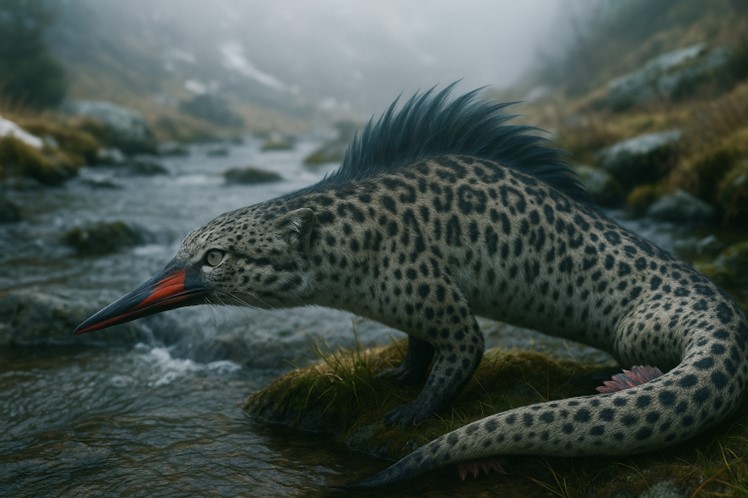
The Threskglacine Slinker is long and low-bodied, about 3 m nose-to-tail with an agile, limbless trunk like a giant glass lizard but sheathed in sleek snow-leopard rosetted fur that breaks into iridescent, water-shedding feather-filaments along the back and shoulders. Its head is narrow and stork-like, ending in a black-and-crimson beak with a slight down-curve; the eyes are large and pale silver, fringed by transparent nictitating lids adapted for both air and water. Six small, vestigial fins sprout along the tail, edged with shimmering axolotl frill-gills. When agitated it flares those gills and emits a faint bioluminescent shimmer.
Size
- Length: ~3 m (10 ft)
- Mass: ~90 kg (200 lb)
- Body height: ~0.7 m (28 in) at midsection
Speed
- Ground: 30 ft (can undulate and leap short gaps)
- Swim: 40 ft (fast in rivers and coastal shallows)
- Burst: can lunge up to 50 ft in water once per rest using tail-fin propulsion
Stat Modifiers (relative to an average humanoid baseline)
- Strength +2 (muscular trunk and tail)
- Dexterity +3 (serpentine agility and climbing via micro-hooks hidden in ventral scales)
- Constitution +1 (amphibious lung/gill mix, cold-resistant fur)
- Intelligence −1 (feral cunning rather than reasoning)
- Wisdom +1 (keen sensory acuity)
- Charisma −2 (alien, unsettling presence)
Skills
- Stealth +4 (cryptic rosetted and feathered coat; nearly silent in water)
- Perception +3 (rotating eyes, vibration sense from axolotl heritage)
- Athletics +2 (bursts of muscular undulation; climbing slick stone)
Behavior
Solitary ambush predator; stakes out riverbanks or snowy ridges where prey drinks or migrates. Will watch silently for hours, submerging like a log or curling under brush. Territorial but cunning: leaves “feather-rosette” scrapes and scent marks to warn rivals. Capable of short cooperative hunting when food is scarce, but usually avoids others of its kind.
Diet
Carnivorous opportunist: fish, amphibians, river birds, small to medium mammals. Occasionally scavenges carrion. Can survive lean times by slowing metabolism and absorbing dissolved nutrients via frill-gills.
Emotions
Cautious and observant; expresses curiosity via feather-flare and slow head tilts. Rage is sudden but brief, triggered by territory breach or injured prey escape. Can be playful in youth, rolling and snapping at floating debris.
Environment Where Found
Cool, misty alpine rivers descending into foggy lowlands; also glacial tarns draining toward coastal estuaries. Thrives where cold mountain melt meets warmer brackish marsh, giving it year-round amphibious refuge.
Tags
Feral Predator, Amphibious, Ambush Hunter, Alpine River Delta, Cold-Tolerant, Semi-Plumaged, Agile, Bioluminescent Threat Display, Saṃsāra-Native, Hybrid-Beast, Aquatic Predator, Territorial Lurker, Camouflaged, Night Hunter, Riverbank Stalker, Quick Strike, Solitary Ambusher, Cold Adapted, Silent Swimmer, Apex Mesopredator
Life Cycle
- Hatchling Stage (0–2 years): Eggs (4–6 per clutch) are laid in concealed riverbank burrows reinforced with woven reeds and fur. Hatchlings are 30 cm long, translucent-skinned with external feathery gills. They remain near water, feeding on insects and small fish while their fur and faint rosettes develop.
- Juvenile Stage (2–6 years): Limbless but agile, about 1.2 m long. Begin shifting from pure aquatic hunting to ambush at shorelines; develop first stealth feather-plumes and partial cold coat. Small groups of siblings sometimes linger together for safety.
- Adolescent Stage (6–10 years): Reach 2+ m length, full predatory instincts awaken. Become solitary; begin marking territories with rosette scrapes and musk glands. Migrate slightly upstream or to isolated tarns.
- Adult (10–25 years): Peak strength and hunting ability; 3+ m long. Full coat, resilient gills, and broad hunting range (river to coastal marsh). Maintain stable territories and ambush paths.
- Elder (25–40+ years): Slower metabolism, duller coat, but extremely cunning. Some migrate to deeper estuarine pools and become near-mythic “river spirits.” Fewer eggs in late life but extremely hardy.
Mating
- Seasonal, triggered by snowmelt and lengthening daylight.
- Males and females exchange displays: feather-frill spreading, throat bubbling, and water-surface drumming with tails.
- Courtship can involve slow underwater circling and gentle beak clacking.
- Females dig semi-flooded burrows reinforced with mud and reeds; males often remain for early egg-guarding but depart before hatching.
- Fertilization internal; eggs gelatinous but layered with fine fur to hide scent from predators.
Tactics
- Ambush Precision: Lies submerged with only nostrils and eyes above water or coiled under snow drifts.
- Vibration Sense: Detects prey footsteps or splashes via lateral line–like organs and gill fringes.
- Explosive Burst: Tail coils, then unleashes a sudden serpentine strike; can vault out of water or leap downslope to surprise land prey.
- Distraction Plumes: In desperate fights, fans out feathers and gills to appear larger and emit quick bioluminescent pulses to disorient predators or intruders.
- Feather Scent Lure: Shedding specialized feathers into water that smell like rotting fish, luring scavengers close.
Actions (Combat & Survival Instincts)
- Tail Whip: Wide sweep that can unbalance or knock medium foes into water.
- Crushing Constriction: Wraps long trunk to immobilize prey before finishing with beak bite.
- Hooked Strike: Uses sharp beak to pierce vulnerable areas.
- Water Jet Leap: Bursts from shallows with extra momentum, good for ambushing at river edges.
- Cold Sink: Rapidly dives and hugs river bottom, becoming nearly invisible and letting colder waters dull predator scents.
Other Interesting Information
- Seasonal Camouflage: Rosettes pale in snowy months and darken with green algae staining in summer floods.
- Residual Regeneration: Can regrow small tail tips or frill edges if injured, a leftover axolotl trait.
- Mythic Reputation: Riverfolk tell stories of “Lantern Tails” guiding lost children to safety—likely older Slinkers following curiosity rather than hunting.
- Resourceful Shelter Use: Will dig complex bank dens with multiple escape tunnels and underwater exits.
- Semi-Social Signals: Low, rumbling subsonic purrs under water; audible only to others of its kind and to tuned sonar devices.
Why Adventurers Might Encounter or Seek the Threskglacine Slinker 487
1. Tactical Challenge & Ecosystem Balance
The Slinker sits near the top of its aquatic-alpine food chain. Any expedition traveling through glacial river passes, misted highlands, or cold estuaries is likely to stumble across one when:
- Crossing remote fords or using secret smugglers’ streams.
- Following fish-rich waterways that the Slinker dominates.
- Attempting to rest or camp on riverbanks that it claims as ambush grounds.
Because it’s solitary and territorial, just wandering too close can trigger an attack. Locals may warn about “lantern-tail waters” — but warnings are sometimes vague or superstitious.
2. Rare Alchemical Components
Its bioluminescent frill-gills and water-shedding feather-filaments are prized for potions and gear:
- Silent Step Elixirs: brewed from frill mucus for stealth enhancement.
- Frost-Breath Filters: its cold-resistant pelt helps craft insulation against magical frost.
- Amphibious Breather Charms: gill material holds latent water-to-air transmutation potential.
Adventurers might be hired by alchemists or gearwrights to harvest these rare materials.
3. Territorial Threat Removal
Settlers, miners, or bridge-builders working near alpine streams sometimes offer bounties because Slinkers prey on livestock, disrupt ferry trade, or attack lone travelers. A party may be contracted to track and remove a “rogue river wraith.”
4. Guiding Lore & Spirit Quests
Some faiths and local cultures view elder Slinkers as semi-mystic “River Wardens.” Certain rituals require their shed feathers or presence:
- Pilgrims or druids might need to follow or commune with one to gain safe passage or water blessings.
- Shamans may send adventurers to collect a frill or to witness its bioluminescent displays as a test of worth.
5. Treasure & Curiosities
Because they dig multi-chamber burrows with underwater access, old Slinker lairs often accumulate valuables:
- Sunken trade goods swept into dens.
- Trinkets from drowned or ambushed travelers.
- Bones and carved fetishes from past riverfolk rites.
6. Arcane Research
Mages and scholars study its hybrid biology — regenerative tissues, amphibious adaptations, cold-climate survival. They pay for live specimens or field notes. The party may be asked to capture or observe one rather than kill.
Common Adventure Hooks
- “Lantern on the Rapids”: reports of eerie lights near a critical ford; caravans disappearing.
- “Frills of Silence”: a master thief hires adventurers to collect frill secretions for a custom stealth cloak.
- “Guardian of the Lost Ferry”: villagers can’t reopen a trade ferry because a Slinker has nested there.
- “Echo of the Warden”: a druidic sect believes the next great flood can be foretold by tracking an ancient Slinker upriver.
Harvestable Materials from a Threskglacine Slinker 487
1. Frill-Gill Fans
- Use:
- Distilled into Aquatic Adaptation Potions — temporary water breathing and cold tolerance.
- Crushed into Resonance Powder that helps artisans tune vibration-sensitive weapons or detection gear.
- Spell component in Silence Wards (the Slinker’s subsonic purr channels are prized for dampening sound).
- Handling: Must be kept moist; dry frills lose potency in 24 hours.
2. Bioluminescent Mucus & Tail Lantern Nodes
- Use:
- Shadowveil Ink for stealthy tattoos or scrolls that glow only under moonlight.
- Light-modulating paint for secret map markings and safe-path runes.
- Catalyst in potions of Illusory Veil or Dazzling Display (brief light bursts).
- Handling: Requires cold storage; heat neutralizes glow proteins.
3. Rosetted Cold-Fur Pelt
- Use:
- High-value armor and cloaks resistant to cold and wet conditions.
- Tailoring for stealth gear — patterning breaks visual outlines.
- Arcane insulation: lining for cold-exposed magical instruments or rifles.
- Handling: Skin within 2 hours; rosettes fade after death if exposed to direct sun.
4. Transparent Skull & Beak Sheath
- Use:
- Beak edge sharpened and alchemically tempered into cutting tools or ritual daggers with True Cut (pierces minor magical wards).
- Skull dome polished into divination bowls — clarity aids scrying waters and reflection spells.
- Handling: Soak in saline before curing to avoid brittleness.
5. Vibration-Sense Nerve Filaments
- Use:
- Integrated into Tremor Sensors or hunter gear to detect movement through stone/water.
- Bound into boots or staves for silent, sure-footed travel across unstable terrain.
- Handling: Must be preserved in oil; dries to useless thread otherwise.
6. Hydrostatic Tail Musculature
- Use:
- Dried and braided into Elastic Cords for grappling hooks, bows, and climbing gear with enhanced recoil.
- Alchemical “spring sinew” for prosthetics or trap triggers.
- Handling: Cure with brine or lose elasticity.
7. Glandular Musk Sacs
- Use:
- Potent lure for other aquatic predators (used in fishing or monster baiting).
- Ingredient in Territorial Oils to mark and ward areas magically.
- In diluted form, repellent to some river pests (leeches, biting flies).
- Handling: volatile; store in sealed stone or bone containers.
8. Calcified Eggshell Shards
- Use:
- Alchemists crush into Vital Bloom Powder — slow-release healing accelerant.
- Scribed with protective runes to create talismans against drowning and hypothermia.
- Handling: Fragile but stable if kept dry.
9. Nictitating Eye Lenses
- Use:
- Refined into lenses for goggles granting Enhanced Vision Underwater or Fog.
- Ground for Clear Sight Potions that counter murk and magical darkness briefly.
- Handling: Keep submerged in saline until processed.
10. Heart Pearl (Elder Only)
- Use:
- A mineralized core sometimes found in very old Slinkers — prized arcane focus for Shape Water and frost/wave magics.
- In some faiths, crafted into protective amulets said to “ward river wrath.”
- Handling: Extremely rare; fragile crystalline shell, dissolve in strong acids if mishandled.
Field Note
Parties often bring waterproof sacks, salt brine, and cooling charms to preserve these materials — the Slinker’s body decays fast once removed from cold river water. Specialized trappers or riverfolk guides know how to harvest safely; mishandling the musk sacs or frills can attract other predators or spoil the goods.
Song of the Lantern Tail
As Spoken by the Ice-River Priests
Long ago—no man may count so far—the White Waters fell from the Teeth of Sky and sang deep in the stone hollows. In that youth of the world, before the iron roads, before the high smoke wheels, there was no fisher who dared the melt-runs when night had eaten the sun. For there lived the Long Silver Shadow, with coat like broken moon and tail aflame of quiet light. Some called it Lantern Tail, some whispered Threskglacine, but all feared its breath and the sudden silence of its water.
It is said that the first tale was brought not by man but by wind: the wind who found bones of a hunter leaning on reeds, his spear broken and his eyes wide though no mark upon him. The river carried the memory down, and the Ice-River Priests caught it in cups of polished horn, and they poured it into words. But words were slippery then, and our fathers’ tongues forgot many meanings; thus we say what we can, crooked though it be.
In those lost snows, a clan known as the Reed-Binders lived near a lake fed by glacial tears. They built houses of bent willow and sang to the deep for fish. But fish vanished; only ripples came, and sometimes soft glow far below. The elders feared the silent hunter and said, give gift, not spear, for none returned who sought to pierce it.
One youth, Haan the Bold-for-nothing, would not heed. He took spear and skin-boat and went when ice cracked like laughter. The glow came: long coil, fur like broken frost, feathers half-seen, beak red as sunset. It rose without sound and looked into him. Some say he felt his heart beat in its silver eyes. He thrust his spear—but water turned heavy, limbs failed, and he sank. Yet death passed him by; instead the Lantern Tail circled thrice, binding him with frill-light, then pushed him to shore.
Half-frozen he crawled back, voice broken, and spoke: The hunter who strikes the deep will be struck; but the watcher who waits will learn the deep’s path. His words were not his, they say, but river’s echo. From that hour the Reed-Binders changed: no spears in night melt, only gifts—bright shells and smoke leaf dropped into dark pools. The fish returned, and sometimes the glow came gentle, watching but not taking.
A second telling speaks of flood years later: the White Waters swelled beyond knowing. Haan, now elder, led children to high rock. As they cried, the Lantern Tail rose from roaring foam, mighty now, with frills like banners of cold fire. It struck stones aside, dug new cut for flood to pass. So the clan lived, though half their huts were lost. They say the beast vanished upstream, leaving only drifting feathers bright as moonlight.
Moral: Strike not the hidden deep in haste, for its silence is older than spear or song; but give respect, and the deep may guard as well as drown.
Suggested conversions to other systems:
Call of Cthulhu 7e — Threskglacine Slinker 487
STR 85; CON 70; SIZ 90; DEX 80; INT 35; POW 50
Hit Points 16; Move 9 land / 12 swim; Build +1; Damage Bonus +1d4; Armor 3 (dense fur and muscle)
Skills Stealth 75%, Swim 80%, Listen 70%, Spot Hidden 60%, Climb 60%, Track 60%, Jump 50%
Attacks
Beak Snap 65% (1d8+DB piercing, ignores 1 point of armor)
Constriction 60% (on grapple, 1d6+DB each round, STR vs STR to escape)
Tail Whip 55% (1d6+DB bludgeoning, target DEX×5 or fall prone/unbalanced in water)
Special
Amphibious Lungs — breathes air and water.
Silent Strike — +25% Stealth for surprise from water or snow.
Cold Resilience — halves cold-based damage/effects.
Bioluminescent Dazzle — once per hour, glow forces POW×5 or suffer −20% to next action.
Sanity Loss 0/1d4 on first encounter.
Blades in the Dark — Threskglacine Slinker 487
Type Large Hybrid Beast (Exotic Predator)
Threat 3 (solitary apex ambusher)
Scale Large, counts as two humans
Armor 2 (thick hide and cold fur)
Quality Exceptional stealth and aquatic movement
Clocks & Harm
Tail Constriction (4 segments): if filled, inflicts Level 3 Harm “Crushed Breath.”
Lantern Tail Dazzle (3 segments): if filled, all nearby resist or take Level 2 Harm “Disoriented.”
Vibration Sense: ignores ambush unless countered with shock or misdirection.
Edges Amphibious, Cold-Hardened, Perfect Stillness
Weaknesses Startles at concussive water shocks; slow recovery after burst exertion.
GM guidance: treat as Severe Threat; demands teamwork and specialized tactics.
Dungeons & Dragons 5e — Threskglacine Slinker 487
Large monstrosity, unaligned
Armor Class 15 (natural)
Hit Points 102 (12d10+36)
Speed 30 ft., swim 40 ft.
Strength 17 (+3), Dexterity 16 (+3), Constitution 16 (+3), Intelligence 5 (−3), Wisdom 13 (+1), Charisma 6 (−2)
Saving Throws Dexterity +5, Wisdom +3
Skills Perception +5, Stealth +7, Athletics +5
Senses darkvision 60 ft., tremorsense 30 ft., passive Perception 15
Languages none
Challenge 5 (1,800 XP)
Proficiency Bonus +3
Traits
Amphibious — breathes air and water.
Snow and River Camouflage — advantage on Stealth in snowy or aquatic terrain.
Cold Adaptation — resistance to cold damage.
Silent Ambusher — extra 2d6 damage on first attack when hidden.
Actions
Multiattack — one beak and one tail attack.
Beak — melee +5 to hit, reach 5 ft., 12 piercing damage.
Tail Constrict — melee +5 to hit, reach 10 ft., 10 bludgeoning, grapple (escape DC 13), restrained while grappled.
Lantern Flare (Recharge 5–6) — bioluminescent pulse in 20 ft. radius, DC 13 Constitution save or blinded until end of next turn.
Reaction
Cold Dive — when hit by ranged attack near water, dive and swim up to half speed as reaction.
Knave — Threskglacine Slinker 487
Hit Dice 6d8; Armor Class 15; Move 40 swim / 30 land
Attack Beak +5 (2d8 damage) and Tail Constrict +5 (2d6 damage, grapple)
Morale 9; Save 13+
Special abilities: Amphibious; Silent Ambush (+4 surprise near water or snow); Cold Resist (halve cold damage); Lantern Dazzle once per exploration turn (creatures Save vs CON or lose next action); Tremor Sense 30 ft.
Treasure: 1d4 valuable alchemical parts such as frill-gills, glow glands, or patterned pelt.
Fate Core — Threskglacine Slinker 487
High Concept: Silent Lantern-Tailed River Ambusher
Trouble: Territorial Apex Hunter
Aspects: Cold-Furred Shadow of the Meltwaters, Bioluminescent Frill That Dazzles, Amphibious Predator of Forgotten Rapids
Approaches:
Careful +1, Clever +0, Flashy +1, Forceful +2, Quick +3, Sneaky +4
Stress: 3 boxes
Consequences: Mild (2), Moderate (4), Severe (6)
Stunts:
- From Snow and Silence: Gain +2 Sneaky when setting ambushes in water or snowy terrain.
- Lantern Flare: Once per scene, spend a Fate Point to blind or disorient foes in close range, creating the aspect Dazzled by Frill-Light with two free invokes.
- Amphibious Burst: Once per exchange, may cross water obstacles as if they were normal ground.
Refresh: 1
Numenera / Cypher System — Threskglacine Slinker 487
Level 5 (target number 15)
Motive: Territorial ambush predator
Environment: Cold alpine rivers, glacial deltas, and estuaries
Health: 25
Damage: 6 points with beak snap; tail constriction 5 damage per round and immobilizes (escape requires Might task vs Level 5)
Armor: 2 natural fur and scales
Movement: Short on land, long in water
Modifications: Stealth as Level 7 in snowy or aquatic terrain; Perception as Level 6 (vibration sense)
Combat: Typically surprises prey; opens with Lantern Flare (Intellect defense Level 5 or blinded/disoriented for one round; −2 to next action). Then constricts or drags into water.
Interaction: Feral and territorial but curious; might be lured with glowing fish bait or sonic disruptions.
Use: River hazard, living relic of prehistory, or guardian of treasure caches in submerged lairs.
Loot: Frill-gills (air/water breathing ciphers), glowing mucus (light or invisibility cyphers), cold-fur pelt (protective clothing).
Pathfinder (2e) — Threskglacine Slinker 487
Creature 6
Alignment Unaligned
Perception +13; darkvision, tremorsense 30 feet
Languages none
Skills Stealth +16, Athletics +14, Survival +12, Swim +16
Str +4, Dex +5, Con +3, Int –3, Wis +2, Cha –2
AC 23; Fort +15, Ref +17, Will +12
HP 95
Speed 30 feet, swim 40 feet
Melee beak +16 (agile), Damage 2d10+4 piercing
Melee tail +16 (reach 10 feet), Damage 2d8+4 bludgeoning plus Grab
Special Abilities
- Amphibious: Breathes air and water.
- Snow and River Camouflage: Gains +2 circumstance bonus to Stealth in snowy or aquatic environments.
- Lantern Flare (aura, light, visual) [two actions]: The Slinker’s frill bursts with cold-white light in a 20-foot emanation. Each creature must attempt a DC 22 Fortitude save. Critical failure: blinded for 1 round and dazzled for 1 minute. Failure: dazzled 1 minute. Success: dazzled until start of next turn. Recharge 1d4 rounds.
- Constrict [one action]: 2d8+4 bludgeoning to grabbed creature, DC 22 basic Reflex save.
Savage Worlds (Adventure Edition) — Threskglacine Slinker 487
Wild Card
Attributes: Agility d10, Smarts d4, Spirit d6, Strength d8+2, Vigor d8
Skills: Athletics d8, Fighting d10, Notice d8, Stealth d12, Swimming d10
Pace: 6; Swim 8; Parry: 7; Toughness: 7 (2)
Special Abilities:
- Aquatic Predator: Pace 8 in water, no penalties to fight submerged.
- Camouflage: +2 to Stealth in snowy or aquatic terrain.
- Cold Hardened: +4 to resist environmental cold.
- Lantern Flare (Cone 6”, once per combat): Targets make Smarts roll vs Slinker’s Stealth or be Distracted and Vulnerable for 1 round; raise also Shaken.
- Constrict: On successful grapple (Fighting vs Athletics), inflicts Str+d6 each round and restrains.
- Size +2: Large and imposing.
- Tremor Sense: Detect movement in 10” radius if touching same surface or water.
Edges: Ambusher (+2 to attack from stealth)
Hindrances: Territorial (aggressive if lair approached)
Shadowrun (6e) — Threskglacine Slinker 487
Metatype/Creature: Paracritter (Hybrid Amphibious Predator)
Attributes: BOD 6, AGI 7, REA 5, STR 7, WIL 4, LOG 2, INT 4, CHA 2, EDG 1
Essence: 6
Initiative: 9 + 1d6 (land), 11 + 1d6 (in water)
Movement: 10/25 land, 15/40 swim
Armor: 6 (dense cold-resistant fur and flexible scales)
Condition Monitor: 11P, 10S
Skills: Unarmed Combat 8, Sneaking 10 (water), Perception 8, Swimming 8, Tracking 6
Powers & Qualities:
- Amphibious: Breathes air and water.
- Natural Camouflage: +4 dice to Sneaking in snowy or aquatic terrain.
- Cold Resistance 4: Natural environmental protection.
- Lantern Flare (Magical): Simple Action, Magic 4 vs Willpower + Logic; on success, targets in 10m radius –3 dice pools for 1 Combat Turn (flash-blinded).
- Constrict: Grapple (Opposed STR + Unarmed vs STR + Gymnastics). On success, immobilizes and inflicts STR/2 Stun each turn.
- Enhanced Senses: Low-light vision, vibration detection in 15m water radius.
Tactics: Prefers ambush from water or snow, blinds prey with Lantern Flare, then constricts or drags underwater.
Starfinder — Threskglacine Slinker 487
CR: 6
XP: 2,400
Alignment: N
Type: Magical Beast (Amphibious)
Init: +7; Senses: darkvision 60 ft., tremorsense 30 ft., low-light vision; Perception +15
DEFENSE HP: 90; EAC/KAC: 20/22
Fort +9, Ref +9, Will +5
Resistances: cold 10
Speed: 30 ft., swim 50 ft.
OFFENSE:
Melee beak +14 (2d8+6 P)
Melee tail constrict +14 (2d6+6 B plus grab)
Special Abilities:
- Amphibious: Functions equally in air and water.
- Silent Ambush: +4 circumstance bonus to Stealth in snowy or aquatic terrain.
- Lantern Flare (Ex): Standard action, 20 ft. radius. Creatures must succeed a DC 17 Fort save or be blinded 1 round and dazzled 1d4 rounds; usable once every 1d4 rounds.
- Drag Below: If grappling in water, automatic 1d6 extra bludgeoning per round and forces Athletics DC 17 to avoid being pulled deeper.
STATISTICS:
STR +6, DEX +3, CON +4, INT –3, WIS +2, CHA –2
Skills: Athletics +15, Stealth +18, Survival +13, Swim +18
Traveller (MGT 2e) — Threskglacine Slinker 487
Type: Large Amphibious Carnivore
STR 15, DEX 12, END 14, INT 3, EDU —, SOC —
Hits: 21
Speed: 8 m land / 12 m swim
Armor: 6 (hide and fur)
Attacks:
- Beak Snap (Melee 10+, damage 3D6)
- Tail Constrict (Melee 8+, damage 2D6 and grapple; opposed STR check each round to escape)
- Lantern Flare (Special): Once per encounter, creatures within 10 m make END or INT check 8+ or be blinded/disoriented for 1–3 rounds (DM-2 to actions).
Traits:
Amphibious; Camouflage (DM+4 Stealth in snow/water); Cold Tolerance (ignore cold up to –40°C); Tremor Sense (detect movement within 10 m through water/ground).
Behavior: Territorial predator, ambushes near water crossings, known to drag prey below.
Warhammer Fantasy Roleplay (4e) — Threskglacine Slinker 487
Creature Traits: Large, Amphibious, Cold-Blooded Predator, Ambusher
Characteristics: WS 45, BS —, S 50, T 45, Ag 55, Int 15, WP 35, Fel 10
Wounds: 32
Move: 6 land / 8 swim
TB: 4
SB: 5
Skills: Athletics 55, Perception 55, Stealth (Water, Snow) 65, Swim 65
Talents: Combat Reflexes, Silent Move, Hardy, Strider (Snow/Water)
Traits:
- Amphibious — breathes and moves freely underwater.
- Camouflage — +20 Stealth in snowy or aquatic terrain.
- Cold Resistant — +10 to resist freezing conditions.
- Constrict — if hit with Tail, opposed Strength; if failed, target is entangled, takes 1d10+SB damage each round.
- Lantern Flare — once per encounter, 20-yard light burst; targets test Willpower or become Blinded for 1 Round and gain –20 WS/BS for next Round.
- Tremor Sense — detect movement within 10 yards in contact with ground or water.