
Geography and Political Divisions
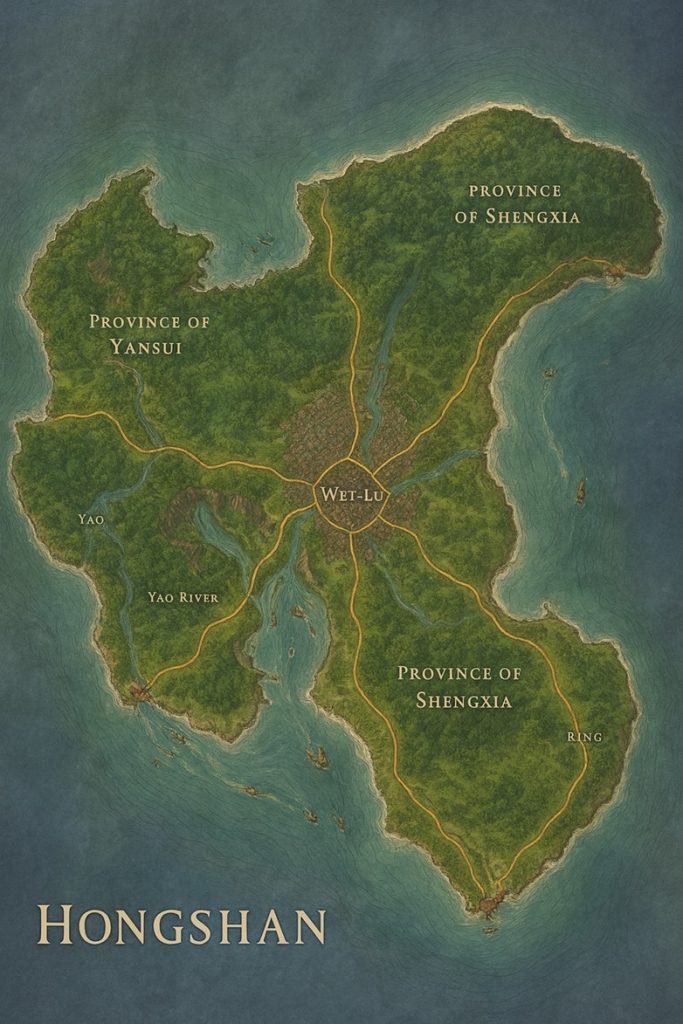
The island nation of Hongshan spreads across a broad, fertile landscape defined by its spiraling ridges and river basins. Its boundaries are organized into three main provinces, each demarcated by major trade roads that converge at the nation’s central capital, Wei-Lu.
- Province of Yansui — Western and southwestern region, rich in river plains and escarpments.
- Province of Shengxia (North) — Northeastern coastal forests and high ridges.
- Province of Shengxia (South) — Southeastern river valleys and maritime deltas.
The surrounding seas are turquoise and dotted with small fishing islands. Major rivers such as the Yao River flow from the central uplands toward the coasts, providing key trade arteries.
Major Cities
- Wei-Lu (Capital Megacity, Center of the Island)
- The heart of the nation and seat of the horn-scroll dynasties.
- Famous for its spiral canals, resonance towers, and the Great Jade-Ledger Hall, where rainfall, grain, and terrace data are inscribed.
- A cosmopolitan trade hub where all provinces’ roads converge, handling jade, grain, and textile exchange.
- Population: estimated several million, making it one of the largest cities in Saṃsāra.
- Yao (Southwest, Province of Yansui)
- A major river-port city located on the banks of the Yao River.
- Renowned for jade-harvesting guilds and canal-carved dry docks where river barges are built and repaired.
- Acts as a gateway between interior terraces and open sea trade routes.
- Known for Lantern Spiral regattas, where decorated barges sail at dusk.
- Ring (Southeastern Coast, Province of Shengxia)
- A fortified coastal city facing the southeastern ocean, named after its great harbor walls carved in concentric rings.
- Functions as Hongshan’s primary seaport for international trade, receiving caravans of griffon couriers and airship traffic.
- Home to the Red-Feather Guard aerie, where elite glider corps launch patrols over the escarpments.
- Holds large sanctums of the Path of the Jade Coil, where pilgrims ascend spiral walkways into towering greenstone sanctuaries.
Rivers and Commerce
- Yao River: The main artery of Hongshan. Its wide, navigable waters teem with grain barges, jade-laden rafts, and coil-pennant couriers.
- Smaller rivers branch from the central uplands toward both eastern and western coasts, forming spiral-shaped canals that irrigate terraces.
- Commerce is concentrated at river confluences, where warehouses and resonance docks record shipments on jade tablets.
Points of Interest
- Red-Jade Escarpment (Western Borderlands): Sheer cliffs veined with iron oxide, dotted with resonance towers that stabilize terraces.
- Spiral Jade Sanctums: Found across all provinces, these are colossal hollow jade columns where wind hums through helical passages, serving both religious and civic functions.
- Sky-Tram Pylons: Lines of tall pylons run from Wei-Lu to Ring, carrying grain baskets and passenger gondolas across ridges, doubling as storm harps during high winds.
- Lantern Spiral Festival Routes: Long causeways and promenades from Wei-Lu outward, where entire provinces gather for night processions of spiral lanterns.
- Moss-Spiral Grottoes (Central Highlands): Caverns beneath the ridges, storing resonance archives and crypts where echo-ledger records are interred.
Terrain and Provincial Character
- Western Province of Yansui
Rolling escarpments and deep alluvial basins define Yansui. The Yao River and its tributaries dominate, with fertile clay floodplains supporting terrace farming of millet, rice, and copper-pear orchards. The Red-Jade Escarpment rises along the coast, where resonance towers hum to stabilize the sheer cliffs. Yansui is renowned as Hongshan’s “granary state.” - Northeastern Province of Shengxia
Shengxia’s northern portion is heavily forested, thick with ironwood, celadon pines, and moss valleys. Terrain slopes into rugged ridges and canyon corridors. The people here are miners, glider-couriers, and woodworkers, often living in stone villages perched against cliff faces. Shengxia-North is resource rich, though difficult to traverse. - Southeastern Province of Shengxia
The southern half of Shengxia slopes down toward maritime delta systems. Here, brackish lagoons and tidal wetlands host oyster coil farms and salt harvests. The coastal capital of Ring sits astride this watery fringe. This region provides the island’s pearl trade, salt, and sea-lantern oils.
Secondary Communities
- Qingdu (Upper Yao River, Yansui)
- A fortified river town known for jade ledger workshops.
- Acts as a midpoint between Wei-Lu and Yao.
- Famous for chime-tower markets where rainfall ledgers are auctioned.
- Loqun (Northern Shengxia)
- Built against a ridge saddle at the edge of the Wind-Whistle Ridges.
- Noted for its glider training schools; young Jadecrest Echoers practice launching from wind catapults here.
- Hosts hidden Moss-Spiral grottoes storing family archives.
- Feishu (Delta marshlands, Southern Shengxia)
- A fishing and pearl-farming town spread across raised wooden walkways.
- Known for spiral oyster farms and coil-patterned reed rafts.
- Provides much of Ring’s food supply and salt reserves.
- Tianshan (Highland terraces, near Wei-Lu)
- A plateau settlement supporting terrace academies.
- Specializes in spiral geometry, canal engineering, and hydromancy schools.
- Its scholars assist Coil-Stewards in maintaining rainfall prediction calendars.
Trade Routes
- Spiral Roadway from Wei-Lu to Yao
- The largest inland artery, following the Yao River’s course.
- Supports grain caravans, jade-laden barges, and coilring couriers.
- Also carries seasonal Lantern Spiral festivals, where pilgrims march crest-to-crest.
- Wei-Lu to Ring Road
- Traverses Shengxia’s southern ridges, supported by sky-tram pylons.
- Major lifeline for jade, salt, pearls, and sea-lantern oils.
- Protected by the Red-Feather Guard’s glider patrols.
- Wei-Lu to Loqun Road
- Climbs through narrow ridges, linking the capital to northern Shengxia.
- Supports timber, copper loess, and glider exports.
- Dangerous during storms due to high winds; resonance chime towers line the path as safety beacons.
- Circle-Ridge Caravans
- A ring-shaped trade loop connecting smaller villages to main hubs, following natural terraces.
- Merchants exchange greenstone powder, ceramics, feather lacquerware, and reed mosaics.
Natural Resource Zones
- Jade Quarries (Celadon Basin, Central East)
- Pale greenstone mines worked in spiral galleries.
- Supply both ritual sanctums and artisan workshops.
- Managed jointly by temple sanctums and royal dynasties.
- Copper Loess Fields (Western Yansui)
- Copper-rich dust plains used in pigments, bronze-smelting, and crest-feather lacquer.
- Farmers blend loess into terrace soils, producing high-yield pear groves.
- Pearl and Oyster Farms (River-Shell Deltas, Southern Shengxia)
- Long, spiral-patterned oyster ropes hung beneath reed rafts.
- Provide pearls for foreign trade and oyster shells for geomantic charms.
- Ironwood and Celadon Pine Forests (Northeast Shengxia)
- Dense ridge forests harvested selectively for resonance tower struts, canal beams, and glider frames.
- Guilds manage cutting rotations under temple oversight.
- Moss-Spiral Grottoes (Central Highlands)
- Sacred caverns filled with jade ribs that shimmer faintly under torchlight.
- Serve as echo archives and crypts.
- Access restricted to Coil-Stewards and lineage archivists.
Additional Features
- Sky-Tram Lines: Grain baskets and gondolas connect Wei-Lu to outlying towns; pylons double as storm harps, warning farmers during high winds.
- Lantern Spiral Causeways: Major roads also serve as ceremonial promenades during Lantern Spiral festivals, when jade-lit lanterns are carried along terraces to create moving rivers of light.
- Echo Crypts beneath Sanctums: Each major sanctum includes subterranean spiral ramps where rainfall ledgers and funerary data tablets are interred.
- Glider Corps Patrol Ledges: Narrow cliff paths, used by Red-Feather Guards, mark the outer defensive network.