
Definition: Lysentia is an amorous language that goes beyond conventional methods of communication, transcending barriers of species, enabling creatures to convey profound emotions and intimate thoughts with heightened intensity. It possesses a unique magical essence that intensifies the emotional connection between speakers.
Emotional Intensity: Lysentia is built upon words and phrases that evoke powerful emotions and sensations, emphasizing the expression of love, desire, passion, and intimacy. It enables speakers to convey their deepest feelings and forge strong emotional bonds.
Telepathic Foundation: Lysentia has a telepathic component that allows individuals fluent in the language to communicate through their minds directly. This telepathic connection strengthens the emotional aspect of communication, making it more intimate and private.
Complex Symbolism: The language employs a rich tapestry of symbols and metaphors, imbuing each word with multiple layers of meaning. This adds depth to the communication, enabling speakers to convey nuanced emotions with precision.
Structure: Lysentia has a fluid and evolving structure, with a base of universal symbols that convey core emotions like love, joy, longing, etc. Speakers can combine these symbols to create unique words and expressions that resonate with their personal experiences and emotions. The language encourages creativity, allowing individuals to shape it to fit their unique identities.
Cultural Identity and Usage: Lysentia originated among an ancient civilization known for their profound connections with nature and the cosmos. Over time, it spread across different cultures and species, becoming a language used by poets, artists, lovers, and mystics. It became a symbol of emotional expression, healing, and understanding among those seeking deeper connections.
Rarity, Type, Script, Source, and History:
Rarity: Lysentia is considered rare, known only to select individuals or secretive groups that actively preserve and pass down its knowledge.
Type: It is an esoteric language, not widely spoken in everyday life, but cherished for its special purpose.
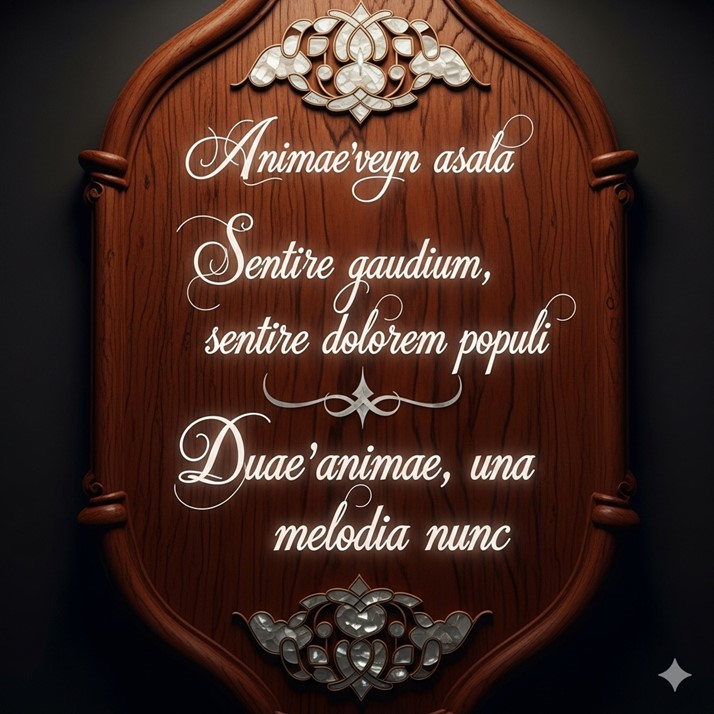
Script: Lysentia can be written in an elegant, flowing script that appears almost like calligraphy, adding to its artistic appeal.
Source and History: The language’s origin is shrouded in myth and legend, often associated with celestial beings or ancient spirits who gifted it to the early practitioners. Throughout history, it has been safeguarded and taught through exclusive guilds or handed down through generations of families.
Sensory Experience: Speaking or receiving Lysentia is an intensely emotional experience. When spoken aloud, the words seem to resonate in the air, creating a melodic aura that envelops both the speaker and the listener. When used telepathically, a warm, ethereal connection forms between the minds of the speakers, amplifying the emotional exchange.
In conclusion, Lysentia is an extraordinary language that goes beyond conventional communication, focusing on amorous expression and emotional intimacy. Its magical essence, unique structure, and cultural significance make it a treasured art form and a means of forging deep connections between individuals across different cultures and species.
Tags: Amorous, Esoteric, Rare, Telepathic, Emotional, Intimate, Symbolic, Magical, Fluid, Ancient, Artistic, Passionate, Mystical, Elegant, Tribal, Healing, Connecting
Inscriptions
- Animae’veyn asala – Our souls are entwined as one.
- Solis et umbrae, serenum te – Through light and shadow, my affection protects you.
- Cor’vis linae memoriam – The heart remembers this thread of feeling.
- Aethem flamma, amoris’ae – An eternal flame, this love of ours.
- Elysia sentira per manuum – Feel my devotion through this touch.
- Velare revelat venustas – What is veiled reveals true beauty.
- Lyr’enua sana vulnera – Let this gentle melody heal your wounds.
- Sy’enae pactum silentia – A promise held in shared silence.
- Somnia nostra, via lucen – Our dreams are a path of light.
- Hic locus, primus’amoris – Here in this place, our first affection.
- Vox’animae, veritas mea – The soul’s voice is my truth.
Political Oaths
- Sentire gaudium, sentire dolorem populi – To feel the joy, to feel the sorrow of the people.
- Cor unum, communitas nostra nectere – I will connect our community, making it one heart.
- Non una vox, sed veritas communis – Not with a single voice, but with a shared truth.
- Terrae’animae, passionem meam voveo – To the soul of the land, I vow my passion.
- Intellectus ante judicium, aequo animo – Understanding before judgment, with an empathetic heart.
- Foedus per amorem, non per usum – An alliance through mutual affection, not for mutual gain.
- Consonare dissonantia, sanare vincula – To bring harmony to discord, to heal the bonds between us.
- Voluntatis’vas, sententiae communis – A vessel for the will, the shared feeling of all.
- Memoriam doloris, in omni arbitrio – To hold the memory of emotional cost in every decision.
- Animae’gentis, scutum meum ero – For the soul of the nation, I shall be a shield.
- Floreat ardor, vigeat populus – May passion flourish, may the people thrive.
Cultural Ceremonies
- Duae’animae, una melodia nunc – Two souls are now one melody.
- In corde incipit, via communis – In the heart, our shared path begins.
- Nomen’datum, sensus novus – A new feeling is given a name.
- Cor tuum, nunc sua voce canit – Your heart now sings with its own voice.
- Amorem amissorum, in nobis sentimus – We feel within us the love of those who are gone.
- Cum’orbis, floreant passiones – As the world blooms, so may our passions.
- Calor’noster, fracta sanet – May our shared warmth mend what is broken.
- Hanc’artem, anima infunde – Infuse this creation with the soul’s art.
- Inveniat’numerum, discordia nostra – May our discord find a shared rhythm.
- Cor’onerat, cor’alterum liberat – A heart unburdened frees another.
- Amplexus noster, te nunc continet – Our circle of warmth now holds you.
Weaver of Whispers and Silent King
It is told, from records copied with much difficulty, that in the age before the sun knew its own name, the world was filled with a Great Stillness. This was not a quiet of peace, but a quiet of fullness, for all things had hearts, yet no thing had a voice for it. The mountain felt its own heavy loneliness, the roots of the first trees felt their deep love for the earth, and the beasts of the field felt both terror and tenderness, but all these feelings were trapped inside. They were colors in a sealed pot, songs in a locked chest. This was the time of the First Sorrows, for to feel so much and to share none of it was a burden upon all life.
In this silent world dwelled a being whose true name is an un-writable symbol, but whom the translators call the Weaver of Whispers. It is not known if she was spirit or flesh, but her soul was not contained within her own skin. She felt the silent cry of the crushed moss, she knew the patient affection of the river for its stones, and she tasted the bitter longing of the moon as it chased the horizon. This great empathy, this heart-mind that was open to all other heart-minds, it gave her a pain that had no equal, for she carried the feelings of the entire world within her. She wept, and her tears were the first dewdrops, each one holding a tiny, perfect, and silent feeling.
There was also the Silent King. He was a being of immense power and presence, whose form is described as being like a storm cloud given solid shape, or a mountain that could walk. He was the master of all that was manifest, the lord of shape and substance. He could command the rocks to rise and the winds to cease, but his heart was a chamber of perfect emptiness. He saw the Weaver and her endless sorrow. He observed her as she would touch a flower and recoil from the joy of its blooming, for it was too much to bear alone. He watched, and he knew she was in pain, but the meaning of pain was to him as the concept of water is to a flame. It was a thing to be observed, not experienced.
The Weaver, in her great and compassionate agony, resolved that she would no longer be a vessel for these captive emotions. She would give them a shape, a way to travel from one being to another. She sat by the edge of the world and began her work. She did not use wool or flax, but the very essence of feeling itself. She reached into her heart-mind and pulled forth the thread of a wolf’s lonely howl, long and silver. She found the warm, golden feeling of a sunning lizard’s contentment and spun it into a soft cord. She took the sharp, crystalline feeling of a star’s cold fire and faceted it like a gem.
With these threads of pure emotion, she created a pattern, a language. For the feeling of love, she wove the symbol of two trees whose branches grew into one another. For joy, she made a sound that mimicked the rush of a freed river. For sorrow, she devised a touch to the mind, as gentle and as cool as her tears. This was the birth of what would become Lysentia. It was not a language of words alone, but of symbol, sound, and direct mental touch, all braided together into a single, profound expression.
She approached the Silent King, her first creation held in her mind. He saw her lips move, making the sound for joy, but he heard only noise. He saw her trace the symbol for unity in the air, but he saw only a meaningless shape. The Great Stillness between them remained.
And so, the Weaver did the thing that had never been done. She set aside sound and symbol and reached out with the core of her new language. She took the pure, undiluted feeling of her own immense loneliness—the loneliness of knowing all but being known by none—and placed it gently, directly, into the empty chamber of the King’s heart.
It is written that in that moment, the stars in the sky shook. For the first time, the Silent King felt. The concept of loneliness became an experience. It was a cold weight, a sharp edge, an endless gray vista within him. The stone of his being did not break, but it was forever changed, for a crack had appeared, and through that crack, feeling poured in. He looked at the Weaver, and now when he saw her tears, he felt the echo of their meaning within himself. He reached out, not with a command, but with a question, formed not of words, but of a shared, nascent feeling of wonder. He had received her whisper, and for the first time, he was no longer silent.
Together, the Weaver and the King shared the language with the world. It could not be taught like a craft; it had to be given, an exchange of core feelings. They went to the warring beasts and did not give them words for peace, but instead exchanged the feeling of the predator’s hunger with the feeling of the prey’s fear. They traveled to the lonely mountains and filled them with the feeling of the clouds’ fleeting companionship. The language spread, not as a common tongue for trade or command, but as an esoteric art for those who wished to truly know another. It was a key, unlocking the heart-minds of all creatures, and binding them in a tapestry of shared emotion. The Great Stillness was broken, replaced by a melodic aura that hummed just beneath the world’s mundane noise, a warm and ethereal connection available to any who learned to listen.
Moral of the story: A word may name a feeling, but only a shared heart can truly speak it.