
Definition: The Healing Circle is a society or association formed by healers, healthcare professionals, herbalists, and nurses who share a common interest and purpose in providing holistic care, promoting wellness, and fostering the well-being of individuals and communities. This alliance serves as a platform for collaboration, knowledge exchange, and the integration of various healing practices.
The Healing Circle brings together individuals from diverse healing backgrounds, including traditional medicine, alternative therapies, herbalism, and modern healthcare. Members within the circle contribute their expertise, knowledge, and experiences to provide comprehensive care and support for those in need.
Within The Healing Circle, members engage in regular meetings, workshops, and training sessions to enhance their skills, learn new healing techniques, and share best practices. They collaborate on projects and initiatives aimed at promoting holistic well-being, community health education, and the integration of traditional and alternative healing practices.
The Healing Circle places a strong emphasis on the exchange of knowledge and the development of comprehensive healing approaches. Members share insights on herbal remedies, energy healing, nutrition, mindfulness, and other modalities, promoting a holistic understanding of health and wellness. The society also serves as a platform for research, innovation, and the exploration of new healing methodologies.
The Healing Circle fosters a sense of community and support among its members. It provides opportunities for mentorship, professional development, and networking within the healing community. The society also advocates for the rights and welfare of its members, promoting fair working conditions, ethical practices, and the recognition of the healing profession’s value in society.
In summary, The Healing Circle is an association formed by healers, healthcare professionals, herbalists, and nurses who come together to provide holistic care, promote wellness, and foster the well-being of individuals and communities. Through collaboration, knowledge exchange, and the integration of various healing practices, the society strives to enhance the quality of care, advocate for comprehensive well-being, and promote the importance of holistic healing in society.
Tags: Holistic Healing, Community Wellness, Integrative Medicine, Knowledge Exchange, Professional Development
Joining The Healing Circle: To join The Healing Circle, individuals typically need to demonstrate a commitment to holistic care and a professional background in healing practices. Prospective members may apply through referrals, attend introductory workshops or meetings, or be invited based on their expertise and contributions to the healing community. A formal acceptance often involves pledging to uphold the values of holistic care, community well-being, and ethical healing practices.
Benefits of Membership:
- Knowledge Exchange: Access to a wealth of information on various healing modalities, herbal remedies, energy healing techniques, nutrition, mindfulness, and more.
- Professional Development: Opportunities for workshops, training sessions, and mentorship programs to enhance skills and learn new healing techniques.
- Networking: Connection with a diverse group of healers, healthcare professionals, herbalists, and nurses for collaboration, support, and career advancement.
- Community Support: Engaging in projects and initiatives aimed at promoting holistic well-being and community health education.
- Advocacy: Representation in advocating for fair working conditions, ethical practices, and the recognition of holistic healing in society.
Resources Controlled:
- Knowledge Repository: Comprehensive archives and libraries of healing practices, research, and methodologies.
- Training Facilities: Workshops, meeting spaces, and possibly healing centers for community outreach and education.
- Networking Platform: Access to a broad network of professionals and experts in various fields of healing.
Limitations of the Faction:
- Limited Influence: Despite advocating for holistic care, societal acceptance and integration of alternative healing practices may vary.
- Resource Constraints: Dependence on member contributions and external funding for initiatives and projects.
- Regulatory Challenges: Compliance with healthcare regulations and navigating legal frameworks for alternative therapies.
Leadership Concerns:
- Public Perception: Maintaining a positive image and dispelling misconceptions about holistic healing practices.
- Member Well-being: Ensuring fair treatment, professional ethics, and fostering a supportive community environment.
- Advocacy Challenges: Overcoming resistance or skepticism from mainstream healthcare and regulatory bodies.
Secret Motivations and Hidden Agendas:
- Influence in Policy: Seeking to influence healthcare policies to include and recognize holistic healing practices.
- Research and Innovation: Exploring new healing methodologies and innovations, possibly in collaboration with academic institutions.
- Preservation of Traditional Knowledge: Safeguarding ancient healing wisdom and practices from being lost or diluted.
Passphrases, Codes, and Identifying Gestures:
- Passphrase: “Harmony heals all.”
- Code: Using specific symbols or colors in their logos or communication materials to signify membership or affiliation.
- Gesture: A subtle hand gesture resembling a healing touch or symbol of unity among healers.
Friendly Groups:
- Herbalist Guilds: Share common interests in herbal remedies and natural healing practices.
- Alternative Therapists Associations: Collaboration on integrating holistic approaches into mainstream healthcare.
- Community Health Organizations: Joint efforts in promoting wellness and preventive care initiatives.
The Healing Circle serves as a hub for holistic healers and healthcare professionals dedicated to promoting well-being through integrated healing practices.
Ranks and Jobs in The Healing Circle:
- Apprentice Healer:
- Job Description: Entry-level position where individuals learn foundational healing techniques and practices.
- Advancement: Progress through apprenticeship by demonstrating proficiency in basic healing skills and completing required training modules.
- Journeyman Healer:
- Job Description: Intermediate level, practitioners who have gained experience and competence in specific healing modalities.
- Advancement: Achieved by contributing to community projects, participating in advanced training, and mentoring apprentices.
- Master Healer:
- Job Description: Seasoned healers recognized for their expertise in multiple healing modalities and significant contributions to the field.
- Advancement: Requires extensive experience, leadership in projects, and possibly published research or innovations in healing practices.
- Herbalist Specialist:
- Job Description: Experts in herbal remedies, botanical medicine, and natural healing approaches.
- Advancement: Recognized through advanced studies in herbalism, successful formulations, and contributions to herbal knowledge.
- Energy Healer:
- Job Description: Practitioners specializing in energy-based healing methods such as Reiki, Qi Gong, or Pranic Healing.
- Advancement: Mastery demonstrated through advanced certifications, teaching, and holistic integration of energy healing into practice.
- Holistic Nurse:
- Job Description: Registered nurses integrating conventional medical training with holistic approaches to patient care.
- Advancement: Requires additional certifications in holistic nursing, leadership in healthcare settings, and patient advocacy.
Advancement within The Healing Circle:
Advancement in The Healing Circle is merit-based and involves a combination of practical skill mastery, ongoing education, community service, and leadership contributions. Members progress by:
- Completing structured training programs and workshops.
- Participating actively in community healing projects and initiatives.
- Mentoring junior members and contributing to the collective knowledge base.
- Engaging in research and innovation in healing practices.
- Demonstrating ethical conduct, professionalism, and commitment to holistic principles.
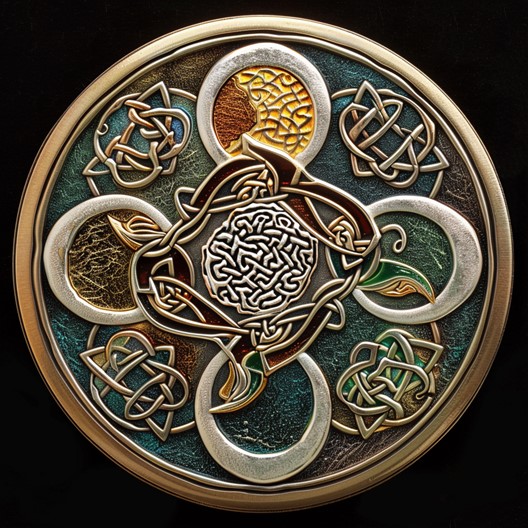
Badge Description: The badge of The Healing Circle features a circular design symbolizing unity, harmony, and holistic integration. At its center is an intricate knotwork pattern representing interconnectedness and the continuum of healing practices across cultures and traditions. Surrounding the knotwork are five elemental symbols (Earth, Water, Fire, Wind, and Void), each representing a facet of holistic health and the natural world’s influence on healing.
Badge Symbolism:
- Colors: Earth tones symbolize grounding and connection to nature.
- Shape: Circular to denote inclusivity and the cyclical nature of healing.
- Elements: Representing the diverse healing modalities embraced by The Healing Circle.
- Knotwork: Intricate patterns symbolizing the complexity and interconnectedness of holistic healing practices.
Rank Affiliation:
The badge varies slightly in design based on rank:
- Apprentice Healer: Bronze accents and a simpler knotwork design.
- Journeyman Healer: Silver accents and additional elemental symbols incorporated.
- Master Healer: Gold accents, intricate knotwork, and personalized elements denoting specialized expertise (such as herbal motifs for Herbalist Specialists or energy patterns for Energy Healers).
Wearing the badge signifies membership in The Healing Circle and a commitment to holistic care, community well-being, and professional excellence in healing practices. It serves as both a symbol of identity within the faction and a recognition of dedication to advancing holistic health and wellness.
The Healing Circle, dedicated to holistic care and wellness, faces several adversaries and rivals who challenge their mission and practices:
- Pharmaceutical Conglomerates and Biotech Companies:
- Motivation: These entities prioritize profit-driven healthcare solutions over holistic approaches.
- Conflict: They often lobby against holistic practices and natural remedies, promoting pharmaceutical solutions instead.
- Interaction: The Healing Circle advocates for natural healing and opposes the over-medicalization of healthcare.
- Consequences: Tensions arise over healthcare policies, funding for research, and public perception of holistic healing versus modern medicine.
- Skeptics and Critics of Alternative Medicine:
- Motivation: They question the efficacy and safety of alternative healing practices.
- Conflict: Skeptics argue against holistic methods, citing lack of scientific evidence or potential risks.
- Interaction: The Healing Circle defends its practices through research, patient testimonials, and advocating for integrative healthcare models.
- Consequences: Public trust in holistic medicine may be undermined, affecting access to resources and acceptance in mainstream healthcare.
- Regulatory Bodies and Legal Challenges:
- Motivation: Concerns over safety, standardization, and professional ethics in alternative healing.
- Conflict: Regulatory bodies impose restrictions or seek to standardize practices that may not align with holistic principles.
- Interaction: The Healing Circle engages in legal advocacy, lobbying for fair regulations that accommodate holistic practices.
- Consequences: Legal battles may arise over licensing, practice guidelines, and the scope of holistic healthcare within mainstream systems.
- Traditional Medical Institutions:
- Motivation: Defending established medical practices and academic standards.
- Conflict: Traditional institutions may view holistic healers as competitors or unscientific.
- Interaction: The Healing Circle seeks collaboration opportunities and strives for mutual respect and recognition.
- Consequences: Professional friction can hinder collaboration on patient care, research initiatives, and healthcare policy development.
- Misinformation Campaigns and Stigmatization:
- Motivation: Discrediting holistic practices through misinformation and stigma.
- Conflict: Opponents spread myths about holistic healing, portraying it as ineffective or unsafe.
- Interaction: The Healing Circle counters with education campaigns, factual information dissemination, and community outreach.
- Consequences: Public perception may be swayed against holistic healing, impacting patient choices and access to alternative healthcare options.
In navigating these conflicts, The Healing Circle strives to promote its values of holistic care, advocate for patient-centered approaches, and integrate diverse healing modalities into mainstream healthcare systems.
Legend of the Healing Circle
In times of old, when the world was young and the spirits of nature whispered in the wind, healers from all lands gathered under the canopy of a sacred tree. They formed a circle, united by their shared calling to mend bodies and soothe souls. Each brought gifts of knowledge, herbs, and ancient arts passed down through generations.
Together, they tended to the sick and weary, drawing strength from the earth and wisdom from the stars. They spoke in tongues forgotten by most, weaving spells of healing and chanting ancient hymns to restore balance to the afflicted.
As their fame spread, so did envy and fear from those who did not understand their ways. Kings sought their counsel, while others plotted to silence their chants. Through trials of fire and storms, the Healing Circle persevered, their bond unbroken and their resolve unwavering.
Through wars and plagues, they stood as beacons of hope, shielding the vulnerable and guiding lost souls back to health. They journeyed far and wide, crossing mountains and seas, to bring solace to those in need, regardless of borders or beliefs.
In their hearts burned the eternal flame of compassion, lighting the path for future generations to follow. For they knew that healing was not merely mending flesh, but nurturing the spirit and honoring the interconnectedness of all life.
Moral of the Story: “Within the circle of care, unity heals where division weakens.”