
Original Life Forms Chosen
Mammalia: Sloth Bear (Melursus ursinus)
Insecta: Orchid Mantis (Hymenopus coronatus)
Reptilia: Thorny Dragon (Moloch horridus)
Aves: Secretarybird (Sagittarius serpentarius)
Appearance
The Skorthyphid 672 is a broad-shouldered quadruped whose core body structure mirrors that of a sloth bear, with a powerful chest and thick, shaggy fur along the torso and neck. Its fur is broken by clusters of hardened, scale-like spikes inherited from its thorny dragon heritage, forming ridges along its spine and tail. Its forelimbs are elongated and mantis-like, ending in inward-folding raptorial claws edged with chitin and fine orchid-petal frills, giving it both a floral camouflage and a menacing strike profile. Its legs are long and stilted like those of a secretarybird, jointed for powerful downward stomps, enabling it to deliver devastating blows to prey or threats. The head is a blend of bear and mantis — a short, broad snout with carnivorous teeth beneath an armored chitin mask shaped like overlapping orchid petals, accented with the piercing, forward-facing eyes of a bird of prey.
Size
Length: 2.8 m from snout to tail base
Height: 1.9 m at the shoulder when standing on all fours; 2.6 m fully reared
Weight: 310 kg
Speed
Ground: 35 ft per round (cruise), with bursts up to 60 ft per round for 1d4 rounds
Leap: Up to 20 ft horizontally, 8 ft vertically
Stat Modifiers
- Strength: +3
- Dexterity: +2
- Constitution: +3
- Intelligence: −2
- Wisdom: +1
- Charisma: −1
Skills
- Stealth (blending into floral or thorny terrain)
- Athletics (powerful leaps and strikes)
- Perception (keen avian vision)
- Survival (locating hidden prey in arid scrub or grasslands)
Behavior
Solitary or found in mated pairs, the Skorthyphid spends much of its time patrolling a territory dense with thorny vegetation and flowering plants. It uses camouflage to ambush, standing perfectly still to mimic a large, flowering shrub before exploding into motion with its mantis claws and stomping legs. It often incapacitates with a flurry of rapid strikes before delivering a fatal bite.
Diet
Primarily carnivorous, preying on small to medium terrestrial animals, though it will also consume eggs, carrion, and high-protein insects. Occasionally eats succulent plants for water retention in dry months.
Emotions
Displays calculated patience during hunting, slow methodical stalking, and sudden ferocity when provoked. Protective and aggressively territorial toward intruders during breeding season. Can be oddly curious toward objects or beings that do not act aggressively.
Environment Where Found
Semi-arid scrublands, thorn forests, savanna edges, and rocky highland plateaus. Prefers regions with both open hunting grounds and dense flowering or thorny cover for camouflage.
Tags
Feral, Predator, Ambush-Hunter, Spined, Floral-Camouflage, Territorial, Large, Carnivore, Avian-Eyed, Mantis-Clawed, Thorn-Scaled, Stomping-Attack, Camouflage-Hunter, Semi-Arid, High-Agility, High-Strength, Solitary
Life Cycle
The Skorthyphid 672 begins life as a solitary egg laid in a shallow scrape lined with dry thorn branches and floral detritus to mask scent. The female guards the clutch—usually two to four eggs—while the male patrols the surrounding territory. Incubation lasts around 42 days, with hatchlings emerging fully furred, their mantis claws still soft and translucent. Juveniles remain with the mother for nearly a year, learning to blend into their environment and practicing quick strikes on insects and small lizards. By their second year, their thorn-spines fully harden, and they disperse to establish their own territories. Lifespan averages 16 to 20 years in the wild, with elders slowing in speed but becoming even more cunning.
Mating
Breeding season occurs during the first high-flower bloom of the dry season. Males will display by erecting their thorn ridges, spreading their mantis claws wide, and performing a rhythmic stomping display similar to a secretarybird’s threat dance. Fights between males are brief but violent, often ending in a flurry of claw strikes to the shoulders and hind legs. Mated pairs remain together for several years, raising multiple clutches before separating.
Tactics
The Skorthyphid’s hunting style relies on patience and sudden violence. It will:
- Select a spot with dense floral or thorn cover matching its petal-frilled claws.
- Stand motionless for hours, swaying slightly like a plant in the wind.
- Wait for prey to enter striking range before delivering a blindingly fast mantis-claw slash followed by a downward stomp aimed to stun or kill.
- If prey flees, it will use short bursts of speed to close the gap before finishing with a bite to the neck or spine.
Against larger threats, it relies on intimidation—erecting its thorn ridges, clicking its chitin mask, and slamming its claws into the ground to throw up dust and debris.
Actions
- Ambush Strike – Surprise attack with mantis claws, advantage on first hit if unseen.
- Crushing Stomp – Secretarybird-style double-leg stomp, effective against smaller or prone targets.
- Thorn Ridge Erection – Raises spines to deter attackers, inflicting damage if grappled.
- Petal Flare Camouflage – Claws flare out into orchid-like patterns to either lure prey or startle foes.
- Leap Pounce – Jumps onto prey from short distances, pinning it with claws and spines.
Other Interesting Information
- Juveniles are sometimes captured and trained by Sangoan border scouts to act as living alarms in thorn forests; their camouflage allows them to remain hidden until an intruder is within striking distance.
- Folklore in certain rural regions speaks of “flower-bush spirits” that protect sacred groves—most likely misidentified Skorthyphids.
- They shed their thorn-spines once every two years in late summer, leaving behind ridged, chitin-coated spines that are collected for use in armor plating and ornamental weapon handles.
- Their floral claw-frills can subtly shift hue depending on mood—brightening when agitated, dulling when calm or sick.
- A starving Skorthyphid will resort to nocturnal scavenging, stalking into settlements to raid livestock pens, but it avoids prolonged presence in populated areas due to its preference for concealment.
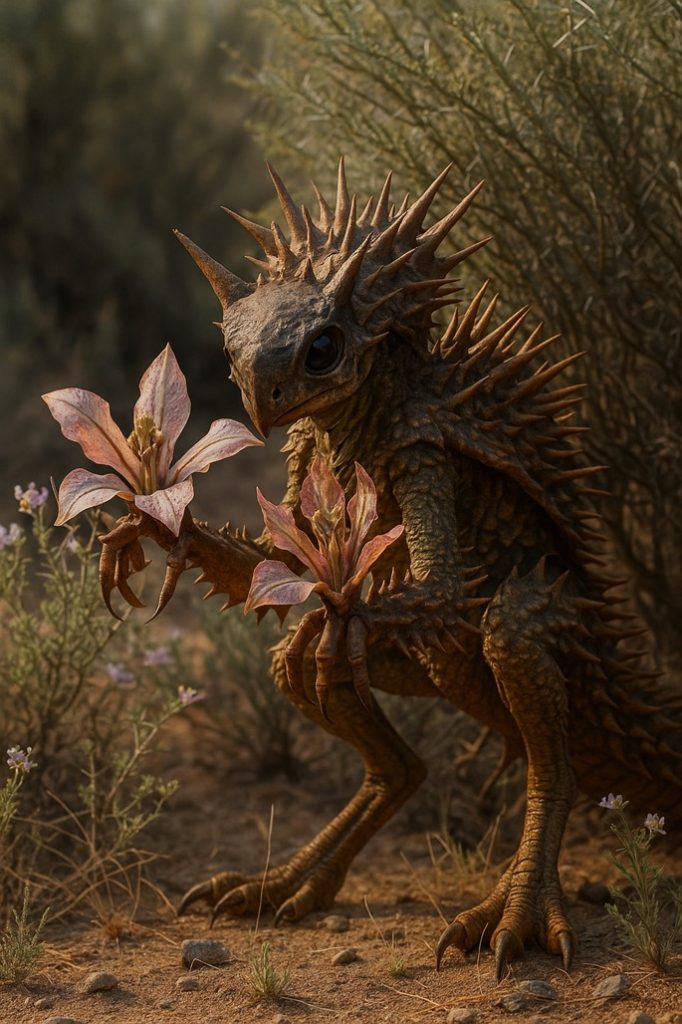
Adventurers might cross paths with the Trastelvorn 892 for several reasons tied to its rarity, danger, and the value of its unique adaptations:
The Trastelvorn’s glistening crystalline bone growths, which form along its ridged back and jointed limbs, are highly sought after by artificers and enchanters for use in channeling volatile magical currents. When properly prepared, these shards can be embedded into gear to improve its resilience to mana surges or to amplify certain elemental properties. The crystals grow only in mature individuals, forcing those in need of them to locate and survive an encounter with a full-grown specimen.
The creature’s peculiar glandular oils—secreted from its feathered ridge—are a base ingredient for a potent alchemical draught known to dull pain without impeding reflexes. Apothecaries and battlefield healers pay well for such substances, meaning that a hunting contract can be lucrative, albeit deadly.
The Trastelvorn is also an apex environmental stabilizer in the volcanic scrublands where it roams. Hunting it recklessly risks upsetting the delicate balance of local prey species, so sometimes adventurers are hired to track and relocate an individual rather than kill it—often because it has wandered too close to trade routes or settlements.
Certain cultures within Saṃsāra attribute omens to sightings of the Trastelvorn. In the Sangoan archipelago, the creature’s low, bone-rattling call is considered a warning of oncoming magical storms. Seers may send trusted parties to shadow the animal and predict the pattern of such storms, believing that its migration path reveals the places most likely to be struck by dangerous magical weather.
There are those who see the Trastelvorn not as a target, but as a challenge—its speed, armored hide, and unnerving combat tactics are legendary among beast-hunters. More than one seasoned warrior wears its talon hooks as trophies, and in certain dueling societies, besting one in single combat is an unspoken rite of passage.
Beyond its crystalline bone growths and glandular oils, a skilled harvester can extract several other valuable components from a Trastelvorn 892’s corpse:
1. Joint-Tendon Filaments – The dense, corded tendons in the creature’s multi-jointed limbs remain flexible even when dried. Artificers braid them into whipcords for ranged weapons or use them in mechanical assemblies that need both strength and resilience under sudden strain. Bowyers prize them for reinforcing high-draw magical bows.
2. Volcanic Pouch Ash – Found in a heat-retaining chamber near the lower abdomen, this fine, black ash is a mixture of ingested minerals and magically infused grit. When mixed with alchemical stabilizers, it becomes an ignition catalyst for single-shot firearms or volatile demolition charges, particularly in environments where conventional powder fails due to humidity or magical interference.
3. Ridge-Feather Vanes – The creature’s semi-rigid ridge feathers are edged with naturally insulating fibers that resist heat and static magic discharge. Tailors weave these fibers into specialized cloaks or lining for protective gear, reducing the wearer’s susceptibility to burns or lightning-based attacks.
4. Bio-Luminal Eye Fluid – The Trastelvorn’s eyes secrete a thick, luminescent gel that holds its glow for weeks without losing intensity. In diluted form, it becomes a stable light source for low-visibility work; concentrated, it is used in the creation of rare “sight-through-shadow” inks for stealth maps and enchanted scrolls.
5. Hooked Claw Blades – Hardened keratin claws, especially from the forelimbs, retain a micro-serrated edge after removal. Weapon-smiths mount them as natural blades on daggers or arrowheads, taking advantage of their inherent durability against magical corrosion.
6. Magma-Filtered Stomach Lining – The inner stomach walls have a heat-proof membrane capable of neutralizing certain caustic compounds. This material can be used as a sheath lining for transporting unstable alchemical concoctions or as a base layer in armor meant for volcanic or high-temperature combat zones.
Fire-Feather and Hollow Stone
In the days before the tides of stone settled, when the red rivers still sang and the sky was cracked with light, there was a valley where no step was safe and no shadow was trusted. There, the creature called Trastelvorn was born of many hungers. Its birth was said to come from the breaking of four elder beasts in the war of storms—when the bear lost its mountain, when the vulture lost its sky, when the beetle lost its shell, and when the lizard lost its flame. All their remains were washed into the earth’s mouth, where the deep molten breath shaped them into one.
It was in the third season of the ash bloom when the people of Karrat came down from the high ridge to search for the Hollow Stone, a gem said to hide sound from the ears of gods. The Hollow Stone was guarded, so the elder seers whispered, by a thing whose feathers could not be burned and whose eyes could swallow the moonlight whole. Four hunters were sent, each with a purpose—one to strike, one to speak, one to see, and one to carry home what they found.
The journey was marked by the signs of its passing: claw marks on stone as if the rock was butter, char-lines on trees not from fire but from heat in breath, and prints in the mud shaped like no beast of the world. They did not see the creature for seven nights, yet they felt it near, for the ground would sigh when they slept, and the stars seemed to bend when it walked under them.
On the eighth day, when the red sun was low and the air thick with the smell of copper rain, they found the creature upon the Ridge of Three Thorns. Its feathers shimmered like black glass set aflame from within, its claws curved like hooked moons, and from its mouth came a steam that stank of stone and storm. It did not roar, for it had no need—its eyes told the hunters they were already caught.
The one who was to strike leapt first, throwing a spear wrapped in the skin of water-serpents to pierce the creature’s throat. But the shaft burned to ash before it touched the beast’s hide. The one who was to speak called out the names of the four beasts from which it was born, hoping to confuse its spirit. The Trastelvorn only tilted its head, and the words melted in the hunter’s mouth like snow on coals.
The one who was to see closed her eyes and turned her mind inward, searching for the Hollow Stone’s place. She saw not the stone, but the belly of the beast—within which lay not one stone, but many, swallowed and kept until the day the earth cracked again. She spoke this to the last hunter, the one who was to carry. He took the only path left: he did not fight, nor speak, nor look, but instead offered the beast his pack of food and the silver clasp from his cloak, and bowed so low that the ash settled on his neck like chains.
The Trastelvorn came near, close enough that its breath made the hunter’s skin blister. It sniffed the offering, and with claws that could cut the bones of the mountain, it opened its mouth. Out rolled a single black gem, dull as night, yet cold enough to make the hunter’s skin pale. The beast left without sound, and when the hunters looked up again, it was as if the earth had swallowed it whole.
The gem was brought back to Karrat, and though it had no hollow within it, the voices of the gods could not be heard for seven seasons after. The seers declared it the Hollow Stone, though the hunter who carried it never spoke again, and the one who saw it died in her sleep before the next ash bloom.
The Trastelvorn still walks the Ridge of Three Thorns, it is said, not as guardian, but as collector. It keeps the things it wishes, and gives only to those who do not demand. And when it is seen, the wise remember the hunters—three who failed in their purpose, and one who lived by giving away all he had.
Moral: That which cannot be taken may still be given, but only if your hands are empty enough to receive it.
Suggested conversions to other systems:
CALL OF CTHULHU (7th Edition)
Name: Ashfeather Collector
STR 130 (65%), CON 110 (55%), SIZ 160 (80%), DEX 65 (32%), INT 60 (30%), POW 90 (45%)
Hit Points: 27
Damage Bonus: +1D6
Build: 2
Move: 9 (12 when sprinting)
Armor: 6-point carapace and feathers; immune to normal fire damage.
Attacks:
• Claw Swipe – 55%, 1D8+DB damage.
• Breath of Stone-Storm – 35%, cone attack, 2D6 damage, targets must succeed in CON roll or be blinded for 1D3 rounds.
• Silk Net Cast – 45%, immobilizes target on failed DEX roll; escape requires STR vs STR roll.
Skills: Stealth 50%, Listen 70%, Spot Hidden 60%, Intimidate 65%, Track 60%.
Powers:
• Fearsome Presence – Those seeing it must roll SAN 0/1D6.
• Flame-Fed Healing – Regains 1D4 HP per round when exposed to intense heat.
• Whispered Names – When addressed by its four ancestral beast names, gains +20% to INT rolls to resist trickery.
Sanity Loss: 0/1D6 to see the Ashfeather Collector.
BLADES IN THE DARK
Name: Ember-Crest Hunter
Tier: IV
Edges: Armored Carapace, Giant Size, Silent Stalker, Breath Weapon
Magnitude: 8
Threat: 3
Scale: Large creature (fills an alley or small street)
Harm: Heavy Claws (Level 3 Harm), Scalding Breath (Level 3 Harm, area)
Special Armor: Can resist any heat or flame-based attack without spending stress.
Abilities:
• Silk Snare – Once per scene, immobilize a PC or cohort unless they resist with Prowess.
• Collector’s Bargain – Will not attack if offered a rare gem, unique artifact, or equivalent treasure; may instead provide strange aid.
• Sudden Bound – Move from long to close range instantly; ignores most obstacles.
GM Notes: Its presence shifts position clocks in hunting territory (advances danger by 2 ticks per scene unless countered).
DUNGEONS & DRAGONS (5th Edition)
Name: Trastelvorn, Hollow Stone Guardian
Large monstrosity, neutral
Armor Class: 18 (armored carapace, natural armor)
Hit Points: 210 (20d10+100)
Speed: 50 ft., climb 30 ft., leap up to 40 ft. without running start
STR 22 (+6) DEX 14 (+2) CON 20 (+5) INT 10 (+0) WIS 16 (+3) CHA 12 (+1)
Saving Throws: Str +10, Con +9, Wis +7
Skills: Perception +7, Stealth +6, Survival +7
Damage Resistances: fire; bludgeoning, piercing, and slashing from nonmagical attacks
Damage Immunities: normal flame
Senses: darkvision 120 ft., tremorsense 60 ft., passive Perception 17
Languages: understands all but speaks none
Challenge: 12 (8,400 XP)
Traits:
• Legendary Resistance (3/Day) – Succeeds on a failed saving throw.
• Feather-Flame Armor – Any creature hitting the Trastelvorn with a melee attack takes 7 (2d6) fire damage.
• Silk Net (Recharge 5–6) – Ranged Weapon Attack: +8 to hit, range 30 ft., one target. Hit: target is restrained (escape DC 18).
Actions:
• Multiattack – Two claw attacks and one bite or net cast.
• Claw – Melee Weapon Attack: +10 to hit, reach 10 ft., 1 target. Hit: 19 (3d8+6) slashing damage.
• Bite – Melee Weapon Attack: +10 to hit, reach 5 ft., 1 target. Hit: 22 (4d8+6) piercing damage.
• Breath of Stone-Storm (Recharge 6) – 30-ft cone, DC 18 Dex save, 45 (10d8) bludgeoning and slashing damage, plus blindness until end of target’s next turn on failed save.
Legendary Actions (3/round):
• Detect – Makes a Wisdom (Perception) check.
• Bound – Moves up to half its speed without provoking opportunity attacks.
• Intimidating Display – All creatures within 20 ft. make DC 16 Wis save or be frightened until end of their next turn.
KNAVE (Latest Edition)
Name: Hollow-Eye Talonbeast
HD: 12
Armor: 6 (armored carapace, thorn hide)
Attack: +8 (claw 2d8, bite 2d10, or breath cone 3d8)
Move: 50 ft.
Morale: 10
Special:
• Fire Resistant – Ignores damage from normal flame; half damage from magical fire.
• Net Cast – Once every 1d4 rounds, entangle a target within 30 ft. (STR save to escape).
• Silent Stalker – Advantage on attempts to ambush prey in natural terrain.
• Leap – Can clear 40 ft. horizontally or 20 ft. vertically without running start.
Treasure: May carry rare gem in gullet (value 1d6×100 gp).
Disposition: Territorial collector; hostile if threatened, but can be bargained with using rare stones or artifacts.
FATE (Core Edition)
Name: Obsidian-Feathered Mawstalker
High Concept: Armored predatory collector of rare stones and bones
Trouble: Driven to protect its hoard at all costs
Aspects:
• “Silent Until the Stones Sing”
• “Flame Feeds My Wounds”
• “One Leap and I Am Upon You”
Approaches:
• Careful +2
• Clever +1
• Flashy +0
• Forceful +4
• Quick +3
• Sneaky +2
Stunts:
• Silk Net – Once per scene, spend a Fate Point to immobilize a target within two zones until they Overcome with Forceful or Quick at +2 difficulty.
• Breath of Stone-Storm – Once per session, attack all in your zone and an adjacent zone with +2 Forceful; on success, also create “Blinded by Dust” aspect with two free invokes.
• Flame-Fed Healing – Spend a Fate Point when exposed to intense heat or fire to remove a moderate consequence or 2 stress.
Stress: 4 boxes
Consequences: Mild (2), Moderate (4), Severe (6)
NUMENERA & CYPHER SYSTEM
Name: Serrak-Talon Collector
Level: 8 (Target Number 24)
Motive: Collect rare stones, magical relics, and corpses of unusual creatures
Health: 40
Damage: 10 points (claws), 12 points (bite), or 8 points in 30-ft cone (breath; also blinds for one round)
Armor: 3
Movement: Short; can leap Long as a single action
Modifications: Perception as level 9, Stealth as level 7, Intellect defense as level 6
Combat:
• Claw Strike – Inflicts 10 points damage.
• Bite – Inflicts 12 points damage; target must succeed on Might defense or be knocked prone.
• Silk Net – On hit, entangles target; Might task to escape, difficulty 8.
• Breath of Stone-Storm – 1/1d4 rounds; all in cone must succeed on Speed defense or take 8 damage and be blinded.
Interaction: Can be reasoned with if offered valuable minerals or artifacts.
Use: Territorial predator in treasure-rich ruins; its lair holds valuable items.
Loot: Rare stones (worth 2d6×50 shins), exotic carapace plates (armor crafting), and preserved silk nets (trap crafting).
GM Intrusion: A leap knocks multiple characters prone, separating them from allies.
PATHFINDER (2nd Edition)
Name: Vornak the Dust-Winged Collector
Creature 12
Rare, Neutral, Large, Beast
Perception +25; darkvision, tremorsense 60 ft.
Languages — (understands any, does not speak)
Skills Acrobatics +22, Athletics +28, Stealth +23, Survival +23
Str +8, Dex +4, Con +6, Int +1, Wis +5, Cha +2
AC 32; Fort +26, Ref +22, Will +23
HP 245; Immunities fire (nonmagical)
Speed 50 ft., climb 30 ft., leap 40 ft.
Melee [one-action] Claw +26 (reach 10 ft.), Damage 3d10+14 slashing
Melee [one-action] Bite +26 (reach 5 ft.), Damage 3d12+14 piercing
Ranged [one-action] Silk Net +23 (range increment 30 ft.), Effect restrained (DC 32 to Escape)
Breath of Stone-Storm [two-actions] (arcane, evocation, earth) 30-foot cone, 10d8 bludgeoning; DC 32 basic Reflex save; creatures failing save are also blinded until end of next turn. Recharge 1d4 rounds.
Flame-Fed Healing [reaction] Trigger: Takes fire damage; Effect: Regains 10 HP.
Powerful Leaper – Ignores difficult terrain when leaping and can leap up to 40 feet without a running start.
Treasure: Hoard of minerals and rare curios worth 2,000 gp plus exotic crafting materials.
SAVAGE WORLDS (Adventure Edition)
Name: Emberhide Shard-Hunter
Wild Card
Attributes: Agility d8, Smarts d6, Spirit d8, Strength d12+2, Vigor d10
Skills: Athletics d10, Fighting d10, Intimidation d8, Notice d10, Stealth d8, Survival d8
Pace: 8; Parry: 7; Toughness: 13 (4)
Edges: Fleet-Footed, Improved Frenzy, Quick
Special Abilities:
• Armor 4 (Carapace & feathered plates)
• Claws/Bite – Str+d8 (claws) or Str+d10 (bite)
• Silk Net – Ranged attack, 12/24/48; entangles target (−2 Pace, Agility roll at −2 to escape)
• Breath of Stone-Storm – Cone template, 3d10 damage, targets must also make a Vigor roll at −2 or be blinded for 1d3 rounds; 1/1d4 rounds.
• Leap – Can leap 4″ horizontally or 2″ vertically without running start.
• Flame-Fed Healing – Regains 1 wound when taking fire damage once per encounter.
Hindrances: Greedy (Major; for rare stones/artifacts), Bloodthirsty (Minor)
Treasure: Valuable mineral nodules, silk netting, and exotic feathers (500–1000 credits equivalent).
SHADOWRUN (6th Edition)
Name: Emberplate Relic-Hunter
Metatype: Paracritter
Attributes: Body 10, Agility 6, Reaction 6, Strength 9, Willpower 5, Logic 2, Intuition 6, Charisma 3
Edge: 4
Condition Monitors: Physical 13, Stun 10
Initiative: 12 + 2D6
Movement: 20 m Walking, 40 m Running, Leap up to 8 m (standing)
Skills: Unarmed Combat 12, Perception 10, Stealth 8, Athletics 9, Survival 8
Attacks:
• Claw Swipe (DV 10P, AP –2)
• Bite (DV 11P, AP –1)
• Silk Net (Ranged, 15 m, Opposed test vs Escape Artist; Immobilized on success)
Powers:
• Breath of Stone-Storm – Complex Action; 15 m cone; DV 8P; targets resist with Body + Armor; failure also imposes –3 dice pool penalty to Perception for 1D6 turns.
• Flame-Fed Healing – When exposed to fire damage, recovers 4P once per encounter.
• Enhanced Senses (Thermographic Vision, Tremorsense 20 m)
Armor: 8 (natural)
Notes: Highly territorial paracritter often found in deep ruins or volcanic highlands. Selling its carapace, feathers, and silk nets can net 4,000¥–8,000¥ to the right buyer.
STARFINDER
Name: Obsidian-Crested Talonstrider
CR: 12
XP: 19,200
NE Large magical beast
Init +7; Senses darkvision 60 ft., low-light vision, tremorsense 60 ft.; Perception +23
DEFENSE
HP 220; RP 5; EAC 28; KAC 30
Fort +17, Ref +14, Will +15
Immune fire (nonmagical)
OFFENSE
Speed 50 ft., climb 30 ft., leap 40 ft.
Melee claws +24 (4d10+18 S)
Melee bite +24 (4d12+18 P)
Ranged silk net +22 (range 40 ft.; entangle, DC 28 to escape)
Special Attacks breath of stone-storm (cone 30 ft., 10d10 B, Reflex DC 28 half; recharge 1d4 rounds; failed save blinds for 1 round)
STATISTICS
Str +8, Dex +3, Con +6, Int +1, Wis +5, Cha +2
Skills Acrobatics +20, Athletics +25, Stealth +20, Survival +23
Languages understands Sangoan and Ruanikai but cannot speak
ECOLOGY
Environment volcanic uplands, mineral-rich ruins
Treasure rare minerals, exotic silk (worth 10,000 credits total)
TRAVELLER (Mongoose 2E)
Name: Emberhide Cliffstalker
Animal Type: Carnivore (Pouncer)
Characteristics: STR 18 (+3), DEX 11 (+1), END 15 (+2), INT 5 (–1), Instinct 8 (+0)
Size: Large (500 kg)
Hit Points: 35
Armor: 10 (chitin and feathers)
Attacks:
• Claw (2D6+6 damage)
• Bite (3D6+6 damage)
Special:
• Silk Net – On successful attack, target is restrained until making Athletics or Melee (Unarmed) check 10+ to break free.
• Breath of Stone-Storm – 15 m cone; 2D6+4 damage; also blinds target for 1D3 rounds on failed END roll 8+. Recharge 1D4 turns.
• Flame-Fed Healing – Recovers 5 HP once after taking heat or fire damage in an encounter.
Speed: 12 m
Traits: Leaper (can jump 8 m horizontally), Tremorsense 20 m, Fire Resistant
Behavior: Ambushes prey near mineral-rich escarpments; drags corpses to lair for hoarding.
Value: Carapace, silk glands, and feathers worth 12,000 Cr to collectors and biotechs.
WARHAMMER FANTASY ROLEPLAY (4th Edition)
Name: Obsidian-Beaked Deathwing
Creature Traits: Large, Magical Creature, Night Vision 30 yds, Terrifying 2, Armoured (4), Ward (Fire)
M: 7; WS: 65; BS: 35; S: 65 (6); T: 60 (6); I: 50; Ag: 45; Dex: 40; Int: 25; WP: 45; Fel: 20
Wounds: 58
Skills: Athletics (S) 75, Intimidate (S) 75, Perception (I) 60, Stealth (Ag) 55, Survival (Int) 45
Talents: Combat Reflexes, Fearless, Frenzy, Hardy
Attacks:
• Claw – SB+6 (6) damage
• Bite – SB+8 (8) damage, Armour Piercing
• Silk Net – Entangles target (Athletics or Strength Test vs 65 to break free)
Special Rules:
• Breath of Stone-Storm – 20 yd cone; deals 2D10+6 Damage, ignores armour; targets must also test Endurance or gain Blinded Condition for 1D5 Rounds; Recharge 1D4 Rounds.
• Flame-Fed Healing – Recovers 1D10 Wounds when taking fire damage once per encounter.
• Leaper – Can leap 8 yds without test; ignores Difficult Terrain when leaping.
Motivation: Protect mineral hoard; attack those with valuable stones or relics.
Rarity: Very Rare; materials from body worth 1D10×50 gc to armourers and mages.