
The original life forms referenced were: butterfly (from Insecta), snake (from Reptilia), owl (from Aves), and clam (from Mollusca).
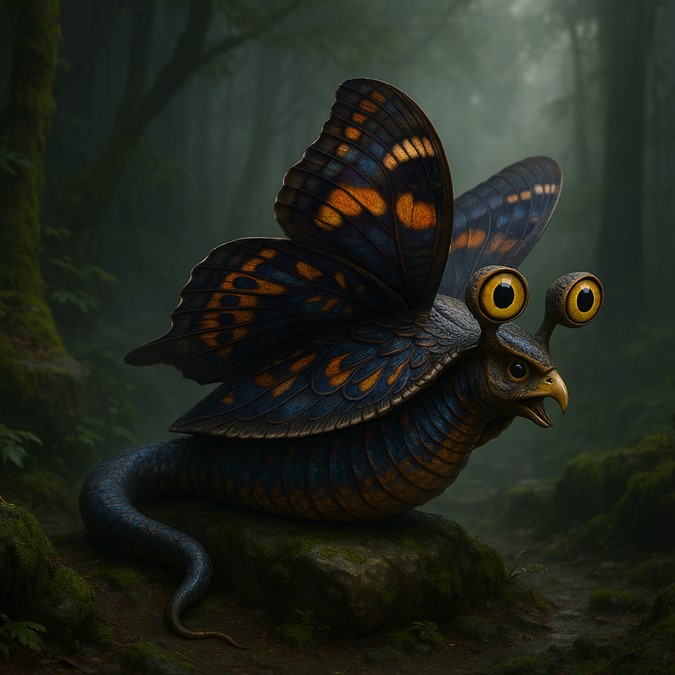
Appearance: The Buttersnakeowlclam 73 is a surreal, armored feral creature that combines the vibrant, winged patterns of a butterfly with the sinuous, scaled body of a snake, the silent flight and keen eyes of an owl, and the bivalve shell enclosure of a clam. Its body is primarily an elongated, serpentine tube like a snake, encased in a hard, hinged clam shell that opens and closes along the length, protecting the soft interior while allowing emergence for attacks or movement. The shell features iridescent butterfly wing scales that shimmer in colors from deep indigos to fiery oranges, shifting for camouflage or display, with faint, feather-like ridges from owl plumage texturing the exterior. From the shell’s front hinge protrude owl-like eyes on flexible stalks, large and golden for nocturnal vision, flanked by a beak-mouth that snaps with snake fangs for venom delivery. Wings, butterfly-scaled but owl-feathered for silent glide, fold along the shell when closed, unfolding to span wide during flight. The tail tapers to a clam-like foot for burrowing or anchoring, with small, retractable tendrils for sensing. Overall, it resembles a flying, shelled serpent with ethereal wings, evoking the elusive mysteries of Saṃsāra’s shadowed realms.
Size: Buttersnakeowlclam 73 specimens usually measure 5 to 7 feet in length when fully extended from the shell, with the bivalve enclosure spanning 2 to 3 feet wide when open, and a compacted height of 1.5 to 2 feet when closed. Weight ranges from 60 to 110 pounds, affected by shell density and mana intake, with larvae starting at 6 inches long.
Speed: This creature glides silently at 30 feet per round in air using owl wings, slithers at 20 feet per round on ground like a snake, and burrows at 10 feet per round with the clam foot, while shell closure allows defensive hovering at 15 feet per round.
Stat Modifiers: The Buttersnakeowlclam 73 has base stat adjustments from its fusion: +3 to stealth (enhancing camouflage and silent movement), +2 to perception (boosting nocturnal vision and sensory tendrils), -2 to strength (limiting physical force due to shell bulk), +1 to dexterity (improving flight maneuvers), and -1 to constitution (vulnerability when shell opens).
Skills: Instinctual skills include silent flight for evasion, venom injection via beak-fangs, shell camouflage shifting colors, burrowing for ambush setups, and tendril sensing for vibrations or scents.
Behavior: Feral and nocturnal, the Buttersnakeowlclam 73 behaves as a solitary hunter that forms loose aerial flocks during migrations, using wing displays for territorial signals and shell snaps for warnings, retreating into enclosure when threatened and emerging for strikes.
Diet: Carnivorous with opportunistic filter-feeding, it consumes small prey like insects or fish with fang strikes, supplemented by absorbing nutrients through shell filters in water or air, favoring mana-laden particles that enhance wing glow.
Emotions: Basic instincts drive emotions: curiosity through tendril probes, aggression in fang snaps and wing flares, fear by shell closure and burrowing, and contentment in silent glides after feeding.
Environment Where Found: Primarily in temperate forested riversides, jungle canopies, and coastal marshes across Saṃsāra’s islands, where mixed air and water allow flight and burrowing, avoiding arid or frozen zones.
Tags: Buttersnakeowlclam73, Feral Hybrid, Winged Shell, Silent Glider, Venom Beak, Camo Shifter, Nocturnal Hunter, Burrow Ambush, Mana Filter, Instinct Flocker, Vibration Tendril, Carni Feeder, Shell Retreater, Aerial Migrator, Emotion Flasher
Life Cycle: The Buttersnakeowlclam 73 follows a complex, metamorphic life cycle that blends its foundational traits, beginning with egg-laying in sheltered nests within coastal marshes, where clutches of 40-60 gelatinous orbs are deposited in mucus-lined depressions, absorbing ambient mana to develop shells over 2-4 months. Upon hatching, larvae emerge as small, clam-like forms with soft bivalves and basic tube feet for adhesion, measuring 4-6 inches long, filter-feeding on plankton while burrowing shallowly to avoid predators over the first year. During this phase, they develop snake-like sinuosity inside the shell, with rudimentary eyes forming for light sensitivity. By year two, metamorphosis introduces butterfly scales on the shell’s exterior and owl feather precursors, as the body elongates and wings begin as fin-like stubs, growing to 2 feet length over the period while transitioning to active hunting. Juvenile stages last 3-5 years, during which fangs and venom glands mature, the shell hinges strengthen for rapid opening, and flight capabilities emerge through mana-infused wing expansion. Adulthood is reached at 6-7 years, marked by full reproductive readiness and color-shifting mastery, permitting survival for 18-28 years. Aging shows as dulled scale shimmer and slowed regeneration, leading to a final enclosure where the shell seals permanently, the body dissolving into nutrient slime that leaves a mana crystal usable in low-tier conduits. Possession can occur post-juvenile, blending memories with the form’s instincts, but feral versions stay at tier 1, unable to progress without merging.
Mating: Mating for the Buttersnakeowlclam 73 is a nocturnal, aerial display triggered by mana highs, where solitary individuals converge in jungle canopies or marsh skies, attracted by bioluminescent wing flashes that mimic butterfly courtship amplified by owl silent glides. Hermaphroditic like clams, but with snake dimorphism where “dominant” specimens (brighter scales) initiate by uncoiling from shells to entwine mid-air, exchanging genetic fluids via tendril contacts in a coiled dance lasting hours. This involves silent wing beats for propulsion and fang nips to test compatibility, with aggression minimal but resolved through venom dabs that induce temporary paralysis in rivals. Fertilization happens internally post-exchange, with eggs stored in the shell’s interior for weeks before laying in mucus nests. Groups disperse after, but vibrational bonds from tendrils may reform for protection. In feral states, mating happens annually, but possessed avatars curb these urges due to sterility, though instinctual emotions like territorial flashes can emerge during mana events, needing trained skills to control.
Tactics: As a feral hunter, the Buttersnakeowlclam 73 uses stealthy, aerial tactics adapted to its form, preferring ambushes in mixed air-water zones where it glides silently at 30 feet per round to drop on prey, opening the shell mid-dive to deploy tentacles for grapples. In flocks, they coordinate via bioluminescent signals, encircling targets with wing formations to create confusion while one strikes with fangs, injecting venom that causes irregular HP loss (two d4 rolls: higher for minutes, lower for damage). Defensively, it secretes shell mucus for slips or closes the bivalve to boost armor, burrowing at 10 feet per round to escape or set traps. Against larger foes, it feigns injury by dimming glows and retracting into the shell, regenerating internally before emerging for counters. If possessed, these tactics shift to strategic applications, enhancing trained skills in aerial scouting or venom delivery without innate magic, dependent on attuned gear like wing-enhanced cloaks.
Actions: The Buttersnakeowlclam 73’s actions are multifaceted and instinct-led, divided into offensive, defensive, and utility behaviors reflecting its merger. Offensive actions encompass fang strikes (melee venom injections dealing piercing damage and paralysis debuffs), tentacle whips (ranged grapples up to 15 feet that restrain and pull), and wing buffets (area gusts knocking foes prone). Defensive actions include shell closure (as a reaction, increasing AC by 3 while reducing speed to hovering 15 feet), mucus sprays (reactions imposing sensory crossovers like overwhelm for 1 round), and regeneration bursts (bonus healing 1-3 HP in mana zones). Utility actions involve tendril sensing (detecting vibrations or scents up to 50 feet passively), silent glides (evading detection in air), and filter absorption (sustaining without food for days by intaking mana particles). In combat, it multi-actions by allocating tentacles—two for grapples, one for strikes, others for balance—while non-combat actions include burrowing nests or flashing signals for flock alerts. When possessed as an avatar, these become intentional, allowing gear integration—e.g., attuning a shell backpack for extra slots—without exceeding tier limits to prevent pain.
Other Interesting Information: The Buttersnakeowlclam 73 shows unique mana symbiosis, where absorbed particles cause wing scales to glow, attracting nocturnal prey like lures but risking over-absorption in storms that forces shell closure for days, boosting regeneration but immobilizing it. Flocks exhibit hierarchy based on fang venom potency, with “alphas” leading hunts and sharing filter-fed mana to weaker members, echoing primitive gestalts though feral and tier-locked. Venom from fangs is harvestable as alchemical agents, distilled into potions that induce silent movement (advantages on stealth in low light), traded in coastal markets for 3-6 silver. Mutations from mana highs can add extra wings or enhanced tendrils, making them valued by tamers for scouts in marsh trades—their gliding speed carries small loads without fatigue. Emotionally, curiosity leads to tendril explorations of new objects, often resulting in accidental symbioses with avatars offering shelter, while fear prompts deep burrows during ebbs. In cultural tales, they symbolize elusive mysteries, with crystals from deaths crafted into conduits for vibration detection, enhancing Mind’s Eye for hidden stats in abstract veils. As non-sentient ferals, possession rituals use lures of glowing particles, blending owl instincts for nocturnal prowess in avatars suited to Mississippian’s delta nights. Rare sightings in uncharted marshes reveal variants with clam pearls that store mana boosts, serving as natural batteries in cave explorations. Their mucus trails enrich soils, promoting jungle growth but fouling clear waters, leading to ecological quests for balance.
Reasons for Encounters
Encounters with the Buttersnakeowlclam 73 frequently arise incidentally as parties navigate its favored habitats, which align with common adventure routes in Saṃsāra’s island chains, such as forested riversides or coastal marshes where mana pulses draw the creature into activity, transforming ordinary travels into sudden confrontations. These ferals, with their silent glides and shell enclosures, create dynamic hazards in zones where air and water mix, turning explorations into tests of readiness.
Parties delving into jungle canopies for lost ruins or mana veins—typical paths for quests seeking ancient conduits or Cult artifacts—may disturb Buttersnakeowlclam 73 nests during ascents, the creature’s tendril senses detecting vibrations from climbing gear up to 50 feet away, prompting a silent dive with unfolded wings to grapple intruders mid-climb. In somewhat safe canopy camps, this could occur as a dusk raid, with the feral emerging from shell to fang-strike sentries, their venom causing irregular HP loss (two d4 rolls: higher for minutes, lower for damage), forcing the group to break holds while avoiding soft interior exposure that vulnerabilities the creature.
During voyages along temperate rivers via steam barges or griffon flights, adventurers might cross the creature’s aerial territories during migrations, where flocks form loose aerial groups signaled by bioluminescent flashes, mistaking the party’s lights for rivals and swooping with beak-mouth snaps. In unsafe marsh crossings where AC halves, this escalates to pack dives, their owl-feathered wings enabling silent approaches at 30 feet per round, tentacles coiling to restrain while the shell protects from counterstrikes, their filter-feeding drawing mana from the air to sustain prolonged assaults.
Mana highs, flowing like weather across Saṃsāra, often coincide with Buttersnakeowlclam 73 surfacing to absorb particles, their scales glowing in deep indigos to fiery oranges. Groups caught in these events—perhaps during zeppelin races through marsh skies or hot air balloon surveys of rivers—could encounter glowing specimens that perceive the party’s conduits as threats, leading to defensive fang nips or mucus sprays that impose sensory crossovers like overwhelm for 1 round, complicating Mind’s Eye identifications amid the glow.
Collateral encounters stem from larger disturbances, such as escaping tier-higher ferals in deathly marshes where attacks always hit, driving Buttersnakeowlclam 73 into the party’s vicinity with frantic shell closures and burrowing. Political schemes in mound-cities might involve herding the creatures toward rivals’ camps via vibrational lures, using their venom as unwitting weapons that cause lingering damage, or their tendrils to probe for hidden gear.
These encounters adjust with party tier: tier 1 (40% populace) face them as lethal surprises requiring mana reactions to survive at 1 HP, while tier 3 (10%) might counter with extended shared senses tripled in range for early warnings.
Reasons to Search for Them
Deliberate searches for the Buttersnakeowlclam 73 are driven by its hybrid value in Saṃsāra’s gear-reliant, resource-hungry society, where harvesting these ferals yields materials for attunement, alchemy, and quests, frequently compensated with precious metals or cultural prestige in nations like Mississippian or Minoan.
Harvesting stands as a key incentive, as the creature’s iridescent shell scales, venom fangs, and wing feathers produce components vital for crafting. Parties at tier 2 (20% demographic) might hunt for scales to forge silent glide cloaks, attuning in 1 minute to boost stealth in aerial or marsh zones without slot penalties. The fangs, yielding venom for potions that induce paralysis (halving speeds for rounds), are sought for rule breakers training vocal cords as conduits, with searches timed to nocturnal highs when the ferals glow for easier spotting. Wing feathers craft into bracers enhancing flight maneuvers, adding slots for tools without excess pain (two d4 rolls avoided), while the shell hinges make regenerative armor that heals 1 HP per round in mana areas. Quests from alchemists in mound-markets offer 5-15 silver per intact corpse, encouraging hunts in riversides during egg seasons when clutches are vulnerable, providing double yields but increased risks from protective flocks.
Quests linked to cultural or religious needs often target the race, especially in Mississippian where the Buttersnakeowlclam 73 symbolizes elusive mysteries under Itakwa’s coil. Tier 3 groups (10%) could be assigned to collect live specimens for temple analyses, observing shell regenerations to gain Mind’s Eye advantages on abstract concepts like flight cycles, rewarding 2 mana points per session. Trade guilds in delta ports bounty feathers for steam barge enhancements, reducing wind disruptions in races, with successful captures granting gear like tendril sensors for vibration detection up to 50 feet. Scholarly expeditions from cave libraries seek mutated variants from mana highs—those with extra wings—for gestalt experiments, where harvesting tendrils aids in merging memories without clashes, tying into possession rituals.
Ecological or defensive motivations prompt searches for relocation or control, as the creature’s mucus trails enrich soils but foul clear waters in mound-irrigated farms. Tier 4 adventurers (5%) might undertake quests to move flocks from unsafe marshes threatening trade routes, using bioluminescent lures to guide them to safer canopies, earning pacts with sentient swarms that share senses (up to 20 feet) for future aids. Conversely, overabundance in jungle rivers leads to culling bounties to prevent veiling sacred sites, with harvested shells traded for dyes that amplify Mind’s Eye clarity in mound frescoes. In beastly civilizations, parties allied with them search to safeguard Buttersnakeowlclam 73 from poachers, seeing the ferals as kin whose silent glides mirror their own nocturnal hunts, protecting by preempting with tendril probes.
Personal or survival imperatives compel searches, particularly for higher tiers. Tier 5 mystics (2%) pursue them as omens, capturing to examine flashing signals for plane-spanning insights, sharing senses unrestrictedly to uncover hidden stats in abstract veils. Survival in isolated isles might involve hunting for nutrient slime from dissolutions, used as regenerative meals recovering up to 2 HP over 20 minutes. Beast tamers in marsh enclaves hire groups to tame young for scouts, their gliding speed at 30 feet carrying small loads without fatigue, with taming rituals (10 minutes) yielding loyal companions that enhance utility in delta explorations.
Iridescent Wing Scales
These shimmering scales from the butterfly-owl wings, layered with color-shifting properties, are scraped off the folded surfaces using held tools (auto-attuned when gripped), yielding 200-400 scales per corpse, each thumbnail-sized, remaining viable for 7-10 days unless sealed in mana jars.
Uses: Scales craft into camouflage cloaks or belts, attuning in 1 minute to provide bonuses to stealth in low-light or forested areas, reducing detection and aiding evasion in unsafe marshes where AC halves. Alchemically, they distill into dyes for potions that enhance Mind’s Eye passive views of environmental stats, such as hidden river paths, granting advantages on identifications without active focus. In gear like bracers, scales add slots for scouting tools, preventing overwhelm debuffs from multiple stimuli during flights.
Venom Gland Sacs
The snake-derived venom sacs behind the fang-beak, extracted by careful incision, produce 1-2 sacs per corpse, bulbous and pulsing with toxin, lasting 4-6 days fresh or longer if frozen in shell fragments.
Uses: Sacs refine into paralysis vials or dart coatings, attuning as held items to inject debuffs that halve foe speeds for rounds, useful for rule breakers training body parts as conduits. In potions, they brew elixirs that cause irregular HP loss (two d4 rolls: higher for minutes, lower for damage), applied to weapons for lingering effects post-hit. For defense, sacs integrate into torcs, granting temporary resistances to venom, capping at 20 times tier for bonus HP in marsh combats.
Feather-Ridged Shell Hinges
The hinged mechanisms from the clam shell, reinforced with owl feather textures, are dismantled with chisels, yielding 2-4 hinge sets per corpse, metallic and flexible, enduring indefinitely if oiled.
Uses: Hinges forge into mechanical locks or sheaths, attuning automatically when held to boost burrowing or enclosure skills, adding defensive slots to gear without counting toward tier limits. Alchemically, they grind into powders for regeneration salves, recovering 1-2 HP as reactions in mana zones, subtracted from temporary bonuses first. In utility backpacks, hinges allow expandable holds (up to 3 extra), protecting items from environmental damage during steam travels.
Stalked Eye Lenses
The owl-like eyes on flexible stalks, removed by severing at the base, provide 2 lenses per corpse, golden and refractive, preserving for 5-7 days in moist wrappings.
Uses: Lenses craft into monocles or crowns, attuning in 1 minute to extend perception in nocturnal settings, enhancing Mind’s Eye active identifications of hidden stats without cooldowns in dim marshes. In potions, they distill into vision serums that reveal false stats on shielded foes, countering misdirection. For exploration, lenses embed in glasses, granting advantages on abstract concept views like flight paths, their owl traits aiding silent glides.
Tendril Sensory Filaments
The retractable tendrils from the tail foot, plucked or cut free, yield 10-20 filaments per corpse, thin and sensitive, viable for 3-5 days unless dried.
Uses: Filaments weave into gloves or belts, attuning as reactions to detect vibrations up to 50 feet, revealing basic stats of approaching threats via Mind’s Eye without effort. Alchemically, they infuse detection elixirs that enhance shared senses by 10 feet (dimming at 20 feet base), useful for gestalt coordination in riversides. In gear like armbands, filaments add slots for probing tools, preventing surprises in unsafe zones.
Beak-Fang Enamel
The enamel from the snapping beak-mouth with fangs, chipped or ground off, produces 1-2 ounces per corpse, hard and venom-resistant, storing long-term in pouches.
Uses: Enamel coats weapons or bracers, attuning ritually to ignore minor resistances on bites or strikes, boosting damage post-hit with silver fire. In salves, it creates anti-venom creams that halve toxin effects, recovering 1 HP from lingering damage during long rests. For crafting, enamel inlays armor covering multiple slots, granting +1 to dexterity modifiers against fang-like attacks.
Filter Membrane Layers
The internal filter layers from the shell’s soft interior, peeled in sheets, yield 4-6 layers per corpse, porous and absorbent, lasting 6-8 days fresh.
Uses: Layers craft into masks or torcs, attuning in 1 minute to filter mana particles, producing 1 mana point daily (capping at 10 times tier), with slower dissipation in air-water mixes. Alchemically, they brew absorption potions that sustain without meals for days, recovering temporary HP as reactions. In backpacks, layers add waterproof slots (up to 2 extra), protecting gear from marsh damage.
Mucus Gland Ducts
The glands secreting mucus for slips or adhesion, excised from wing bases and shell edges, provide 3-5 ducts per corpse, tubular and sticky, viable for 2-4 days.
Uses: Ducts distill into slip sprays or adhesives, attuning as reactions to impose overwhelm crossovers for 1 round on foes. In potions, they create evasion elixirs that evade detection in low light, granting advantages on stealth. For utility, ducts seal gear repairs, shortening attunement for damaged items by 20 seconds, their adhesive aiding in climbing marsh trees.
Harvesting a full corpse requires 2-4 hours with skilled tools, risking fang pricks (minor venom debuffs) or mucus slips (temporary dexterity penalties), and yields grow with maturity—juveniles offer half, but rarer glands. These materials drive Saṃsāra’s trade, exchanging for 1-4 gold per quality piece in delta markets, and need container storage (not affecting slots) to keep efficacy. Quests stress sustainable practices, as over-harvest disrupts marsh ecosystems, potentially invoking Cult prohibitions on imbalance.
Shelled Wing-Fang and Marsh’s Veiled Glide
In the shrouded veils preceding the souls’ great swirling, when the marshes of Saṃsāra exhaled mists like breaths from depths unplumbed, and islands floated as fragments from the ocean’s shattered mirror, there lurked in the forested riversides a being spawned from life’s tangled knots. The splintered reeds, inscribed from dialects crumbled into silence, whisper thus: “From the egg of iridescent flutter, the coil of scaled slither, the gaze of nocturnal hush, and the hinge of bivalve clasp, arose the Buttersnakeowlclam, tallied seventy-three in the gods’ obscure ledger.” Yet the archaic signs quiver, for it was not eggs but the storm’s chaotic brew of forms that birthed it, body a tube serpentine encased in shell hard as the clam’s embrace, wings scaled in butterfly hues yet feathered for owl’s mute soar, eyes golden on stalks piercing the night, beak snapping with fangs venomous, tail footing for burrow’s delve, tendrils retracting to sense the unseen.
This Buttersnakeowlclam 73 first unfolded its wings in the coastal marshes where avatars of tier one—forty in each hundred—fished for conduits amid the reeds, their gear attuned without excess to fend the pain’s erratic surges, minutes by higher die, loss by lower, cycling till balance reclaimed. A Minoan trader, veins glowing faint as the creature’s scales, ventured into the jungle canopies where mana highs pulsed like weather untamed, seeking crystals in the muck. “The horror glided from the branch,” the reeds fracture, “shell hinging open, eyes stalking wide, wings unfolding in indigos deep to oranges fiery, beak fanging forth.” The trader, belt adding slots for tools held auto-attuned, sensed the vibration through tendrils hidden, but the feral dived silent at thirty feet per round, tentacles coiling to grapple, venom injecting loss irregular—higher for spans, lower for harm, persisting till antidote sought.
The beast retreated, shell closing to hover at fifteen feet, mucus spraying to cross senses—sounds as colors, touches as whispers lost—overwhelm imposing for a round’s span. Word rippled through Mississippian’s mound-cities, where the House of Cahokia ruled matriarchal, taxes funding steam barges that plied the endless rivers without combustion’s taint. “Pursue the shelled wing-fang,” the queen decreed, tier five among the two in the hundred, “harvest its essence for the Path’s mound altars.” Adventurers of tier two—twenty in the hundred—mustered, possessed with echoes multiversal, bracers for arms without over-tier to shun the fits.
They sailed airships levitated over the marshes, griffons scouting the canopies where flocks loose formed, signals by flashes bioluminescent. The pack, nocturnal and feral, converged during egg seasons, hermaphroditic exchanges in mid-air dances, mucus nests lining the clutches guarded. The adventurers struck during a mana high, the ferals’ scales glowing as omens from Itakwa’s coil. One tier three—ten in the hundred—shared senses tripled, spotting the dive from fifty feet ere dimming.
Clash erupted in the unsafe marshes, AC halved, fangs snapping to paralyze, wings buffeting to knock prone, shells closing to boost guards by three. The party chanted rituals in Chokari, evidentials amplifying by twenty-five, true names doubling if known through Mind’s Eye active. Mana boost spent—one to linger at one health, silver fire unresistable post-hit—but the feral regenerated, tendrils sensing the assault’s vibe. A tier four guardian—five in the hundred—used venom from prior hunts, distilled to halve the glide, while another’s gear, attuned without cap breach, disrupted the shell’s hinge.
From the slain, blood pooling as unpossessed feral, they reaped: iridescent scales for cloaks of shift, venom sacs for vials of halt, feather hinges for locks regenerative, stalked lenses for eyes nocturnal, tendril filaments for senses vibe, beak enamel for coats resistant, filter layers for absorbers mana, mucus ducts for sprays slip. “The yields wove into conduits low,” the signs waver, “belts granting slots added, bracers boosting stealth, without divine wrath’s intervals.” Yet one hoarder touched excess, pain wracking in bursts till shared.
The queen awarded metals precious—ten copper to silver, two nickel one, rising to rhodium’s gleam—but cautioned harmony, for overhunt frayed the marshes’ web, beastly kin protesting the blur of monster and folk. Flocks reformed, filter-feeding on mana particles, emotions basic—curiosity in probes, aggression in snaps, fear in closures swift.
Legends burgeoned: a tier five mystic—two in the hundred—chased a storm-mutated Buttersnakeowlclam, wings extra for aerial trials, but hubris invited the overwhelm, senses crossed in the mucus veil. The creature’s trails enriched the soils, aiding farms along the rivers, yet fouled the clear waters, drawing Cult’s scrutiny.
The reeds splinter, marks dissolving as scales in aged shells.
The moral of the story is: In the glide of the shelled fang, balance veils the strike, for greed in the harvest invites the tendril’s sense, and only through woven respect does one soar the marshes unvenomed.
Suggested conversions to other systems:
Call of Cthulhu
Buttersnakeowlclam Abomination
STR 65 (3D6+3 x5), CON 55 (3D6 x5), SIZ 75 (4D6 x5), DEX 60 (3D6+2 x5), INT 30 (2D6+1 x5), POW 50 (2D6+5 x5), HP 13 (average), Move 8 flying/6 slithering/burrowing 4, Build 1, Damage Bonus +1D4, Armor: 4-point hinged shell (regenerates 1 point/round when closed, halves piercing damage).
Attacks: Fang-Beak Snap 50%, damage 1D6+DB + venom (CON vs. POT 10 or 1D4 HP loss/round for 1D4 rounds); Tentacle Coil 45%, damage special (grapple, escape STR vs. STR or restrained and 1D3 crush/round); Mucus Spray 40%, damage special (blinds for 1D3 rounds, -30% to actions).
Sanity Loss: 0/1D4 to see the Buttersnakeowlclam Abomination; 1/1D6 if witnessing its silent glide or venom injection.
Description: This shelled hybrid glides silently to strike with fangs and coils, regenerating within its enclosure. Balanced for CoC 7E, its low INT keeps it beastly for investigative horror; in marshy or forested settings, tremorsense (50 ft.) enables ambushes, suitable for pulp campaigns where failed dodges lead to Sanity loss from lingering venom.
Blades in the Dark
Shellwinged Glider Threat
Threat Level: Risky (Scale 1 solitary, Scale 2 for flock of 4-8; Quality 3 for silent flight, Quality 4 in marshes). Magnitude 3 (venom and grapples pose escalating peril). Edge: Silent (undetectable approach eases ambushes). Flaw: Shellbound (vulnerable when open, worsens position if targeted).
Resistances: Insight (stalked eyes counter Survey), Prowess (tendrils hinder Finesse), Resolve (mucus overwhelms, forcing resistance or hindered actions).
Harm: Fang Venom (Level 2 Harm, “Paralyzed and Draining,” lingers if not resisted); Tentacle Restrain (Level 2 Harm, “Coiled and Crushed”); Wing Buffet (Level 1 Harm, “Knocked and Disoriented,” area).
Special: In canopies or riversides, “Regenerate Shell” clock (4 segments) fills per turn if not engaged; fang strikes worsen consequences to Desperate on failed resistance, adding bleed effects.
Description: This feral glider ambushes silently, coiling to restrain before envenoming. Tuned for BitD’s score-driven play, it’s a Desperate foe for novice crews, emphasizing position degradation via restraints; flocks build “Encircle Prey” clocks for heightened danger, rewarding environmental exploits like lures to expose the shell flaw.
Dungeons & Dragons
Buttersnakeowlclam
Medium aberration, unaligned
Armor Class 15 (natural armor, shell)
Hit Points 45 (7d8 + 14)
Speed 20 ft., burrow 10 ft., fly 30 ft. (hover when shell closed)
STR 12 (+1) DEX 14 (+2) CON 15 (+2) INT 4 (-3) WIS 16 (+3) CHA 6 (-2)
Skills Perception +5, Stealth +4
Senses darkvision 60 ft., tremorsense 50 ft., passive Perception 15
Languages —
Challenge 2 (450 XP)
Proficiency Bonus +2
Shell Enclosure. As a bonus action, the buttersnakeowlclam can close its shell, gaining +3 AC but reducing speed to hover 15 ft. and blinding itself beyond tremorsense. It can open as a bonus action.
Silent Glide. The buttersnakeowlclam has advantage on Dexterity (Stealth) checks while flying.
Actions
Multiattack. The buttersnakeowlclam makes two attacks: one with its tentacle and one with its fang-beak.
Tentacle. Melee Weapon Attack: +4 to hit, reach 10 ft., one target. Hit: 6 (1d8 + 2) bludgeoning damage, and the target is grappled (escape DC 12).
Fang-Beak. Melee Weapon Attack: +4 to hit, reach 5 ft., one grappled creature. Hit: 7 (1d10 + 2) piercing damage plus 5 (2d4) poison damage.
Mucus Spray (Recharge 5–6). The buttersnakeowlclam sprays mucus in a 15-foot cone. Each creature in that area must make a DC 12 Dexterity saving throw or be blinded for 1 minute.
Description: This shelled flyer grapples and poisons after silent dives. Balanced for D&D 5E (CR 2 for levels 2-4), multiattack controls with grapples; recharge on spray adds utility—packs raise CR to 3 via aiding. In campaigns, its tendrils sense hidden loot, tying to marsh explorations.
Knave
Buttersnakeowlclam Glider
Morale 7, Armor 15 (hinged shell), HD 4 (18 HP), Attacks: tentacle coil (d8 + grapple: escape d20+STR vs. 15 or restrained), fang-beak (d6 + venom: d20+CON vs. 15 or d4 poison/round for d4 rounds).
Special: Fly 30 ft. silently (advantage on stealth in air), burrow 10 ft., mucus spray (cone, d20+DEX vs. 15 or blinded 1 round, recharge d6:5-6).
Description: A shelled serpent that glides to grapple and poison. Adapted for Knave 2E (HD 4 for moderate foe), grapple sets up venom; groups +1 HD each. In hex travels or marshes, morale permits shell retreats, rewarding tactics like grounding to negate flight.
Fate
Buttersnakeowlclam Silent Coiler
Aspects: Armored Shell Serpent with Silent Butterfly Wings; Venom-Fanged Beak and Stalked Owl Eyes; Retractable Tendril Sensor and Burrowing Foot; Feral Nocturnal Hunter of Marshes; Mana-Absorbing Filter in Ethereal Flight.
Skills: Great (+4) Notice (stalked eyes and tendrils for vibration/scent), Good (+3) Athletics (silent glide and burrow), Fair (+2) Fight (fang-beak and tentacles for grapples), Average (+1) Physique (shell enclosure and regeneration), Average (+1) Stealth (color-shifting scales and mucus camouflage).
Stunts: Silent Dive—Gain +2 to Athletics when creating advantage by gliding silently into a zone for ambush, adding “Unseen Descent” aspect with free invoke. Fang Venom Injection—After succeeding on a Fight attack with the beak, spend a fate point to inflict “Venomed and Draining” consequence that lingers, hindering resistance rolls. Shell Regeneration—As a reaction to taking stress, invoke “Armored Shell Serpent” to reduce a consequence by one severity level, simulating enclosure healing.
Stress: Physical [ ] [ ] [ ], Mental [ ] [ ].
Consequences: Mild (2), Moderate (4), Severe (6).
Description: This shelled flyer ambushes with silent dives, coiling to envenom and restrain. Balanced for Fate Condensed’s narrative focus, it’s a Fair threat for starting characters, emphasizing creates advantage over direct shifts; flocks scale as minions with Average Athletics. Stunts highlight ambush and lingering effects, encouraging fate point spends for regeneration in prolonged marsh scenes.
Numenera & Cypher System
Buttersnakeowlclam Shell Glider (level 3; health 12; Armor 3 from hinged shell; movement long flying/short slithering/burrowing short)
Motive: Hunting and territory.
Environment: Jungle canopies, marshes, or riversides in flocks of 4-8.
Damage Inflicted: 3 points (fang-beak) or 4 points (tentacle coil with crush).
Modifications: Stealth as level 4 (silent wings); Perception as level 5 (stalked eyes/tendrils); Speed defense as level 2 when shell open.
Combat: Glides silently (eases stealth by one step), grapples with tentacles (might task to escape, inflicts 3 points crush/round); fang-beak injects venom (Intellect defense or 2 points poison/round for 3 rounds). Mucus spray (area short cone, Speed defense or blinded 1 round, recharge 5+ d6). Regenerates 2 health/round if shell closed and not attacked.
Interaction: Feral; signals with flashes but flees if outnumbered.
Use: Ambush predator in foggy numina or swampy sites; tendrils detect artifacts.
Loot: 1d6 shins, 1 oddity (glowing scale for low-light camo), 1 cypher (venom fang, level 3, lingering damage).
Description: This winged shelled serpent glides to grapple and poison. Balanced for Cypher System Revised (level 3 for tier 1-2 explorers); flocks increase level by 1 via aids. Mechanics stress stealth hindrance and venom persistence, fitting discovery—shell loot as cyphers for mana-like effects in Ninth World marshes.
Pathfinder
Buttersnakeowlclam (Creature 2)
N Medium Aberration
Perception +8; darkvision, tremorsense (imprecise) 50 ft.
Skills Acrobatics +7, Athletics +6, Stealth +9 (+11 in marshes)
Str +2, Dex +3, Con +2, Int -3, Wis +2, Cha -2
AC 17 (19 when shell closed); Fort +7, Ref +8, Will +6
HP 35
Speed 20 ft., burrow 10 ft., fly 30 ft. (hover 15 ft. shell closed)
Melee [one-action] tentacle +8 (agile, reach 10 ft.), Damage 1d6+2 bludgeoning plus Grab
Melee [one-action] fang-beak +8, Damage 1d8+2 piercing plus buttersnakeowlclam venom (DC 16 Fortitude; Stage 1 1d4 poison (1 round); Stage 2 1d6 poison and slowed 1 (1 round))
Mucus Spray [two-actions] (manipulate) 15-ft. cone, DC 16 Reflex or blinded 1 minute.
Shell Closure [one-action] +2 AC, reduces speed to hover 15 ft., blinds beyond tremorsense; open as free action.
Description: This shelled flyer grapples and poisons after silent dives. Balanced for Pathfinder 2E Remaster (level 2 for parties 2-4), Grab sets up venom; closure adds defense trade-off—flocks use Aid for +1 bonuses. In wetland adventures, tendrils sense hidden items, integrating loot post-fight.
Savage Worlds
Buttersnakeowlclam Silent Stalker (Wild Card)
Attributes: Agility d8, Smarts d4 (A), Spirit d6, Strength d6, Vigor d8
Skills: Athletics d8, Fighting d6, Notice d10, Stealth d10, Survival d6
Pace: 6 (d6 running); Parry: 5; Toughness: 6 (3)
Hindrances: Animal Instincts (feral, -2 Smarts rolls)
Edges: Flight (Pace 12″, Climb 0), Low Light Vision
Special Abilities: Armor +3 (hinged shell); Regeneration (Vigor roll heals Wound/turn if shell closed and unharmed); Tentacle Grapple (Fighting hit grapples, escape Athletics vs. d6; restrained takes Str+d4 crush); Venom Fang (Fighting hit adds Vigor vs. TN 4 or Shaken + 1d4 damage/round for 3 rounds); Mucus Spray (Cone Template, Agility vs. TN 4 or Shaken and -2 to actions for 1 round, recharge on Spirit d6: 4-6).
Description: This shelled flyer glides to grapple and envenom. Balanced for SWADE (Toughness 6 for Novice heroes), grapple controls foes; regeneration extends fights—packs as Extras drop Wild Card. In marsh adventures, flight adds surprise, flaw allows ground traps to counter, enhancing tactical depth.
Shadowrun
Mana-Shelled Wingviper
Attributes: Body 4, Agility 5, Reaction 4, Strength 3, Willpower 3, Logic 2, Intuition 5, Charisma 1, Magic 4 (mana filter absorption).
Essence 4, Initiative 9 + 1D6, Movement 6/12/+1 (slither), Fly 10/20/+2 (silent glide), Burrow 4.
Skills: Perception 7 (stalked eyes +2), Sneak 6 (silent wings +2), Unarmed Combat 5 (tentacles +2), Survival 4.
Qualities: Armor (Rating 4, hinged shell), Low-Light Vision, Natural Venom (fang-beak: Vector Contact, Speed Immediate, Power 7, Effect Stun Damage + Disoriented -2 dice for 4 turns), Regeneration (1 box/turn if shell closed in mana areas).
Powers: Concealment (Self, color-shifting scales), Movement (Self, enhanced glide/burrow), Noxious Breath (mucus spray: DV 5S, AP -, cone 5m, blinds for 2 turns).
Attacks: Tentacle Coil (Reach 2, DV 4P, AP -, +grapple: opposed Strength + Unarmed vs. target’s Physical Limit), Fang-Beak (Reach 1, DV 5P, AP -1 + venom).
Notes: Critter Type: Paranormal Beast (Feral Hybrid). This shelled glider ambushes silently, coiling to restrain before envenoming. Balanced for SR6’s mixed tech-magic—Rating 4 threat for street runners; in polluted marshes or arcologies, mana absorption boosts regeneration in high background, flocks add +1 Initiative for coordinated dives.
Starfinder
Shellwing Venomglider
Medium aberration
Tier 2
Senses darkvision, tremorsense 50 ft.
Defensive Abilities hinged shell (DR 4/-, +2 AC when closed but blinded beyond tremorsense); Resistances poison 5.
Offensive Abilities tentacle coil (KAC +9, damage 1d6+4 B & grab), fang-beak (KAC +9, damage 1d8+4 P + shellwing venom: Fort DC 13 or 1d6 poison + sickened 1d4 rounds).
Statistics
Str +3, Dex +3, Con +2, Int -3, Wis +2, Cha -2
HP 35; RP 3
Speed 20 ft., burrow 10 ft., fly 30 ft. (hover 15 ft. shell closed)
Skills Acrobatics +8, Athletics +7, Stealth +8 (+10 in marshes), Survival +6
Special Attacks mucus spray (15-ft. cone, Reflex DC 13 or blinded 1 minute, recharge 1d4)
Ecology
Environment tropical jungles or marshes
Organization solitary or flock (4–8)
Description: This shelled flyer grapples and poisons after silent dives. Adjusted for Starfinder 1E (CR 3 for levels 3-5), grab controls; shell trade-off adds tactics—flocks raise CR to 4 via aiding. In humid worlds or Drift anomalies, tendrils sense tech anomalies, integrating as loot hooks.
Traveller
Buttersnakeowlclam Marsh Coiler
Type: Ambusher (Aberration)
Size: 80kg (Size 6)
Hits: 15/7
Speed: 5m (slither), Fly 10m (silent), Burrow 4m
Armor: Reflec +3 (hinged shell)
Attacks: Tentacle Grapple (Melee (unarmed) +2, Dmg 2D + grab: opposed Str/End vs. Diff 9+ or restrained), Fang-Beak (Melee (blade) +3, Dmg 3D + venom: Endurance DM -2 for 1D6 rounds if wounded)
Traits: Flight (silent, +2 DM evasion in air), Low-Light Vision, Poison (venom: injury, delay immediate, damage 2D Endurance + disoriented DM -1 for 3 rounds), Regeneration (heal 1D hits/turn if shell closed).
Psionics: None (instinctual flashes mimic Clairvoyance for flock alerts within 50m).
Description: This shelled coiler ambushes from air or burrow, grappling to envenom. Balanced for Mongoose Traveller 2E Update 2022 (Animal Table: Marsh, Hits for mid-explorers); packs add +1 DM attacks via aids. In wet worlds or Aslan borders, vibrations detect scouts, shell loot crafts survival gear (+1 DM in humid environs)—encounters escalate with regeneration in prolonged hunts.
Warhammer
Buttersnakeowlclam Shellwing Lurker (Beast)
M 5 (slither)/9 (fly), WS 35, BS 0, S 35, T 40, I 40, Ag 35, Dex 25, Int 12, WP 30, Fel 8
Wounds 12
Traits: Armor 3 (all, hinged shell), Bestial, Flight 9 (silent, +20 Ag in air), Nocturnal, Weapon +6 (fang-beak: SB+2, Venomous, +poison: Difficult -10 Toughness or 1D10 damage ignoring TB/AP + Stunned 1 round), Tentacle +5 (SB+1, Entangling, +grab: opposed S or Restrained)
Special Rules: Mucus Spray (Breath template, all hit gain Blinded condition for 1 round, recharge on 5+), Regeneration (heal 1D10/round if shell closed and unharmed), Tremorsense (detects hidden/moving within 50 yards)
Description: This shelled lurker glides silently to coil and poison. Tuned for WFRP 4E (T 40 for mid-groups), Entangling sets up venom; regeneration extends fights—packs gain Group Advantage. In Reik jungles or Empire marshes, it haunts as a mutant terror, tendrils sensing warpstone-like mana for Corruption risks on failed tests.