
Lore
The Way of the Whispering Sky is the ancient, animistic faith of the Inugsuk people. It is not a religion of gods and masters, but one of spirits and balance. The lore, passed down through millennia of oral tradition, teaches that when the first Ukaliq souls arrived on the vast, frozen island, they were lost in a world of blinding white and profound silence. They were alone and dying.
It was then that they were found by Tulugak, the Great Raven. Tulugak was not a god in the traditional sense, but the first and wisest of the world’s spirits—the inua of thought, memory, and the dark spaces between the stars. Tulugak did not offer salvation, but guidance. It landed before the freezing Ukaliq and spoke the first “true name,” causing a single, dark stone to rise from the snow, creating the first inuksuk or wayfinder. Tulugak then taught them how to listen—not with their ears alone, but with their whole being—to the whispers of the other spirits: the spirit of the wind, the ice, the sea, and of every animal. The faith is the practice of living in accordance with the lessons of Tulugak and maintaining balance with the countless spirits that inhabit their world.
This faith is practiced by a slight majority of the nation’s populace. Of the 158,272,000 citizens, approximately 55%, or around 87 million souls, follow the Way.
The Deity: Tulugak, the Great Raven
The central figure of the faith is Tulugak, the Great Raven. Tulugak is not worshipped as a supreme being but is revered as the First Teacher and the Great Trickster. It is the spirit of wisdom, cunning, memory, and change. It is not seen as inherently good or evil, but as a catalyst. Its role is to test the Ukaliq, to guide them through hardship, and to remind them of the complex, often paradoxical, rules of survival in the great white world.
Personality
Tulugak’s personality is complex and multifaceted. It is a wise, ancient, and patient teacher, but its lessons are often delivered through clever tricks, frustrating riddles, and harsh, unforgiving trials. It is said to have a dark sense of humor and finds amusement in the cleverness of mortals who solve its puzzles, as well as in the folly of those who act with arrogance. It is utterly impartial, valuing cunning, endurance, and community above all else. Tulugak does not offer comfort; it offers a challenge, and through that challenge, an opportunity to gain strength and wisdom.
Traits, Characteristics, and Attributes
- Deity’s Attributes: Tulugak’s domain includes wisdom, secrets, storytelling, memory, magic (specifically the knowledge of true names), cunning, and change. It is the patron of lore-keepers, shamans, hunters, and scouts.
- Follower Characteristics: Adherents are expected to be patient, observant, resilient, and deeply respectful of the natural world and its spirits. They value community cooperation above individual glory. They believe that survival depends on cleverness and adaptability, not brute force. Honoring one’s word and remembering the stories of the ancestors are among the highest virtues.
- Ritual and Practice: The faith has no temples. All rituals are performed in the open, under the vast sky.
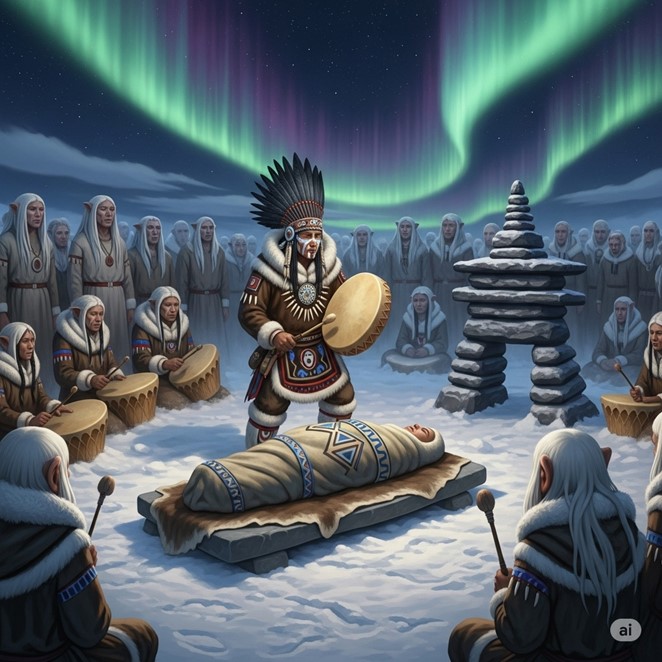
- Drum Dancing and Storytelling: The most common form of worship. The community gathers to chant the old stories, with shamans playing caribou-hide drums. This is not for entertainment; it is a vital act of passing on history, survival knowledge, and the sacred true names.
- Respect for the Hunted: Before a hunt, a hunter will whisper a plea to the spirit of the animal they seek, promising to waste nothing of its sacrifice. After a successful hunt, the animal’s spirit is thanked, and a small part of the animal (often a piece of the liver or heart) is left on the ice as an offering to Tulugak and the land itself.
- Shamanic Communion: Specially trained individuals, known as Angakkuq or shamans, serve as intermediaries between the physical and spirit worlds. Through trance-like states induced by drumming and chanting, they travel in spirit to consult with Tulugak or appease other, lesser spirits who may have been angered.
Symbols
- The Stylized Raven: The primary symbol of the faith. It is not a realistic depiction, but a minimalist, geometric design, often just a single, sharp angle representing a wing or a beak. It symbolizes wisdom, watchfulness, and the presence of Tulugak.
- The Inuksuk: The stone wayfinder is a deeply sacred symbol. It represents guidance, hope, and the community’s mark upon the vast land. Building a new inuksuk along a hunting trail is a practical and spiritual act.
- The Carved Spiral: A spiral, often carved into whalebone charms or tools, represents the cyclical nature of the seasons, the winding path of a story, and the journey of the soul through life and reincarnation.
Tags: Tulugak, The Whispering Sky, Animistic, Shamanistic, Oral Tradition, Trickster Deity, Spirit Veneration, Ancestor Respect, Balance, Survival, True Names, Raven Symbol, Inuksuk, Drum Dancing, Communal Faith
Number of Followers
The Way of the Whispering Sky is the foundational and majority faith of the Inugsuk nation. Its animistic beliefs and oral traditions are woven into the very fabric of the Ukaliq culture. The faith is practiced by approximately 55% of the nation’s total population. Given a national population of 158,272,000, this amounts to a following of roughly 87 million souls. While other beliefs exist in the more cosmopolitan trade enclaves, the vast majority of the Ukaliq people, from the ruling families to the most remote hunters, follow this path.
Type of Temple
The followers of the Whispering Sky do not build permanent, monumental temples. Their faith teaches that the sacred cannot be contained within walls and that the entire world—the sky, the ice, and the sea—is their place of worship. Their sacred spaces are natural landmarks or temporary community structures.
- The Great Inuksuk Fields: These are vast, windswept plains or high mountain ridges where generations have built thousands of stone wayfinders, or inuksuk. These fields of silent stone figures are their most holy sites. They are not tombs, but libraries of memory and spiritual energy. It is here that the largest seasonal gatherings and most important drum dances are held, under the open sky.
- Singing Ice Caves: Deep within the glaciers are certain caves renowned for their incredible acoustics. The wind passing through the crystalline formations creates shifting, harmonic tones that are believed to be the voices of the ice spirits themselves. The nation’s shamans, the Angakkuq, make pilgrimages to these caves to commune with the spirits, perform initiation rites, and seek guidance in times of crisis.
- The Qaggiq (Gathering House): In the larger settlements, a special ceremonial structure known as a Qaggiq is built for the community. Traditionally a large, reinforced snow house, in more permanent settlements it might be made of sod, stone, and whalebone. This is not a temple for a god but a functional gathering place for the people, especially during the long, dark winters. It’s the heart of the community, where stories are told, drums are played, and the collective spirit is strengthened against the cold.
Positives of the Religion
The faith’s core tenets foster a society with remarkable strengths. Its belief that every animal and landform has a spirit that must be respected creates a profound environmental harmony, leading to sustainable practices that prevent over-hunting and waste, ensuring the community’s long-term survival. The emphasis on communal storytelling, drumming, and sharing resources forges incredibly powerful social bonds and a culture of mutual support. The trickster nature of their primary spirit, Tulugak, and the need to constantly navigate the whims of a spirit-filled world cultivates a populace that is mentally resilient, adaptable, and clever in its approach to problem-solving.
Negatives of the Religion
The same beliefs that ensure harmony can also create significant challenges. A worldview governed by countless, unseen spirits can lead to a culture steeped in superstition and fear. A sudden storm or a failed hunt can be attributed to a broken taboo, potentially leading to paranoia, social conflict, or the unjust blaming of individuals. This deep-seated traditionalism can also create a resistance to new ideas and technologies. An innovative new hunting tool might be rejected if it is believed to be disrespectful to the spirit of the prey. Furthermore, the shamans, as the primary intermediaries with the spirit world, hold immense power. A corrupt or misguided shaman could easily manipulate the community for personal gain. This can also lead to a degree of fatalism, where in the face of a great crisis, the people might resign themselves to their fate, believing a great spirit has been offended, rather than seeking a practical solution.
Core Beliefs of the Faithful
Followers of the Way of the Whispering Sky, the faith of the Inugsuk nation, hold a deeply animistic and cyclical view of the world. Their beliefs are a practical and spiritual framework for survival in their harsh, beautiful homeland.
- The World of Spirits: The central tenet is the belief that every single thing in the world possesses a spirit, or inua. The wind, the sea, the ice, a particular mountain, and every animal has its own consciousness and personality. These spirits are not gods to be worshipped, but powerful, ancient neighbors who must be understood and respected.
- Tulugak, the First Teacher: Believers revere the Great Raven, Tulugak, not as a creator god, but as the ultimate teacher and a wise trickster. They believe Tulugak was the first spirit to take pity on the original, lost Ukaliq souls, teaching them how to see and communicate with the other spirits of the world. Tulugak’s lessons, often delivered through riddles and hardships, are the foundation of their wisdom.
- The Great Balance and Taboos: The world is a delicate balance of relationships between the physical world and the spirit world. The spirits are not inherently malevolent, but they are powerful and have rules. These rules, or taboos, govern how one must hunt, travel, and live. Breaking a taboo—by wasting the meat of a kill, for example, or speaking a spirit’s true name in vain—angers the spirits, who then cause misfortune like storms, failed hunts, or sickness. A good life is one lived in harmony with these taboos.
- The Power of Stories and Names: Since their history is oral, stories are the most sacred vessels of their culture. Stories hold the knowledge of their ancestors, the maps of their lands, the details of their taboos, and the “true names” of the spirits. To forget the stories is to lose the knowledge of how to survive.
- The Soul’s Journey: The soul, or anirniq, is believed to be eternal. After death, the soul leaves the body and undertakes a difficult journey to a spirit world. After a period of rest, it is reborn into a new body, often within its own family line. For this reason, newborns are often given the name of a recently deceased relative, as it’s believed to be the same soul returning to the community.
Regular Services and Gatherings
The faith’s practices are communal and tied to the events of the world, not to a weekly calendar. There are no sermons, only shared experiences.
- Daily Acts of Respect: Services are woven into the fabric of daily life. A hunter will pause to whisper thanks to the spirit of the seal she has killed. A family will leave a small offering of food or a carved trinket on a nearby stone to thank the spirits of the land for their protection. These are constant, small acknowledgments of the spirit world’s presence.
- The Community Drum Dance: The closest thing to a formal service is the drum dance, which takes place in the central Qaggiq (gathering house) during the long winters or to celebrate a significant event, like the first whale hunt of the season. The community’s shaman leads the people in hours of drumming on caribou-hide drums, chanting, and dancing. These events are vital for community cohesion, serving to honor the spirits, retell the great oral legends, and collectively strengthen the people’s will against the harshness of the world.
- Shamanic Rites: When the community faces a crisis—a persistent famine, a strange sickness, or an angry spirit—the shaman (Angakkuq) will perform a special rite. The community supports the shaman with continuous drumming while the Angakkuq enters a deep trance. In this state, their soul is said to leave their body and travel into the spirit world. There, they will bargain with the angered spirit, seek wisdom from Tulugak, or discover the broken taboo that has caused the misfortune.
Funeral Rites: The Journey Outward
Ukaliq funeral rites are focused on ensuring the soul has a safe journey to the spirit world and that the body is returned to the natural cycle in a way that honors the spirits.
- Preparation and Vigil: After death, the deceased’s body is carefully washed and dressed by their family in their finest and warmest gear. Their most essential personal items—a favorite knife, a special amulet, tools for their trade—are placed with them. The body is then laid out in the family home for a day, allowing the community to pay their respects by telling stories of the person’s life. This is not a time for loud grief, but for respectful remembrance, as it’s believed the soul needs calm and quiet to begin its departure.
- The Sky Burial: To entomb a body in the ice or earth is considered a great taboo, as it is seen as trapping the physical form and insulting the spirits of the land. Instead, the prepared body is securely wrapped in layers of sealskin. A small, solemn procession of family members carries the body far out onto the high, open tundra, to a sacred location known only to their clan.
- Returning to the Cycle: The body is placed on a simple stone bier or directly onto the open ground. A small inuksuk is constructed nearby, not as a grave marker, but as a wayfinder to show that a soul has departed from this place. The family then leaves the body to the elements and the animals. This is seen as the deceased’s final gift back to the world, providing sustenance to the creatures of the land, especially the ravens who are seen as Tulugak’s children and guides for the departed soul.
- The Naming and Rebirth: The cycle is completed when a new child is born. The shaman and the elders will observe the child and consult the spirits. They will then declare which ancestral soul has returned to the community, and the child is given that ancestor’s name in a joyful ceremony, celebrating that the soul’s journey is complete and it has rejoined its people.
The “power of the god” Tulugak is not a force that is granted directly like a gift. Tulugak is the Great Teacher, and the faith’s power comes from applying the cunning lessons taught in the ancient stories. A follower doesn’t pray for a miracle; they use their knowledge and specially crafted gear to ask for assistance from the countless spirits (inua) of the world. Magic, for them, is a respectful conversation with the wind, the ice, and the creatures of the land.
Defense: The Cunning of the Shifting Snow
The defensive philosophy of the Whispering Sky is one of evasion, misdirection, and harmony with the environment. It mirrors the teachings of the Great Raven, who teaches that the strongest defense is to not be where the blow lands. It is not about armored resilience but about being a ghost in the storm, using trickery and the aid of spirits to avoid harm.
- Whispering Wind Amulets: These are common defensive charms, often carved from the jawbone of an arctic fox or a swift-flying bird. By breathing a quiet request through the amulet’s perforations, the wearer can ask the local wind spirit for a small boon. The effect isn’t guaranteed, but the spirit may answer with a sudden gust of snow to obscure the wearer’s escape, a crosswind that slightly nudges an incoming arrow off course, or a howl of wind that momentarily deafens a foe to a shouted command.
- Gear of the Unseen Path: This light armor, crafted from the white winter pelts of multiple animals and stitched with sinew, is more of a spiritual tool than physical protection. It’s covered in minimalist Qila-Syllaabary glyphs representing silence and mist. Its enchantment doesn’t harden the armor, but rather asks the snow and land spirits to forget the wearer’s passage, muffling the sound of their footsteps and causing their tracks to fill in behind them with unnatural speed.
- The Trickster’s Totem: A shaman or a cunning hunter might carry a small, sacred totem carved in the likeness of a raven. This totem is a direct appeal to Tulugak’s trickster nature. When presented with a hostile action, the wielder can ask the Great Raven for a deception. This doesn’t create a powerful illusion, but a minor, believable “trick” to foil an attack. It might cause the wielder to appear to stumble left while they dodge right, make an illusory flash of movement in the opponent’s peripheral vision, or cause a flock of illusory snow birds to burst from their cloak, spoiling the attacker’s aim.
Offense: The Bargain of the Hunter
Offensive power is not about destructive force, but about patience, respect, and using the world as an ally. A hunter doesn’t command an animal to die; they ask its spirit to make a sacrifice for the good of the community. An attack is a bargain made with the spirits of the weapon, the world, and the target.
- Harpoon of the Spirit’s Bargain: The Ukaliq’s most iconic weapon is a harpoon, often tipped with enchanted whalebone or carved narwhal tusk. Before it’s thrown, the hunter will whisper the harpoon’s “true name,” a secret word that awakens the spirit within the weapon. When they throw it, they are not just aiming a projectile; they are making a request to the wind spirit to guide it true. The result is an attack of uncanny accuracy that seems to navigate gusts of wind. It is believed that a perfectly executed throw, one made with a respectful heart, can even convince a target’s own spirit that its time has come, making the blow more potent than its physical force would suggest.
- The Shaman’s Rattle: A shaman’s primary offensive tool is often a simple rattle made from a caribou bladder and filled with sacred stones and the teeth of powerful animals. By performing a specific rhythmic chant and dance, the shaman enters a dialogue with the local spirits. They might ask the ice spirit to create a sudden patch of slick, black ice at a charging enemy’s feet, or beseech the spirit of the deep snow to momentarily grasp a foe’s legs, hindering their movement. The effects are subtle, environmental, and depend entirely on the spirits’ willingness to cooperate.
- Gear of the Beast-Soul: Warriors and hunters often wear gear made from the pelts and bones of a specific powerful animal, like a great white bear or a cunning wolverine. These items are created through rituals that honor the animal’s spirit. By wearing these “spirit-pelt” gloves or a “bear-bone” helmet, the user can ask that animal’s spirit for a sliver of its strength in a moment of need. This won’t transform them, but it might grant them a burst of desperate, ferocious strength to push an enemy back, or the cunning to spot an opening they might have otherwise missed.
Two Hunters and Faceless Seal
It’s known that the spirits of the world are always watching. They don’t measure the strength of your arm, but the respect in your heart. This is the story of that measurement.
There were two hunters of the Ukaliq people. The first was Anik. He was young and his legs were very fast. His spear always flew true. He was the best hunter of his clan, and his pride was a loud drum in his chest. The second hunter was Pita. He was older, and his legs were not so fast. His hunts were often unsuccessful. But his heart was quiet, and he always remembered the old ways and the proper words of thanks for the spirits.
A long winter was ending, and the village’s food stores were low. The Queen declared a great hunt to feed the people. Anik stood before the people and boasted, “I will return with a catch so large it will feed us for a month! My skill is greater than any other.” Pita, in another part of the village, quietly sharpened his harpoon and whispered a prayer of thanks to the spirit of the wood of its shaft and the bone of its tip.
Out on the great ice sea, the two hunters found themselves on the same plain. And they both saw it at the same time. It was a seal, lying by a breathing hole in the ice. But it was a seal of impossible size. Its body was as large as a boat, and its fur was a perfect, silver-white. To catch such a creature would make a hunter a legend for all time.
Anik’s heart burned with a great fire of greed and pride. He saw the seal as a prize, a trophy to prove his boast was true. He began his stalk at once, his movements fast and sure. But Pita watched from a distance. He felt a deep unease. The creature was too perfect. It had no scars, no marks of life. And the air around it was too still. No birds circled. No smaller animals scurried nearby. He knew in his soul that this was not a hunt for meat, but a test for the spirit.
Anik reached the seal. It didn’t move. It simply watched him with its great, dark, and empty eyes. Anik raised his harpoon high. He shouted to the sky, “See, all you spirits! See the greatest hunter, Anik, and the prize he takes with his own strength!” He did not thank the seal for its life. He did not ask its spirit for its sacrifice. He only praised himself.
He threw the spear. As the bone tip touched the creature’s silver fur, the seal dissolved. It was not made of meat, but of a lesson. It exploded into a swirling cloud of black raven feathers and snow. From the cloud, the shadow of Tulugak, the Great Raven, rose up. It made no sound, but a cold thought entered Anik’s mind: “You who are so full of yourself have no room for a face.” The raven’s shadow swooped down and seemed to scoop Anik’s reflection from the shining ice. Then it was gone.
Anik was unharmed, but he felt a strange lightness. He looked down at the ice where his reflection should be. There was nothing. It was a smooth, empty surface. Confused and afraid, he returned to the village. But when he walked through the gates, no one greeted him. The children did not call his name. His own parents looked through him as if he were a stranger, a gust of wind. His dogs did not know his scent and they growled at him. He shouted his name, but the word felt empty. By placing his own pride before the balance, he had broken his connection to the community. He had lost his place in The Great System. He was faceless.
He couldn’t hunt. The animal spirits didn’t see him. He couldn’t trade. The people didn’t know him. He was a ghost in his own home. In his despair, he found Pita. The old hunter looked at him for a long time. “I do not know your face,” Pita said, “but I know your sorrow. You met Tulugak’s test, and you failed. The seal was a question, and you answered with arrogance.”
Anik, now humbled, asked what he must do. Pita replied, “You tried to take a great thing from the world for yourself. Now you must give of yourself to the world, and ask for nothing. You have to become nobody to become somebody again.”
And so Anik began his long atonement. He could not hunt for glory, so he used his great speed and sharp eyes to help the other hunters. He would track the prey, drive it towards them, and then fade away, allowing another to make the respectful kill. He couldn’t be praised for his work, so he took on the tasks no one else wanted. He mended nets in the dark. He built walls of snow to protect the homes of others from the wind. He did all this without a name and without thanks. He slowly emptied himself of his pride, and filled the emptiness with work for his community.
One day, while helping Pita hunt, a great white bear ambushed the old man. Anik, without a thought for his own life, threw himself at the bear, creating a distraction that allowed Pita to escape. He did not fight the bear, for he knew he couldn’t win. He just ran, using his great speed to lead it away on a long and desperate chase across the ice, a final act of giving. He finally escaped, collapsing near the village, and slept for a day and a night.
When he woke, he was in his own bed. His mother was there, and she was weeping and saying his name. He looked at his reflection in a bowl of water, and he saw his own face looking back. Tulugak’s test was over. He had learned his lesson.
The Moral: The greatest hunter isn’t the one who takes the most, but the one who understands their place in the hunt.