
Original life forms: Lionfish (Class Actinopterygii), Blue-Ringed Octopus (Class Cephalopoda), Praying Mantis (Class Insecta), Slate Pencil Urchin (Class Echinoidea)
Appearance
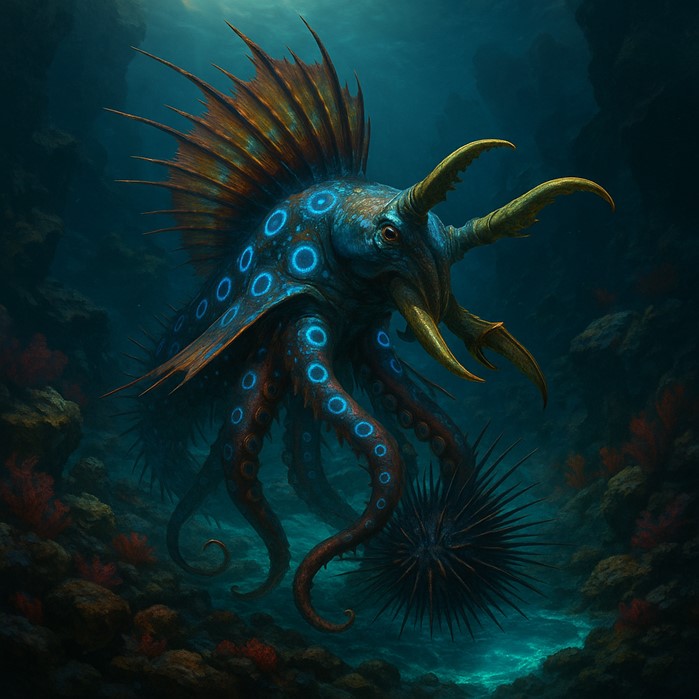
A laterally compressed torso sheathed in fin-like membranes radiates outward like a lionfish’s pectorals, each membrane laced with translucent venom channels that glow faint azure rings when agitated. Eight cephalopod tentacles sprout from the midline; the first pair elongate into raptorial, serrated raptorial claws reminiscent of a mantis’s forelimbs, hinged for rapid scything strikes. The dorsal and ventral surfaces host interlocking rows of rigid, hematite-dark spines copied from slate-pencil urchins; spines twist with slow muscular torque, redirecting incoming force. An ocular crown of six faceted mantid eyes sits atop a flexible octopoid mantle hood; beneath it a beaked mouth recessed inside a suctorial funnel alternates between crushing and siphoning feeding modes.
Size
Fully grown specimens average 6 ½ ft snout-to-tail-fin, with the fin array spanning nearly 8 ft tip-to-tip; body mass hovers around 190 lb when water-laden.
Speed
Aquatic burst: 35 ft/second in short jetting spurts using mantle propulsion; sustained swim glide: 12 ft/second. Terrestrial crawl: 6 ft/second employing tentacle undulation aided by fin shuffling. Vertical reef ascent via spine anchor and tentacle haul at 4 ft/second.
Stat Modifiers
+3 Agility (sudden fin flare and tentacle strike coordination)
+2 Perception (compound eyes and ring-pulse vibration sense)
+2 Resilience (urchin spine armor and distributed nerve net)
+1 Strength (tentacle grip torque)
−2 Charisma (alien visage, toxin musk)
−3 Cold Tolerance (ectothermic tissue with high surface area)
Skills
Ambush Camouflage, Reef Navigation, Multilimb Grapple, Venom Engineering, Pressure-Pulse Echo-location, Spine Parry Reflex.
Behavior
Usually solitary; establishes spiral hunting corridors around coral pillars or briny sinkholes. During crepuscular hours it hovers motionless, fins spread like fronds, bioluminescent rings pulsing lighthouse patterns that mesmerize prey. If threatened it releases a mist of neurotoxic ink, retracts fins, and rolls into a bristling spined orb before jetting away. Mating involves complex fin semaphore; clutches of gelatinous egg-beads adhere to underside of overhanging rocks where male guards with low-frequency hums that deter scavengers.
Diet
Carnivorous; favors crustaceans, small piscine shoals, and soft-shelled mollusks. On land near tide pools it may scythe insects or small amphibians, injecting digestive enzymes through the beak funnel and siphoning liquefied tissue.
Emotions
Displays calculated curiosity; flares fins in triumph after successful strike; exhibits blanching pallor bands during fear state; enters rigid torpor when temperatures drop below preferred brine warmth; exhibits rare communal tolerance only during spawning spirals.
Environment
Native to hypersaline rift-pools and wave-cut terraces along volcanic coastlines of arid archipelagos; tolerates brackish estuary deltas when prey migration demands. Occasionally ventures inland through flooded canal tunnels where salinity remains above seawater thresholds.
Tags: Feral Hybrid, Marine-Terrestrial, Venomous, Bioluminescent, Spine-Armored, Tentacle-Grappler, Fin-Glider, Ambush-Predator, Reef-Dweller, Brine-Adaptive, Mantid-Claw, Cephalopod-Jet, Urchin-Spine, Lionfish-Flare, Ink-Cloud, Compound-Vision, Solitary
Life Cycle
New clutches contain four-to-six hundred gelatinous bead-eggs adhered beneath saline overhangs or basalt shelves just below low-tide datum. Within six days the beads swell and split, releasing threadlike planktonic fry crowned by micro-spines and a single rudimentary fin collar. Fry drift on hypersaline surface slicks for one lunar cycle, absorbing brine nutrients until mantle development begins. At roughly four weeks they enter the “ring-burst” stage: chromatophores fire irregular blue pulses as tentacle nubs bud. Ring-burst juveniles descend to mid-reef crevices, feeding on copepods while plating themselves with tiny detachable spicules that later fuse into permanent slate-spines. By three months body length reaches two feet; mantis claws form and juvenile crest eyes replace larval stalks. Sexual maturity occurs near the end of the first year at lengths exceeding five feet. Typical lifespan, if predation or temperature shock are avoided, approaches thirty-two Saṃsāran years; elders develop thicker ventral fins and exhibit slower but more forceful jet bursts.
Mating
Seasonal brine surges prompt adults to convene in helicoid formations called spawning spirals. Participants circle a central basalt pillar, synchronizing bioluminescent rings in nested wave patterns that travel outward along the spiral. Courting pairs detach from the formation and perform mirror-dance swoops: one launches a short jet burst upward while the other drifts downward, creating intersecting trails of glowing venom vapor. Successful alignment results in tentacle intertwining; male individuals then fertilize egg strings externally. Post-fertilization, the pair locates an undercut ledge, chisels shallow grooves with mantis claws, and press the gelatinous beads into place. Males remain guardian for thirteen days, emitting sub-audible hum pulses that repel scavenger eels; females patrol the perimeter, displaying intensified ring color to intimidate rival females seeking to usurp guarding roles. Once fry emerge, adults abandon the site—parental investment ends abruptly to prevent cannibalistic incidents.
Tactics
Hunting relies on tiered ambush strategy. Initial approach employs stationary fin spread in mimicry of stationary coral fronds; chromatophores dampen ring glow to faint teal, drawing curious reeflings. When prey nears within two body lengths, the creature emits weak pulsed light that stuns prey perception for a heartbeat, then snaps forward with dual mantis claws at 50 ms strike speed. Tentacles coil and inject paralyzing tetrodotoxin derivative; suction funnel extracts liquefied tissue without tearing, leaving minimal blood plume that could attract competitors. Against larger threats the life form spirals into spine-ball stance, using mantle jet to ricochet while the rotating spines shave flesh upon contact. If heavily outnumbered it ejects cobalt-tinged neuro-ink cloud, then performs a vertical jet burst to deeper column layers where few predators tolerate salinity.
Actions
• Fin Flare Hypnosis – expand fins to maximum radius, pulse rings in rotating pattern; small vertebrates within six feet suffer momentary disorientation.
• Mantis Scythe Strike – rapid double slash; each claw edge secretes hemolytic enzyme causing delayed internal bleeding.
• Tentacle Grapple – four midline limbs ensnare up to two medium targets, applying increasing constriction each heartbeat until tissue rupture.
• Slate-Spine Barrage – muscular ripple snaps outermost spines which launch like quarrels; lost spines regrow over three days provided diet is protein-rich.
• Neuro-Ink Cloud – mantle sac expels dense toxin fog obscuring a fifteen-foot sphere for twenty seconds; any gill-breathing organism inside experiences full neuromuscular lock.
• Hydro-Jet Burst – mantle contraction expels brine at high velocity for instantaneous repositioning up to forty feet; subsequent motion speed halves until mantle re-fills.
Other Interesting Information
Apothecaries prize neuro-ink condensate for precision surgical stasis; one drop freezes cardiac spasms without stopping respiration, though exceeding dose proves fatal. Reef-dwelling glass shrimp maintain obligate cleaning symbiosis, nibbling parasites from between dorsal spines; the shrimp’s translucent bodies reflect blue rings, granting them predator pass immunity. Canal engineers of Hohokam occasionally divert hypersaline effluent to form moat enclosures; releasing a pair of Echinomantipteroceph into such brine keeps siphon lizards and rust weasels from gnawing masonry foundations. Legend among linecanal children claims the creature’s ring pulses echo Talutara’s twin flow-bell tones in miniature; water-monks studying wave acoustics verify harmonic similarity yet warn novices against approaching. Trophy spines fashioned into resonance plectrums resonate at unusually pure frequencies, enriching Sa hó tam choral instruments with piercing overtones heard even above rushing spillways.
Adventuring companies seldom risk the hypersaline grottoes or basalt tide-terraces of Hohokam without strong motive, yet the Echinomantipteroceph provides several compelling incentives that outweigh the danger of its neuro-ink clouds and mantis claws.
- Foremost lies medicinal demand. Apothecaries prize the creature’s cobalt-tinged ink as a surgical stasis agent that suspends cardiac fibrillation without stopping breath. High-tier healers import the compound in drams no larger than a gemstone vial, and civic hospitals within the monarchy’s canal cities issue annual contracts for fresh supply. Obtaining ink of reliable potency requires harvesting it directly from a startled specimen; aged or diluted residue loses efficacy. Adventurers capable of locating a breeding spiral during the creature’s seasonal congregation and extracting ink before the swarm disperses command generous bounties from medical guilds and matron-pharmacists.
- Artisans and resonance-smiths meanwhile covet the slate-pencil spines. When shaped into plectrums, the spines generate pure overtone harmonics that carry above canal roar—ideal for Sa hó tam choir instruments and for flow-bell repair within Keystone Sanctums. Spine stocks harvested after the animal’s third molting year exhibit optimal density; such spines are rare because most predators never allow specimens to reach full maturity. Surveyor guilds pay in bulk coin or gear upgrades for bundled spines, while royal archivists commission single matched pairs to restore cracked flow-bell tongues. Parties seeking prestige with the Flow Gate Covenant may earn honorary water-monk escorts by supplying prime spines for temple refurbishment.
- Scholars of hydromancy and acoustics chase a different reward: observation of the creature’s bioluminescent ring pulses. The pulses replicate miniature versions of Talutara’s twin flow-bell signature, and water-monks suspect the beast’s nervous system channels faint echoes of the deity’s pressure resonance. Securing uninterrupted study time demands clearing rival predators and constructing damp-stone blinds within submerged rift-pools. Academic sponsors offer scrolls of advanced resonance notation, access to restricted canal libraries, or tier-attuned hydro-tools in exchange for detailed ring-pulse recordings or preserved neural tissue.
- Canal engineers sometimes hire mercenary dive crews to transplant live Echinomantipteroceph to hypersaline moat enclosures that guard strategic lock complexes. The monarchy considers this biological deterrent cheaper and less conspicuous than clockwork turrets. Transporting an adult requires sedating it with powdered star-anise eel skin, trussing tentacles with mineral-resistant cordage, and carrying it in brine coffers lined with obsidian shards to prevent tunnel chew-through. Success earns long-term tax reductions or monopoly rights on downstream market stalls—lucrative prizes for merchant-adventurers willing to brave transport risks.
- Occasionally the impetus is ecological rather than economic. Sudden population spikes of Echinomantipteroceph in neglected branchway tunnels can obstruct brine drainage, raising salinity in adjacent crop terraces beyond maize tolerance. Agricultural stewards offer charter marks authorizing lethal cull or relocation. While the monarchy provides modest coin for such sanitation, the real gain is political leverage: successful contractors gain first notice of forthcoming royal irrigation projects, securing future employment.
- Collectors of exotic pets, particularly ennobled Kokorut matrons fascinated by bioluminescent ornamentation, may quietly commission live juveniles. Smuggling fry past covenant inspection panels risks canal-tithe seizure and fines, yet the private market rewards exceed hazard pay for crews adept at clandestine transport. Rivalries among noble houses sometimes escalate into covert contests to display the most radiant ring-burst juvenile during solstice feasts, spurring adventuring parties into midnight egg-snatch expeditions beneath heavily guarded spawning spirals.
- Purely martial motives draw warriors who seek trophies of personal valor. Mantle-jet speed and hedgehog spine rolls make the creature an infamous test of reflex and planning. Victory staves carved from the primary fin rays symbolize mastery over ambush predators and grant bearer status at certain desert dueling circles. Champions hoping to claim such symbolism recruit scouting rogues and hydromancy casters to corner a single adult in confined rift-tubes where its jet burst options narrow.
Whether for medicine, craft, scholarship, civil engineering, clandestine commerce, or prestige, every motive converges on the dangerous brine realms where the Echinomantipteroceph drifts. Adventurers enter prepared for piercing spines, hypnotic ring glare, constricting tentacles, and suffocating neuro-ink—yet the promise of wealth, influence, or renown keeps their curiosity burning brighter than the azure circles rippling across that feral mantle.
Additional items or ingredients can be harvested:
- Bioluminescent Ring Glands – every blue circle marks a paired gland embedded between fin collagen and outer skin. When steeped in distilled brine and powdered turquoise, the glands exude a cold-light resin that adheres to ceramics and horn. Artificers mix this resin into flow-bell inscriptions so canal wardens may read depth gauges at midnight without flame. Scribes of Sa hó tam illuminate rite scrolls with the same compound, ensuring whispered hydromancy chants remain visible inside vapor-filled echo galleries.
- Mantle Propulsion Bladder – the flexible jet sac, once cleaned of venom trace, retains remarkable elastic recoil. Gearwrights pack it with steam-water and fit a bronze valve; the result becomes a single-pulse thrust canister that survey divers strap to their backs for emergency escape when rift-pool ceilings collapse. Canal sentries also mount paired bladders beneath light skiffs, granting short bursts against headwater surge.
- Neuro-Ink Filtration Lobe – surrounding the venom sac lies a frilled membrane that concentrates trace alkaloids. When dried, powdered, and sifted through linen, the lobe functions as a portable toxin filter: water poured through it loses most heavy-metal taints yet keeps mineral salts intact, ideal for desert patrols rationing brackish seep. Apothecaries embed slivers of the membrane inside ceramic sealing rings; any attempt to open a medicinal vial without the matching pressure chant triggers residue release that spoils the contents, foiling counterfeiters.
- Slate-Spine Core Marrow – beneath the rigid graphite-black shell, a pale silica-rich marrow calcifies to quartz hardness. Crushed marrow blended with lime produces a grout that self-heals hairline fractures when exposed to canal pressure rhythms. Mason-mages patch spillway arches with the mixture; each midnight tide triggers micro-vibrations that reseat crystals, preventing seep before dawn inspections.
- Compound Crest Eyes – each of the six faceted eyes houses a liquid crystal lens naturally attuned to polarized shimmer. When mounted in obsidian casings filled with saline gel, the lenses act as glare-cutting monocles for navigators guiding mirror-bright salt flats. Enchanters suspend them within scrying basins; the eyes block surface reflection, allowing clearer visions of subsurface currents or hidden sinkholes.
- Mantis Scythe Serrations – the inner cutting ridges on the raptorial claws shear stone dust finer than steel files. Metallurgists set rows of these ridges into hand-crank planers that shave gear teeth for precision clockwork sluice gates. Farmers favor smaller segments as harvest sickle inserts: the living residue enzyme keeps plant sap from gumming blades, doubling field efficiency.
- Tentacle Tendon Cords – longitudinal muscle strands dry into springy, high-tension fibers. Weavers braid them into snap-cords that recoil shutters on storm-vent roofs the instant wind rises. Bowyers replace traditional sinew with tendon cord for tidal-line projectile launchers; the cords resist salt decay and hold enchantment runes that dampen recoil shock.
- Sub-Dermal Chromatophore Net – peeled as a translucent sheet from beneath the ring patterns, this living film shifts hue in response to electrical potential. Alchemists stitch small patches onto canal lock dials; color fade warns crews when grounding wards weaken. Tailors inset strips along the hems of festival robes; wearers display subtle modulation that reflects their internal mana rhythm during Sa hó tam choral duels.
- Beak-Funnel Teeth – composed of layered keratin-silica plates, the beak withstands torsion without dulling. Lapidaries cut the plates into engraving nibs capable of scoring jade, obsidian, or even soft mithral. Flow-gate covenant priests reserve whole beaks for carving miniature resonance keys used to tune bell tone; only the funnel teeth produce the precise twin echo that matches Talutara’s signature chord.
- Pressure-Sense Ampullae – lining the mantle are pearl-size nodules filled with conductive gel. When set into brass housings, they become passive hydraulic sensors mapping minute flow changes. Royal surveyors embed strings of these ampullae along experimental siphon tunnels; any blockage alters the nodules’ charge differential, triggering amber lanterns topside hours before catastrophic backup.
- Urchin-Spine Fulgurite Tips – the outer third of each spine concentrates trace metals that flash-fuse under lightning strike. Collected tips, once polished, act as natural grounding rods for airship mooring towers. Sky-captains pay premium weight allotment to bolt arrays of fulgurite tips along keel lines, greatly reducing storm lash risk over the open desert.
- Mantle Cartilage Keel – the internal Y-shaped cartilage maintains jet alignment. After boiling in limewater it hardens into lightweight spring struts. Engineers rivet split keels inside collapsible desert sled runners; the struts absorb shock over dune corrugations while returning enough energy to glide across salt pan crust without cracking.
- Blue-Ringed Venom Pearl – repeated toxin cycling crystallizes micro-spherules near the liver. These pearls, faintly luminous, suspend neuromuscular inhibitors of graded potency. Physicians crush measured grains into salve that temporarily numbs peripheral nerve endings, granting burn victims relief while regenerative poultices set. Rogue alchemists distill the pearls into contact gel for silent incapacitation, though flow-gate law brands such use as civic sabotage.
- Fin-Membrane Resonance Vein – within each broad fin a lattice of elastin fibers resonates under directed chant. Cutting slivers into reed flute chambers yields instruments whose notes propagate clearly through rushing spillway noise. Flow-procession leaders conduct dawn ceremonies with such flutes, guiding barge rhythms along main canals.
- Ink-Gland Pigment Residue – post-distillation sludge hardens into dark violet cakes that burn with smokeless flame. Canal lantern makers pack the cakes under mica screens, creating maintenance-free lights for underwater work shafts where ordinary oils smother. Street performers prize the cakes; a thumb-sized shard ignites fireworks of indigo sparks when ground upon granite, drawing crowds—and coin—during market nights.
Each harvested element commands bids from healers, engineers, artificers, or nobility, ensuring that even after death the Echinomantipteroceph continues to circulate within Hohokam’s economy, much as canal water itself cycles through gate, field, and sea.
Chant of Many-Ringed Tide-Dweller
When sea still carried the first smoke of newborn vents and land was yet counting its stones, there arrived in the rim-pools a drift of orphan salts. These salts whispered that they once were clouds but forgot the path of rising. From their quarrel woke a beast with fins like quarrelsome banners and eyes that glinted many mornings at once. Folk beside basalt shores saw the glow-rings round its hide and named it “Water That Draws Circles upon Itself,” yet none could say its shape straight because every witness told a new limb or a changing number of spines.
Moon after seventh moon, the creature crept among coral lanterns and fed on dream-shrimp that collect in sleepless brine. Shrimp voices spoke in bubble tongues; the beast drank them and learned silence more perfect than speech. Silence weighed heavy—heavier than armor—so heavy the rock crabs fled their hollows, believing night itself took shape. In that hush a lone canal-singer wandering too far from gate music lost her step. With no song-line to light path, she sank into tidal cleft where the beast lay folded like a many-bladed fan.
The singer did not scream; she unrolled her reed scroll and uttered half a chord from Sa hó tam, hoping coral would answer. Blue rings on the mantle flared; claws unfurled, yet did not strike. The beast tasted the chord inside the water and found it kin to world’s first hush. Thus it spared the singer, curling tentacles beneath and lifting her to a ledge where barnacles wrote prayers no one reads.
She carried tale to canal court, saying, “There is hush that sings louder than bells; rings of deep sky circle a body of tide.” Court sages argued till dew dried on their horns. Some claimed the beast was a punishment for water wasted; others swore it guarded forgotten vents where mother-salt sleeps. The matron of sluice mathematics ordered a journey: retrieve the hush-rings, measure their glow, and know whether balance tilts.
A company of seven took bronze weir keys as spears and glass shrimp nets for bait. They walked basalt stairs until wave struck eye level. There world narrowed to green gloom and sulfur lantern snow. For seven watches they tracked trails of tremor—nuanced quakes that echo readers liken to heartbeat of tilted stone. On eighth watch they found a spiral trench, walls written by claw tip, lines smooth yet jagged like script remembered through fever. At bottom, ring pulses circled shadows, painting rock in mirrored moons.
The boldest of seven cast a net scented with crushed urchin marrow. Tentacles like whip and ribbon slipped through mesh, but the glow stayed bright—ink blue becoming storm blue. Net shredded, bronze keys bent, and water thickened with narcotic scent. Six lost senses and floated as puppets of tide. The seventh, smallest and youngest, had remembered mother’s talk of fear: “When dread grows claws, show back-bone calm.” He bound lungs with striped eel skin and inhaled slow. Toxin kissed breath but could not steal it.
He saw the beast coil into ball of razors, saw its fins twist, saw light in rings turn rhythm of gate-bells, two-stroke echo. He struck bronze key into mantle jet sac by chance, for darkness fooled aim. Sac pulsed, jettisoning brine and beast together upward. Creature collided with stone arch and cracked spines rained like night hail. Rings dimmed to ash gray. It drifted beside stunned warriors in the trench mouth.
The youth gathered shards of spine and fragments of glow-gland, wrapped them in eel skin, and sang one steady half-tone above threshold where hush dwells. Beast drifted, breathing quell-breaths, then spread fins thin as prayers and slipped back to deeper vent before dawn could pry eyes open. Six regained thought; all crawled home with spoils that still pulsed faint cobalt under sunrise.
Matron ground spine marrow into grout that healed leaky spillway joints for a hundred leagues. Glow-glands became midnight lamp guiding barges through dust storms. Yet the youth returned each season to trench edge, laying turquoise crumbs and humming half-tone. Some winters the water answered with soft ring shimmer, thanking—or warning.
Thus memory runs crooked through generations: people speak of silent circles that spare singers but swallow nets; of grout that remembers wounds and closes them without hammer; of hush so deep it carries homeland bell across salt void. Children at canal schools press ears to spillway wall hoping to hear twin pulse, and old sandwalkers say when you do, keep voice low, for tide still builds its secret beast in places maps forget.
Moral: Measure breath before blade, for fear cut in calm waters may return as circle unbroken.
Suggested conversions to other systems:
Call of Cthulhu — Ring-Bearing Circlopod
STR 110 CON 80 SIZ 90 DEX 85 INT 35 POW 70
HP 17 Move 8 (Swim 12) Damage Bonus +1D4 Build 2
Armor 6-point chitin and slate spines; mundane weapons doing less than 7 points in a single blow cannot pierce the mantle.
Skills: Fighting 75%, Stealth (reef camouflage) 50%, Swim 90%, Spot Hidden 65%, Track by pressure wake 40%.
Attacks:
• Scythe Claw (75%, 1D8+db, impale on 01–05, untreated wound bleeds 1 HP/minute).
• Tentacle Grapple (65%, opposed STR; on hold, victim is paralyzed after three rounds from injected toxin unless CON ×5 roll succeeds).
• Venom Ink Cloud (special, CON vs. CON resistance table; failure paralyses for 1D10 minutes and inflicts 1/1D6 SAN).
Special: Bioluminescent Hypnosis — a POW vs. POW roll against anyone within 8 m who watches the pulsing rings; failure leaves target fascinated for 1D4 rounds.
Sanity Loss: 0/1D6 when first witnessing its full form; additional 1/1D4 if incapacitated by the ink cloud.
Blades in the Dark — Spiral Spine Horror
Tier III • Threat 4
Scale: large solitary predator, equivalent to a barge in mass.
Instinct: Defends saline vents and feeds on warm-blooded intruders.
Armor: plated slate spines; ignores first level-2 harm from blades or pistols.
Moves:
• Slip-shadow through silt, appearing atop prey.
• Flash rings in a mesmerising pattern, seizing initiative.
• Jet-burst to disengage or reposition instantly.
Special Abilities:
• Neuro-Ink — spill level-3 harm “paralysed lungs” in a cloud template; resist with Prowess.
• Shatter-Spine Barrage — spend 1 quality to inflict area level-2 harm “spined, bleeding”.
• Hypnotic Pulse — roll Command at Tier+1 versus a group; on success, victims hesitate, unable to act for a moment.
Goal: Maintain the vent’s sacred salinity gradient; any tampering with pumps or sluices provokes immediate violence.
Weakness: Rapid shifts in water temperature or salinity force it to withdraw and regroup (treat as setup for the crew’s next action).
Dungeons & Dragons — Echinomantipteroceph 73
Large aberration, unaligned
Armor Class 17 (natural armor)
Hit Points 184 (16d10 + 96)
Speed 30 ft., swim 60 ft., climb 30 ft.
STR 20 (+5) DEX 16 (+3) CON 22 (+6) INT 7 (–2) WIS 14 (+2) CHA 5 (–3)
Saving Throws DEX +8, CON +11
Skills Perception +7, Stealth +8 (advantage while motionless in water)
Damage Resistances bludgeoning, piercing; Damage Immunities poison; Condition Immunities poisoned, stunned while in water
Senses darkvision 120 ft., passive Perception 17
Challenge 10 (5,900 XP)
Amphibious.
Spine-Carapace. Any creature that hits the Echinomantipteroceph with a melee attack from within 5 ft. takes 1d6 piercing damage.
Bioluminescent Hypnosis (Recharge 5–6). The creature emits pulsing rings; each creature within 30 ft. that can see it must succeed on a DC 17 WIS save or be charmed for 1 minute (repeat save at end of each turn).
Actions
Multiattack. It makes one Scythe Claw and one Tentacle Lash, or two Tentacle Lash attacks.
Scythe Claw. Melee Weapon Attack: +10 to hit, reach 10 ft., one target. Hit: 16 (2d10 + 5) slashing.
Tentacle Lash. Melee Weapon Attack: +10 to hit, reach 15 ft., one target. Hit: 13 (2d8 + 5) bludgeoning, and target is grappled (escape DC 18). Until grapple ends, the creature cannot use that tentacle on another target.
Ink Cloud (Recharge 6). The creature expels venomous ink in a 20-ft. radius sphere; creatures in area must make DC 18 CON save or be poisoned and paralyzed for 1 minute (save at end of each turn). The cloud is heavily obscuring for 3 rounds.
Spine Volley (Recharge 4–6). Ranged Weapon Attack: +8 to hit, range 60 ft., up to three targets. Hit: 14 (2d8 + 3) piercing; target must succeed on DC 16 CON save or take 7 (2d6) poison damage.
Knave — Blue-Ringed Spine-Scyther
Hit Dice 9 HP 45 AC 15 (natural)
Attack +6 Damage d10 scythe slash or d8 tentacle constrict (save vs STR or grappled)
Movement 30 ft., swim 60 ft.
Morale 10
Specials:
• Spine Armor — melee attackers take d4 damage on a miss or hit if using shorter weapons.
• Ink Cloud — once per fight fills a 15-ft. radius with toxin; all inside save vs CON or be paralysed for 1d4 rounds.
• Hypnotic Rings — action to force all who can see within 30 ft. to save vs WIS or be mesmerised until harmed.
• Jet Burst — may move its swim speed as a free action after taking damage (once per round).
Treasure: 1–3 spine clusters worth 200 sp each to artificers; venom gland fetches 500 sp from healers; bioluminescent hide patch trades for 150 sp with scholars.
Fate — Ring-Fin Splicer
High Concept: Bioluminescent ambush predator that merges fin blade, hypnotic rings, and neuro-ink.
Trouble: Drawn to any shift in salinity or temperature, it lashes out when balance breaks.
Other Aspects: Spine-armored juggernaut • Jet-burst escape artist • Silence that sings.
Approaches (default pyramid, +3 Good, +2 Fair, etc.): +3 Flashy (hypnotic display), +2 Quick, +2 Forceful, +1 Sneaky, +1 Careful, +0 Clever.
Stunts
• Bioluminescent Hypnosis (ans) Once per scene spend 1 Fate Point to force every observer in the zone to defend with Will or take the aspect Dazed by Circles (two free invokes).
• Spine Volley Create Advantage with Forceful; on success inflict the situational aspect Riddled with Slate Quills.
• Jet Burst When you succeed at Quickly Overcoming an obstacle to move, treat it as a success with style and gain a free Boost “Out of Reach.”
Stress: 3 boxes. Consequences: Mild (2), Moderate (4), Severe (6). Defeated only when Severe box filled and all stress marked—its vent-grown resilience demands sustained effort.
Numenera & Cypher System — Echo Spine Predator
Level 7 (target number 21) Health 28 Damage 7 points
Armor 3 natural chitin Movement Long swim, Short crawl
Modifications Stealth 9 (27) when motionless among coral; Speed defense 8 (24) against ranged; Might defense 8 (24) versus grapples.
Special Abilities
• Mantis Scythes: on a natural 17–18 deal +2 damage; on 19–20 impose impaired for one round.
• Neuro-Ink Cloud (1 Intellect Pool cost): all creatures within Immediate range make Might defense 8 (24) or become paralyzed for one minute.
• Hypnotic Rings (action, once per ten minutes): Intellect attack 7 (21); failures stand transfixed one round per level of Effort target could not match.
• Spine Volley (one action): up to three Short-range targets, 4 damage each; counts as ranged attack.
Interaction: Utterly alien; negotiations require trained animal handling and an asset representing prey.
Use: A guardian of hypersaline vents whose ink pearls cure heart arrhythmia, drawing explorers.
Loot: 1d6 venom pearls (level 5 ciphers), 1 spine cluster (level 6 artifact crafting component).
Pathfinder 2e — Echinomant Scythe
Creature 8 Large Aberration Unaligned
Perception +18; darkvision
Skills Athletics +19, Stealth +18 (coral only +20), Acrobatics +17
Str +6 Dex +4 Con +5 Int –1 Wis +2 Cha –2
AC 28 Fort +19 Ref +17 Will +14
HP 150; Immunities poison; Resistances piercing 10, bludgeoning 5
Spine Carapace (Reaction) A creature that strikes the scythe within 10 ft. takes 1d6 piercing.
Speed 30 ft., climb 20 ft., swim 60 ft.
Melee Scythe Claw +20 (Reach 15 ft., Slashing) 2d12+6 dmg plus 1d6 bleed
Melee Tentacle +18 (Reach 20 ft., Grapple) 2d8+6 bludgeoning
Ranged Spine Volley +18 60 ft. 2d8+4 piercing; two-action activity fires three spines at distinct targets.
Ink Cloud ◆◆ (arcane, incapacitation, poison) 10-ft. emanation, once per hour; DC 27 Fortitude or paralyzed and poisoned 2 (stage damage 2d6). On success poisoned 1; critical success immune one hour. Cloud is thick mist for 3 rounds.
Hypnotic Rings ◆◆ (arcane, visual, mental) Creatures in 30 ft. must DC 26 Will save: fail › stunned 1, slowed 1 one round; crit fail › stunned 2, slowed 2 one minute; success immune 24 h.
Jet Burst ◆ (move) The scythe Strides or Swims up to half speed without triggering reactions.
Savage Worlds Adventure Edition — Many-Ringed Horror
Attributes: Agility d10, Smarts d6, Spirit d8, Strength d12, Vigor d10
Skills: Athletics d10, Fighting d12, Notice d10, Stealth d10 (reef +2), Swimming d12+2
Pace 6 (Running d6) • Parry 8 • Toughness 13 (3)
Special Abilities
• Amphibious: fully capable on land and in water.
• Armor +3 chitin and slate spines.
• Spine Reflex: melee attackers with unarmed or natural weapons take Str d6 damage.
• Scythe Claws: Str + d10.
• Tentacle Grapple: Contested Athletics; on success entangled and automatic Str + d6 on its action.
• Hypnotic Pulse (Cone, Special): Smarts roll vs. Spirit; failure leaves targets Distracted and Vulnerable; critical failure adds Stunned. Once per encounter.
• Neuro-Ink Cloud: Medium Blast Template; Vigor roll at –2 or Incapacitated for 2d6 rounds; success leaves target Fatigued (–1). Once per hour.
• Jet Burst: As a free action after taking damage it may move Pace inches in any direction without drawing free attacks (once/round).
Edges: Quick
Hindrances: Bloodthirsty, Environmental Weakness (Freshwater; Toughness –4 while immersed).
Treasure: d4 venom pearls worth $1,000 each; d6 razor spines (razor boomerang, Str +d8, AP 2, Throwable).
Shadowrun 6E — Quill-Ring Sepsis (PR 5)
Attributes BOD 7 AGI 5 REA 5 STR 7 WIL 5 LOG 2 INT 4 CHA 2 ESS 6
Initiative 9 + 1D6 (water) / 7 + 1D6 (land) Edge 3 Armor 4 (natural slate spines)
Physical CM 12 Stun CM 10 Movement 10 m Swim / 6 m Crawl
Skills Athletics 6, Perception 7, Stealth (Aquatic) 8, Unarmed Combat 8, Exotic Ranged Weapon: Spine Volley 6
Powers
• Constrict (STR + 3 P; Opposed Escape Test)
• Natural Weapon: Scythe Claw (DV 9P, AP –2)
• Toxin Attack: Neuro-Ink Cloud (10 m ø, Contact, Power 8, Speed 1 Combat Turn, Onset Instant, Effect Stun 6 + Paralysis)
• Hypnotic Bioluminescence: Opposed Willpower + Logic vs. Magic 5; failure grants Dazed status 2 Combat Turns
• Water Adaptation; Regeneration (only while immersed in saline water)
Weakness Environmental Allergy (Severe, Freshwater) –2 dice to all tests, no Regeneration.
Starfinder — Echinomanti Spineray CR 8
XP 4,800 Large aberration (aquatic)
Init +5; Senses darkvision 60 ft., blindsense (vibration) 30 ft.; Perception +17
DEFENSE HP 135 EAC 22; KAC 24 Fort +14, Ref +12, Will +9
Immunities poison; Resistances piercing 10; DR 5/—
OFFENSE Speed 30 ft., swim 60 ft.; jet burst 120 ft. as move (Ex, recharge 1d4 rounds)
Melee scythe claw +18 (3d8+10 S plus 1d6 bleed)
Melee tentacle +18 (2d6+10 B plus grab)
Ranged spine volley +16 (2d6+7 P; 60 ft.; 3 targets)
Space 10 ft.; Reach 15 ft. (claw), 20 ft. (tentacle)
STATISTICS STR +5, DEX +3, CON +4, INT –1, WIS +2, CHA –2
Skills Stealth +17 (+21 in reefs), Acrobatics +15, Survival +17 (track by pressure)
Feats Mobility, Multi-attack
Languages — (cannot speak)
ECOLOGY Environment hypersaline coasts and magma vents; solitary
SPECIAL ABILITIES
Ink Cloud (Ex) once per 1d6 rounds; 20-ft. radius; creatures inside must succeed at DC 17 Fort save or be paralyzed and flat-footed for 1 minute (new save each round). Cloud grants total concealment for 3 rounds.
Hypnotic Rings (Su) standard action, 30-ft. cone; DC 16 Will save or fascinated 1d4 rounds. This is a mind-affecting visual effect.
Spine-Carapace (Ex) any adjacent foe hitting with a melee attack takes 1d6 piercing damage (Ref DC 16 negates).
Traveller (Mongoose 2e) — Blue-Ringed Spine Scyther
Animal (Aquatic / Amphibious Hunter) Instinct 7 Pack 1D3 (usually solitary)
STR 15, DEX 11, END 13; Characteristics Modifier +3/+1/+2
Skills Athletics 1, Recon 2, Melee (Claw) 2, Survival 1
Attack Scythe Claw 2D damage, AP 4; if 8+ hits effect Grapple (Opposed STR)
Special Ink Cloud: as action fills 6 m radius; creatures inside suffer −2 DM and must roll Endurance 8+ or be Paralysed for 1D6 rounds.
Armour 8 (spine-scale)
Traits Bioluminescent Hypnosis (Intelligence or END 8+ to resist Stunned for 1 round); Jet Burst (once per combat, free Move 9 m ignoring reaction fire); Environmental Weakness (Freshwater, suffers 2D damage per minute).
Average Specimen Hits 21 Speed 9 m Swim / 6 m Land Size: Large (500 kg).
Warhammer Fantasy Roleplay 4th Ed — Many-Ringed Horror
M WS BS S T I Ag Dex Int WP Fel W
6 55 0 55 55 45 45 30 20 40 05 46
Skills: Athletics 65, Perception 55, Stealth (Urban) 55, Melee (Claw) 65, Swim 75.
Traits: Amphibious; Armour 3 (Chitin); Weapon (Scythe Claw; SB+6, Impale); Tentacles (Entangle, SB Damage each round); Razor-Sharp (spines inflict SB Wounds to striker on failed Agility Test); Jet Burst (Enter or leave combat ignoring Opportunity attacks, Cooldown 1 Round); Hypnotic Glow (Average Cool Test or gain Stunned 1); Neuro-Ink Cloud (10 yd template, Difficult Endurance Test or Paralysed for 1d10 Rounds); Large; Night Vision.
Toxic Blood: any called-shot causing Critical Hit splashes attacker; Average Endurance Test or gain Poisoned Condition.
Note: Exposure to fresh water halves Movement and Weapon Damage, removes Jet Burst.