
Species
The Kwe-Sar are a unique species of sentient humanoids whose physical forms are a fusion of biological life and geological matter, native to the island nation of Acheulean. They are the predominant race of the island and comprise its ruling monarchy. Their very being is tied to the volcanic nature of their homeland and the cultural tenets of craftsmanship, discipline, and endurance. To the Kwe-Sar, the body is not merely a vessel for the soul, but the raw material that the soul tempers and shapes through a lifetime of effort and experience.
Physical Form and Sensory Traits
A Kwe-Sar’s body is composed of a living, mutable, obsidian-like substance. In its base state, an adult’s form is smooth and polished, ranging in color from deep black to smoky grey or dark, earthy browns, often with a vitreous luster like volcanic glass. Rather than blood, a silvery, viscous fluid with the consistency of quicksilver flows through them, carrying magical energy and vital essence.
Their sensory traits are uniquely adapted to their environment. While they possess sight, hearing, and smell comparable to other humanoids, they also have two specialized senses:
- Thermal Sense: Kwe-Sar can perceive a wide spectrum of heat, allowing them to “see” the flow of lava, detect the temperature of metal in a forge, and navigate in complete darkness by sensing the residual heat of their surroundings.
- Lithic Resonance: They possess a fine-tuned sense of touch that can detect vibrations through stone and earth. This allows them to feel distant tremors, assess the stability of rock formations, and sense the movement of creatures in nearby caves or tunnels.
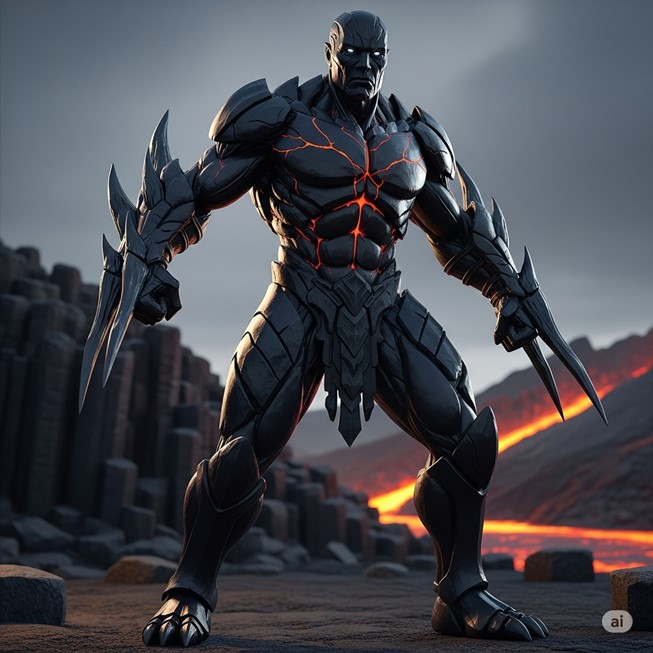
General Size
The Kwe-Sar undergo a significant physical change upon reaching adulthood. As children, they are small, typically standing between 3 and 4 feet tall. Upon reaching maturity, they experience a transformative growth spurt known as the “First Tempering,” rapidly growing to their full adult height, which averages between 5 ½ and 7 feet tall. Their bodies are dense and solid, and they weigh considerably more than a similarly sized humanoid of flesh and bone, typically between 300 and 500 pounds.
Body Pattern
The most defining characteristic of the Kwe-Sar is their transformative body. After their First Tempering, their physical form changes in response to significant life events, mastery of difficult skills, or deep devotion to their faith. This process is a slow, methodical shaping, not a random mutation. A Kwe-Sar’s body becomes a living chronicle of their deeds and identity.
- A warrior who has endured many battles may find their skin hardening into layered, basalt-like plates, with sharp, crystalline edges forming along their forearms and shins.
- A master smith’s hands and forearms might grow incredibly dense and heat-resistant, their skin taking on the texture of cooled magma.
- A powerful pyromancer devoted to Korrath may develop a network of glowing, lava-like veins that pulse beneath their surface when channeling magic.
- A practitioner of the Kwe-Va language might see crystalline structures form around their throat and chest that resonate faintly when they perform magical chants. These transformations are permanent marks of an individual’s journey, making each elder Kwe-Sar a unique work of living art that tells the story of their life.
Life Cycle
- Childhood (The Unformed): Kwe-Sar children are considered “Unformed.” Their bodies are a dull, matte grey color, and they lack the magical potential of adults. They attend compulsory education to learn the skills and discipline required for a productive life in Acheulean society.
- Adulthood (The First Tempering): When a Kwe-Sar becomes capable of reproduction, they undergo the First Tempering. This is a physically arduous and painful process lasting several days, during which they grow to their adult size and their body gains its polished, obsidian-like sheen. It is at the culmination of this process that their soul becomes capable of interfacing with gear to use magic.
- Maturity (The Long Tempering): The majority of a Kwe-Sar’s life is a continuous process of shaping and being shaped by their experiences. They can live for 400 to 500 years, their bodies becoming ever more intricate and specialized.
- Death (The Final Tempering): Upon death, a Kwe-Sar’s body does not decay. Following the rites of Acheuleanism, the body is brought to an Emberforge to be consumed by the flames, its essence returning to the volcanic ley lines of the island while their life’s story is preserved in a ceremonially crafted Soul Shard.
Potential Positives and Negatives
- Positives: Their dense, stone-like bodies provide exceptional natural resilience to physical damage, heat, and pressure. Their ability to physically adapt to their chosen profession gives them a significant advantage in their work. A warrior’s body becomes a weapon, while a craftsman’s becomes a set of perfect tools.
- Negatives: Their great weight and density make them less agile and almost entirely unable to swim. The processes of transformation are physically taxing. There is immense social pressure to have a well-tempered form; a Kwe-Sar with a plain, unadorned body may be viewed as lazy, unskilled, or lacking in significant life experience. Healing from severe wounds is a slow process akin to mending stone, often requiring specialized magical techniques or physical grafting.
Tags: Kwe-Sar, Living Obsidian, Volcanic Lifeform, Body Tempering, Physical Transformation, Living Chronicle, Stone Body, Geological Physiology, Acheulean Native, Thermal Sense, Lithic Resonance, Forge-Tempered, Korrath’s Chosen, Matrilineal Lineage, Obsidian Armor, Rune-Scribed Skin, Disciplined, Pragmatic Culture, Bio-Geological, Megalithic Being
Specialized Item Slots Available
Due to their unique physiology, the Kwe-Sar can utilize specialized gear slots that are part of their body.
- Core-Slot: A natural indentation in the center of their chest allows for the direct installation of a primary power source, such as a Forge Heart crystal or a magi-steam regulator. This item powers their most significant magical abilities and can influence the nature of their bodily transformations.
- Rune-Scribe Slots (4): They have four areas on their body—typically the back of the hands, the shoulders, the upper back, and the forehead—where their living-stone skin is perfectly suited for the direct inscription of Va-Shar magical runes. These function as permanent enchantment slots, allowing the Kwe-Sar to wear magical effects as tattoos carved into their very being.
Environmental Adaptability
Kwe-Sar are masters of hot, mountainous, and subterranean environments. Their thermal sense and lithic resonance make them perfectly at home in volcanic calderas, deep cave systems, and the industrial heat of a massive forge-city. Conversely, they are poorly adapted to extreme cold, which can make their bodies brittle, and are at a severe disadvantage in aquatic environments.
Other Information Important to This Race
The ruling family of Acheulean are Kwe-Sar whose bodies are legendary masterpieces of transformation. The Queen’s body is said to reflect the mastery of all the island’s major disciplines, with patterns that evoke the strength of a warrior, the precision of a craftsman, and the wisdom of a scholar, symbolizing her connection to all her people. As heredity is passed through the female line, the Queen’s daughters are watched closely as they mature, with their First Tempering and subsequent transformations seen as omens for the nation’s future. The appearance of a Kwe-Sar is their public history, a resume of deeds and skills worn for all to see, creating a society where respect is earned and visibly displayed.
Chronicle of the First Tempering
It is told, from carvings on stones whose edges have been worn by ages, a story from a time before time was struck. The telling is fractured, for the language of its first etching is a dust long scattered. In those days, the People of Stone, who are the Kwe-Sar, were not as they are. They were formed of a single, unchanging stone, a dull grey rock given life and thought, but no alteration. They were strong, yet static, their forms a single word spoken at their making. They lived upon the great land of Acheulean, which was then a younger, more violent place, its mountains breathing fire with greater fury.
The Forgemaster, the one who is Korrath, saw his children of stone and knew they were strong, but he also saw their strength was brittle, for what cannot change is destined only to break. He watched them hew the rock and shape the obsidian, their hands skillful but their forms unaltered by their labor. He saw them stand against the beasts of the savanna and the monsters from the deep caves, their forms taking wounds but learning no new shape from their victories. The Forgemaster was patient, for his work is the work of eons, and he waited for one of stone to ask not for a shield, but for the skill to become one.
Then came the Great Ashfall, a time spoken of in dread whispers, when the Great Fire Mountain, the very heart of the land, awoke in judgment. The ground did split, and from the fissures came beings of raw chaos and mindless flame, their forms ever-shifting, their heat a thing that could melt the unchanging stone of the Kwe-Sar. The People of Stone fought, but their bodies, when broken, were merely broken. They fell back to their megalithic cities, and despair, a feeling cold as quenched iron, began to settle in their hearts.
Among them was a carver, whose name is remembered as Kaelen. It is also written as Ka-Elun, the glyph’s true meaning is debated. This Kaelen, whose hands were the most skilled at shaping the hard rock, did not fall to despair. He went to his forge, which was but a humble place, and he knelt before its fire. He did not ask the Forgemaster to smite the flame-beings. He did not pray for walls of divine metal to shield his city. His voice, spoken in the old Kwe-Va of that era, was a low and resonant pitch, and he asked for one thing: the strength to make his own flesh into a tool and a weapon. He asked for his soul to become the hammer, and his body, the anvil. He asked to be tempered.
A silence fell upon the land, and the roar of the Great Fire Mountain seemed to listen. And from the fire in Kaelen’s own forge, a single spark, brighter than any sun and heavier than any mountain, did leap forth. It struck Kaelen in the chest, and the People of Stone who saw this believed him to be slain. But he was not. He rose, and the dull grey of his form was gone, replaced by the deep, polished black of true obsidian. A fire, like the heart of the volcano, now glowed within his chest. This was the First Tempering.
Kaelen walked out from the city gates, and the beings of raw chaos turned their fury upon him. The first, a thing of molten slag and cinders, struck him with a fiery claw. Where it struck his arm, the obsidian did not shatter. Instead, it sharpened, forming a blade of glass-hard stone. Kaelen struck back with this new weapon that was his own body, and the slag-beast was cleaved in two. He marched on, and a wave of pure heat washed over him. His skin did not melt. Instead, it hardened into interlocking plates like the basalt of the high cliffs. He faced the greatest of the fire-things, a monster whose roar was the sound of a continent breaking, and he endured its assault. His body was a chronicle of the battle, each blow forging him anew.
He fought his way to the heart of the Great Fire Mountain, to the very source of the Ashfall. There, he did not strike the mountain, for he was of the stone, and would not harm his kin. He used his tempered form, his blade-arms and his plate-skin, to redirect the flows of lava, to shore up the failing rock, and to seal the fissures that birthed the chaos-spawn. It was a labor of many days, a work of crafting on a scale no mortal had ever attempted. With every act of shaping the land, his own form became more intricate, more powerful, more perfectly suited to its task.
When the work was done and the mountain was quieted, Kaelen returned. He was not the same carver who had left. His body was a masterpiece of living armor and natural weaponry, his eyes glowing with the faint light of the forge-spark within him. He showed his people that their forms were not a prison of unchanging stone, but a potential waiting to be unlocked. The strength was not a gift he was given, but a reward he had earned through will, through labor, and through a desire not to be protected, but to become protection itself. From that day forward, the Kwe-Sar understood that the soul was the smith, and the body was the metal, and life was the long, arduous, and glorious process of the tempering.
The Moral of the Story: Your body is but the stone, your soul is the craftsman, and your life’s deeds are the shape you carve.
Comments
3 responses to “Kwe Sar of Acheulean”
[…] From: Kwe Sar of Acheulean […]
[…] From: Kwe Sar of Acheulean […]
[…] Form: Kwe Sar of Acheulean […]