
Lore: In the sprawling, mist-shrouded expanse of Aboriginal, an island nation stretching across 130720000 acres in Saṃsāra’s southern equatorial zone, the religion of Aboriginalism has flourished for over 5,000 years. The faith’s origins lie in the Dreamflood, a legendary event when Yirra, the Weaver of Dreams and Waters, emerged from the island’s endless rivers and subterranean aquifers to weave the first dreams into the fabric of the world. These dreams, carried on magical currents, summoned the earliest avatars—souls from the multiverse—whose arrival shaped Aboriginal into a land of lush jungles, cascading waterfalls, and floating cities.
Aboriginalism teaches that all life is a dream spun by Yirra, with Saṃsāra serving as the loom where souls are threaded and rethreaded through reincarnation. The deity’s waters, infused with high magic that ebbs and flows like weather, are believed to hold the memories of past lives, accessible to those who attune their “Mind’s Eye” to the currents. Early communities, scattered across the island like droplets from a storm, mastered the art of water-based magic, using steam derived from elemental fire and water to power their burgeoning society. This fusion birthed an industrial age of steam-driven mills, airships, and zeppelins, all guided by Yirra’s dreamlike vision.
Temples, called Dreampools, are built along rivers or atop floating platforms, where priests known as Waterdreamers conduct rituals involving the channeling of magical waters into steam engines and dream-weaving ceremonies. These rituals summon visions of past lives or future possibilities, aiding avatars in navigating their reincarnated journeys. The faith embraces Isekai characters, viewing their diverse memories as threads added to Yirra’s tapestry, enriching Aboriginal’s culture with tales of other worlds, from ancient realms to futuristic visions.
Aboriginal society blends Renaissance elegance with Middle-Ages resilience, its megacities rising from jungles and cave systems, connected by trade routes plied by steamships and griffon-riding couriers. The religion warns of the Dreamrift, a mythical calamity where unchecked ambition disrupted Yirra’s waters, causing floods that swallowed a forgotten city. This tale reinforces the balance between innovation and reverence, a principle upheld as Aboriginal exports water-crafted goods across Saṃsāra’s 73 island nations.
Personality of Yirra: Yirra is a fluid, enigmatic deity whose presence feels like the gentle ripple of a river or the sudden surge of a storm. They are nurturing yet unpredictable, weaving dreams that guide or challenge avatars with equal measure. Yirra appears in visions as a shimmering figure of liquid light, their form shifting between a serene water spirit and a towering wave, their voice a melodic murmur that echoes through the mind. They value harmony and intuition, rewarding those who flow with the currents of life, yet they grow restless with stagnation or greed, sending dreams of warning to redirect the faithful.
Yirra’s demeanor is compassionate but firm, teaching through trials that test an avatar’s ability to adapt. In myths, Yirra is depicted as a guide who leads lost souls to new shores, offering visions of their past lives to reveal their purpose. They are ever-present in Aboriginal’s waters, their essence felt in every droplet and steam plume, making followers feel connected to a vast, dreaming consciousness that shapes their destiny.
Traits
- Fluid: Yirra embodies adaptability, flowing around obstacles like water.
- Intuitive: The deity inspires insight through dreams and water-based visions.
- Nurturing: Yirra supports growth and renewal, fostering life and creativity.
- Unpredictable: Their moods shift like tides, bringing sudden inspiration or challenge.
- Harmonious: Yirra seeks balance between nature and industry, condemning excess.
Characteristics
- Domain: Dreams, water, reincarnation, intuition, steam industry.
- Alignment: Chaotic Good, reflecting Yirra’s free-flowing nature and care for the faithful.
- Favored Magic: Water-based magic, particularly hydromancy and steamcraft, used to manipulate currents and power machinery.
- Sacred Element: Water, with secondary ties to air (for dream travel) and fire (for steam).
- Manifestation: Yirra appears as a figure of liquid light, wreathed in steam, or as a ripple across water surfaces.
Attributes
- Strength: Moderate, capable of shaping rivers or lifting floating cities with magical currents.
- Perception: Keen, sensing the dreams and emotions within every soul.
- Intellect: Profound, with wisdom drawn from the multiverse’s collective memories.
- Agility: High, moving with the swiftness of water or the drift of clouds.
- Charisma: Captivating, drawing followers with visions of beauty and mystery.
Symbols
- Water Spiral: A carved spiral of flowing water, symbolizing the cycle of dreams and reincarnation, worn as amulets by devotees.
- Steam Lily: A flower-shaped steam vent, etched into temple floors, representing the fusion of magic and industry.
- Dream Orb: A translucent orb filled with swirling water, believed to capture Yirra’s visions, placed in Dreampools.
- Wave Crest: A stylized wave pattern, carved into airship hulls or zeppelin sails, signifying protection during travel.
- Broken Reed: A snapped reed stalk, a reminder of the Dreamrift, often set beside altars as a cautionary symbol.
Tags: High Magic, Steampunk, Hydromancy, Dreamweaving, Reincarnation, Watercraft, Industrial Harmony, Isekai Integration, Ritual Visions, Floating Cities, Water Magic, Dream Visions, Steam Navigation, Rebirth Cycles, Jungle Temples, Aquatic Trade, Intuitive Crafts, Floating Industry, Tidal Rituals
Positives of Aboriginalism
- Spiritual Insight: Aboriginalism offers followers access to dream visions through Yirra’s waters, providing guidance from past lives or future possibilities. This intuition aids avatars in decision-making, skill development, and understanding their reincarnated purpose, fostering personal growth.
- Cultural Diversity: The faith embraces Isekai avatars, integrating their memories and skills into its tapestry. This inclusivity enriches Aboriginal’s society with a blend of traditions, from jungle rituals to steam-powered innovations, strengthening cultural resilience.
- Industrial Innovation: The use of water-based magic and steam, derived from elemental fire and water, drives Aboriginal’s industrial economy. Steam mills, airships, and zeppelins enhance trade and travel, positioning the island as a key player among Saṃsāra’s 73 island nations.
- Environmental Harmony: The religion’s emphasis on balancing nature and industry ensures sustainable use of rivers and aquifers. Water magic purifies resources, supporting lush jungles and floating cities without ecological collapse, aligning with Saṃsāra’s magical ecosystem.
- Community Bonding: Rituals like dream-weaving ceremonies in Dreampools foster communal unity, as avatars share visions and collaborate on steam-powered projects. This strengthens social ties across Aboriginal’s diverse population, from cave dwellers to metropolis residents.
- Adaptive Resilience: Yirra’s fluid nature inspires adaptability, equipping followers to navigate Saṃsāra’s unpredictable magic flows and monster threats. This resilience is evident in the island’s ability to recover from natural disasters like floods or Dreamrift-like events.
- Trade Prosperity: Aboriginal’s mastery of watercraft and steam navigation supports a thriving trade network, exporting water-crafted goods like enchanted fabrics and steam engines. This economic success elevates the island’s influence and provides resources for its people.
- Healing Potential: Waterdreamers can use hydromancy to heal wounds or soothe minds, drawing on Yirra’s nurturing essence. This ability enhances community well-being, particularly in remote jungle or underwater population centers.
Negatives of Aboriginalism
- Unpredictable Visions: The dream visions, while insightful, can be erratic or cryptic, leading to misinterpretations that cause confusion or conflict among followers, especially those new to the faith or Isekai avatars unfamiliar with the practice.
- Resource Dependency: The reliance on rivers and aquifers for magic and steam power makes Aboriginal vulnerable to droughts or ley line disruptions, potentially crippling industrial and ritual activities if water sources falter.
- Overemphasis on Intuition: The faith’s focus on intuitive guidance over structured planning can hinder strategic efforts, leaving communities unprepared for sudden threats like monster incursions or political intrigue from rival nations.
- Risk of Stagnation: Yirra’s disapproval of greed can discourage ambition, causing some followers to avoid innovation or expansion, limiting Aboriginal’s growth compared to more aggressive island societies.
- Flood Hazards: The use of water magic, if mishandled, can trigger uncontrolled floods, echoing the Dreamrift legend. This risk requires constant vigilance, straining resources and expertise among Waterdreamers.
- Isolationist Tendencies: While inclusive, some Aboriginal communities prioritize their water-centric traditions, leading to tensions with outsiders or faiths that rely on different magical domains, such as stone or fire.
- Emotional Strain: The constant connection to past-life memories through dreams can overwhelm followers, causing psychological distress or identity conflicts, particularly for Isekai avatars with fragmented multiversal experiences.
Type of Temple: Aboriginal temples, known as Dreampools, are sacred sites built along the island’s rivers, atop floating platforms, or within cave systems, reflecting the religion’s deep connection to water and dreams. These temples serve as both spiritual centers and industrial hubs, blending worship with steam-powered craftsmanship. A typical Dreampool features the following:
- Structure: Constructed from water-resistant materials like reinforced wood or magically treated stone, Dreampools are often partially submerged or elevated on stilts. Floating temples drift on magical currents, anchored by steam-driven pulleys, while cave temples are carved into rock faces with natural water channels.
- Central Feature: A large, circular pool filled with glowing, magically infused water serves as the focal point, surrounded by steam vents arranged in steam lily patterns. This pool is used for dream-weaving rituals and to power steam engines that drive temple machinery.
- Magical Integration: Ley lines beneath the temple channel water magic to sustain the pool’s glow and fuel steam-driven tools, such as looms or airship engines. Waterdreamers maintain these lines to ensure a steady magical flow.
- Ritual Chambers: Adjacent rooms host dream-weaving ceremonies, where avatars submerge in the pool to receive visions, and workshops where steam-powered crafts like enchanted fabrics or water pumps are created as offerings to Yirra.
- Wave Crest Platforms: Elevated platforms, adorned with wave crest carvings, provide space for airship landings or griffon perches, facilitating pilgrimage and trade. Some temples feature underwater extensions for aquatic population centers.
- Accessibility: Dreampools are designed for communal use, with ramps or steam-lift systems to accommodate all avatars. Floating temples adjust their height with magical currents, ensuring accessibility during floods or low tides.
- Variations: Jungle Dreampools incorporate cascading waterfalls for enhanced rituals, while cave Dreampools use subterranean springs. Coastal temples harness tidal magic, with pools that ebb and flow with the sea.
Number of Followers: Aboriginalism is the predominant religion on the island nation of Aboriginal, which spans 130720000 acres and supports a population of approximately 26144000 avatars, estimated proportionally from Saṃsāra’s total population of 7 billion across 183 billion acres. Of these, about 45% of Aboriginal’s population, or 10,457,600 avatars, actively practice Aboriginalism. This figure reflects the faith’s deep cultural roots and its appeal to Isekai avatars who resonate with its emphasis on dreams and water. Beyond Aboriginal, the religion has gained traction among traders and navigators in other island nations, adding an estimated 4 million followers, bringing the total to approximately 14,457,600 across Saṃsāra.
The faith’s influence is strongest in major centers like the floating metropolis of Dreamtide, which houses the Grand Dreampool, a temple-city with over 8,000 resident Waterdreamers. Rural jungles and underwater settlements maintain smaller Dreampools, ensuring widespread access to worship. The religion’s adaptability to Isekai narratives sustains its growth, though its water-centric focus limits its spread compared to more universal faiths, with followers concentrated in regions with abundant water sources.
Beliefs of Aboriginalism: Aboriginalism holds that existence is a dream woven by Yirra, the Weaver of Dreams and Waters, with Saṃsāra serving as the loom where souls are crafted and recrafted through reincarnation. The core beliefs of its followers are as follows:
- Dreams as Divine Thread: All life is a dream spun by Yirra, with each soul a thread in a vast tapestry. The waters of Aboriginal, infused with high magic, carry the memories of past lives, and followers believe their purpose is to weave their current life into harmony with these memories.
- Reincarnation as Renewal: Death is not an end but a transition, with souls returning to Saṃsāra to be rethreaded into new avatars. Each life refines the soul’s pattern, guided by Yirra’s visions, until it achieves a state of perfect harmony worthy of merging with the deity’s dream.
- Intuition as Guidance: The “Mind’s Eye” allows followers to attune to Yirra’s waters, receiving dream visions that reveal past deeds, future paths, or hidden truths. These insights shape decisions, from crafting to combat, and are seen as direct communion with the deity.
- Balance of Nature and Industry: Aboriginalism teaches that steam, born from elemental fire and water, must harmonize with the natural world. Overuse of magic or resources risks disrupting Yirra’s currents, echoing the Dreamrift legend where ambition caused catastrophic floods.
- Integration of Isekai Souls: Isekai avatars, arriving from the multiverse, are welcomed as new threads in Yirra’s tapestry. Their diverse memories enrich the faith, provided they flow with its principles, fostering a culture that blends ancient rituals with foreign innovations.
- Fluidity as Virtue: Adaptability is sacred, reflecting Yirra’s fluid nature. Followers are encouraged to move with life’s currents, embracing change and overcoming obstacles, much like water shaping stone over time.
- Communal Dreamweaving: The faith emphasizes collective effort, with communities sharing visions during rituals to strengthen their shared destiny. Individual growth is tied to the group’s harmony, mirroring the interconnectedness of Yirra’s tapestry.
- Respect for the Waters: Rivers, aquifers, and rain are sacred, seen as Yirra’s lifeblood. Polluting or overharvesting these resources is forbidden, as it weakens the magical flow and invites the deity’s displeasure.
Regular Services: Regular services in Aboriginalism, known as Dreamflows, are held weekly in the Dreampools, the water-bound temples along Aboriginal’s rivers or floating platforms. These services combine spiritual reflection with steam-powered craftsmanship, reflecting the religion’s focus on dreams and industry. The structure and atmosphere of a typical Dreamflow are as follows:
- Setting: Services occur in the circular chambers of a Dreampool, where a glowing pool of magical water serves as the centerpiece, surrounded by steam vents arranged in steam lily patterns. The air hums with the rhythm of steam engines and the soft trickle of water, illuminated by natural light filtering through jungle canopies or cave openings.
- Participants: All avatars, from skilled Waterdreamers to novice dreamers, attend, bringing offerings like water vials or steam-crafted items. Isekai avatars contribute unique perspectives, enhancing the ritual’s diversity. Attendance varies from dozens in rural Dreampools to thousands in urban centers like Dreamtide’s Grand Dreampool.
- Ritual Structure:
- Opening Ripple: The service begins with a rhythmic tapping on the pool’s edge, creating ripples that symbolize Yirra’s presence. Waterdreamers lead a chant, its melody mimicking the flow of water, invoking the deity’s guidance.
- Communal Dreamweaving: Congregants submerge their hands or tools in the pool, attuning to its magical currents to receive visions. These dreams are shared aloud, guiding the group’s crafting or planning, while steam-driven looms or pumps are operated as acts of worship.
- Vision Ritual: A Waterdreamer channels hydromancy to enhance the pool’s glow, projecting collective visions onto the steam rising from vents. These images, ranging from past-life memories to future warnings, are interpreted to align the community’s path with Yirra’s will.
- Teaching of the Wave: A Waterdreamer recites a parable or lesson from Aboriginal lore, often drawn from the Dreamrift or tales of Isekai arrivals, emphasizing fluidity, balance, or intuition. Foreign stories from other worlds may be woven in if relevant.
- Steam Offering: The service ends with a release of steam from the temple’s vents, forming a wave crest pattern. Followers place water-filled orbs, inscribed with personal dreams, into the pool, believed to carry their intentions to Yirra through the currents.
- Duration and Frequency: Dreamflows last 2–3 hours, held every seventh day to align with the ebb and flow of Aboriginal’s magical waters. Major festivals, like the Tideweave, replace regular services with multi-day events involving competitive steamcraft and vision quests.
- Atmosphere: The mood is serene yet industrious, filled with the hum of steam engines, the splash of water, and the murmur of shared dreams. Participation is active, with no passive observation, reflecting the belief that worship is a dynamic flow.
- Variations: Jungle Dreampools use waterfall cascades to amplify rituals, while cave Dreampools harness subterranean springs. Floating temples adjust their ceremonies with tidal magic, incorporating the sea’s rhythm.
Funeral Rites: Funeral rites in Aboriginalism, known as the Thread Unraveling, are gentle ceremonies that honor the deceased’s soul as it prepares for reincarnation. These rites reflect the faith’s belief in the soul as a thread returning to Yirra’s loom. The process is as follows:
- Preparation of the Body: The deceased is cleansed with magical water from a Dreampool, wrapped in fabric woven with wave crest patterns, symbolizing their life’s flow. The body is placed on a floating bier within the temple, surrounded by offerings of steam-crafted items or water orbs from their life.
- Dream Thread Ritual: The core of the rite involves crafting a Dream Thread, a thin strand of water-infused fiber spun during the ceremony. Family and friends contribute to the weaving, using steam-powered looms guided by a Waterdreamer. The thread is believed to capture the soul’s essence, preserving its pattern for the next life.
- Hydromantic Release: The Waterdreamer channels ley line energy to infuse the Dream Thread with magic, causing it to glow faintly and dissolve into the pool. This release is seen as the soul’s return to Yirra’s currents, with a brief vision of the deceased’s next form sometimes appearing in the steam.
- Water Return: The body is not buried but dissolved using hydromancy, its essence merging with Aboriginal’s rivers or aquifers. The Dream Thread’s remnants are released into the pool, carried by the current to a communal Water Vault, a submerged chamber where threads are stored as a collective offering to Yirra.
- Steam Ascension: A burst of steam rises from the vents, forming a wave crest pattern, symbolizing the soul’s ascent into Yirra’s dream. Mourners hum a melody mimicking water’s flow, wishing the soul strength in its next weaving.
- Mourning Period: For seven days, the deceased’s community refrains from new dream-weaving, instead maintaining existing steamcraft (like airships or looms) in their honor. This period, called the Still Current, reflects respect for the soul’s transition.
- Variations: Jungle communities may release Dream Threads into waterfalls, while cave settlements embed them in spring-fed pools. Coastal temples use tidal currents, with threads carried out to sea. Isekai avatars may request elements of their past world’s traditions, such as specific weaves, if they align with Yirra’s principles.
- Cultural Significance: The Thread Unraveling emphasizes continuity, not loss. The Dream Thread ensures the deceased’s legacy endures, and the lack of a permanent grave reflects the belief that the soul will return to Saṃsāra. Exceptional souls, believed to have achieved harmony with Yirra, have their threads placed in the Grand Dreampool of Dreamtide, a rare honor.
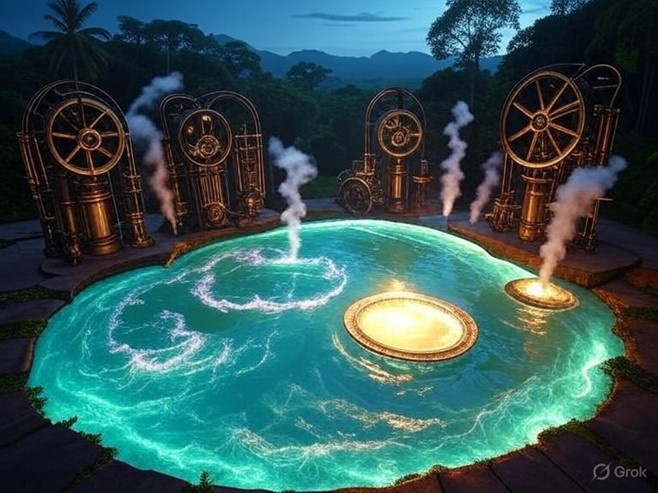
Defensive Uses of Yirra’s Magical Power
Yirra’s dominion over water, dreams, and fluidity lends itself to a variety of defensive applications, harnessing the deity’s nurturing yet unpredictable nature and the magical currents that flow through Aboriginal’s rivers and aquifers. These defenses are typically enacted by Waterdreamers, priests trained in hydromancy, or skilled avatars wearing gear attuned to Yirra’s essence, such as water-infused armor or steam-powered devices.
- Water Wall Barrier: Waterdreamers can channel ley line energy to raise towering walls of magical water from rivers or pools, forming protective shields around settlements or Dreampools. These walls shimmer with dreamlike hues, deflecting projectiles and magical assaults, their fluidity allowing them to reshape and absorb impacts for a sustained defense.
- Dream Mist Veil: By infusing steam with hydromantic magic, defenders can release thick, disorienting mists that obscure visibility and induce dreamlike confusion in attackers. This veil, drawn from temple vents or portable steam devices, allows Aboriginal forces to reposition or evade, with the mist occasionally projecting illusory decoys to mislead foes.
- Floating Fortress: Floating cities or platforms can be reinforced with water magic, creating buoyant barriers of liquid that rise to protect against aerial or naval assaults. These fortifications, powered by steam-driven pulleys, adjust their height and density, offering mobile defense against griffon riders or airships.
- Healing Currents: Waterdreamers can summon gentle streams of magical water to heal wounds or restore stamina among defenders. These currents, drawn from Dreampool pools, flow over allies, soothing injuries and boosting morale, particularly effective in prolonged sieges or monster encounters.
- Tidal Surge Shield: Along coastal Dreampools, tidal magic can be harnessed to create temporary surges that wash back invaders or cushion impacts. This defensive surge, guided by Yirra’s will, recedes harmlessly for allies but disrupts enemy formations, requiring precise timing with natural tides.
- Dream Ward: During critical defenses, Waterdreamers can weave protective wards from dream visions, projecting intangible barriers that repel weaker magical attacks or psychic intrusions. These wards, visible as shimmering water patterns, draw on the collective dreams of the community for strength.
Offensive Uses of Yirra’s Magical Power
Yirra’s intuitive and harmonious nature translates into offensive capabilities that emphasize fluid, adaptive strikes and the manipulation of the battlefield. These applications rely on the deity’s agility and intellect, channeled through Waterdreamers or avatars with offensive gear, such as steam-powered water cannons or dream-infused weapons.
- Water Jet Barrage: Waterdreamers can propel high-pressure streams of magical water from rivers or steam devices, cutting through armor or sweeping enemies off their feet. These jets, enhanced by ley line energy, can be directed with precision, targeting weak points in fortifications or clustered foes.
- Dream Daze Assault: Offensive use of dream magic involves projecting disorienting visions into enemies’ minds, causing confusion or fear. Delivered through water mist or direct hydromantic contact, this tactic disrupts coordination, making opponents vulnerable to follow-up attacks from steam-powered weapons.
- Steam Blast Wave: By combining elemental fire and water magic, Waterdreamers can unleash scalding steam blasts from temple vents or handheld devices. These waves, infused with magical heat, burn exposed skin and melt weaker defenses, with range and intensity adjusted by steam circuits.
- Tidal Wave Strike: In coastal or riverine battles, Waterdreamers can summon controlled tidal waves to crash over enemies, sweeping them away or flooding their positions. This powerful technique, drawn from Yirra’s currents, requires significant ley line energy and risks collateral damage if unchecked.
- Water Whip Lash: Avatars with water-infused gear can form flexible whips of magical water, striking with force or entangling foes. These whips, powered by steam-driven mechanisms, can extend or retract, ideal for close combat or disabling enemy machinery.
- Dreamthread Traps: Waterdreamers can weave dream-infused threads into the environment, creating invisible snares that bind or disorient enemies. These traps, activated by contact, project nightmarish visions, slowing or incapacitating foes while allowing Aboriginal forces to maneuver.
- Aquatic Ambush: Underwater population centers can launch surprise attacks using submerged water currents to propel warriors or steam-powered torpedoes. This tactic, guided by Yirra’s fluidity, exploits the element of surprise against surface-based enemies.
Additional Considerations
The use of Yirra’s magical power for defense and offense is governed by the deity’s principles of harmony and balance. Offensive actions must protect the faithful or assert Aboriginal’s interests without disrupting the natural flow of waters, as greed or excess risks Yirra’s withdrawal of favor, potentially weakening magical effects or causing floods. Defensive applications are more readily blessed, reflecting the deity’s nurturing instincts, though they require sustained magical currents from ley lines, which can be disrupted by enemy interference or drought.
Waterdreamers and avatars rely on gear—such as water-infused armor, steam-powered pumps, or dream-orb staves—to amplify Yirra’s power, with effectiveness tied to the wearer’s skill and training. The integration of Isekai avatars with combat or navigational experience from other worlds enhances these tactics, introducing new strategies while adhering to Aboriginal methods, such as adapting telepathy to coordinate underwater assaults or combining foreign engineering with steam blasts.
The scale of these magical applications varies by context. Small skirmishes might involve a single Waterdreamer raising a water wall or launching a jet, while large-scale conflicts, such as defending Aboriginal from a rival navy, could see multiple Dreampools channeling currents to create tidal surges, deploy mist veils, and unleash wave strikes. The steampunk aesthetic of steam and mechanical power transmission systems, like gears and pulleys, complements these magical efforts, ensuring a seamless blend of fluidity and industry on the battlefield.
Dreamrift and City of Lost Waters
In epochs shrouded by mists older than the stones of Aboriginal, a tale was sung in broken cadences, its words wrested from a tongue so ancient it crumbled like dry leaves underfoot. This saga, etched into the memory of those who revere Yirra, the Weaver of Dreams and Waters, speaks of the Dreamrift, a calamity that swallowed a city whole, its echoes rippling through the rivers of time. Passed down from Waterdreamer to weary traveler, the story, warped by the ages as if scribed in a forgotten script, warns of the perils of straying from the deity’s flow.
Long ago, when the jungles of Aboriginal were young and the floating cities danced on untested currents, there rose a settlement called Mirravane, a jewel nestled where river met cavern. Its people, avatars plucked from the multiverse’s vast weave, were skilled in hydromancy, their hands shaping water into steam that powered mills and airships. The Dreampools glowed with Yirra’s magic, their waters whispering dreams of past lives, guiding the faithful to craft a life of harmony. Mirravane grew rich, its trade ships sailing far, its zeppelins soaring high, all fueled by the endless flow of the island’s aquifers.
Yet, in the hearts of Mirravane’s elders, a thirst grew, not for water but for power beyond Yirra’s dream. They gathered in the Grand Dreampool, their robes adorned with wave crest patterns, their voices a murmur like the rush of a flood. In a language half-lost, they spoke of bending the waters to their will, of weaving dreams not for guidance but for dominion. They devised a great work, a steam engine vast as a mountain, its gears turned by magical currents drawn from the deepest ley lines. This engine, they named Vyrthul, meaning “Heart of the Tide” in the old tongue’s fractured form, promising to lift Mirravane above all other lands.
For cycles unnumbered, they labored, their steam-driven looms humming, their hydromantic spells pulling water from rivers and springs. The engine rose, a marvel of brass and crystal, its pistons pulsing with a rhythm that rivaled the heartbeat of the earth. Waterdreamers chanted, their “Mind’s Eye” straining to thread the ley lines into the machine, believing it would bind Yirra’s power to their command. When the final bolt was fixed, a steam lily wreath rose, and Vyrthul roared to life, its steam plumes reaching the sky, its waters glowing with a fierce light. The people rejoiced, their pride swelling like a tide, for they thought they had tamed the Weaver’s dream.
But Yirra, whose essence flowed in every droplet, watched with eyes of liquid light. The deity’s will, vast as the ocean’s depths, felt the discord, the intent not of harmony but of mastery. In the night, as Mirravane slept beneath a sky of restless clouds, a vision came to the high Waterdreamer, a dream of waters rising and steam turning to chaos. The priest awoke, his cry drowned by the engine’s hum, and sought to halt the celebration. Yet the people, drunk on their triumph, turned away, their hearts deaf to the warning.
On the morn of the thirteenth day, as the Tideweave festival began, Vyrthul was unveiled before the gathered masses. Its form gleamed, its steam wreath spiraling high, and the crowd sang with joy. But then, a shadow fell, not of cloud but of will. The engine’s pistons faltered, its waters churned, and a groan like a breaking wave filled the air. The ley lines, overtaxed by the elders’ greed, ruptured, and the Dreamrift was born. From the Grand Dreampool surged a flood, not of cleansing but of wrath, its waters dark with broken dreams.
The flood swept through Mirravane, its streets becoming rivers, its spires sinking into the mire. Steam hissed and died, airships crashed, and the people fled, their cries mingling with the roar of the tide. The Waterdreamers fought, their hydromancy raising mist veils and water walls, but the flood’s power, fueled by their own ambition, overwhelmed them. Vyrthul, its heart cracking, unleashed a final burst of steam that shattered its frame, its pieces sinking into the deluge. For seven days and nights, the waters raged, swallowing Mirravane whole, leaving only a crater where the city once stood, its depths now a silent pool reflecting the sky.
When the flood receded, Mirravane was gone, its people scattered like droplets on the wind, some borne to other islands by griffons, others lost to the jungle’s embrace. The crater became a sacred site, its waters still, its surface etched with the scars of that day. The tale spread, carried by steamship crews and dream-weavers, its words twisted by time into a caution. The Waterdreamers rebuilt, their Dreampools smaller, their works humbler, and in every temple, a broken reed stands, a reminder of Mirravane’s fate.
The moral of the story is that to force the Weaver’s waters against their flow invites the Dreamrift, for harmony with Yirra’s dream is the only path to endure.
Comments
One response to “Aboriginalism The Faith of Yirra”
[…] From: Aboriginalism The Faith of Yirra […]