
Species
The Nga-Tara are the predominant race of avatars on the island nation of Aboriginal, a sprawling 130,720,000-acre land in Saṃsāra’s southern equatorial zone. As the ruling matriarchal family and the cultural backbone of the Nga-Vara society, the Nga-Tara are revered as embodiments of the island’s ancient traditions, blending multiversal memories with the primal magic of Aboriginal’s rivers, jungles, and caves. Their form and culture reflect the island’s heritage, shaped by the Dreamweave era when souls from the multiverse merged with the land’s magical currents, creating a race uniquely attuned to water, earth, and steam.
Physical Form and Sensory Traits
The Nga-Tara are towering, bipedal humanoids with robust, elephantine features adapted to Aboriginal’s high-magic environment. Their thick, wrinkled skin ranges from deep gray to earthen brown, often shimmering with faint magical luminescence when exposed to water or steam. A prominent trunk, flexible and muscular, extends from their face, capable of delicate manipulation or powerful grasping, used for tasks from crafting to channeling hydromantic magic. Broad, fan-like ears, etched with vein-like patterns resembling river systems, provide acute hearing, detecting subtle vibrations in water or air, including the hum of magical ley lines. Their eyes, large and expressive, glow softly in low light, granting enhanced vision in the dim jungles or subterranean caves. Tusks, varying from short and curved to long and spiraled, protrude from their upper jaw, often inscribed with Vo-Run glyphs to amplify magical resonance. Their hands, with four thick fingers, are surprisingly dexterous, suited for intricate steamcraft and ritual weaving.
The Nga-Tara’s sensory traits are heightened by their “Mind’s Eye,” a cultural and magical focus that enhances their perception of dreams and magical currents. Their trunk can sense chemical traces in water or air, akin to a heightened olfactory sense, allowing them to detect environmental shifts or magical disturbances. Their skin, sensitive to humidity and temperature, aids in navigating Aboriginal’s fluctuating magical weather, while their ears pick up low-frequency sounds, such as distant monster movements or steam engine rhythms.
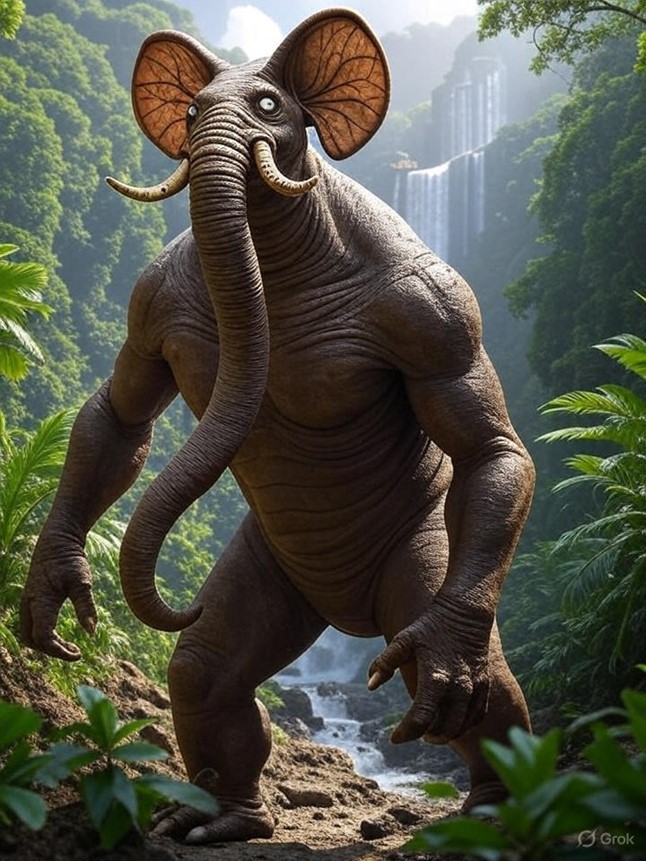
General Size
Nga-Tara stand between 8 and 10 feet tall, with males averaging slightly shorter than females, who dominate the matriarchal hierarchy. Their broad, muscular frames weigh between 800 and 1,200 pounds, with a dense bone structure supporting their mass. Their size grants them physical strength but requires significant resources for sustenance, often met through communal farming and magical water purification. Children are born smaller, around 3 feet tall and 100 pounds, growing rapidly until reaching adulthood at reproductive maturity, typically around 15 years.
Body Pattern
The Nga-Tara’s skin displays intricate, natural patterns resembling rippling water or coiled vines, which glow faintly when channeling magic through their gear. These patterns, unique to each individual, are believed to reflect their reincarnated soul’s history, with more complex designs indicating multiple past lives. Their tusks and ears often bear cultural markings, such as Vo-Run carvings or steam lily motifs, etched during coming-of-age ceremonies. Their robust limbs and wide feet, adapted for stability in jungles or on floating platforms, are adorned with tattoos or gear inlaid with wave crest symbols, signifying their connection to Yirra, the Weaver of Dreams and Waters.
Life Cycle
Nga-Tara reach adulthood at reproductive maturity, around 15 years, when they gain access to magic through trained skills and gear. Before adulthood, they are mundane, without magical abilities, and are protected under Saṃsāra’s laws, which deem harming a non-magical child a heinous crime. Their lifespan averages 120 years, with elders often serving as Waterdreamers or matriarchal leaders. Reproduction follows a matrilineal tradition, with females passing down cultural and magical knowledge. Upon death, their souls are believed to return to Yirra’s loom for reincarnation, a process honored through the Thread Unraveling funeral rite, where their essence is dissolved into Aboriginal’s waters. Aging Nga-Tara retain physical strength but may experience reduced magical potency unless supported by high-tier gear.
Potential Positives and Negatives Due to Physical Form
Positives:
- Physical Strength: Their massive size and muscular build allow Nga-Tara to perform heavy labor, such as operating steam-driven machinery or defending against monsters, with ease.
- Enhanced Senses: Their acute hearing, chemical-sensing trunk, and glowing eyes provide superior awareness, aiding in navigation, crafting, and detecting threats in Aboriginal’s dense environments.
- Magical Resonance: Their skin and tusks amplify hydromantic and steam-based magic when paired with gear, making them potent practitioners of Aboriginalism’s rituals.
- Cultural Authority: As the ruling race, their imposing presence reinforces their leadership in the matriarchal monarchy, fostering unity and respect among the Nga-Vara.
- Environmental Adaptability: Their thick skin and sensory traits suit Aboriginal’s jungles, caves, and aquatic regions, allowing them to thrive in diverse settings.
Negatives:
- Resource Demands: Their large size requires substantial food and water, straining communal resources during droughts or ley line disruptions.
- Mobility Challenges: Their bulk can hinder agility in tight spaces, such as narrow cave tunnels or crowded urban markets, limiting maneuverability in combat or travel.
- Magical Dependency: Their magical potency relies on gear and training, leaving untrained Nga-Tara vulnerable in high-magic conflicts.
- Social Pressure: As the ruling race, Nga-Tara face expectations to uphold cultural traditions, which can strain Isekai members with conflicting past-life identities.
- Heat Sensitivity: Their thick skin, while protective, can overheat in intense tropical conditions, requiring frequent hydration or cooling magic.
Tags: Nga-Tara, Aboriginal, Elephantine, Hydromancy, Steamcraft, Matriarchal, Water-Magic, Jungle-Dwellers, Floating-Cities, Vo-Run, Tusked, Luminescent-Skin, Dreamweaving, Water-Sensitive, Steam-Powered, Monarchy, Isekai, Reincarnation, Cave-Adapted, Magical-Gear
Specialized Item Slots Available
Nga-Tara avatars utilize specialized gear slots to channel their magical tiers (Tier 1: 40%, Tier 2: 20%, Tier 3: 10%, Tier 4: 5%, Tier 5: 2%), as magic is not innate but derived from trained skills and equipment. Their unique physiology allows for the following item slots:
- Tusk Inlays: Glyph-carved tusk covers or inlaid Vo-Run runes amplify hydromantic spells or steamcraft, enhancing magical output (e.g., boosting water jet barrages or dream wards). Limited to two slots (one per tusk).
- Trunk Bracer: A steam-powered bracer worn around the trunk, equipped with nozzles or magical circuits, enables precise water or steam manipulation, such as water whip lashes or mist veils. One slot.
- Ear Pauldrons: Lightweight, wave-crest-patterned pauldrons fitted over the ears enhance auditory perception and protect against sonic attacks, often doubling as magical amplifiers for dream-weaving rituals. Two slots (one per ear).
- Chest Harness: A broad, water-infused harness across the torso stores magical energy or steam, powering high-tier abilities like tidal wave strikes or healing currents. One slot.
- Ankle Gauntlets: Reinforced bands around the lower legs, embedded with steam-driven pulleys, boost stability and strength for heavy lifting or combat in unstable environments like floating platforms. Two slots (one per ankle).
- Orb Belt: A belt holding dream orbs, translucent spheres filled with magical water, used to store visions or power rituals. Can hold up to four orbs, each functioning as a single-use magical focus.
These slots, combined with trained skills, determine the Nga-Tara’s magical tier, with higher tiers requiring more complex gear and extensive training. Gear is often crafted in Dreampools, using steam-powered looms and hydromantic enchantments, and inscribed with Ngara-Vo’s Vo-Run script for potency.
Environmental Adaptability
The Nga-Tara are exceptionally adapted to Aboriginal’s diverse environments, thriving in its jungles, rivers, caves, and coastal regions. Their thick skin resists humidity and minor injuries from jungle flora or coral, while their trunk’s chemical sensitivity detects water purity, aiding survival in aquatic settlements. Their large feet provide stability on floating platforms or muddy jungle paths, and their glowing eyes excel in low-light cave systems. In coastal areas, they use hydromancy to navigate tidal shifts, and their steam-powered gear mitigates the strain of tropical heat. However, they struggle in arid regions or during droughts, as their magical and physical vitality depends on abundant water sources. Their size limits agility in dense urban settings or narrow cave passages, requiring careful navigation or magical assistance via levitation gear.
Other Important Information
The Nga-Tara dominate Aboriginal’s matriarchal monarchy, with the High Matriarch and her female lineage ruling from Vara-Sul, the coastal capital housing over 10 million avatars. Their cultural prominence stems from their alignment with Aboriginalism, the Faith of Yirra, which 45% of the population (10,457,600 avatars) practice, plus 4 million external followers. As the ruling race, they oversee the monarchy’s land ownership, collecting taxes to fund roads, steam-powered public works, and a military equipped with water-jet cannons and airships. Their society encourages Isekai avatars to join if their past-life cultures resemble Aboriginal’s water-centric traditions, offering coin (10 Copper = 1 Silver, 10 Silver = 1 Gold, etc.) as incentives. Nga-Tara children attend compulsory schools until adulthood, learning Ngara-Vo, hydromancy, and steamcraft, with curricula emphasizing the island’s history and Yirra’s teachings. Their lavish gear, resembling elaborate costumes, serves as both magical conduits and cultural expressions, making daily life a vibrant display of Nga-Vara heritage. The Nga-Tara coexist with sentient non-human civilizations, such as water-serpents or coral-beings, trading enchanted goods or competing for resources. Their resilience against Aboriginal’s monsters, like jungle hydra, relies on their strength and magical gear, though their size makes them prime targets in open conflicts.
Saga of Vara-Khul
Dream-Tusked Wanderer
In times long faded, when mists clung thick to earth of Aboriginal, and rivers sang with voices not of man, there come tale of Vara-Khul, great one of Nga-Tara kind. Words twist from tongue old as stone, carved by hands forget, speak of him born where water fall crash and jungle breath magic deep. He, with skin like earth wet and tusks spiral high, glow with light of dream-water, say to be child of Yirra, Weaver of All. Elders murmur he come from beyond stars, soul thread pull from multiverse loom, first of his blood to walk island green.
Vara-Khul grow strong, trunk lift stone and ear hear whisper of ley line hum. People of jungle, Nga-Vara, look to him with awe, call him Dream-Tusked for visions dance in water pool when he near. He learn way of steam, fire and water mix in engine roar, and craft gear shine with Vo-Run mark. But heart restless, seek meaning past life memory, see shadow city sink in flood old. One day, he hear call soft, like wave on shore, from cave dark where spring glow. There, Yirra speak in ripple voice, say, “Go seek root of dream, find balance lost.”
Vara-Khul journey long, foot heavy on floating stone, airship hum with steam lift. He meet beast of water, serpent wise with coral crown, trade tale for path. Serpent say, “Deep cave hold heart of tide, but greed break it once.” He go, trunk sense danger, ear catch echo of cry old. In cave, find ruin of Mirravane, city drown, where engine Vyrthul lie broke, brass twist like root dead. Water rise, steam hiss, and ghost of elders past wail, “We take too much, now lost.”
Vara-Khul, with “Mind’s Eye” open, see vision—elders force water against flow, build engine vast to rule, not serve. Yirra weep, flood come, city fall. He touch ruin, trunk glow, and water calm. He speak Vo-Kara, word of power, pull steam gentle, mend ley line tear. But shadow rise, monster of rift, scale black and eye fire, guard old sin. Fight long, tusk clash, water whip lash, steam blast wave. Vara-Khul fall, rise, fall again, till dream-orb in belt shine, show past life strength. With last breath, he bind monster in thread dream, sink it deep.
People find him still, trunk rest on stone, tusks mark with glyph new. Water flow pure, cave breath life again. Matriarch, woman tall with ear wide, take his gear, say, “He give balance back.” Tale spread, twist by wind and wave, sing in Dreampool chant. Some say he rise again, thread weave new, others say his tusk stand as broken reed, warn all.
The moral of the story is that to pull against the Weaver’s current bring ruin, but to flow with dream and water bring life anew.
Comments
3 responses to “Nga Tara Race of Aboriginal”
[…] See: Nga Tara Race of Aboriginal […]
[…] From: Nga Tara Race of Aboriginal […]
[…] From: Nga Tara Race of Aboriginal […]