
Lore In the rolling hills and steppe lands of the Anatol Protectorate, the people’s wealth is measured in their flocks. They are master shepherds and leatherworkers, and their lives are deeply intertwined with the animals they tend. Long ago, a furrier named Ismail was so skilled that his work was sought by sultans and merchants from floating cities. His rivals grew deeply envious, and soon, a curse of the evil eye—the nazar—fell upon him. His tools would slip, his finest hides would inexplicably tear, and his hands would cramp. Desperate, he sought the counsel of a wise hoca, a woman who understood the old ways. She prepared for him not a weapon, but a charm. She took a scrap of leather from Ismail’s own workbench, and within it, she sealed a prayer written on paper, a pinch of sacred dust, and the wisdom of dreams. She attached a small blue eye to ward off envy and a wolf’s claw for strength. This muska did not make Ismail stronger or faster, but it soothed the spirits of the hides he worked and turned aside the envious glances of his rivals, allowing his skill to flourish once more, protected and unhindered.
Description This item is a small, tightly-sealed triangular packet made from expertly tanned, soft doe-skin leather and stitched with waxed sinew thread. It is clearly old, the leather worn smooth from years of handling. Pinned to the front of the muska is a tiny, glass Nazar Boncuğu—the iconic blue and white evil eye bead—which seems to watch its surroundings. A small, polished claw from a mountain cat is tied to the bottom corner with a thin leather cord. The muska feels warm to the touch and emits a faint, pleasant scent of worn leather and old paper.
Detailed Stats
- Type: Magical Charm
- Rarity: Common
- Required Tier: 1
- Weight: Negligible
- Material: Tanned Leather, Paper, Ink, Glass Bead, Cat Claw
Passive Magic
- Nazar Ward: The blue eye bead on the muska constantly watches for ill will. The wearer is passively protected from minor curses and the effects of envy. This grants a slight advantage on checks made to resist social debuffs or magic born of jealousy or spite.
- Spirit’s Peace: The prayers sealed within the muska soothe the lingering spirits of the animals whose hides the wearer works with. Pelts and leathers handled by the wearer become exceptionally supple and easy to work with. This provides a minor, circumstantial bonus to any crafting checks involving fur, leather, or hide.
Activable Magic
- Whisper of Quality: Once per day, the wearer may press the muska against a fresh, raw hide and whisper a short prayer into it, asking for the animal’s spirit to rest and for its hide to find a noble second purpose. The hide becomes blessed, making it immune to being accidentally ruined by a mundane crafting error. This allows the crafter to ignore a single non-critical failure during the tanning or crafting process for that specific hide.
- Trace the Gaze: Once per day, if the wearer suspects a recent misfortune was the result of nazar, they can hold the muska and concentrate on the event. The Nazar Boncuğu will grow noticeably warm when the wearer is facing the cardinal direction from which the envious gaze originated. This does not reveal the individual, only the general direction of the source of the ill will.
Specific Slot: Chest (traditionally pinned over the heart)
Tags: Utility, Protective, Crafting, Divination, Worn, Turkish-inspired, Charm, Artifact, Racial, Reputation, Wealth, Ritual, Triggered, Verbal, Somatic, Light, Darkness
The Turkish Muska 581 of the Skinner is a specialized item of folk magic. Its availability and the nature of its sale would vary greatly depending on the location and the type of merchant.
1. The Source: An Anatolian Market Stall
- The Shop: This is not a formal shop but the humble market stall of a community hoca or a wise elder in a town within the Anatol Protectorate. The stall is simple, perhaps just a rug laid on the ground, covered with various herbs, handwritten prayers, and a small selection of protective charms. The air around it smells of dried sage, ink, and old parchment.
- The Transaction: The process is personal and ritualistic. The hoca will not simply sell the muska; they will speak with the buyer to understand their need. They may ask about the buyer’s trade and their heart to ensure the charm is going to a worthy individual. The sale is a spiritual consultation. The price is often specific, believed to hold numerological significance. The hoca would explain the proper way to care for the muska and the importance of showing respect to the spirits.
- Cost: 9 Silver and 2 Nickel. The cost is less about market value and more about a balanced offering. The buyer is paying for the prayer, the ritual, and the spiritual protection embodied in the item.
2. The Professional: An Artisan’s Guild Supplier
- The Shop: A large, well-organized supply house located in a major city’s crafting district. The shop caters to professional artisans and sells everything from rare woods to masterwork tools. The muska would be found in a small, specialized section under a sign that reads “Metaphysical Crafting Aids” or “Talismanic Tools.”
- The Transaction: The sale is a professional one between craftsmen. The merchant, likely a retired master furrier themselves, understands the item’s practical value. They would use their Mind’s Eye and say, “A Skinner’s Muska. A fine choice. It will keep the hide’s spirit calm and your competitor’s envy from fraying your stitches. A must-have for any serious leatherworker aiming for master-tier quality.”
- Cost: 2 Gold pieces. The price reflects its value as a professional tool that protects a craftsman’s livelihood and improves the quality of their finished product, making it a sound investment.
3. The Traveler: A Caravan Merchant’s Tent
- The Shop: A chaotic and colorful tent in a sprawling trade bazaar on the outskirts of a port city. The merchant is a well-traveled individual who brings goods from distant lands. The muska would be hanging on a string alongside dozens of other charms, beads, and trinkets from various cultures, its specific purpose likely unknown to the seller beyond it being a “good luck charm from the Anatol plains.”
- The Transaction: This is a fast-paced, commercial haggle. The merchant will emphasize its exotic nature and its general protective qualities against the evil eye. “Ah, a real Anatolian charm! Very powerful, wards off all bad spirits! For you, my friend, a special price.” They rely on the buyer’s desire for an authentic, foreign object.
- Cost: The starting price would be high, perhaps 1 Gold and 4 Silver. A savvy buyer with a good bartering skill could likely purchase it for around 1 Gold, or slightly less. The final price depends entirely on the buyer’s and seller’s negotiating skills.
4. The Collector: A Relic and Curio Shop
- The Shop: A quiet, dusty, and high-end shop in a wealthy part of a metropolis. The proprietor is more a historian and collector than a simple merchant. The muska would be presented under a glass dome on a velvet cushion, with a small, hand-written placard detailing its cultural origin and likely age.
- The Transaction: The exchange is academic and formal. The shopkeeper will speak at length about the specific traditions of the Ukiuk people, the symbolism of the triangular shape, and the likely prayers sealed within. They are selling a piece of authentic cultural heritage, not just a magic item. The buyer receives a certificate of authenticity with the purchase.
- Cost: 2 Electrum and 5 Silver. The price is high, not because of its magical power, but because of its validated provenance, its story, and its status as a genuine cultural artifact.
The Turkish Muska 581 of the Skinner is an item of subtle influence, spiritual protection, and craftsmanship. Its use in “defense” and “offense” is rarely physical, focusing instead on the social, professional, and spiritual conflicts that a master artisan might face.
1. In an Artisan’s Guildhall or Workshop
This is the item’s most natural environment, where professional jealousy can be as sharp as any blade.
Defensive Roleplay:
- Scenario: A rival furrier, envious of your rising fame, constantly finds ways to criticize your work in front of the guild master, hoping their negativity will make you doubt yourself and falter.
- How it’s used: As the rival approaches, you feel a faint, reassuring warmth from the muska pinned to your chest—the Nazar Ward at work. Their spiteful words, meant to sting and distract, feel distant and hollow. The charm is not a wall, but a filter, protecting your confidence and focus from their venom. You might subtly touch the muska, a small, grounding gesture, before calmly and professionally defending the quality of your work, your spirit unruffled by their envy. The defense is maintaining your composure and professional integrity against psychological attacks.
Offensive Roleplay:
- Scenario: You have just finished a masterwork piece of leather armor, but you discover a small, almost unnoticeable flaw that will disqualify it from a competition. You suspect sabotage born of envy.
- How it’s used: You hold the muska in your hand, close your eyes, and concentrate on the feeling of frustration and misfortune surrounding the ruined piece, activating Trace the Gaze. The blue eye bead grows warm as you turn your head, the warmth peaking when you face the workstation of your chief rival. The “offense” is not a direct attack. You would then approach the guild master, not with an accusation, but with information. “Master, my work was flawed by an outside influence. My protective charm tells me a strong current of ill will flows from this direction. I ask that you keep a closer watch.” You have used the item to initiate an investigation, turning your rival’s secret envy into a public liability.
2. In a Bustling City Market or Social Court
Here, reputation and public perception are everything, and the evil eye can manifest as gossip and slander.
Defensive Roleplay:
- Scenario: You are negotiating a major contract with a noble. A competitor across the room is trying to catch the noble’s eye, sneering and making dismissive gestures about your wares.
- How it’s used: The muska’s Nazar Ward warms slightly, alerting you to the focused ill will. Instead of becoming angry or distracted, you feel a sense of protected calm. You are able to completely ignore the competitor and give the noble your full, undivided attention, speaking with passion and confidence about your craft. Your defense is a shield of focus, preventing the envy of others from affecting your business dealings.
Offensive Roleplay:
- Scenario: A particularly loud and boastful merchant has consistently outbid you and slandered your name, costing you clients. You suspect their success is built on undermining others.
- How it’s used: During a large social gathering, you use Trace the Gaze while thinking of your recent lost contracts. The bead warms intensely when you face this merchant. The “offense” is to use this knowledge to your advantage. You might approach a neutral party, a respected elder or official, and say, “My spirit-charm, which protects me from the evil eye, grows hot whenever that merchant speaks of me. His heart holds a powerful envy.” In a society that understands folk magic, this is a serious social accusation, casting doubt on the merchant’s character and business ethics without ever mentioning their actions.
3. In a Frontier Town or Wilderness Camp
In the wilds, the spirits of nature and the respect of beast-folk are paramount.
Defensive Roleplay:
- Scenario: You are trying to trade your finished leather goods with a wary, shamanistic clan of beast-folk who are deeply connected to animal spirits. They are suspicious of you, a stranger who works with the skins of dead creatures.
- How it’s used: You lay out your wares. The clan’s shaman approaches to inspect them. As they do, the Spirit’s Peace passive of your muska does its work. The shaman, sensitive to such things, can feel that the spirits of the hides you carry are at rest, not trapped in anguish. Their posture softens, and their suspicion lessens.
- Roleplay: Your defense is a bridge of trust. You would explain, “The charm I wear ensures that every spirit whose vessel I work with finds peace and is honored.” You are defending against social suspicion and cultural distrust by demonstrating your spiritual integrity.
Offensive Roleplay:
- Scenario: You are a trapper, and another, more aggressive trapper has been encroaching on your territory and sabotaging your snares.
- How it’s used: You have no proof, only suspicion. You sit by your fire, hold your muska, and use Trace the Gaze, focusing on the anger you feel about your ruined traps. The charm points you directly toward the rival trapper’s camp. The “offense” is the confrontation this knowledge allows. You can walk into their camp and say, “I came to speak with you. My charm, which guides me away from those who wish me ill, led me directly to your fire.” It is an esoteric, but powerful, opening to a confrontation, implying that even the spirits are witness to their wrongdoing.
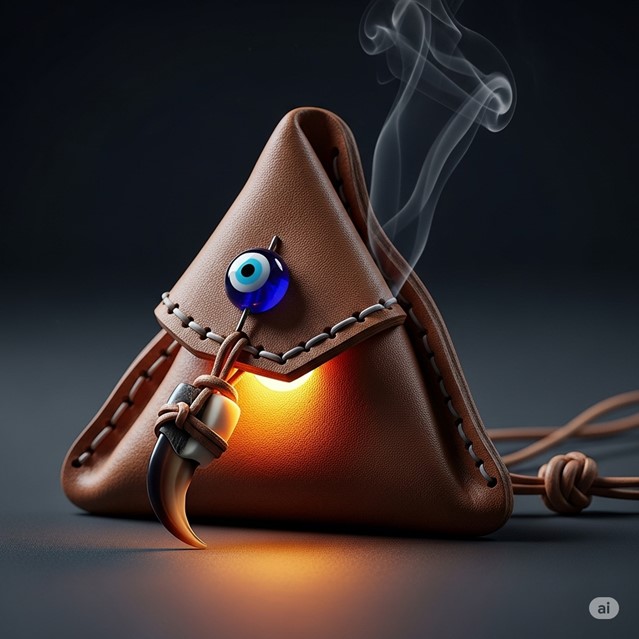
Perception of Activation:
This describes the sensory experience of using the muska’s divination ability, Trace the Gaze, to find the source of the evil eye (nazar).
Sight
- User’s Perspective: As you focus your will into the charm, your peripheral vision dims and blurs, creating a tunnel effect. The only object that remains in sharp focus is the muska itself. The small, blue Nazar Boncuğu seems to gain depth, its black pupil looking like a deep, endless well. The world, viewed through your ambient senses, becomes a landscape of indistinct, shimmering shapes.
- Observer’s Perspective: The user’s eyes become unfocused and distant, their gaze fixed on nothing. The glass eye bead on the muska itself begins to glow with a faint, internal azure light, noticeable only to those paying close attention or in dim conditions.
- Positives: The focused vision eliminates distractions, allowing the user to concentrate fully on the subtle feedback from the charm.
- Negatives: The user is effectively blind to their surroundings, making them completely vulnerable to physical approach or danger.
Sound
- User’s Perspective: All ambient noise fades into a gentle hush. The only sound you can perceive is a low, rhythmic hum, like a distant, whispered prayer or chant that you can’t quite make out. It is calming and helps to center your focus.
- Observer’s Perspective: The user becomes completely unresponsive to noise. If an observer is very close, they might feel rather than hear a very low-frequency vibration emanating from the user’s hand holding the charm.
- Positives: The silencing of the outside world is conducive to the deep concentration required for the ritual.
- Negatives: The user is deaf to any warnings, calls for help, or sounds of approaching threats.
Touch
- User’s Perspective: The leather of the muska grows intensely and reassuringly warm in your hand. It is a dry, steady heat, like a stone that has been sitting in the sun all day. As you slowly turn, seeking a direction, the warmth remains constant until you face the source of the nazar. In that direction, the heat focuses into a single, sharp point, like a hot needle pressing into your palm.
- Observer’s Perspective: There is no visible change, but if one were to touch the user’s hand during the ritual, it would feel unnaturally warm.
- Positives: The directional feedback is clear, sharp, and unambiguous, leaving no doubt as to the source’s general direction.
- Negatives: If the source of the envy is very strong or very close, the focused heat can become painful, forcing the user to break concentration.
Smell & Taste
- User’s Perspective: A distinct and pleasant aroma fills your senses, even if you are outdoors. It is the scent of sun-warmed leather, old paper, and a hint of a dry, herbal incense, like burning sage or cedar. A faint, dry taste, like old parchment, forms on the tongue.
- Observer’s Perspective: A person standing very close to the user might notice a subtle, pleasant, and slightly smoky scent appear as if from nowhere.
- Positives: The familiar, calming scent helps to ground the user and create a ritualistic mental space for the magic to work.
- Negatives: The unnatural appearance of the scent can alert magically-aware individuals that a ritual is being performed.
Extra-Sensory: Empathic Contagion
- User’s Perspective: As you perform the ritual, you feel a phantom emotion that is not your own: the sharp, bitter, acidic feeling of intense envy. It is an unpleasant sensation that gnaws at the edges of your own spirit. When you face the correct direction, this feeling surges powerfully, allowing you to gauge the depth of the jealousy directed at you.
- Observer’s Perspective: An observer using their Mind’s Eye would see faint, sickly green threads of negative emotional energy flowing from a particular direction. The muska on the user’s chest would glow with a warm, golden light, intercepting and dissolving these threads before they can touch the user.
- Positives: This provides more than just a direction; it gives crucial insight into the intensity and bitterness of the ill will.
- Negatives: Directly experiencing the raw, corrosive emotion of another’s envy is spiritually draining and can leave the user feeling tainted, cynical, or emotionally raw for a short time after the ritual ends.
Extra-Sensory: Ancestral Blessing
- User’s Perspective: You feel a quiet, steadying presence settling over you. It is the echo of the wise hoca who first created the charm. This presence does not speak, but it imparts a feeling of legitimacy, safety, and ancestral authority, giving you the confidence that your magic is just and that you are protected while you perform it.
- Observer’s Perspective: The user’s demeanor changes. Their posture becomes more centered and their expression more serene and focused. They carry themselves with a quiet, unshakeable confidence they might not normally possess.
- Positives: The spiritual support banishes fear and doubt, allowing for a clearer and more powerful execution of the divination.
- Negatives: A constant reliance on this external spiritual validation may, over time, prevent the user from developing their own innate spiritual strength and authority.
Rite of the Skinner’s Charm
This recipe details the traditional method for creating a protective muska charm, designed to shield an artisan from the envy of rivals and to bring peace to the spirits of the materials they shape.
Materials Needed
- The Vessel: A palm-sized, unblemished scrap of high-quality leather, preferably from an animal the crafter works with or respects (e.g., doe-skin, calfskin, or wolf hide).
- The Covenant: A small square of clean, handmade paper and a pot of ink mixed with a pinch of salt (for purification).
- The Watchful Eye: One small, glass Nazar Boncuğu bead.
- The Spirit of the Craft: A symbolic component representing the crafter’s skill. This could be a polished claw from a predator (for strength and sharpness), a smooth river stone (for patience), or a pinch of dust from the crafter’s own workshop floor (for dedication).
- The Cleansing Smoke: A bundle of dried Syrian rue (üzerlik) or sage.
- The Binding: A length of waxed sinew or other durable, natural thread.
Tools Required
- Leatherworker’s Tools: A sharp knife, an awl, and a sturdy needle.
- A Scribe’s Pen: A quill or fine brush suitable for writing with care.
- A Fireproof Dish or Bowl: To safely burn the cleansing herbs.
Skill Requirements
- Artisan Skill: Proficiency with Leatherworker’s Tools. The packet must be expertly stitched to be considered a worthy vessel.
- Steady Hand: The ability to write clearly and with intent. This may be represented by a skill in Calligraphy or simply a high degree of focus.
- Spiritual Attunement: The crafter must understand and respect the concepts of the evil eye and protective wards. They must be able to imbue the object with genuine intent.
Crafting Steps
Step 1: The Cleansing In a quiet, focused space, light the bundle of Syrian rue or sage until it smolders. Pass all materials and tools through the purifying smoke, one by one. As you do, clear your mind of all envy, doubt, and fear, focusing only on the purpose of protection and respect for your craft.
Step 2: Scribing the Covenant Take the pen and ink and write the protective prayer upon the paper. The words should be specific, calling for a shield against jealous eyes, a blessing upon the work of your hands, and peace for the spirits whose forms you shape. An example might be: “By the eye that sees all, turn back the gaze of envy. By the hand that shapes, bring peace to the spirit within the hide. Let my work be true, my focus clear, and my heart shielded from ill will.”
Step 3: Folding the Prayer Once the ink is dry, carefully fold the paper into a small, tight triangle. Each fold should be deliberate, sealing the power of the words within.
Step 4: Crafting the Vessel Cut the leather into the shape required to form a triangular packet that will perfectly encase the folded prayer. Use the awl to punch stitching holes along the edges.
Step 5: The Final Seal Place the folded prayer and the chosen “Spirit of the Craft” component inside the leather packet. Before making the final stitches, hold the open packet to your lips and whisper or breathe your personal intent into it—a final, silent prayer for protection. Quickly stitch the packet completely shut, sealing the magic inside.
Step 6: The Outer Wards Use the needle and thread to securely affix the Nazar Boncuğu to the face of the muska. Then, tie the claw or other symbolic object to one of its corners with a sturdy knot. The charm is now complete, a vessel of focused intent, ready to be worn and protect its owner.
Ismail, and Charm That Saw Envy
And in the city of the great Khan, there was a man named Ismail. His hands had great knowledge of hides, and it was said he could speak the language of leather. The cloaks he made were so soft they felt like water, and the boots he stitched were so strong they could walk a thousand miles and ask for a thousand more. His fame was a bright fire, and many people came to see its light.
But a bright fire makes dark shadows. There was another furrier, Hasan, whose shop was across the way. Hasan was a good worker, but his skill was a crooked stick next to the straight spear of Ismail. When people praised Ismail, Hasan’s heart would fill with a sourness, a green bile of envy. He did not perform a dark magic. He did not speak a curse. He only watched, and his watching was full of a powerful jealousy. This was the nazar, the evil of an envious eye, and it is a poison that needs no cup.
And so it came to be that a shadow fell upon Ismail’s workshop. His sharpest knife, which could split a hair, slipped and made a great gash in a priceless lion pelt. The tanning liquids in his vats spoiled overnight and gave off a terrible stink. The spirits of the animal hides were restless; the leather became stiff and angry under his touch. Ismail’s hands, once so sure, began to tremble and cramp. A great heaviness settled on his soul. He knew a sour looking was upon him.
He grew poor. His fire of fame became a weak smoke. He went to see Fatima, a wise woman who lived at the edge of the city, whose eyes could see the world that is unseen. He showed her his trembling hands and the ruined hide. Fatima looked not at the hide, but into Ismail’s spirit, and she saw the green shadow of Hasan’s envy clinging to him like a shroud.
She said to him, her voice like the rustling of dry leaves, “A blade cannot cut a shadow. A shield cannot stop a gaze. The poison that enters through the eye must be met by an eye.”
Fatima took from Ismail a small piece of doe-skin from his own pouch, for the magic must know its master. She took paper and wrote upon it a prayer, not for riches, but for a quiet heart. She wrote a plea for the spirits of the hides to be at peace. She folded this paper into a triangle, a shape of strength. She put inside the paper a pinch of salt from Ismail’s own table, to make it clean. Then she stitched the doe-skin around the paper, making a small packet.
From a pouch of her own, she took two things. A claw from a lynx, for the lynx has eyes that see in the dark. And a small bead of blue glass, like a tiny piece of the sky with a black spot to be its pupil. She pinned the blue eye to the front of the leather packet and tied the claw to its corner.
“Wear this over your heart,” she said. “It is a muska. Its claw will give your hands the spirit’s strength. Its prayer will give the hides peace. And its eye… its eye will watch the watchers. It will see the sour gaze, and it will not let it pass. It will make a turning back of the envy.”
Ismail returned to his workshop. He pinned the muska to his vest. He felt a warmth spread through his chest, a quietness in his soul. He took up a new hide, and as he touched it, the leather felt soft and willing. His hands were steady. His knife was true.
Across the way, Hasan watched, and his envy was a hot stone in his gut. He glared at Ismail, willing his tools to slip. But as he watched, he felt a strange sickness. His own hands began to tremble. His own knife slipped, ruining the work before him. The muska on Ismail’s chest saw the sour gaze of Hasan and did not allow it to land. It built an unseen wall and the poison of Hasan’s envy could not pass, and so it turned back and poisoned Hasan himself.
Ismail’s work became greater than ever before, for his heart was at peace. Hasan’s work became clumsy and poor, for his heart was full of the poison he had made for another.
The Moral of the Story: A shield that protects your spirit from the envy of others is a greater treasure than the skill that first made them envious.
Suggested conversions to other systems:
Dungeons & Dragons (5th Edition)
Artisan’s Muska Wondrous item, common
This is a small, triangular leather packet, worn smooth with age and stitched with sinew. A small blue glass bead shaped like an eye is pinned to its face. It is typically worn pinned to the chest.
- Nazar Ward. While this charm is on your person, you have advantage on saving throws against any spell that would cause you to be cursed.
- Artisan’s Boon. When you make an ability check using artisan’s tools, you can use the charm to gain a +2 bonus to the roll. You can use this property a number of times equal to your proficiency bonus, and you regain all expended uses when you finish a long rest.
- Trace the Gaze. As an action, you can hold the charm and focus on a recent misfortune you have suffered. The charm grows warm if that misfortune was the direct result of another creature’s ill will or curse, and you learn the general direction of that creature if they are within 1 mile of you. Once you use this property, you cannot use it again until the next dawn.
Call of Cthulhu (7th Edition)
Anatolian Protective Charm
A traditional folk talisman from the Near East, this muska is a small, sealed leather triangle containing prayers to ward off the evil eye (nazar). It features a prominent blue glass eye bead. It is not an artifact of the Mythos, but a tool of human belief, effective against the evils of humanity but of questionable use against cosmic horrors.
- Mechanics:
- Nazar Ward: When another human attempts to affect the Investigator with a curse, hypnosis, or a malicious psychic ability, the Investigator may make a POW vs POW roll to resist. If the charm’s wearer succeeds, the effect is negated, and the glass eye on the charm cracks slightly. After deflecting three such effects, the bead shatters, and the charm loses this property.
- Artisan’s Peace: If the Investigator is engaged in a task requiring fine manipulation (e.g., Art/Craft, Mechanical Repair, Sleight of Hand), the charm’s soothing nature allows them to add a Bonus Die to one such roll per day.
- Sense Ill Will: Once per investigation, the wearer may hold the charm and make a Psychology roll. If successful, they get a strong, intuitive feeling about which NPC in their immediate vicinity harbors the most jealousy or ill will towards them.
Blades in the Dark
The Tanner’s Packet
A small, triangular leather charm from the old country, stitched tight with prayers sealed inside. It has a little blue eye pinned to it that seems to watch you back. They say it turns aside a rival’s envy and soothes the spirits of the dead. In Duskvol, that’s a useful combination.
- Mechanics: This is a piece of special gear.
- Ward against Envy: When you Resist a social or supernatural consequence stemming from another faction’s jealousy, rumor-mongering, or a direct curse, take +1d to your roll.
- Honed Skill (Downtime): During downtime, when you work on a long-term project involving crafting, you may mark one additional segment on the clock.
- Trace the Gaze: When you need to know where the heat is coming from, you can hold this charm and Survey the social landscape. You can ask the GM, “Who here is my biggest rival?” or “Where did the ill will that caused this trouble originate?” You take +1 Effect on your roll.
Knave (2nd Edition)
Warding Muska
A small, triangular leather packet worn on a cord or pinned to a shirt. It has a blue eye bead and a small animal claw attached. It takes up 1 inventory slot.
- Passive: You have Advantage on saves versus curses.
- Daily Use (1): Once per day, you may touch a set of artisan’s tools. For the next hour, anyone using those tools has Advantage on checks made to craft or repair items.
- Daily Use (1): Once per day, you may hold the muska and concentrate for one minute. You learn the direction of the nearest person who is actively jealous of you or wishes you specific harm, provided they are within one mile.
Fate Core System
The Hoca’s Gift
This is a significant personal item, best represented as a character Aspect that also grants a special stunt.
- Aspect: Protected by a Hoca’s Gift You wear a small, triangular leather charm, a muska, given to you by a wise elder. It contains handwritten prayers and a small blue eye that watches the world for you, warding off jealousy and ill will.
- Invoke: You can spend a Fate Point to invoke this aspect for a +2 or a reroll on a Will roll to defend against intimidation, curses, or social attacks born of envy.
- Compel: The GM can offer you a Fate Point to compel this aspect. For example, the charm’s overt folk magic might make a scientifically-minded official dismiss you as superstitious, or its protective nature might cause you to be overly cautious when a little risk is needed.
- Stunt: Artisan’s Blessing Because you are Protected by a Hoca’s Gift, once per session when you are working on a complex crafting task, you may spend a Fate Point to automatically succeed on one Overcome roll related to that task. You must describe how the charm soothes the materials or guides your hands to avoid a critical error.
Numenera & Cypher System
Psycho-Spiritual Harmonizer
This device appears to be a primitive leather talisman, but its construction is more complex than it seems. The leather is an organic polymer, and the blue “eye” is a sophisticated psionic lens that resonates with and neutralizes directed, negative empathic transmissions.
- Level: 1d6 (Level is determined when found, minimum 2)
- Form: A small, triangular leather-like packet worn on a cord or pinned to clothing.
- Effect: This device provides an asset on all tasks related to crafting or repairing items made from organic materials (such as leather or wood), as it seems to calm and align their structure. The difficulty of these tasks is reduced by one step. As an action, the user can activate the harmonizer’s lens. For one minute, the blue eye will glow with increasing warmth and brightness as it gets physically closer to any creature within short range that has harbored a strong, negative emotion (such as envy or hatred) toward the user in the last hour.
- Depletion: 1 in 1d100 (The device is stable and reliable).
Pathfinder (2nd Edition)
Skinner’s Ward Item 2 [Uncommon] [Abjuration] [Divination] [Invested] [Magical] Price 30 gp Usage worn; Bulk —
This small, triangular leather amulet is pinned with a glass bead resembling a blue eye and a polished animal claw. It is a charm favored by artisans who believe it protects their work from both mundane flaws and the evil eye.
When you invest the amulet, you gain a +1 item bonus to Crafting checks.
Activate [One-Action] envision; Frequency once per day; Effect You touch a set of artisan’s tools. For the next hour, the first time you would get a critical failure on a Crafting check using those tools, you get a failure instead.
Activate [Three-Actions] concentrate, envision; Frequency once per day; Effect You focus on a specific item you own that has recently been damaged or a recent misfortune you have suffered. The amulet points in the general direction of the creature who holds the most envy or ill will related to that event, as long as they are within 1 mile. This gives a direction but no information about distance or identity.
Savage Worlds Adventure Edition (SWADE)
The Evil Eye Charm
A traditional folk magic charm consisting of a leather packet containing prayers, a protective blue bead, and other symbolic items. It is believed to ward off curses and the negative effects of jealousy.
- Requirements: Novice, Spirit d6+
- Nazar Ward: The wearer gains Armor +2 against any powers that directly target their spirit or will (such as fear, puppet, or social Tests like Taunt and Intimidation).
- Artisan’s Boon: The wearer gains a +1 bonus to all Repair or other skill rolls related to their primary craft (e.g., leatherworking, alchemy, etc.).
- Trace the Gaze: The charm allows the wearer to cast the Divination power, but only to ask questions related to identifying the source of curses, bad luck, or ill will directed at them (e.g., “Who is jealous of my success?”). Activating this power costs Power Points as normal and uses the wearer’s Spirit as the casting skill.
Shadowrun (Sixth World)
Hoca’s Ward Fetish
A traditional protective fetish, common among communities with roots in the former nation of Turkey. It is a small, triangular leather packet containing ritual components and prayers, with a blue glass “evil eye” bead pinned to the front. While dismissed by some as superstition, awakened individuals know these charms can channel subtle but real magic.
- Type: Centering Focus
- Rating: 2
- Availability: 6R
- Cost: 10,000 nuyen
- Mechanics:
- Nazar Ward: The bearer gains 1 Edge automatically when they are required to make a test to resist a Manipulation spell or an Intimidation social test.
- Artisan’s Peace: The fetish’s calming influence aids in detailed work. The bearer may add the fetish’s Rating (2) as a dice pool bonus to any Artisan or Engineering skill group test.
- Trace the Gaze: The fetish functions as a Centering Focus of Rating 2, but only for divination and detection spells (such as Analyze Truth or Detect Enemies) used to identify a source of hostility or a curse aimed at the bearer.
Starfinder
Artisan’s Empathic Ward Level 2 Price 850 credits Hands —; Bulk L Armor Slot worn item
This small, triangular charm is made from tough, synth-leather and features a blue optical sensor that vaguely resembles an eye. Marketed as a “luck charm” on many fringe worlds, it actually contains a low-power empathic filter that dampens minor psychic aggressions and a sonic harmonizer that aids in delicate work.
- Mechanics:
- While wearing this ward, you gain a +1 insight bonus on saving throws against mind-affecting effects.
- You gain a +2 insight bonus on all checks made with any skill that has the Crafting descriptor.
- Once per day, you can activate the ward’s sensor as a standard action. For the next 10 minutes, the blue “eye” will glow with a soft light if you are within 30 feet of a creature who has targeted you with a harmful spell or effect within the last 24 hours. The glow is brighter the closer the creature is.
Traveller (Mongoose 2nd Edition)
Psionic Dampener (‘Nazar’ Charm)
Disguised as a primitive folk charm, this device is actually a sophisticated piece of Zhodani psionic technology. It functions as a passive dampener for low-level, hostile telepathic projections and contains a suite of micro-sensors for detecting psionic residue.
- Tech Level: 15
- Cost: 60,000 Cr+
- Legality: Highly Illegal / Restricted (Zhodani technology)
- Skills: Psionics (any)
- Mechanics:
- Mind Shield: The wearer gains Advantage on any roll made to resist hostile Telepathy or other psionic powers that target their mental state.
- Harmonic Focus: The device emits a subtle field that aids concentration on fine motor tasks. The wearer gains a +1 bonus to any relevant Craft or Mechanic skill checks.
- Residue Tracker: Once per day, the user can activate the device. It will scan the immediate area for lingering psionic residue. If a psionic talent was used against the wearer within the last hour, the device will vibrate and indicate the direction of the source on a linked datapad or via a neural comm signal.
Warhammer Fantasy Roleplay (4th Edition)
Arabyan Evil Eye Charm
A common talisman brought back from the mysterious lands of Araby by merchants, pilgrims, and crusaders. It is a small leather packet containing sand and secret prayers, stitched with a prominent blue eye bead. The people of Araby swear by these charms to protect them from curses, djinns, and the envy of their neighbours.
- Encumbrance: 0
- Qualities: Magical, Protective, Talisman
- Mechanics:
- Ward against Envy: The wearer is immune to the effects of non-magical intimidation and may ignore the effects of the Broken Condition when it is caused by a social test. Furthermore, the wearer gains a +10 bonus to Cool Tests made to resist fear or terror caused by another mortal being (not a monster or daemon).
- Artisan’s Peace: The charm’s soothing nature calms the nerves and steadies the hand. The wearer gains a +10 bonus to all Trade skill Tests that involve fine, detailed work.
- Sense Ill Will: The charm subtly warms when in the presence of someone who actively wishes the wearer harm. While this gives no specific information, the GM should inform the player when this occurs, granting them a chance to make a Perception or Intuition Test to try and identify the source.