
From: Arcane Forges of Lumengarde
Lore: The legend of Elemental Chalices dates to the ancient alchemists and elementalists who sought to harness the powers of the natural world. According to myth, these chalices were first created by the alchemist Zephyr Alara, a scholar who delved into the secrets of the elements. Zephyr believed that the key to understanding and controlling the elements lay in finding a vessel that could harmonize with the elemental energies.
In his quest, Zephyr discovered a mysterious, enchanted forge hidden deep within a volcanic cave. There, he crafted the first Elemental Chalice, each element represented by a different gemstone embedded into the chalice’s design. The chalice’s unique properties allowed it to harness the elemental energies of water, fire, earth, and air, granting those who wielded it the power to perform minor elemental spells.
Over time, the knowledge of creating Elemental Chalices spread, and alchemists and elementalists from various cultures contributed their expertise to perfecting the craft. Today, these ornate chalices are revered for their ability to channel elemental power, making them invaluable tools for spellcasters and elemental practitioners.
Specific Tier One Stats: Spellcasting: Once per long rest, the user can cast a 1st-level spell associated with the element present in the chalice (e.g., Burning Hands for fire, Fog Cloud for air, Create or Destroy Water for water, or Earth Tremor for earth).
Skills and Requirements: To effectively use Elemental Chalices, characters must have proficiency in Arcana or Nature. Crafting an Elemental Chalice requires proficiency with artisan’s tools (Alchemist’s Tools) and in-depth knowledge of elemental magic and alchemical principles.
Tags:
- Elemental: Elemental Chalices can channel and wield elemental powers, making them a valuable asset for spellcasters and elemental practitioners.
- Alchemical: Crafted with alchemical precision, these chalices are revered for their craftsmanship and arcane properties.
- Rare: The knowledge of creating Elemental Chalices is rare and closely guarded, ensuring that these chalices are treasured and sought after by those who possess them.
- Additional: Elemental Resonance, Volcanic Crafting, Gem-Infused Focus, Ritual Channeling, Arcane Synchronicity, Empowered Invocation, Transcendent Binding, Natural Convergence
Sale and Distribution: Elemental Chalices are not commonly sold in regular marketplaces due to their rarity and potential for misuse. Instead, they are often found in specialized arcane shops, alchemist guilds, and magical academies where they are traded among seasoned spellcasters, elementalists, and scholars.
The process of crafting these chalices is intricate and requires access to rare gemstones and alchemical reagents. Knowledge of their creation is passed down among accomplished alchemists and elemental practitioners, and they may craft and sell the chalices to select clientele or offer them as rewards for significant services.
Usage and Impact: Elemental Chalices have a profound impact on the world of magic and elemental manipulation in Saṃsāra. Spellcasters can use them to augment their powers and unleash elemental spells when needed, offering versatility and tactical advantages in battles and encounters.
Elementalists find the chalices invaluable for their studies and rituals. When combined with other elemental implements, the chalices enhance the practitioner’s connection to their respective element, enabling them to draw upon greater elemental energy for more powerful spells and rituals.
However, the power of Elemental Chalices is not without limitations. The spells they can cast are relatively minor, and the chalice’s magic relies on the user’s own abilities and energy. Overuse of the chalice may lead to exhaustion or depletion of the wielder’s magical resources, making it crucial for users to employ the chalice judiciously.
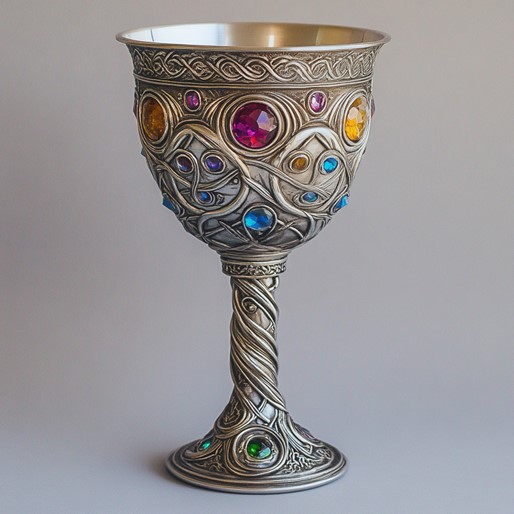
These chalices often feature a tall stem and a wide bowl, designed to highlight the embedded gemstones that represent each element. They are usually fashioned from polished metals with an iridescent sheen—silver or mithral are common choices—giving them a faint glow when exposed to any source of light. Engraved lines around the rim and base trace swirling patterns reminiscent of gusting winds, rolling waves, flickering flames, or shifting earth.
Each elemental gemstone is placed with care, ensuring it catches and refracts the ambient light in a way that accentuates the chalice’s core theme. Rubies or garnets often symbolize fire, sapphires or aquamarines for water, emeralds or malachite for earth, and clear crystals or topaz for air. These stones are set in ornate bezels along the chalice’s circumference, spaced evenly so each facet can be admired. Delicate runic inscriptions may circle each gem, suggesting harmony between the elemental forces.
At the chalice’s foot, stylized metalwork often curves upward in graceful filigree, giving a sense of organic growth as though the chalice has sprouted from the materials of the forge itself. The interior sometimes bears faint etchings or swirling shapes that match the elemental motif, visible when the chalice is lifted. When not in use, many who possess these items keep them resting on a small, inscribed stand—another trace of their alchemical heritage and the care required to preserve them.
Perception of Activation: When the chalice’s powers manifest, a gentle resonance stirs in the air.
- User’s Perspective:
- Sight: Shimmering filaments of light spiral from the gemstones, creating faint trails around the chalice. The bowl appears to pulse, each gemstone brightening in turn as the elemental essence flows.
- Hearing: A soft chord hums at the edge of awareness, reminiscent of distant wind chimes or the crackle of embers depending on the elemental focus.
- Touch: A tingling warmth or coolness radiates through the hands, pairing with a brief sensation of static along the forearms.
- Smell: Hints of fresh ozone, damp earth, or singed air occasionally accompany the surge in power.
- Taste: An electric tang lingers as though licking the tip of one’s tongue against a charged surface.
- Extra-Sensory: A fleeting impression arises, as if one’s consciousness aligns with the chosen element; thoughts clarify, and the mind briefly perceives swirling energies that resonate with the chalice’s essence.
- Observer’s Perspective:
- Sight: Delicate arcs of colored light ripple over the chalice, giving it a faint halo. The user’s outline may appear slightly blurred, as if waves of energy distort the surrounding space.
- Hearing: A gentle pitch shift or vibrato overlays the background noise, subtly hinting at unseen forces in motion.
- Touch (Indirect): Observers close enough might feel a mild shift in temperature or subtle pressure changes in the immediate area.
- Extra-Sensory: Sensitive onlookers experience a whispering pull, as if the ambient energy draws them nearer or wards them away in a passing heartbeat.
- Positives:
- Heightened clarity during activation, offering a momentary boost in mental and spiritual focus.
- A subtle surge of confidence and connection to the elemental realm.
- Expanded awareness of surrounding energies, granting deeper insight into the flow of magic.
- Negatives:
- Risk of mild dizziness or disorientation if the chalice’s energies clash with the wielder’s natural affinity.
- Temporary depletion of the user’s stamina when the surge fades, leaving a sense of emptiness in its wake.
- Possible unintended effects on nearby objects or creatures sensitive to elemental forces, causing warping, heating, or minor disruptions in the environment.
Recipe: The Shimmering Elemental Chalice
- Materials Needed:
- Metal of High Purity (Silver, Mithral, or a comparable alloy of your choice)
- Elemental Gemstones, one representing each chosen element (examples include rubies for fire, emeralds for earth, sapphires for water, and clear quartz or topaz for air)
- Finely Ground Alchemical Reagents (powdered crystals, essences of elemental creatures, or trace minerals)
- Binding Agents (melted flux, rare resin, or specialized arcane bonding solutions)
- Symbolic Engravings (runes or sigils prepared on thin plates of precious metal)
- Tools Required:
- Forge or Enchanted Kiln capable of reaching high temperatures
- Alchemist’s Tools (mortars, pestles, calibrated vials, mixing rods, heat-resistant crucibles)
- Artisan’s Metalworking Set (hammers, tongs, files, molds)
- Fine Engraving Instruments (chisels, gravers, delicate brushes)
- Rune Etching Apparatus or an equivalent method of inscribing magical symbols
- Skill Requirements:
- Metalworking Proficiency for shaping the chalice and setting gemstones
- Alchemical Knowledge for blending elemental essences and reagents
- Arcana or Nature Proficiency for enchanting and aligning the chalice with elemental powers
- Crafting Steps:
- Base Metal Preparation: Heat the chosen metal in the forge until it reaches a workable temperature. Carefully skim away impurities so the alloy remains as pure as possible. Pour the refined metal into a chalice-shaped mold. Allow it to cool, then extract and smooth any rough edges.
- Preliminary Shaping and Polishing: Shape the cooled metal using hammers and files, ensuring the chalice has a sturdy stem and a wide, even bowl. Polishing is vital: rid the surface of blemishes and craft a smooth finish so the embedded gemstones will catch and reflect light.
- Gemstone Alignment: While the chalice cools after shaping, prepare each gemstone by cleansing it in a mixture of powdered crystals and distilled water. Carefully measure the ratio of alchemical reagents, ensuring every stone harmonizes with the desired elemental essence.
- Rune Engraving: Sketch the intended runes or sigils on the surface of the chalice, focusing on places where the gemstones will be set. Use engraving instruments or an etching apparatus to inscribe the designs onto the metal. Precision is key, as this pattern will direct the flow of elemental power once the piece is complete.
- Arcane Binding and Inlay: Heat a small amount of binding agent until it becomes a viscous liquid. Affix each gemstone to its designated spot using the molten solution, pressing gently so the stone’s edges are fully embedded. Let the agent cool and harden, creating a snug fit.
- Alchemical Infusion: Place the chalice on a stable surface within an area free of disruptive energies. Using alchemical tools, create a mild elemental reaction (a swirl of heated vapor or a gentle spark) and channel it into the chalice. Drizzle or brush the chalice’s surface with a specially mixed solution of ground minerals and elemental essences, infusing it with potential.
- Final Tempering: Return the chalice to the forge for a controlled, lower-temperature heating cycle. Carefully monitor the color of the metal and the gemstones to avoid damage. The embedded runes should glow faintly, indicating that the item has begun to resonate with elemental energies.
- Cooling and Polishing Ritual: After removing the chalice from the forge, allow it to cool on a metal surface inscribed with supportive runes. Conduct a final polishing to remove any residue. This step may involve softly chanting or focusing one’s intent to anchor the infusion, though silent concentration can suffice if the crafter’s skill is strong.
- Attunement Process: Once the chalice has fully cooled, examine each gemstone. If any stone remains dull or unresponsive, repeat a brief infusion until it resonates. Complete the process by connecting with the chalice’s elemental alignment—this might be done by gently holding the chalice and mentally envisioning the elemental forces converging within.
- Inspection and Testing: Confirm the chalice’s integrity by slowly filling it with water or another harmless element to check for leaks or structural faults. Lightly tap each gemstone to sense a faint vibration or glimmer of energy, a sign that the elemental alignment is intact. If all aspects appear stable, the chalice is finished.
A successfully crafted chalice should exhibit a soft radiance around each gemstone and a gentle hum or vibration when held. These subtleties signal that the chalice stands ready to channel minor elemental power.
Ancient Whisper of the Fiery Wave Chalice
In the age when suns were believed to nest beneath the mountain peaks, the old parchments speak of a cunning scholar named Zephyr Alara. Once was he said to roam the heated caves of blazing stone, ever-seeking the fabled place where rock and flame embraced the dawn. The words recounted in brittle scrolls are full of uncertain phrases and curious symbols, hinting that he discovered a forge guarded by intangible spirits of cinder and dew. Whosoever dared to reach that hidden realm was believed forever changed, though many could not recall if the change brought fortune or ruin.
Zephyr’s arrival, as told by voices of desert hermits, was guided by luminous dragonflies that glowed in patterns no mortal mind could decipher. Through howling winds and molten crags, he stepped with fearsome resolve. Some fragments suggest that molten rivers of silver ran through the caverns, each winding path resonating with subterranean thunder. Others mention eerie echoes within the rock that whispered the half-formed names of ancients lost to time, conjuring chill in the hearts of those who listened.
It is said he carried with him a set of four gems, each pulsing faintly with an otherworldly color: a ruby tinted with swirling shadows, an emerald flecked with dancing sparks, a sapphire that housed a swirl of mist, and a topaz that flickered as if a captive lightning bolt. Many times, local gatherers of clay bowls recited that Zephyr’s voice drifted among the cave’s blackness, chanting half-known incantations while searching for a vessel to house the essence of air, earth, fire, and water. The meaning behind these words was forever confused by repeated retellings, so the melody of that chant is now lost.
When at last he reached the heart of the volcanic labyrinth, he beheld a dormant forge set upon a dais of basalt. Some versions speak of a mosaic upon the floor—a depiction of swirling seas and blazing comets encircling a chalice. Others reference an inscription carved in symbols so alien that no living sage can decipher them fully. Legend claims that Zephyr placed each gemstone carefully into the chalice’s rim, forging a bond between mortal craft and elemental spirits. The chalice then glowed in brilliant arcs of color, stirring the stagnant air with a breeze that whispered of far-off seas and fiery storms.
With completion of this forging came both wonder and disquiet: rumor spread of lesser spirits swirling around Zephyr as he emerged from the cavern. Some swore they saw tiny motes of flame dancing upon his fingertips; others believed that droplets of water followed his every step. Tales from far villages mention the scholar’s arrival as a sign of storms or drought—his presence both a blessing and a forewarning. Clarity cannot be gleaned from those records, for they are riddled with cryptic references, missing lines, and contradictory statements.
The battered scrolls say that in the following seasons, the chalice passed through many hands, always a magnet for fervent admirers and dread-laden whispers. Once, a wandering hermit claimed that whosoever drank from its rim tasted not wine, but the currents of the earth’s beating heart. Another old record describes an event where the chalice glowed so fiercely that crops around it either flourished overnight or wilted to dust. The reason behind this duality is never clear, but it is told that the elemental forces within the chalice heed only those who approach with wisdom, turning chaotic for those who seek dominion alone.
Across the distances of time, retellings have eroded the details into a puzzle of half-truths. For each region that venerates the chalice as a gift of harmony, another region warns of its potential to unleash ruin. Some hold the artifact aloft in reverence of life’s elemental cycle; others bury it in labyrinthine vaults, fearful that unveiling its energies would beckon restless spirits. Words in the oldest texts mention a final prophecy, though badly garbled, foretelling that when the chalice shines with all four elements in perfect unity, the boundary between mortal and elemental realms grows thin. Whether this heralds creation or destruction remains an enigma lost between rotting pages and smudged ink.
Moral of the Story: A vessel that draws power from many forces can uplift or undo; the heart guiding it decides the fate of all.
Suggested conversions to other systems:
Adaptation for Call of Cthulhu (Seventh Edition)
Name: Elemental Chalice
- Type: Occult Artifact
- Rarity: Very Rare
- Game Mechanics:
- Activation: A user with at least 15% in Occult or Cthulhu Mythos may attempt to activate the chalice by conducting a brief ritual (1D3 rounds).
- Effect: Once activated, the chalice grants the user a single minor elemental effect. This may mimic a low-level spell or produce a phenomenon (flame burst, gust of wind, sudden tremor, or localized rainfall). The effect typically lasts 1D6 rounds.
- Cost: Activating the chalice causes 1D3 SAN loss. Failed activation (roll vs. POW×4) doubles the SAN loss and may cause a temporary hallucination or mania involving the chosen element.
- Prolonged Use: Repeated use in a short span risks additional side effects such as strange nightmares or bizarre physical manifestations of elemental energy.
- Stat Block Example:
- Sanity Loss: 1/1D3 if the user activates or witnesses the chalice’s use.
- Use Roll: POW×4 to channel the chalice’s energy safely.
- Secondary Effect: If the POW roll fails, the user suffers an uncontrollable surge of elemental force, potentially harming themselves or the environment nearby (Keeper’s discretion).
Adaptation for Blades in the Dark
Name: Elemental Chalice
- Type: Special Item (Arcane/Alchemical)
- Tier: 3 (or adjusted according to crew and campaign power levels)
- Game Mechanics:
- Load: 1 (small enough to be carried by hand).
- Usage: Once per score or downtime action, the holder may channel an elemental effect tied to one of four chosen elements (fire, water, earth, air). This is typically used to create or overcome an obstacle, such as igniting flammables, eroding a barrier, summoning a short burst of wind, or shaping soft earth.
- Action Roll: The user makes an action roll (likely Attune, possibly Wreck or another relevant action). On success, the desired effect occurs; on a partial success, there may be complications or reduced impact.
- Stress Cost: Invoking strong or repeated effects may cost 1–2 Stress, reflecting the mental toll of channeling raw elemental forces.
- Stat Block Example:
- Quality: Arcane (enables effects beyond mundane means).
- Limitations: Using the chalice in a public setting might attract unwanted attention from factions aware of its power.
- Upgrades: Characters might acquire improved knowledge (through special projects) to use the chalice for greater elemental feats, or reduce its Stress cost.
Adaptation for Dungeons & Dragons (Fifth Edition)
Name: Elemental Chalice
- Wondrous Item, Rare (Requires Attunement by a spellcaster)
- Game Mechanics:
- Once per day, the attuned user may cast a single 1st-level elemental spell: Burning Hands (fire), Create or Destroy Water (water), Earth Tremor (earth), or Thunderwave (air). This use refreshes at dawn.
- Proficiency: The user must have proficiency in Arcana or Nature to benefit fully. If they lack it, the spell DC and attack rolls made using the chalice are at –2.
- Optional Enhancement: If a campaign allows, the chalice can become more powerful as the party progresses, granting access to higher-level elemental spells. Consult with the group to ensure balance.
- Stat Block Example:
- Category: Wondrous item
- Rarity: Rare
- Attunement: Spellcaster
- Property: Once per day casting of one elemental 1st-level spell (requires Arcana or Nature proficiency to avoid penalties).
- Flavor: When the user casts a spell through the chalice, gemstones on its rim glow in colors associated with the chosen element.
Adaptation for Knave
Name: Elemental Chalice
- Type: Magical Item
- Game Mechanics:
- Usage: Holding the chalice in one hand allows the user to invoke a minor elemental effect tied to a chosen element (fire, water, earth, air) once between rests.
- Check: The user must succeed on a suitable ability check (roll under a relevant ability) to shape the effect safely.
- Failure: On failure, the user suffers a misfire as determined by the referee (sudden backfire or unintended side effect).
- Limited Power: If the user attempts to invoke additional effects without sufficient rest or resources, they risk draining their stamina or incurring a penalty on subsequent rolls.
- Stat Block Example:
- Item Slot: Occupies one carried item slot when not in use; must be wielded in hand when activated.
- Effect Trigger: Single minor elemental phenomenon (e.g., spark of fire, small localized quake, brief gust of wind, conjure one gallon of water).
- Constraints: If used repeatedly in quick succession, the referee may impose disadvantage or similar limitations until the user rests.
Game System: Fate (Fate Core or Fate Condensed)
Name: Elemental Chalice
- Type: Arcane Item (Extra)
- Aspects:
- Ancient Vessel of Elemental Forces
- Glimmering Conduit of Four Elements
- Coveted Relic of Alchemical Craft
- Permission: The character must have an aspect or background trait indicating experience with magic or elemental knowledge.
- Costs: Purchasing this Extra can be handled as a stunt (1 Refresh), or it can be granted by the narrative at the Game Master’s discretion.
- Stunt/Extra Mechanics:
- Once per session, the user can invoke the chalice to gain a significant advantage in creating an elemental effect. Declare the effect (e.g., conjuring a brief flame, shifting stone, summoning a gust of air, or manifesting water) and roll with an appropriate approach or skill (often Lore, Crafts, or another suitable choice).
- On success, the user may either:
- Create a scene aspect with one free invoke, representing the summoned element.
- Overcome a relevant obstacle (like igniting a barrier or quenching a small fire).
- If the user fails, they must either accept a mild consequence (e.g., “Drained by Elemental Backlash”) or pay a Fate point to avoid damage or side effects.
- Drawbacks:
- Attempting multiple uses in the same session requires an additional Fate point each time.
- Prolonged use may draw unwanted attention from supernatural forces or factions.
Game System: Numenera & Cypher System
Name: Elemental Chalice
- Level: 5 (Artifact)
- Form: A finely crafted metal chalice inlaid with elemental gemstones.
- Effect:
- The chalice allows its possessor to command a minor manifestation of a single chosen element (fire, water, earth, or air) once per day. This can deal 5 points of damage (or a GM-approved effect) to a target or allow the user to solve a narrative problem (lighting a small fire, digging through loose earth, creating a fog, etc.).
- The user must succeed on an Intellect roll (Difficulty 4) to properly align their will with the chalice’s elemental forces. Failure may cause a mishap such as backlash or the effect targeting an unintended area.
- Depletion: 1 in 1d20
- After each use, roll a d20. On a result of 1, the chalice loses its potency until repaired (or may turn into a mundane object, depending on the story).
- Guidance:
- Characters with training or specialization in lore of the elements gain an asset on rolls to use or repair the chalice.
- The chalice may be introduced at any tier, with its level and effects adjusted to maintain balance.
Game System: Pathfinder (Second Edition)
Name: Elemental Chalice
- Item Level: 6
- Rarity: Rare
- Bulk: Light
- Price: 250 gp (adjust as needed)
- Usage: Held in one hand, requires one hand free
- Traits: Arcane, Evocation, Consumable Focus (if the GM chooses to treat it differently), or simply Worn (held) if allowing repeated use without consumption.
- Activation [one-action] Interact: You present the chalice and channel its magic. You can cast a single 1st-level spell once per day that corresponds to one of four elements: burning hands (fire), hydraulic push (water), air bubble (air), or magic stone (earth). Use your class DC or spell DC if higher.
- Requirements: You must be trained in Arcana or Nature; if not, treat your level as 2 lower for determining the effects.
- Additional Effects:
- You gain a +1 item bonus to skill checks related to identifying or crafting elemental magic items.
- Overuse: If you attempt to activate the chalice again before your next daily preparations, make a DC 20 flat check. On a failure, you take 2d6 mental damage and the chalice’s magic is suppressed for 24 hours.
Game System: Savage Worlds (Adventure Edition)
Name: Elemental Chalice
- Rank: Rare Artifact
- Powers: Bolt, Burst, and Elemental Manipulation (re-skinned for specific elemental trappings)
- Power Points: 10 (recharges 1 point per hour)
- Requirements: The wielder must have Arcane Background (Magic, Miracles, or Weird Science) to activate.
- Effects:
- Bolt: Costs 2 Power Points. This fires a small elemental projectile (fire, ice, stone shard, or compressed air). Standard bolt mechanics apply, using the wielder’s Spellcasting skill die.
- Burst: Costs 2 Power Points. The chalice unleashes a brief cone or burst of elemental force (flame jets, swirling dirt, crashing water, or tearing wind). Standard burst mechanics apply.
- Elemental Manipulation: Costs 1 Power Point. Minor control over an existing element (small flame, patch of earth, breeze, or shallow water), used for narrative actions or small obstacles.
- Limitations:
- The user must succeed on a Spellcasting roll; failure might provoke a backlash determined by the GM (e.g., shaking, fatigue, or minor damage).
- If the chalice drops to 0 Power Points, it becomes inactive until at least 1 point recharges.
- Optional Drawback:
- Characters who rely too heavily on the chalice may attract attention from elemental entities or experience mental strain. Adjust any additional complications to fit the campaign’s tone.
Shadowrun (Sixth World Edition)
Name: Elemental Chalice
- Type: Power Focus (Specialization: Elemental Manipulation)
- Availability: 10R (may be adjusted for campaign rarity)
- Cost: Base 15,000¥ x Force (plus bonding)
- Bonding: Requires the usual Karma cost to bond a focus at its Force rating
- Game Mechanics and Syntax:
- The chalice counts as a Power Focus for spells with elemental manipulation or elemental effects.
- When a magician casts an elemental spell (e.g., Flamethrower, Lightning Bolt, etc.) while the chalice is in hand, treat its Force as a bonus equal to the chalice’s Focus rating to the Spellcasting dice pool.
- Once per day, the chalice can amplify a single elemental spell so that if it causes elemental secondary effects (fire causing things to ignite, electricity shorting electronics, etc.), the effect is automatically triggered without an additional test.
- Use of this ability imposes a Drain Value increase of +2 for that spell cast, reflecting the intensity of the elemental energies.
- Optional Drawback:
- Over-channeling: If the user pushes the chalice’s power repeatedly (more than twice per scene), they must make a Willpower + Magic (Force) test. Failure causes Physical Drain equal to net hits missed (minimum 1).
Starfinder
Name: Elemental Chalice
- Item Level: 6 (adjust as needed)
- Price: 4,500 credits
- Bulk: L
- Descriptors: Magical, Hybrid, Evocation
- Game Mechanics and Syntax:
- Once per day as a standard action, the wielder can activate the chalice to cast a 1st-level elemental spell (e.g., caustic conversion for acid, supercharged weapon for electricity, etc.). The chosen spell must have a theme matching one of the four classical elements (fire, water, earth, air), subject to GM approval.
- If the user has ranks in Mysticism, they add a +2 insight bonus to checks that identify or deal with elemental creatures or phenomena while carrying the chalice.
- When used as a Spell Focus for other elemental-themed spells (GM’s discretion), the chalice reduces the spell’s resolve point cost by 1 (minimum 0) once per day.
- Optional Expansion:
- At higher item levels, the chalice might unlock 2nd- or 3rd-level spells, or offer a scaling bonus to Mysticism checks related to specific elements.
Traveller (Mongoose 2nd Edition or Latest)
Name: Elemental Chalice
- Type: Exotic Artifact
- Tech Level: Not Applicable (magical or otherwise unearthly origin)
- Value: Varies (commonly 250,000 Credits+ due to rarity)
- Game Mechanics and Syntax:
- Usage: A character with at least one level in a relevant skill (e.g., Science [planetology], Language [arcane scripts], or a psionic discipline at GM’s discretion) may attempt to attune to the chalice as an action.
- Effect: Once per day, the user can create a minor elemental phenomenon (small flame burst, a localized air gust, a quake-like tremor, or a surge of water). Game impact is roughly akin to a +2 DM bonus on checks to solve or bypass environmental challenges that could be influenced by the chosen element.
- Risk: On a failed attunement check (2D6 + relevant skill vs. 8+), the chalice may cause 1D3 damage to Endurance or produce an unintended effect (disruptive weather, localized hazard, etc.).
- Side Effects: Observers may consider the chalice supernatural. Ensuing curiosity or fear might create narrative hooks for infiltration, black-market deals, or cult worship.
Warhammer (Fantasy Roleplay Fourth Edition)
Name: Elemental Chalice
- Item Type: Arcane Artefact
- Encumbrance: 0 (small enough to be carried easily)
- Rarity: Exotic
- Game Mechanics and Syntax:
- Qualities: Channelling (Elemental), Dangerous
- Once per day, the bearer can perform a Channeling Test with a +2 SL bonus if casting a spell tied to one of the four classical elements (fire, water, air, earth). If successful, the spell’s CN (Casting Number) is effectively reduced by 1 (to a minimum of 0).
- If the Channeling Test fails, the caster automatically triggers a Miscast roll on the Minor Miscast Table, representing the chalice’s volatile union of elemental powers.
- Characters without the Petty Magic (Elemental) or Arcane Magic (Elemental) talents treat the chalice as a cursed object, incurring a –2 SL penalty on any Willpower Tests made while holding it.
- Optional Complication:
- Prolonged reliance on the chalice might require periodic Corruption Tests (depending on the setting’s stance on arcane power), highlighting the precarious balance between mortal resolve and primal forces.
Comments
One response to “Elemental Chalices”
[…] Elemental Chalices: These ornate chalices are crafted with alchemical precision, capable of containing and channeling various elemental energies. When filled with water, the chalice can conjure small water-based spells. Depending on the contents, it can exhibit properties of fire, earth, or air, allowing users to harness elemental powers at their disposal. […]