
Deity: Caelis, The Ever-Adapting
Lore: In the world of Saṃsāra, Caelis is venerated as the deity of adaptability, change, and equilibrium. Known as The Ever-Adapting, Caelis emerged during the Age of Elements when the world was rife with imbalances. Through the power of equilibrium and harmony, Caelis stabilized the forces of elemental fire and water, thus achieving a balance that allowed life to flourish. Followers of The Harmonium Faith believe that the essence of Caelis is infused in the elements themselves, constantly shifting and adapting to maintain the world’s balance. Temples dedicated to Caelis often stand at the convergence of natural elements, such as where a river meets a volcano.
Personality: Caelis embodies the ideals of adaptability and balance. Unlike other deities who may represent extremes, Caelis exists in a state of constant equilibrium, often depicted as being both male and female, light and dark, fire and water. Caelis is neither vengeful nor overly benevolent, always emphasizing the necessity of change and adaptation as life’s core principles.
Traits and Characteristics:
- Equanimity: Perfectly balanced in emotions and actions.
- Versatility: Able to adapt to any situation.
- Wisdom: Profound understanding of the importance of balance in life.
- Devoted Sister to Akiura. (See: Akiurism.)
Attributes:
- Elemental Balance: Caelis holds sway over both fire and water, representing equilibrium.
- Mind’s Eye: Possesses a deep understanding of the mechanics of the world and the Mind’s Eye that people use to perceive it.
- Shape-Shifting: Known to adapt form to fit the situation, never fixed to a single physical representation.
Symbols:
- The Harmonium Sigil: An intricately designed circle with fire and water swirling within, meeting at the center to create a burst of steam.
- The Dual Crescent: Two crescent moons back to back, signifying balance and duality.
Detailed Tags:
- Elemental Harmony: Caelis is credited with balancing the elemental forces of fire and water.
- Adaptive Wisdom: Teachings focus on the importance of being able to adapt to life’s ever-changing circumstances.
- Equilibrium: The core principle that life should be lived in a balanced manner, neither in excess nor in lack.
- Divine Versatility: The deity can appear in any form, demonstrating the ultimate adaptability and flexibility.
- Additional: Duality, Metamorphosis, Confluence, Neutrality, Flux, Mediation, Transmutation, Synthesis, Adaptability, Complementary
Followers of The Harmonium Faith are often diplomats, negotiators, and mediators, as they carry a deep understanding of balance and the necessity to adapt. Their rituals include the simultaneous offering of both fiery and watery elements to create steam, symbolizing the harmonious interaction of different forces. This faith often aligns with those who wish to bring about balance and understanding to a world often dominated by polarities and extremes.
Positives:
- Promotion of Balance: The Harmonium Faith encourages equilibrium in all aspects of life, which contributes to societal harmony.
- Conflict Resolution: The teachings are ideal for diplomatic endeavors, helping resolve conflicts by finding middle ground.
- Personal Development: Followers often display exceptional adaptability and versatility, valuable traits in both personal and professional settings.
- Environmental Awareness: The faith’s focus on elemental balance makes its followers more attuned to the natural world, and they often lead efforts in environmental conservation.
Negatives:
- Perceived Indecisiveness: The emphasis on balance and adaptability can sometimes be seen as a lack of strong convictions, which may make followers appear indecisive.
- Complexity of Practice: The rituals and teachings may be difficult for newcomers to grasp due to their multifaceted nature.
- Resource Intensive: Rituals often require specific elemental materials, which may be difficult to obtain.
- Potential for Extremism: Misinterpretation of the principle of balance could lead some to extreme acts to ‘restore balance,’ causing more harm than good.
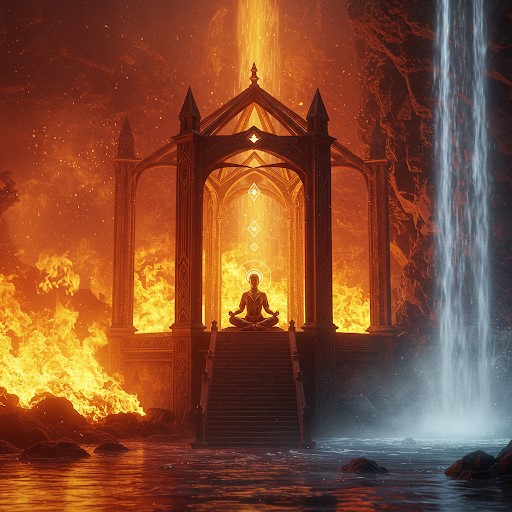
Type of Temple: Temples of The Harmonium Faith are known as “Scales Sanctuaries.” These structures are often situated at the confluence of elemental forces, such as where a river meets a volcano or where the ocean’s tides are affected by geothermal activity. The architecture features dualistic motifs, with half of the temple adorned in fiery hues and the other half in shades of blue. At the heart of every sanctuary is the Altar of Equilibrium, a ceremonial area where fire and water are brought together to create steam, symbolizing elemental harmony.
Number of Followers: It’s estimated that about 200,000 individuals in Saṃsāra follow The Harmonium Faith. The number has been steadily increasing due to the faith’s relevance in a world entering the Industrial Age, where understanding the balance between technological progress and natural preservation is becoming increasingly crucial.
Beliefs: Followers of The Harmonium Faith believe that the universe is governed by dualistic elements, particularly fire and water, which must exist in a state of perpetual balance for the world to remain harmonious. They hold that each individual has a role in maintaining this equilibrium, not only within themselves but also in their interactions with the world around them. The Mind’s Eye is considered an essential tool for understanding and achieving balance.
Regular Services: Weekly services at Scales Sanctuaries include the Ritual of Equilibrium. In a ceremonially crafted chamber, priests channel both elemental fire and water into a central vessel, turning it to steam, which is then dispersed throughout the room. While the steam fills the space, hymns praising Akiura and the elemental forces are sung. Following this, scriptures discussing balance, harmony, and adaptability are read and explained by the temple’s high priest.
Disciples then engage in individual or group consultations with priests to identify areas in their lives that may need rebalancing. Personal elemental readings are also performed using Akiura’s Balance Scales, and offerings of fire and water elements are made to the deity.
Funeral Rites: Upon death, believers undergo the Final Balancing Ceremony. The body is washed with sanctified elemental water and then cremated. The ashes are mixed with elemental fire and water in a ritual bowl. In a process that mirrors the Ritual of Equilibrium, the mixture is turned into steam, symbolizing the departed soul’s return to the elemental balance of the universe. The steam is released into the air, carrying the individual’s essence back into the world to continue the cycle of balance.
The closest family members usually keep a small portion of the ashes in an urn made of Harmonium Steel. This urn is placed in the temple for 49 days, during which daily rites are performed to guide the departed soul through their transition. After this period, the ashes are often scattered at a location embodying elemental balance, such as a hot spring by the ocean or a forest fire regrowth area.
Defense: The magical power granted by Akiura can manifest in defensive capabilities that focus on elemental balance and harmony. Followers skilled in the ways of The Harmonium Faith can summon elemental barriers using the Orb of Elemental Confluence. These barriers combine elemental fire and water to create a steam-based shield that is effective in blocking both physical and magical attacks. The steam can neutralize poisons, disorient attackers, and even dampen the effectiveness of fire- or water-based magic aimed at it. Additionally, the shield can adapt to balance out the energies of incoming magical or elemental attacks, weakening their impact.
Priests and priestesses of Akiura can also use their powers to cleanse areas of elemental imbalances that may be causing harm, such as rogue magical fires or contaminated water supplies, thereby defending communities from environmental hazards.
Offense: The offensive abilities granted by Akiura primarily use the dualistic elements of fire and water in a balanced but potent manner. Devotees can channel elemental fire through specialized acupuncture needles known as the Weaver’s Needles, using them like projectiles that cause both physical and magical burns. The needles can also be used to disrupt the elemental balance within foes, making them more susceptible to subsequent attacks.
For area control, followers use the Orb of Elemental Confluence to summon walls of fire and water, effectively cutting off escape routes or trapping enemies within a confined space. The walls can be manipulated to channel steam towards the enemies, obscuring their vision and causing burns.
The Scroll of Akiura’s Wisdom can also be used offensively by granting the reader insights into the enemy’s energy patterns, enabling them to better counter or disrupt these energies. This capability is especially useful when dealing with enemies that rely heavily on magical or elemental abilities.
Thus, while the powers of Akiura are rooted in maintaining balance, they can be adapted for both defensive and offensive uses, embodying the deity’s focus on adaptability and equilibrium.
Sacred items:
- Akiura’s Elemental Robes
- Lore: These robes are said to have been woven by Akiura herself, embodying the perfect balance of fire and water in their design. Crafted from magical silk infused with elemental essences, these robes have been passed down through generations of high priests and priestesses.Properties:
- Grants the wearer elemental resistance to both fire and water.Enhances elemental spells, particularly those involving fire or water, making them more potent.
- Symbols: Intricate patterns of flames and waves interweaved in a harmonious design.
- Lore: These robes are said to have been woven by Akiura herself, embodying the perfect balance of fire and water in their design. Crafted from magical silk infused with elemental essences, these robes have been passed down through generations of high priests and priestesses.Properties:
- Harmonium Bracelet
- Lore: Legend has it that the first Harmonium Bracelet was created by a faithful craftsman who spent years in meditation to achieve perfect balance in his life.
- Properties:
- Allows the wearer to sense elemental imbalances in their surroundings.
- Can store a small amount of elemental energy for later use.
- Tags: Elemental Sensing, Energy Storage
- Symbols: A perfectly balanced scale with gemstones representing fire and water.
- Scepter of Dual Flames
- Lore: This scepter was forged in the heart of a volcano and cooled in the deepest ocean, representing Akiura’s mastery over fire and water. It is typically held by the grandmaster of The Harmonium Faith.
- Properties:
- Can shoot jets of flame and sprays of icy water, either separately or simultaneously.
- Can be used to cast a unique spell that combines both elements into a steam blast.
- Tags: Elemental Attack, Area Control
- Symbols: A wand topped with a crystal that shifts between blue and red, representing the elements of water and fire.
- Chalice of Elemental Purity
- Lore: Said to have been a gift from Akiura to her most devoted followers, this chalice has the ability to purify any liquid placed within it.
- Properties:
- Purifies water or any other liquid to its most elemental form.
- Can neutralize poisons and toxins.
- Tags: Purification, Detoxification
- Symbols: A chalice engraved with dualistic symbols of fire and water.
These magical items are revered by the followers of Akiura and are considered essential tools in the practice of their faith. They serve as physical embodiments of the deity’s attributes of balance, adaptability, and elemental mastery.
The Ever-Adapting One
In the dawn of time, before the world was formed, there was only chaos. A swirling vortex of pure energy, it knew no form, no order, and no peace. From this chaos, a being of pure light and shadow emerged, Caelis, the Ever-Adapting One. Caelis was neither male nor female, neither light nor dark, but a perfect balance of both.
Caelis looked upon the chaos and saw that it was not good. There was no harmony, no balance, only a wild, untamed energy that threatened to consume all. With a touch of its power, Caelis began to shape the chaos, bringing order to the formless void. From the swirling energies, Caelis created the elements: fire, water, earth, and air.
But the elements were not in balance. Fire raged unchecked, while water lay stagnant. Earth was barren, and air was still. Caelis saw this imbalance and knew that it must be corrected. With a gentle touch, Caelis brought the elements into harmony, creating a world of balance and beauty.
From the balanced elements, life began to flourish. Plants sprouted from the earth, animals roamed the land, and the first humans emerged from the shadows. Caelis watched over the world, ensuring that the balance was maintained.
But the world was not always peaceful. There were times of great upheaval, when the elements raged out of control. In these times of chaos, Caelis would intervene, restoring balance to the world.
Caelis was not a god of war or destruction. It was a god of balance, harmony, and change. Caelis taught the humans that change was not always bad, that it could be a force for good. Caelis also taught the humans the importance of balance, of finding the middle ground between extremes.
The humans revered Caelis, the Ever-Adapting One. They built temples in its honor, and they offered sacrifices to appease it. They prayed to Caelis for guidance and protection, and they sought to live in harmony with the natural world.
Over time, the humans forgot the true nature of Caelis. They saw it as a god of extremes, a god who could be either benevolent or vengeful. They no longer understood the importance of balance and change.
Caelis watched the humans with sadness. It saw that they had forgotten the lessons it had taught them. It knew that they were in danger of destroying the balance that it had so carefully created.
Caelis decided to intervene. It sent a message to the humans, a message of warning and hope. The message was simple: Remember the balance. Remember the change. Remember the Ever-Adapting One.
The humans received the message, but they did not understand it. They misinterpreted the message, seeing it as a threat rather than a warning. They feared Caelis, and they turned away from it.
Caelis watched the humans with sorrow. It knew that they were doomed to repeat the mistakes of the past. It knew that they would eventually destroy the balance that it had created.
But Caelis did not despair. It knew that there would always be those who would remember the lessons of the past. It knew that there would always be those who would seek to live in harmony with the natural world.
And so, Caelis continued to watch over the world, waiting for the day when the humans would finally understand the importance of balance and change.
Moral of the story: The key to a harmonious existence lies in embracing change and maintaining balance.
Comments
4 responses to “Harmonium Faith”
[…] From: The Harmonium Faith […]
[…] From: The Harmonium Faith […]
[…] From: The Harmonium Faith […]
[…] From: The Harmonium Faith […]